
"Don't Touch Me" - Why I Hated BJJ
As I’m sure some of you can understand, the idea of having to work closely with someone else, especially on the ground, used to 'skeeve me out'. There is a stark differential between what I was accustomed to - striking, kicking, and takedowns, in contrast to rolling around on the ground with another human being while wearing pajamas, or skin tight clothing. In the world of hindsight is 20/20…
Original article written in 2012 for another blog.

Getting arm-barred in Chin Na training - circa 2000
Let me get this out of the way from the start - I emphatically hate people touching me. I have issues with physical contact, space invaders, faux-hugging, and ‘touchy-feely’ nonsense. After many failed attempts at coping, I simply avoid large crowds, parties, grandmas, and priests. Chalk it up to a plethora of personal experiences early in life, or just laugh at me as you will. Getting my finger lobbed off in a table saw was a more a preferable experience than some weird inebriated schmuck trying to grope me at a party while pretending we’re long lost friends (a good use for martial arts training).
Now that I’ve made it abundantly clear how much I dislike physical contact, perhaps we can relate to one another, since I imagine if you are still reading this you have similar issues with physical contact. This may well be a primary deterrent to you experimenting with Brazilian jiu-jitsu in the first place, or you just really hate Brazilian jiu-jitsu and clicked on this article in the hopes of reading a series of bad things I have to say about it. Spoiler alert: you can bail now and save yourself some time.
False Fears
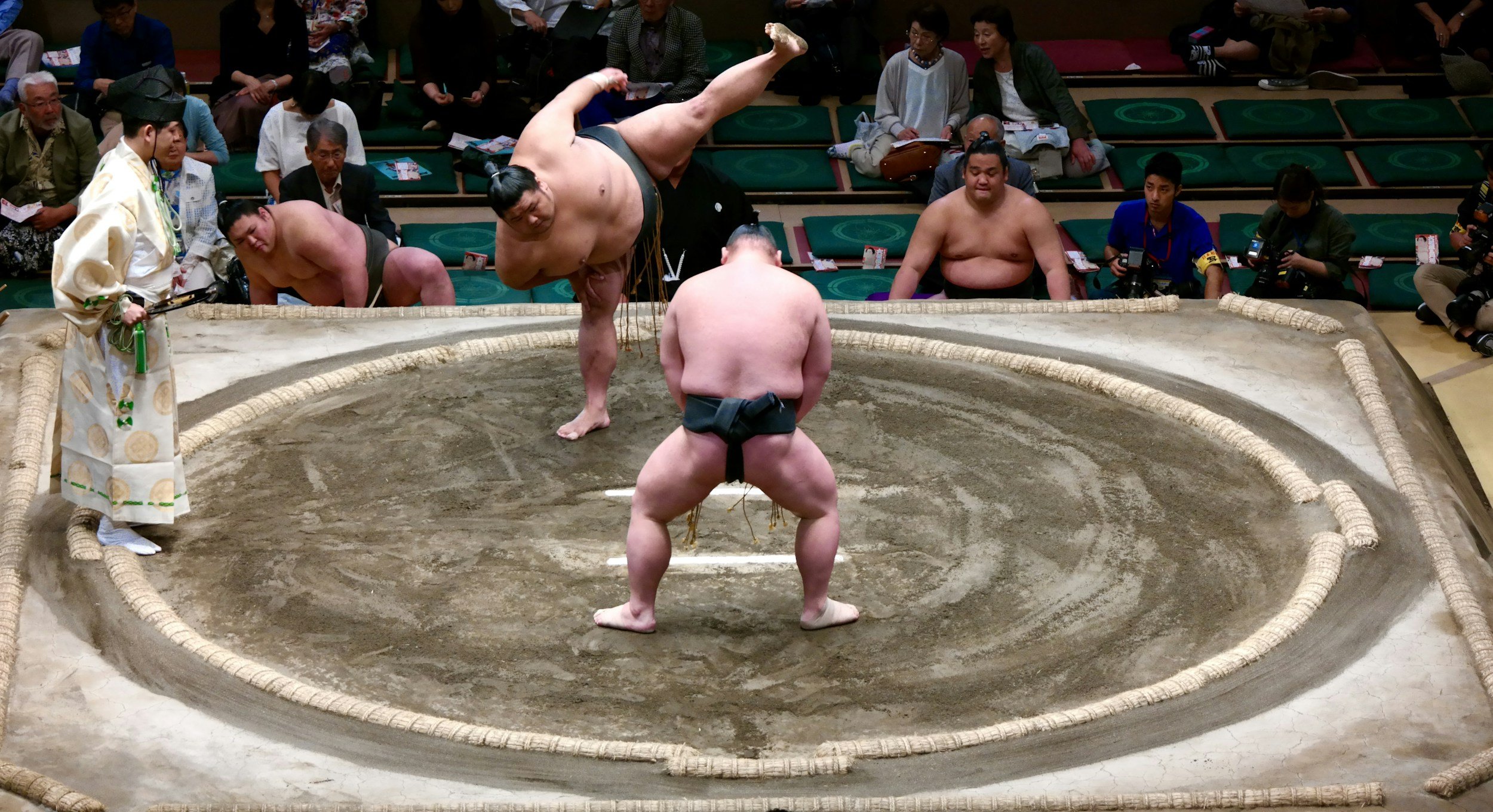
The idea of having to work closely with someone else, especially on the ground, used to 'skeeve me out'. There is a stark differential between the modalities I was accustomed to - striking, kicking, and takedowns, when contrasted to rolling around on the ground with another sweaty human being while wearing pajamas, or skin tight clothing.
However, in hindsight, I probably would have loved high school wrestling given what I know now, but many foes would have fallen trying to force my fat, chubby, adolescent self into one of those onesie-singlets!
During my time training mantis boxing, and other Chinese boxing styles, I became distinctly aware of a giant deficiency they all shared - the lack of a ground game. What to do when an opponent has you on the ground and you are unable to escape; a feeling I was quite familiar with from childhood fights.
I discussed this reality with one of my coaches at the time, being practical and grounded in real-world experience he agreed with the problem, and suggested that I take up BJJ. His advice was to achieve at least a blue belt level, arguing that the blue belt in BJJ being a significant achievement in and of itself. Showing an individual has gone through the grist mill, and survived to a base level of proficiency of self-defense on the ground.
In his assessment, I would have the experience and know-how to deal with an altercation on the ground; if a fight ever ended up there. Which, anecdotally speaking, they usually do when you’re smaller than your opponents. I was reluctant at first (see aforementioned comments on personal space) but eventually I capitulated and decided to try it out. To say my first attempts did not go well is a mild understatement [insert sarcasm]. Unfortunately, my first couple of experiences went horribly awry. I unknowingly chose the wrong coaches/schools to train with, which produced catastrophic results. You can read more about that here.
Before we address the physicality of BJJ, and the close contact dilemma, or even some of the other soft deterrents to training an art like this, let’s dig into some of the benefits I have found that help drive my reasoning on why this is a good thing to overcome.
Ignorance is Bliss - How BJJ can help Martial Artists/Fighters of other styles
Jump below if you are not currently a martial artist but want to learn more about overcoming the physical contact challenges of BJJ

Holly Cyr smashing it with a winning keylock at Boston Summer Open 2013
‘Traditional’ martial arts styles, as they are colloquially referred to, are mostly comprised of arts originating from east Asia. For our purposes we’ll include — western boxing, kickboxing, tae kwon do, karate, aikido, muay thai, shuai jiao, and more. These styles cover one or more of the following modalities in stand-up fighting - striking, kicking, throwing, and at times joint locks.
How do any of these styles, and wrestling as well, account for a larger, stronger, opponent that wants nothing more than to put us on the ground and pummel us? Each and every one of these styles subsist around weight class rule structures in competition. A sound and well rounded martial artist in my opinion, wants solutions for these challenges. Problems such as: being stuck underneath someone that has 100lbs of body weight on us, someone pinning us and choking us to death with their bare hands, or simply pummeling us with fists while sitting on our torso (mount position).
Not only do we want to survive, but as fighters we want to thrive in these situations. To embrace the suck. I have to be frank here - I have seen a variety of nonsensical comments from traditional martial artists over the years when it comes to this very real threat. A belief in their minds, or rather a fallacy, that the threat of someone controlling us on the ground is not real. That arts such as BJJ are useless. These statements include comments such as -
"I will use my eye gouges, groin strikes, and secret pressure point attacks." - anonymous
No, you likely won't, or not for long. You will be too busy trying to figure out which way is up; panicking to get back to your feet, trying to breath as you gas yourself out (the ground is stressful), and performing silent math calculations on how much your opponent really weighs while they crush the soul out of your body with unrelenting pressure.
Another comment I see -
"I won't let them get me on the ground." - anonymous
If the sole purpose of their combat modality is designed to get you on the ground, then you will be on the ground. No doubt about it. Especially if they have been training for years to accomplish said goals. I’ve seen people with a season or two of high school wrestling make short work of people with no grappling game, or defense system against such attacks.
“But I train takedown defense.”
We live in the northeast USA, where snow and ice are prevalent for a large portion of the year. Ending up on the ground is a common mishap for us ‘without’ someone violently assisting us in the process. Bottom line - as a traditional martial artist, or someone with no experience in fighting, we benefit by recognizing the holes in our systems and learning to close these weaknesses. We gain nothing but ignorance, darkness, and oxygen deprivation by hiding our head in the sand.
“Adapt and Overcome”
“Adapt and overcome.” — a common phrase we heard consistently in US ARMY boot camp. As experienced martial artists, adding Brazilian jiu-jitsu, or even wrestling to our game will only improve, not detract, from our primary art. Depending on the style we practice, we may come from arts afflicted by ‘transmission loss’.
Meaning some, or all of the techniques have been lost through the annals of time. We’re left today with empty shells of once proud martial art styles, practicing forms/taolu/kata, and applying best guesses as to the original method(s) of execution. Putting these arts back together can be difficult to downright impossible. I’ve spent the better part of my martial arts journey doing just that with mantis boxing, and taijiquan. I will say, finding crossover principles and techniques in other arts such as BJJ helped link things together in my brain, and improved my primary style of choice.
Brazilian jiu-jitsu has definitively helped me discover more about Chinese boxing and wrestling styles. From takedowns, to defense, to even just kinesthetically putting pieces together to flow and change gears. It has taken my knowledge, my game to a whole new level. This is especially relevant to an art such as mantis boxing, one of many Chinese boxing styles that is rooted in stand-up grappling, and riddled with principles that crossover to BJJ.
Perhaps you are fortunate and train with a school/coach team that has all the applications of your style already intact. Handed down to you in clear drills, and efficient training that turns you into a competent fighter. However, if that art still lacks a ground solution, as my art did, then this is the perfect reason to undertake BJJ, wrestling, or catch wrestling to shore up those weaknesses. You can read more about how BJJ helped me unlock hidden secrets inside Chinese boxing in this essay:
Donut, or Do Not? The fitness benefits of BJJ.

Donut eating me on a trip to train with a new mantis boxing coach - California, 2006
Traditional martial arts teachers across America are known for being out of shape. I have seen it at countless tournaments since the early days of competing. Often embarrassing physical forms of self-titled ‘masters’ of their art, who have clearly not mastered their bodies. Ironic given that we are supposed to be ‘lethal weapons’.
Self-Defense Anecdote: we start classes with proper warm-ups. This can start with — laps around the gym, three minutes of jumping jacks, or jump rope. At times people complain, or whine. My question is always the same: ‘If we can’t manage three minutes of cardio, how are we to last in a full on fight versus one or more opponents, while our heart is racing faster than a greyhound, and our adrenaline is screaming like an eagle through our blood stream?’
A few years after I began training, I myself was overweight. Also while owning and running my school. I had a series of crises in my life that caused my self-discipline to spiral out of control. I ballooned out, and I knew deep down that I was setting a bad example to my students on how I personally believe — a martial artist should live our lives.
Another saying from the military - “fit to fight”. The truth of this simple phrase is so base and fundamental. I’ve fought, sparred, won, and lost to some very good fighters over the years who were better than me, but were grossly out of shape. After 30 to 90 seconds of maneuvering, or light tangling, they were huffing and puffing; buckled over and gassed out beyond function. The amazing skills and techniques they had, rendered useless by a lack of stamina, or basic conditioning. If we’re out of shape, we’re ineffective, or less effective.
How can we stand with our heads high, selling, or marketing fitness, exercise, discipline, along with our self-defense, when we are stuffing donuts down our throat, or puffing cigarettes out behind our dojo? If we are out of shape ourselves, then we are nothing more than an exemplary display of hypocricy. “Do as I say, not as I do.”
How can BJJ change this?
Brazilian jiu-jitsu is an incredible workout. It engages the full body in motion. Exercising almost every muscle in our physical anatomy, including our brain. It takes serious conditioning to roll with another person for an entire class or for a 5 to 10 minute bout at a competition. To get up and down constantly, and often under load.
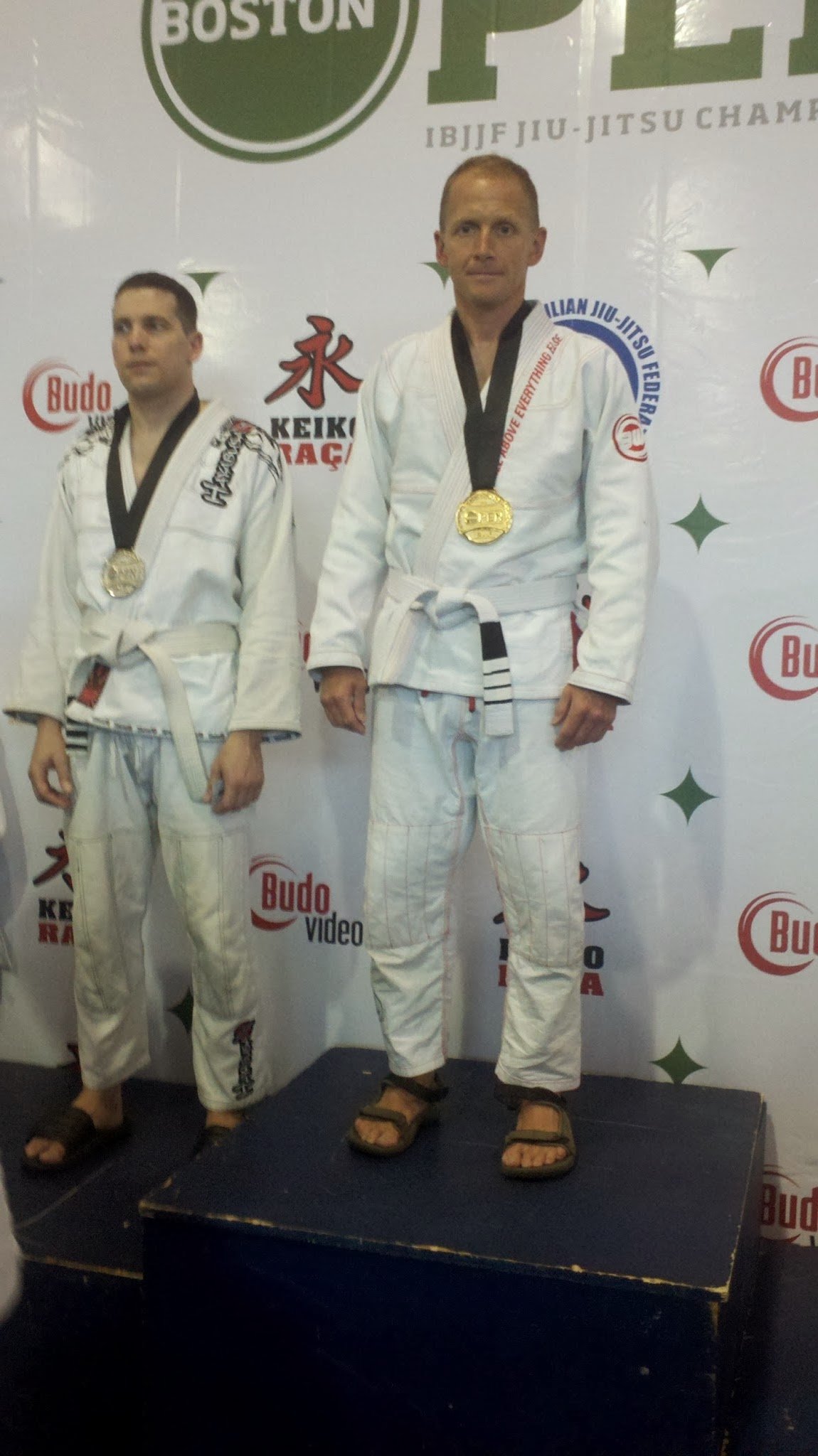
In my first BJJ tournament match, I stepped into the arena with many boxing/kickboxing amateur bouts under my belt, I was no stranger to the exhaustion and fatigue that takes place shortly after an altercation ensues. Additionally, much of our training, and sparring in the gym is inoculation to the stress of what we are going to face for real. With over twelve years of training/fighting, and being in the best shape of my life at the time, I had absolutely no idea what I was going to encounter in my first BJJ match.
Grappling was a completely different animal. The intensity is magnified ten-fold from any san da, boxing or kickboxing match I had ever competed in. The proximity stress, the gripping, tugging, and pushing, all while we’re still on our feet at the beginning of a match, rapidly drains our reserves. By the time we land on the ground, we’re seconds away from being face to face with the ‘adrenaline dump’ (all energy fades from our body).
When the ‘dump’ hits, there is nothing left in the tank; we’re completely gassed. We’re left only with our willingness to give up; or survive. This…is why an IBJJF (International Brazilian Jiu-Jitsu Federation) tournament has more 6 packs than you'll find at a redneck BBQ. It is an incredible test of mettle — physical, mental, spiritual.
During this first fight was the one and only time I looked at the clock in a competition. There was only a minute-thirty on the clock out of a five minute round. I had done hundreds of these rounds (and longer) in the gym, and yet…this felt like Father Time himself was crushing me into dust. I was completely demoralized as I lay under my opponent with a full strength closed guard, a firefighter, who I found out post-match had cut weight from 175lbs (79kg) to 150lbs (68kg) to compete that day.
A voice in my head was screaming for this to be over. That it didn’t matter who tapped, but this needed to end, and end fast. Then the other voice chimed in, calmly, with no emotion, calling the first voice a ‘wussy’. Followed by — “Get it done.” I fought on with everything I had, pushing through the fatigue, the time-demoralization, the doubt.
Fitness Conclusion
What better way to exercise than to have fun? To learn while getting into, or staying in shape? Enjoyment and mental engagement are a necessary function to stay committed to any type of physical activity we choose, BJJ can help us shred fat, build cardio, strength, and keep or return, that weaponized body that some of us once aspired to through joining martial arts in the first place. Of course the nutrition aspect has to go alongside any fitness endeavor, but the mat time we put in incentivizes us to eat better so we don’t gas out in competition or simply training.
The ‘BEST’ Pie is ‘Humble’ Pie.
Soft power wins the gold. Community makes the art.
The saying is - "the mats don't lie." When we walk out on the mats in BJJ, we can't say that we are something we are not. At least we can’t get away with it for long, if we do. When we roll with another grappler the truth becomes abundantly clear who is the higher hand. Hence the above saying.
Having been a part of the ‘traditional martial arts world’ through the rise of the internet, from BBS's, to forums, to facebook, etc., I have seen more petty arguments and nonsensical statements thrown back and forth. Things like -
"My style is the greatest.", "I'm better than you.", "I know more forms than you." “I’ve trained longer than you.”, "My lineage is pure, look who you studied with.", “I trained in {insert country of origin].”, "My teacher is better than your teacher.”, “My grandmother was better than your teacher."

It’s ‘ok’ to get a little mud on our face. Just smile and move on. Chris Meusel — Spartan Race 2012.
This behavior, while downright embarrassing and pathetic, is In direct opposition to the virtues we often seek in martial arts — strength, discipline, confidence, empowerment.
In contrast, I have met some of the nicest people in BJJ. While there are jerks (I met a few in the first couple attempts at starting out), they usually get weeded out early, unless the gym is toxic. The majority of people by and large, are — polite, grounded, and pretty darn cool. All seeking to better ourselves through adversity.
Why the difference? Simple really. In BJJ we have to put our money where our mouth is. We can make claims to ourselves or others about our prowess, our amazing skills, but the truth comes out on the mats.
Each roll, a mirror reflects back on us our own strengths, and weaknesses; whether we’re ready to receive them or not. This is a humbling experience and not for the faint of heart. It requires complete honesty with the most important person listening to us - ourselves.
"In my experience, the more dangerous two people are, the more respectful they are to one another." - Andre ‘Dedeco’ Almeida, BJJ Black Belt.
BJJ, along with any other contact based martial arts, keeps us humble. Aware that we are all just human, flawed at times, amazing at others, even when coaching and helping others. We know in our hearts, and minds — there are always bigger and better fish in the ocean. We all have progress to make in bettering ourselves inside and out. Even if we are the king, or queen, of our own little sandbox, getting tapped out gives us firsthand knowledge and experience in one of the most important martial arts principles to aspire to - humility.
Embrace the Suck
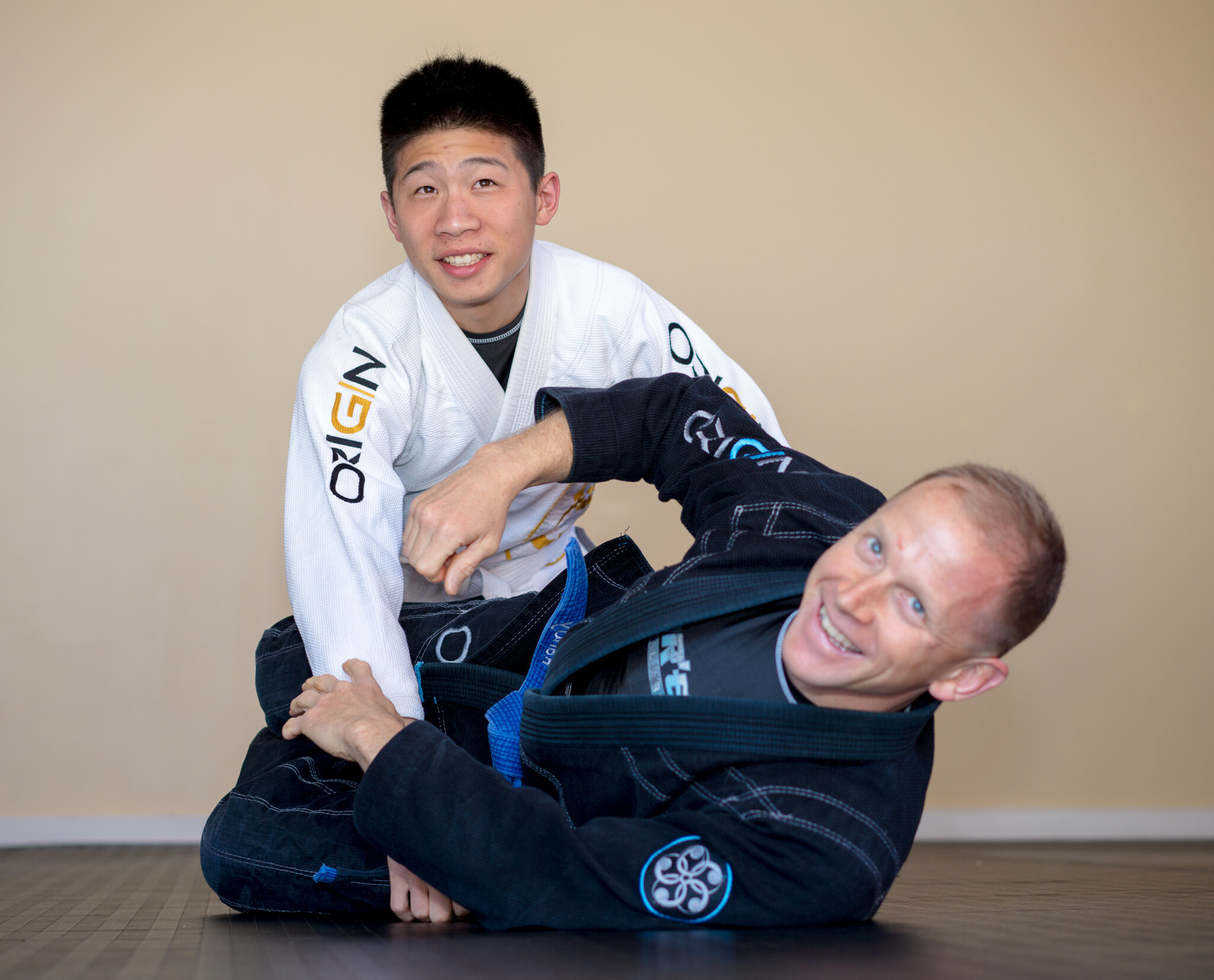
Rolling with Vincent Tseng - 2012. Photo by Max Kotchouro.
All of the above makes the close physical contact worth it. It gives us reason(s) ‘why’ we should we look past our issues with touch, contact, space. But what I can tell you firsthand, having worked through these issues myself, is quite honestly, the contact/space is not that big of a deal after a week or so of training.
Our brain quickly adapts and shuts off the reluctance to these things after we ‘embrace the suck’. Providing our partners are clean and hygenic that is.
We discover that rolling and grappling with someone, the ‘process’ of working with another to better ourselves supersedes the proximity challenge. It is quite different when someone is trying to choke, not grope us.
I highly recommend putting aside your reservations. I believe you will discover, as I did, that praciticing BJJ is just downright fun. One of the greatest challenges you can find, mentally engaging, core-building, and packed with years of intrigue. There are not many sports that encompass all of the elements that BJJ grapples with.
A plethora of the techniques you will learn (sweeps, submissions, escapes, takedowns) are awe-inspiring and a thrill to learn. Empowering. Easily mistaken for magic when we first see them performed by a seasoned grappler, and rewarding beyond measure when we succeed at executing them ourselves; after much trial and tribulation.
STILL RELUCTANT? HERE ARE A FEW TIPS
If you are still struggling with the idea,
Meet different coaches. If you find one you like, do one-on-one training with them. In this environment it should be acceptable to bring up your reservations and have a coach meet you where you are at.
Learn from a friend or family member who trains. Preferrably if they have a couple years of experience. Ask them to show you some moves but avoid grappling until you have a bit of experience. This avoids the competitiveness that can happen between friends.
Join with one or more friends. You can join a team class together, or do a squad style training (semi-private). This gives you the benefit of private lessons while sharing the higher cost of this approach.
If you have overcome this challenge, feel free to leave tips and your experience in the comment section for others to benefit from.
COACHES: RE-KINDLE THE FLAME
As a student, and a coach, I know firsthand that we have to keep the training and the process ‘fun’ in order to stay energized. If you are already a martial arts teacher of another discipline, training BJJ gives us a newfound sense of excitement. The same joy we had when we were a novice student in our original martial art style; when everything was new and enchanting. Reigniting a dwindling flame in our art.
Teaching others is rewarding and fun, but if we are not continuing to learn and grow we can become stagnant, bored, disenchanted, and even bitter. These are a few reasons I highly recommend trying out BJJ for martial artists from other modalities. Try adding it to your game and see for yourself. Box up the ego, don the ‘white belt’ and take the plunge into a fascinating world of new friends, sweet techniques, and all the humble pie you can eat.