

How to Start Martial Arts
As we get more people contacting us, and joining classes of late, I thought it was a good time to send around this video again. Max put this episode together a few years ago as part of his Swamp Talks series. Enjoy the sound effects. [Gunshots were not an intentional part of the production]
How to get started in martial arts. Here are some tips and advice on what to look out for as you search for your first, or subsequent martial arts school.
Enjoy the sound effects. [Gunshots were not an intentional part of the production]
Types of martial arts vary, but this can apply to any of them. Here is a list of some of the more common styles you may find in your quest in the USA:
Boxing (western and Chinese) - often depicted in modern times as the sport with two contestants wearing trunks and padded gloves facing off in a ring. Original roots encompass a far broader definition that included grappling, and weapons. Something more similar with Chinese boxing styles like mantis, eagle claw which include kicking, grappling, and joint locks/chokes/submissions in addition to striking with fists, palms, fingers, and elbows.
Kickboxing - a combination of striking and kicking. Also more sport oriented with rules to protect combatants from serious injury.
Wrestling - as with boxing, in modern times this calls forth distinct imagery in our minds of two combatants on a mat grappling one another to the ground and looking for a pin. Wrestling’s roots are far more pervasive and have origins to every continent on the globe. Greco-Roman which is more common in our minds today, to catch wrestling, to folk-style wrestling that changes slightly from culture to culture whether in Asia, Europe, Africa, or the Americas.
Jiu-Jitsu (Brazilian and Japanese) - jiu-jitsu origins hearkens back to the combat arts of the samurai which included but were not limited to hand-to-hand combat methods such as throws, joint locks, and ground finishing moves (submissions). Eventually this migrated to Brazil in the 1900’s where it was blended with catch-wrestling methods and focused more heavily on the ground fighting component of hand-to-hand combat.
Judo - a descendant of Japanese jiu-jitsu that focused on the grappling and ground fighting elements of jiu-jitsu.
Karate - an Okinawan fighting art that originated by blending methods from Southern China with the indigenous grappling methods of the Okinawan people. Also included weapons in addition to hand-to-hand combat applications.
Shuai Jiao - a Chinese throwing art similar to Judo but lacking the ground fighting elements. Descendant from Bokh, and other folk wrestling styles found in Mongolia and northeast Asia.
Tae Kwon Do - a Korean martial art developed in the mid 1900’s that focuses heavily on kicking.
Hapkido - also a Korean martial art that focuses more on locking and throwing methods.
Aikido - a Japanese martial art centered around falling, throwing, and locking an opponent.
Tai Chi - an old style of Chinese boxing that has been converted to a form of health practice and physical education since the early 1900’s. Prior to that it was a hand-to-hand combat art that included striking, kicking, throwing, and joint locking/chokes.
Kempo - an American martial art that early on focused on practical self-defense. Combined methods from all forms of Asian fighting arts as well as boxing and kickboxing.
Krav Maga - an Israeli hand-to-hand combat system designed specifically for commandos/special forces. Techniques are straightforward and practical, relying heavily on strength and speed to overwhelm the opponent.

Emotional Control - A Core Fighting Principle
‘Emotional Control’ - this often sought after, and rarely attained, side effect from martial arts training. We envision the wise old master sitting quietly in meditation, only to turn into a verifiable badass the moment the movie needs an action star to save the day.
What we don’t see, is that emotional control doesn’t really come for free, or as an automatic trait of just taking martial arts classes a few times per week. It doesn't come with...

Serenity Now!!!
Update (1-7-19) - I recorded a new podcast on this topic. Click below to access it.
‘Emotional Control’, this often sought after and rarely attained side effect from martial arts training. We envision a wise old master sitting quietly in meditation, serene, placid, only to turn into a verifiable badass the moment the movie needs an action star to save the day. Undertaking martial arts, consuming supplemental materials in our journey such as movies, television, or in Asian style martial arts, wu xia, or even religious or philosophical teachings that were, tacked on to the art at times. We can experience teachings and practices that espouse control over the body, mind, and spirit, and yet, fail to show us the way.
What we don’t see is, emotional control does not come for free, nor as an proxy trait of simply being enrolled in martial arts classes a few times per week year over year. Emotional control does not come with sparring, nor does it come without sparring. This skill only comes from proper training, and constant diligence in applying said training.
Being punched, slapped, kicked, or choked induces a highly emotional reaction for most of us. Especially if we have experienced some sort of trauma or abuse in life. For others, the act of hitting someone else is a highly emotional act, and may even cause unforeseen responses in us such as: anxiety, fear, hesitation, and more.
These reactions caused by different catalysts are each, common for some, and completely foreign to others. What they share in common is, learning to control ourselves when we are experiencing these combative acts, and overcoming the body and/or minds’ natural response so that we can still function and apply our skills under duress. Sparring, the glue that binds martial arts training, allows us to confront things within ourselves that we may never see otherwise. In my experience, the mats teach us more about ourselves than we can learn in any other activity we undertake. If attended to, and cultivated we can take that knowledge, and experience growth not just physically but mentally, and spiritually.
REQUIRED TRAINING
If someone studies martial arts but never spars, they simply cannot know what it is like to function under stress until it is too late; they have not been inoculated to violence. On the opposing side, if someone spars all the time and isn’t taught to control their emotions (rage, fear, jealousy, inferiority, retaliation, pity, etc.), they will fail to develop this skill of emotional control.
Rage and anger can cost us a fight, I have won, and lost fights entirely due to this lack of control. Here one of many examples:
One sunny summer day in the early 1980’s, there was a concrete bandstand in the center of a small town in New Hampshire, USA. I was 10 years old. A friend and I were playing on the elevated deck of the bandstand when another friend arrived. I was sitting on the railing about 10 feet of the ground when he suddenly and violently pushed me off the edge.
I fell, slamming into the ground below. He raced down to revel in his glory and laughed uncontrollably as my other friend stood by. I felt the pain, but what overtook my body was an intense broiling rage. My heart raced, my vision closed to tiny tubes as if I were peering at my target through the scope of a snipers rifle; adrenaline coursed through my veins giving me a primal strength my youthful body had never felt. I attacked with all the savage ferocity my tiny preadolescent body could muster.
My opponent, a student of karate, laughed and remained calm in face of my oncoming barrage. He deftly applied his superior range and agility, side stepping my furious charge and throwing me to ground like a doll of rags. I sprung to my feet again and again, each time he would deflect, sending me into the dirt face first. This only angered me more, causing me to go back with increased fury.
Eventually my newfound ally adrenaline fled the front lines, leaving me spent and broken in the coarse hot dirt, starkly aware that with my greatest of efforts, I was utterly useless and defeated. At the time, I could not see that my excessive, wild, and animalistic attacks were causing my own demise.
Emotional control does not mean we are immune to feeling fear, anger, or the other emotions that accompany the chaos of engaging in conflict with another human. It means that we experience these feelings, and we continue function without letting them control us, without allowing them to inhibit us, or prevent us from defending ourselves.
In order to build this skill in training we need to spar, to test our skills to ensure that they work. However, doing this improperly, or too soon, can have permanent adverse effects much akin to trauma.
How do we train Emotional Control?
If sparring is necessary to build emotional control, how do we do so without putting ourselves in the fire of all out conflict and no holds barred fighting? How do we lower the cost of failure in sparring in order to build fighting skills along with emotional control?
There are a few mandatory components to ensure effective results. First though, is understanding what all of us will do if/when we are introduced to sparring too early in the training process.
Slow to learn, fast to test.
Each an every one of us walking into martial arts training has two attributes we come through the door with regardless of whether or not we are absent of skill. These attributes become a crutch that we fall back on whenever we are faced with stress, anxiety, fear, aggression, or the unknown. These attributes are speed and power.
You can easily say, “I’m not strong.”, or “I’m not fast.”, but when push comes to shove, you will move fast and go hard, it is instinctive. In order to properly train skills we need to remove these elements from the training process. Slow things down so we have time to figure things out, to diagnose, to recognize mistakes.
When I was first introduced to this idea, I latched right on to it. Some research on the human brain, learning methods, teaching techniques over the years, all reinforced this in various ways. But the place I learned it didn’t enforce it, only said it over and over like lip service. I spent years saying it in my own gym, telling students to slow down, to stop using strength. Things improved but it was never reliable.
There was one way to mitigate this, and it truly works.
Talk
Yes, talking. It is that simple. Before sparring with someone, especially if we are nervous, try talking with them for a moment. Ask how they are doing. Talk about a recent movie, or current event. Find a way to break the ice, to create a connection between the two of you. This can change the future.
What follows next, is a vastly different approach to the sparring match than what would have happened had we gone into the match amped up, nervous, scared, etc. Silence is deafening. Especially in the training hall. Help one another. Point out what we like about the other's technique or skills.
When I learned this principle from a Mantis Boxing coach I was already a coach myself. I was traveling across the country to train two to three times per year with this group. I only sparred with members of this group on those trips. The rest of the time I was sparring with my own students, and friends, which changes the dynamic of using this principle, especially when you’re the only one who knows it. I was always the one using it to help my students acclimate to sparring.
Aside from when I was first shown it, I never really benefited from this being used to help me, but I gained a invaluable insight from this process. As I traversed my Brazilian Jiu-Jitsu path, more times than I can count I would attend class, team training, or visit another school to train at, invariably I would get paired up with the meanest looking player in the room.
The coach would pair us off, and having already scouted the room beforehand, I knew who was trouble. They would usually have a disgusted or angry face on, and no one would go near them to even talk to them before class. Looking at them, I could ascertain that if I were paired up with them it was going to be all out war in the ensuing match. Instead, I fell back on this skill I had built from coaching.
As it so happened, I would usually end up being paired off with these folks. When the coach called out our names I would go up, shake hands, and sit in front of them or aside them on the mats. As we waited for the coach to finish pairing people off, then for the bell to go off, or after the bell if there was no time, I would ask their name, where they are from, or what they do for work. Something to break the tension.
It turns out, with the exception of one person out of all the times this happened, and it was many, the individual was super nice, and we found something in common after talking for a few minutes. The result? The match would be relaxed, smooth, and injury free. Excellent experiences and the beginning of new friendships.
What I came to realize is, these individuals were just as nervous, anxious, afraid, not of my hulking 5’6” demon frame, but of sparring with people they didn’t know, or wondering if they were going to get smashed again today, or even worse…injured. By the look on their face it was easy to assume they were angry, or mean, but this was simply a mask, their mask, to hide the real underlying emotion - fear. Once someone took the time to say hello, they became completely different people and showed their true colors.
TALK BOX
You can even talk while sparring. I know this seems silly, and it can be quite difficult at first, but later this becomes a crucial training tool. By talking we learn to stabilize our emotions while getting hit or hitting someone else. Removing the stress from the situation allows the brain freedom to learn, and the ability to maintain a good 'speed' for gaining, and advancing skill.
We want to focus on relaxing, and gaining this coveted emotional control. Later on when we have achieved this and sparring is less of a stress to us, we can focus on trying to fix things while we’re sparring. At this stage, we'll be in a different place skill-wise. As our training progresses, so too does our ability to control our emotions. We train, not only to be able to handle ourselves physically in bad situations, but also to inoculate ourselves to physical contact so if and when things go bad outside the gym, we react without thought, we perform as our training has prepared us, without our emotions getting in the way.
UPDATES
All of the above is true and I still stand by it. However, I will add that in the past two years we have taken another step to ensure success. We no longer allow sparring until students have gone through the entire curriculum one time. By giving people skills to fall back on, rather than relying on speed and power when faced with the unknown, we’ve been able to reduce injury, increase camaraderie, and begin building emotional control from the ground up, rather than what we were doing prior.
At the time of this article, and since first learning and instituting this in my gym back in 2006, the success rate was pretty poor from student to student. This was due to sparring early on. We had not replaced the attributes with skills, or instituted a few other necessary practices that have shown extremely high success rates. When it is complete, I’ll post a link to my recent talk on this at the Martial Arts Studies conference in Cardiff, UK. Stay hooked.
YOU ARE NOT ALONE
In the meantime, check out my friend Ando’s vlog on this same topic. Ando is an extremely high level martial artist, and incredibly adept coach who has spent decades perfecting his teaching methods. Take a few moments to watch this great video he put together on how he deals with emotions in the training process. You will laugh, and perhaps cry along with him as you watch. I highly recommend following his channel to see some of the great work he puts out.
Embrace the Suck!!!
Another article on the ‘inner demons’ that hinder our training. “I’m not getting any better…”, or “Why do I suck at this?”
I want to take a few minutes today and try to shed some light on this obscure 'suck zone' we go through, and perhaps offer you some perspective to help you not only get through it, but optimize your progression. “Arrrrgghh!!! Why Can't I Get This!?!?!", "Why is that person getting this so much faster than I am?", "Why do I feel so stupid, or uncoordinated?"
These are common questions I hear, or see, as a coach/mentor/instructor. In order to understand why martial arts, or any
Frustrated with your progress or lack thereof? Embrace the Suck!
I want to take a few minutes today and try to shed some light on this obscure 'suck zone' we go through, and perhaps offer some perspective to help you not only power through it, but optimize your progression.
"Arrrrgghh!!! Why Can't I Get This!?!?!"
"Why is that person getting this so much faster than I am?"
"Why do I feel so stupid, or uncoordinated?"
These are common questions I hear, or see, as a coach/mentor/instructor. In order to understand why martial arts, or any new activity requiring physical prowess [other sports apply here] is giving us a hard time, we have to look at the human brain.
Over the past decade and a half, I have taught highly intelligent people. By and large, most of them extremely intelligent. And yet, when forced to freeze a motion and are asked, many cannot tell you where their arm is located in that moment in time if they do not stop and look at it. I have lost count of the amount of times I have given a correction to someone, and received an incredulous look while stating - "I am leaning, really?!?!?!"
What many of us fail to recognize in ourselves, or cut ourselves slack for, is our level of physical activity going into the arts. So maybe we played sports in high school...then we went to college, got a job, started a family, and then realized at 35 we haven't been active in 17 years and need to so something, anything to do to get moving.
Maybe we are 16 years old and have lived in front of a video game console our whole life; never really using our body. Maybe we are 65 and deciding to take up Tai Chi to stay active, but we spent a bulk of our life parked at a desk job since we were in our 30’s. To our brain, there is a common thread here.
The human brain is incredibly conservative. If something is not being used, then the brain ignores it. Don't exercise? Our muscles atrophy. Don't stand/walk put a load on your skeletal system? Our bones atrophy; after only 18 hours (on a molecular level). It doesn't take long to regress with our physicality, and the brain does the exact same thing.

FRUSTRATED???
We have pathways connecting neurons in our brain, and each pathway connects one piece of information to another, to another; creating a network, or a web of interconectivity. This happens with physical activity as well. Compare it to our high school Algebra experience. That thing we said we would never use in life. Let’s say we were right, and we never used it after leaving school. Now, when we try to do Algebra at the age of 25, 30, 35, it doesn't work so well. The same thing happens with our body and physical movement.
When we have a group of common connections with shared threads, it is due to our brain building relationships. Connecting one neuron to another neuron to build a 'network'. Think of it as a power grid; transmitting electricity from node to node. If one node goes down, other connections still exist. Except...this power grid automatically shuts down lines that are not being used in order to save energy.
Unfortunately, if we stop using a pathway, the brain starts overwriting these connections it no longer deems relevant. Pathways grow dormant, and new information that is relevant to whatever we are doing in our life HERE and NOW, is what is going to take precedence.
If physical activity is not at the forefront of our life, then atrophy sets in; physical AND mental. The brain does not waste time and energy trying to keep things 'alive' that are not useful to its purpose. If we were a star athlete in college, we will still have pathways for those actions in our prior sport, but they have faded; and continue to fade over time. If we return to the sport in our 30's, we will probably stumble a bit in the beginning, but will likely pick things back up relatively quickly after the initial grind.
The Neural Network

Neural Network
Our brain is full of billions of neurons. When we start training in martial arts, we may develop a neuron for a block, or a punch that we learned. We practiced the block, we know the block, and it is now a reflexive part of us. We practiced punching for hours on end as well.
Now, when someone punches us, we block successfully, but we don't punch, or there is a delay before we punch. Why? No connection...yet.
After practicing for a while we see similar circumstances. One day we are comfortable enough with our blocking, and punching enough that when someone in class takes a familiar swing at us, we suddenly match up an opening we see in their guard when we are offensively punching, with the opening we see after blocking one of their strikes at us. We then throw a counter punch.
After an action like this, our brain now creates a connection from the ‘punch’ neuron, to the ‘block’ neuron and we become accustomed to seeing that opportunity in the future, and responding that same way the next time. Voilà! Progress.
Now, let's add a piece to the puzzle. Person A punches. We block. We counter punch, but suddenly our punch misses. The person slips the punch. Now we stand there for a second unsure what to do next. Why? We don't have the connection laid yet. This is a new situation that has occurred. We have to build a new path from here. This is like trying to cross from Boston to San Diego in our car, but there is no map. We have to try road after road, retracing steps and getting familiar with paths so we can venture down new paths from there.
Grappling example: We learn how to do an armbar. Neuron is mapped. We learn how to triangle choke from guard. Neuron mapped. Now we are fighting with an opponent in our guard and we go for an armbar. An armbar that we may be quite successful at and have trained thoroughly over and over.
Our opponent pulls the arm before we can secure it. We lose the submission and have to start over with something else. Or instead, we take that triangle choke we practiced a thousand times and we learn how to snap that on as they counter the armbar. We have successfully mapped a connection between these two submissions and our next response is to immediately counter their counter, with another submission. Something that is impossible to do when we have not mapped out either neuron, or built the connection between them.
The more we train, the more we experience on the mats, failures most importantly, the more neurons we build connections to as we find solutions. Eventually, we get a web of connections and when faced with unfamiliar stimuli, we have a wider net to catch it in, and formulate a ‘creative’ response based on all the other connections in our web. The better we get, the more likely we are to have a 'proper' response to this new threat or action. The more we can ‘see’.
A.I.
When I was studying Artificial Intelligence, the coolest subject I had in college, and yet somehow turned to the most boring in practicum (still unclear how one can do this), we learned about neural networks. One of the early mistakes made by pathfinders in the field was to try and code every potential outcome into the machine in advance.
While this may work with a simple 3 instruction test, they quickly found it was impossible to train every single scenario/outcome that can happen. Even some of the simplest tasks would take years of coding and massive amounts of storage. Impossible for hardware at the time.
The solution, was to go from ‘trying to program every response possible’, to ‘building neural networks’ - nodes with pathways, interconnected so the computer could train as it goes through a series of pass fails - what is now known as 'machine learning'. Learn through added stimuli, the same way we learn as humans - through trial and error.
Fighting is chaos incarnate. The supercomputer residing inside our skull would take 100's of years to try and calculate all the possible responses in fighting. Instructors training students in this way, would result in absolute disaster. Instead, we train principles. We train using sparring and rolling to create randomness and variability, causing us to error out, and learn a mistake. The results we get are far superior.
This explains why someone becomes more proficient the longer they train. They see more options, form more connections, and become more and more adaptable.
Coaches Perspective
"Your left foot. NOOOO!!! YOUR OTHER LEFT FOOT!!!"
From a coach's perspective, it can be extremely frustrating to tell someone to move their left, or right foot, and have them unaware of where their leg is. I have been in schools where teachers have thrown out students and told them - "Get out!!! This is not for you."; completely giving up on the student due to their lack of coordination.
I wholeheartedly disagree with this approach; even though at times past I confess to watching students and wondering if they were ever going to get it. We never know where someone is going. We all have our own struggles, some earlier in the process than others. Sometimes these same individuals turn out to be the hardest workers because of the struggles they faced early on.
They could become the next coach, mentor, or even a champion; the next in line to pass on the art. If we turn them off of martial arts for good because they didn't get it right away, then the loss of potential is immediate, and sometimes everlasting. Encourage, guide, support.
Patience, understanding, and empathy are easier said than done, but they are necessary tools when teaching our art to ALL those who wish to receive it. Someone with long periods of physical inactivity, is going to take longer to get up to speed with basic movement than a seasoned athlete. We each face our own struggles.
MILITARY TRAINING vs. CIVILIAN

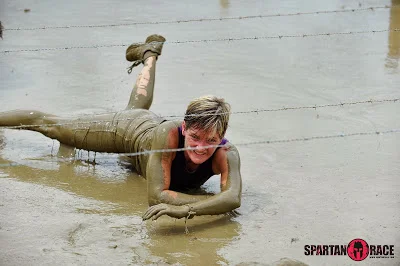
Holly - playing in the mud at Spartan Race 2014
The drill instructors in boot camp have one hell of a job to do - 8 weeks to turn goofy, uncoordinated, immature, head up their a$$ teenagers into lean, mean, fighting machines.
This is not an easy task, and our lives, and the lives of those around us, depend on getting it right. And quickly. However, we are a captive audience; by choice, or not.
When teaching adults/civilians, who are not REQUIRED by some threat to stand there and take our bull$%&^, we have to be somewhat flexible in our demands. We can do this by drawing out the timeline for success. We can't just scream, degrade, and humiliate them until they get it; like boot camp. If we are training people for combat in a condensed period of time, then absolutely.
However, in that case we likely are not teaching in-depth martial arts that require years of training to explore high levels of skill. We would be focused on simplified fighting systems like Xing Yi, Krav Maga, or some other streamlined hand-to-hand combat system. Simplified, and meant for short training not mastering high levels of skill.
High Skill Competition Training
If we are training competitively, or training a team to compete, then this can also change the game. Pushing people, and people wanting you to push them, become an interwoven dynamic to increase performance, and achieve higher gains.
This process is voluntary on both sides, and usually involves a higher degree of focus and effort on the part of the competitor. Skills increase over time, and people compete at the level/age bracket they are currently at. As they gain higher skill and aptitude, they move up in rank and compete against more advanced opponents.
The Long Term Approach
If we are teaching out of our garage, do not need to sustain ourselves from a vibrant school, or we are trying to train people as quickly as possible, then we can cherry pick our students, and kick out (directly, or indirectly) the one's that won't get up to speed fast enough for our taste, or goals.
But...if we are interested in creating a strong community of martial artists that help one another grow and learn to a high level over time, a group that accepts people of all skill and talent levels among their ranks, then we need to keep in mind that not everyone has been training for these arts their entire life. Some will need more time and patience in the process.
One approach I like to use in thinking about this - drawing. When we want to draw a human face, we don't start by drawing every freckle, line, or hair. We start with a rough circle for the head, and rough circles for the eyes, nose, mouth, ears. Then, we begin to create finer and finer circles and lines. Adding more and more detail as we go, and erasing/removing unnecessary lines. Martial Arts is no different. We don't need to feel like our ROUGH DRAFT is supposed to be the final MASTERPIECE.
All black belts are not created equal. All black belts are not created in the same amount of time.
No SECRETS
There really are no secrets. The solution is simple, but not easily achieved. The longer we train, the more we surround ourselves with other people who train, the more we watch; the more we read, ponder, discuss; the more 'consumption', will directly affect the pace at which we move up the skill ladder.
This obviously takes other traits and behaviors such as discipline to keep showing up, perseverance to get up after each failure and try again, and overall grit to stick through the lows and not just ride the highs. Combine this with continuing to build that neural network, and you have the recipe for success. Eventually creating a web in your brain that is ready to catch anything that flies through it.
Many people come and go from activities. If we keep showing up, keep training, we will keep evolving. Sometimes the successful people we see in various fields, were not the best at what they do, but they are the one's that kept showing up.
Stay the course. All will be revealed with time and effort.
--
Photos courtesy of Max Kotchouro
Bibliography:
Buonomano, Dean. Brain Bugs: How the Brain's Flaws Shape Our Lives. New York: W.W. Norton, 2011. Print.
"The Brain That Changes Itself: Stories of Personal Triumph from the Frontiers of Brain Science Paperback – December 18, 2007." The Brain That Changes Itself: Stories of Personal Triumph from the Frontiers of Brain Science: Norman Doidge: 9780143113102: Amazon.com: Books. N.p., n.d. Web. 20 Nov. 2015.

The Truth on Effective Strike
Effective Strike (Xiao Da), is the Chinese principle of striking to vital targets, or targets that have more destructive impact than other areas of the body. This is a common concept in many styles of martial arts. I recall the first time I showed up for Tae Kwon Do/Hapkido class back in 1991 - my teacher said - "Want to kill a man? Hit here, here, here, or here." I was happy, but stunned.
reprint of an article published in 2013 in the Journal of Seven Star Praying Mantis -
Xiao Da - The Truth on Effective Strike (Journal of 7 Star Mantis vol. 4, issue 4/Northern Shaolin Praying Mantis Institute and Association 2013)
Targets
Listed below are the targets and the effects a person experiences when being hit in those regions.
8 Head Targets
Throat
Side of Neck
Back of Neck
Jaw
Nose
Eyes
Ears
Temple
12 Body Targets
Shin
Knee
Outer Thigh
Inner Thigh
Groin
Bladder
Rib (Floater)
Kidney
Liver
Stomach
Solar Plexus
Collar Bone
Photos courtesy of Max Kotchouro

Cervical Spin - Downward Elbow Strike
Effective Strike (Xiao Da), is the Chinese principle of striking to vital targets, or targets that have more destructive impact than other areas of the body. This is a common concept in many styles of martial arts. I recall the first time I showed up for Tae Kwon Do/Hapkido class back in 1991 - my teacher said - "Want to kill a man? Hit here, here, here, or here." I was happy, but stunned.
I thought to myself - "WOW! Cool!!!" Followed by - "wait...why would you tell someone that in their first class? Isn't that dangerous information to hand out to strangers? After all even US Army Basic Training Hand to Hand Combat didn't teach us that!". I chalked it up to him just being half psychopath since he spent most of his life training elite South Korean Special Forces Soldiers in Hand-to-Hand Combat.
It was some time later in my martial arts career that I realized why this information wasn't so dangerous after all. The reason is simple. If you don't train it, you won't use it. Effective Strike is a skill like any other. It needs extensive practice and proper training in order to be effective in real combat, or in other words - to manifest itself under stress. In said Tae Kwon Do class, we never used finger strikes, throat chops, or did any sort of training that incorporated strikes to these vital areas; we simply kicked, punched (less), blocked, and smashed our shins and forearms on one another till bruised an battered.

Brachial Stun using Slant Chop
Train Like You Fight, Fight Like You Train
I like to use the terminology - train like you fight, fight like you train. In your Kung Fu training, the constant focus of hitting to Effective Strike targets is crucial to making this habitual. There is no time to think in a fight. One must react and react appropriately; which is the whole objective of proper training.
So when should you learn this skill? Ideally the sooner the better, especially for smaller fighters. Smaller fighters lack the power that a larger or heavier opponent can produce, so this skill is crucial for us. Being able to hit someone in a targeted area means that your strikes pack more bang for the buck.
With that said, one needs to learn how to properly punch first, before focusing on Effective Strike. Trying to perform Xiao Da from Day One, gives the brain too much to focus on at one time. A beginner should be more concerned with proper striking, blocking, guard principle, and defense first. Once Xiao Da is properly introduced, aim for these targets with every strike in your arsenal.
After you have learned it, you can then veer off to other non-effective targets that may lure or distract your opponent; creating what we call Open Doors to the effective targets we want. This is necessary because an opponent with a good defense will 'require' you to 'open doors' in order to hit his covered targets.

Training Tips
These vary based on whether or not you have a training partner. I did not have a partner to use when I wanted to integrate this into my fighting, so I took colored price stickers used in yard sales, and I plastered them on my heavy bag in the general target areas on the human body. I then practiced various combinations striking to these targets. To test them, I sparred with other people.
For those with a partner, I recommend a great technique called 'Walk the Body', passed down to me from a mantis boxing coach on the west coast. Walk the Body has one person standing still (in their fighting stance is fine) while the other practices slow and very low power combinations to targets on their partners body.
As you grow more comfortable with the targets, the complexity increases by having your partner put their hands up in a defensive fighting position forcing you to move their arms. Following that, you need striking combinations, that the partner blocks, so you can open doors to the Effective Strike targets you wish to hit using solid striking combinations.
Note: this is not a fast paced exercise and requires patience, cooperation, and hours of practice to become second nature. It challenges your critical thinking skills once you add the complexity of combinations versus a live defense. Done properly however these strikes will become automatic and ingrained in your skill set.

Ear Claw
DIM MAK - The fallacy of pressure point based combat
Early in my training I met people, and still do from time to time, that have little knowledge of martial arts, but they talk about Dim Mak (pressure point striking) from books they've read, or videos they've watched, or even some Hollywood movie.
You can find videos online of teachers knocking out students at demonstrations to show Dim Mak, and all the supposed power one can have over other human beings by hitting them in these targets. People are fascinated by this and very enthusiastic. I can understand why, the idea of knocking out someone else with such ease is...alluring! Unfortunately, while some of these are legitimate strikes to real targets, some are incredibly finite and difficult to get to.
In a previous article, Size Matters - In Chin Na I discuss 'gross' versus 'fine' motor function in combat. Just like finite Chin Na skills, high precision striking is less reliable when we are under stress, AND when our opponent is trying to hit us back. That's the live, active, and moving opponent that is also trying to ‘take your head off’ component.
This complicates things and makes it much more difficult to perform a finite strike to a small target area. So unless you're Luke Skywalker firing your torpedo at the Death Star, give up on the idea, and stick with something that will work.
Natural armor - in addition, a human being under the affects of adrenaline in combat (never mind the affects of drugs), is more resilient to these strikes. It really sucks when you're in the thick of it and your silver bullet doesn't really kill the werewolf! This is why it is better to learn multiple targets, strike in combinations that you would normally throw, and cover your bases in case you miss the first target. Meaning, you missed but it still hurts them like hell!!!
Targets Defined

Temple Strike using Backfist
8 Head Targets
Throat - Crush the larynx making it difficult to impossible for opponent to breathe
Side of Neck (Brachial Stun) - Knock out blow, or excrutiating pain at the least
Back of Neck (Occipital Lobe) - Knock out blow
Jaw - Break or Dislocation. Extreme pain.
Nose - Pain. Bleeding. Watery Eyes causing reduced vision.
Eyes - Loss of sight. Extreme pain.
Ears - Tear them off for extreme pain.
Temple - Knock out blow. Extreme pain. Disorientation.

Knee Break using Cross Kick
12 Body Targets
Shin - Extreme pain and discomfort.
Knee - Break/Dislocation. Extreme pain. Loss of Mobility.
Outer Thigh - A solid kick to this target can cripple a fighter and make them think twice about closing distance.
Inner Thigh (Femoral Nerve) - Identical to the Outer Thigh, this target causes excruciating pain.
Groin - Extreme pain and discomfort. Potentially cripple opponent.
Bladder - Pain and discomfort. Possible bladder release. (you figure it out)
Rib (Floater) - Break. Extreme pain and discomfort. Possible breathing effects.
Kidney - Potential knock out as well as extreme pain.
Liver - Knock out blow. Extreme pain/discomfort.
Stomach - Knock out blow. Extreme pain/discomfort.
Solar Plexus - High concentration of nerves. Also the meeting point of the heart, liver.
Collar Bone - Break. Extreme pain. Loss of use of arm on that side. Harder target to hit and not effective on everyone.