
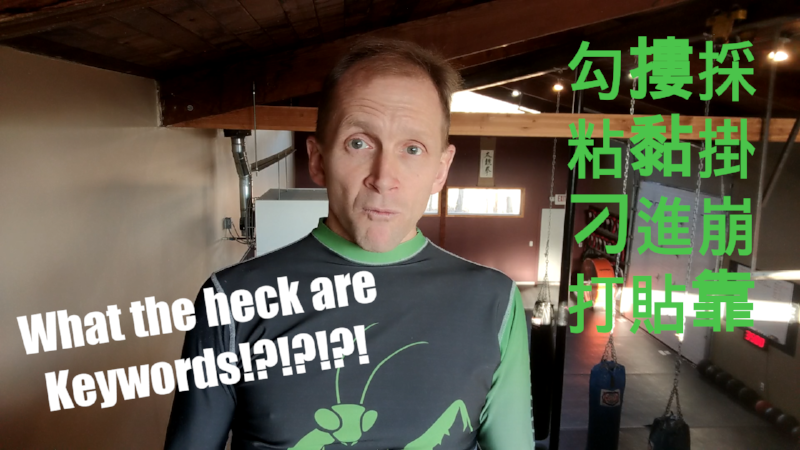

Hook vs Circle Punch - What's the Difference?
What's the difference between a Hook Punch and a Circle Punch? Are they really that different? Yes, and yes.
The Hook Punch is used at a closer range, similar to an uppercut. It works well when you are striking in tight, or engaged in a Clinch (Lǒu 摟). In here, a long range strike will extend beyond my opponent. We position the arm in a tighter hook shape to help…
What's the difference between a Hook Punch and a Circle Punch? Are they really that different? Yes, and yes.
The Hook Punch is used at a closer range, similar to an uppercut. It works well when you are striking in tight, or engaged in a Clinch (Lǒu 摟). In here, a long range strike will extend beyond my opponent. We position the arm in a tighter hook shape to help land on our targets such as the temple, kidney, liver, ribs, stomach, and jaw.
The technical position when throwing a hook punch is critical. When bare knuckle striking, there are no wraps to support the wrist, so technique has to be spot on in order to prevent breaks, sprains, and fractures in our own hands/wrist.
The wrist is held in a straight line, and we use the transverse core rotation of the upper torso to connect the punch, versus extending the arm and bending the wrist which is dangerous to our own hand. Thumb position is up.
When the range to our opponent is further out, and we are still throwing straight punches, this is where the Circle Punch really shines. It allows us to attack the side doors as well as down the middle; utilizing the principle of - Randomized Striking.
Connecting with a Circle Punch has the added benefit of increased power generation through a looser whipping action. The punch is thrown relaxed; the arm builds up speed before connecting. If this impacts the temple, jaw, occipital lobe, bracchial nerve, or ear, it can have devastating consequences.
Because of this, when our opponent sees a Circle Punch steaming for the side of their head, they are more likely to open the center doors trying to defend; thereby allowing our other punches to land.
The hand position for the Circle Punch is wrist straight, thumb pointing down.
Timestamps:
0:42 - Technique
4:12 - Pad Drills - Hook Punch
5:29 - Pad Drills - Circle Punch
6:12 - Bag Drills
6:44 - Bag Drills - Circle Punch
7:10 - Bag Drills - Hook Punch
Gear
You can find some of the items we use in the video by following our affiliate links:
Assassin Pads
Punching Bag
Gloves
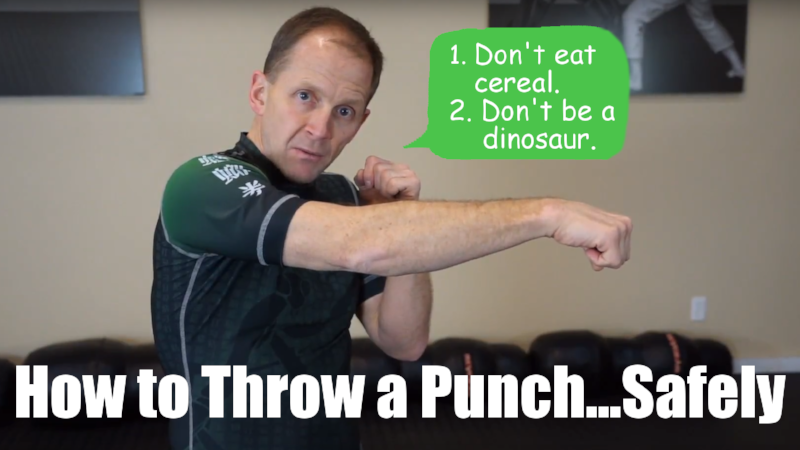
How to Throw a Punch...Safely
Having an improper structure, leaving a finger misplaced, or snapping our elbow, can all cause lasting damage, injuring ourselves more than the object we are trying to hit.
Whether we are hitting bags, pads, mitts, makiwara boards, or sparring partners, it's important to keep these tips in mind to keep us punching without injury for years to come.
Having an improper structure, leaving a finger misplaced, or snapping our elbow, can all cause lasting damage, injuring ourselves more than the object we are trying to hit.
Whether we are hitting bags, pads, mitts, makiwara boards, or sparring partners, it's important to keep these tips in mind to keep us punching without injury for years to come.

The Round Kick - Like a Dragon Lashing It's Tail
Here we help you set up the round kick without getting hit, run over, or shut down. Check out our video on Advanced Footwork if you need help with some of these angles.
This is an extremely powerful kick. It's like getting lashed by the tail of a dragon. When fighting, getting hit here can be a huge game changer. Whether we take our opponents leg out from under them, or we weaken/injure the leg to get them to change sides.
Here we help you set up the round kick without getting hit, run over, or shut down. Check out our video on Advanced Footwork if you need help with some of these angles.
This is an extremely powerful kick. It's like getting lashed by the tail of a dragon. When fighting, getting hit here can be a huge game changer. Whether we take our opponents leg out from under them, or we weaken/injure the leg to get them to change sides.
Check out these angles that can help you set up a good position to throw it from. Thanks for watching.
--
Like the video? Hit subscribe and Get Hooked!
►SUBSCRIBE on YouTube: https://www.youtube.com/mantisboxers
►Get FREE Email Updates on everything I do: http://randybrownmantisboxing.com/#contact-section
▼ FOLLOW ME ▼
FACEBOOK: https://www.facebook.com/RandyBrownMantisBoxer/
INSTAGRAM: https://www.instagram.com/randybrownmantisboxer/
Get Hooked!!!
★ LIKE ★ SHARE ★ SUBSCRIBE ★

Mantis Captures Prey - How to Stop the Underhooks
The underhook is a powerful tool in the hands of an opponent who knows how to use it. They have leverage, control, and setups for numerous takedowns. So how do we stop our opponent from getting the underhooks? With this awesome move from Taijiquan called Fist Under Elbow, and what I like to call Mantis Captures Prey.
The underhook is a powerful tool in the hands of an opponent who knows how to use it. They have leverage, control, and setups for numerous takedowns. So how do we stop our opponent from getting the underhooks? With this awesome move from Taijiquan called Fist Under Elbow, and what I like to call Mantis Captures Prey.
In this video, we'll walk you through 1. The dangers of the underhook. 2. How to shut it down. 3. Counters from our opponent to watch out for, such as the 2nd hand. 4. Spear Hands, Eagle Claws, and Reaping Legs. 5. Hook, don't Reap - how to vary the technique based on our opponents position.
Like the video? Don't forget to hit subscribe.

Speed Kills
Whether you are Boxing, rolling in Jiu Jitsu, or Wrestling on the mats, speed is a factor that can destroy, or enhance your training depending on how you use it. Here's a quick rundown on the benefits of controlling speed to enhance your training.
In martial arts there is a significant importance placed on speed. Why shouldn't there be, this trait is often times what gives one fighter an advantage over another right? Yes. The problem is, speed in 'training', has more negative effects than positive.
All too often speed is the culprit that inhibits our learning and growth when training how to fight. This is easily explained by the emotional state of the fighter who is stressed out in unfamiliar territory; confused, and/or trying to multi-task. Once we can slow down the training/sparring, we see that there is much to learn when we play things out at a decreased pace.
Example
While footwork training two students are going too fast for their skill level. One has never done the drills at all and is green as a Mantis. At the speed they are going, the two of them are wandering all over the ring with no concept of where they are, and why they are moving. Just moving for the sake of moving. They are failing to use all of their newly trained footwork skills, the same skills that they just trained earlier in the class; instead opting for speed. This causes them to revert back to what they had done the most, thereby losing possible advantages gained by reinforcing the lesson learned in class.
When we are learning something like footwork, if someone says, "Freeze!", can you explain the reason you stepped where you did on the last step? Can you describe the advantages and disadvantages of your current position? Can you map out the last 3 moves before you landed there? Or, what your opponent has to do from here to counter you?
If not, then you could benefit greatly from decreasing speed. Slowing down the footwork allows us to see our mistakes. We can then either do it over again, or move on knowing next time not to repeat our previous mistake because we were running at a speed where we could analyze instead of just react.
This principle applies to other aspects of combat training as well, and is not restricted to just footwork. Blocking is a great example. Our partner is throwing punches at us. We are blocking away. They speed up. We start getting hit more often than not. Now we're in survival mode, not training/learning mode. If our partner slows the pace down to 'success, success, fail, success, fail, success' from 'fail, fail, fail, success, fail, success, fail, fail' then we are able to learn and fix. Once we start succeeding too consistently it's time for our partner to ramp the speed up a notch or two till we again fail once in a while.
SPEED IS A MUST!
Do not mistake this as advocating an abolition of speed, as speed is a necessary component when introduced at the right time in the training process. If training is slow all the time, you will never build up the reactions, kinisthetic feedback, or gain the confidence to block for real. So speed has to be a part of the training.
Speed is used heavily to test skills, to determine if we have attained and retained a technique, movement, skill, reaction, but has to go away if failure is the higher percentage of results, or if new material is introduced.
When going fast, we have no ability to analyze our actions. We are throwing our training to the 'Fates'. Speed increases with skill, not the other way around.
"Fast as you can, slow as you must!" and "Slow to learn. Fast to Test." - unnamed source
The DO OVER
A highly productive training environment is evident when sparring/rolling and you are able to ask your partner for a 'do over'. Yes, a 'do over'. A chance to go back one, two, or three positions and try the same move over again to see why you failed. Perhaps you got your De La Riva hook in, but you were too slow and missed the sweep, only realizing after the fact. It could be months before you end up there again, so repeating the setup then and there is a perfect way to try again.
A real fight doesn't give you that opportunity, but our training environment, and friends in the dojo are able and willing to help. This produces better fighter's than an ultra competitive atmosphere where no one ever wants to see their partners succeed. In martial arts, we're only as good as those around us. If you don't help elevate your partners/classmates, then your skills will eventually plateau until you or someone else helps others rise up.
(original post - April 11, 2009 - updated September 14, 2016)

Bridging - How to Close Distance in a Fight
You charge in on your enemy, filled with the hope that you can capitalize on that weak spot you spy in their guard. As you are about to land your punch, suddenly, without warning, BAM!!!! POW!!!! SMACK!!! His strike has met you mid-stride and square in the nose. As blood begins to rush down your face you pause and wonder, why you were unable to hit that giant hole that invited you to enter to begin with?
"You charge in, filled with the hope that you can capitalize on that opening you spy in their guard. As you are about to land your punch, suddenly, without warning, BAM!!!! POW!!!! SMACK!!! A strike has met you mid-stride and square in the nose. As blood begins to rush down your face you pause and wonder...'Why was I unable to hit that giant hole that was wide open, and they were able to hit me'?"
If you have fighting experience then you are likely all too familiar with the above scenario. After countless bouts, sparring matches, fights, most of us have found tricks of the trade that allow moderate success at gaining the advantage as we move in on our opponent (bridge).
Alternatively, some have decided to become counter-fighters, and instead of risking the in-fortuitous disaster, patiently await their opponents charge knowing full well the advantage will be their's.
To help avoid circumstances such as these, here are some solid tactics to incorporate into your training so that you may gain control over this most unsure of moments in fighting; the moment when you go from out of range, to in range. The moment we call - 'bridging'.
The following are a few definitions:
'Bridging' - the act of moving from outside of striking or kicking
range to inside striking or kicking range.
'Critical Distance' - The line that separates the two ranges. Critical Distance is determined by the range just outside the reach of your opponents longest weapon - their rear leg.
'Bridging Tactic' - a method of occupying the enemies mind, body, or both, so that they are unable to move or launch a counter attack the moment you cross the 'Critical Distance' line.
As we explained in above scenario - the danger with bridging is vulnerability when moving or transitioning. Timing (another bridging method) works in this regard. If you are in the midst of steaming headlong into your opponent's waiting defense, while preoccupied with striking, then you are vulnerable. The solution is to incorporate Bridging Tactics into your fighting toolkit to give you the advantage.
Here are some examples for executing an advantageous bridge:
Overwhelm
These tactics involve rushing style attacks that overwhelm the opponent.
Pi Quan
Circle and Chop
Beatdown Chop
Chopping Fist Advance
Flying
Flying Palm
Mandarin Duck Kick
Other
Sān sài bù - 3 Section Step
Distractions
Distractions rely on proper timing to execute. These can vary and you can certainly add more to this list. Here are the primary ones we cover.
Fake Leg Attack Hand
Flag Hand
Smack Hands
Experienced practitioners will also focus on more advanced bridging methods such as:
Feints*
Fakes*
Hiding Motion in Motion
Range Manipulation
*Note: according to veteran coach I worked with, that had been in many fights, these bridging methods have less of a chance of working on people in a street fight situation, who have never been hit. They do not respond as expected because there is no correlation of the fake attack with the actual end result.
Feint
A body movement that simulates a move or shift in one direction while then moving in another direction. This works as a great precursor to an attack when used at the proper range. As the enemy flinches, plants, or reacts in some regard, they are locked into their movement and unable to react to the real attack that immediately follows the lie.
Example on how to Feint-
Pretend to move left with your body and then quickly move right. When your opponent moves to gain advantage or reposition themselves for defense they create openings in their guard. Strike the targets now available, or shoot for the takedown on the exposed side.
Common Pitfalls -
Body movement is jerky and unrealistic. Opponent doesn't believe it.
Feinting, and then moving in the same direction you feinted. This gives your opponent warning of where you are going to move and nullifies the tactic.
Fake
A false strike that triggers the opponents block or counter. Again, as the opponent flinches, you immediately follow the flinch with your real strike to a different target.
Example -
Throw a forward punch (jab) but do not follow through with it. Done properly the opponent should emit a jerk-type response and attempt to block the non-existent punch. More experienced fighter's may resist the temptation, but may blink or twitch instead. Immediately strike the opponent in a different target right after they jerk, blink, or twitch.
Common Pitfalls -
If there is too much of a time break between the fake and the real attack the opponent will have reset and snag the actual strike.
If you try to attack the same target as the fake attack then the opponent will likely block because their hand is already in that region and they previously witnessed an attack to that target a split second before, so they are now expecting a real one.
The fake doesn't look real. You have to sell the fake, as if it is the real deal, without over exposing the limb for them to grab, or seize.
Distraction
An act of motion, sound, or use of surroundings that will trigger a response from your opponent; causing them to momentarily flinch or become distracted.
Example on how to Distract-
Make a loud noise by yelling, stomping, or banging your gloves together. Upon witnessing your opponents twitch immediately bridge and enter past the critical distance and attack. In a street situation, the distraction may be throwing an item such as keys, coins, sand, or an object.
Common Pitfalls -
Too quiet, or not convincing.
Too much lag time between the distraction and the bridge.
You have tried it too many times without following up with a live attack. The opponent is not appropriately conditioned to it and will not respond, making them dangerous if you try to enter.
When bridging, the tactic either works, or does not work. This is immediately determined by whether or not they blocked your attack, moved out of range, or sprawled before you got there. If unsuccessful, the bridging tactic needs to be corrected or refined by training your ability to perform a realistic fake or feint so your partner believes the lie.
Range Manipulation
To be continued...