
Episode 18 - What Style of Mantis Do I Practice?
I get this question from all of you quite frequently - "What style of Mantis Boxing do I practice/teach?" Seven Star, Tai Ji (Supreme Ultimate), Plum Blossom, Supreme Ultimate Plum Blossom, 6 Harmony, 8 Step, Wah Lum? I decided to take some time to answer you instead of leaving a quick comment when you ask. Hope this helps.
Forms are windows to the past. They can show not only a fighters techniques, system, and series of counters, and counters to an opponent's counter. They are a fascinating anomaly. Are they worth the mining for these techniques and sequences within? Today I'll discuss my thoughts on this, and hopefully shed some light on this facet of Chinese martial arts training.
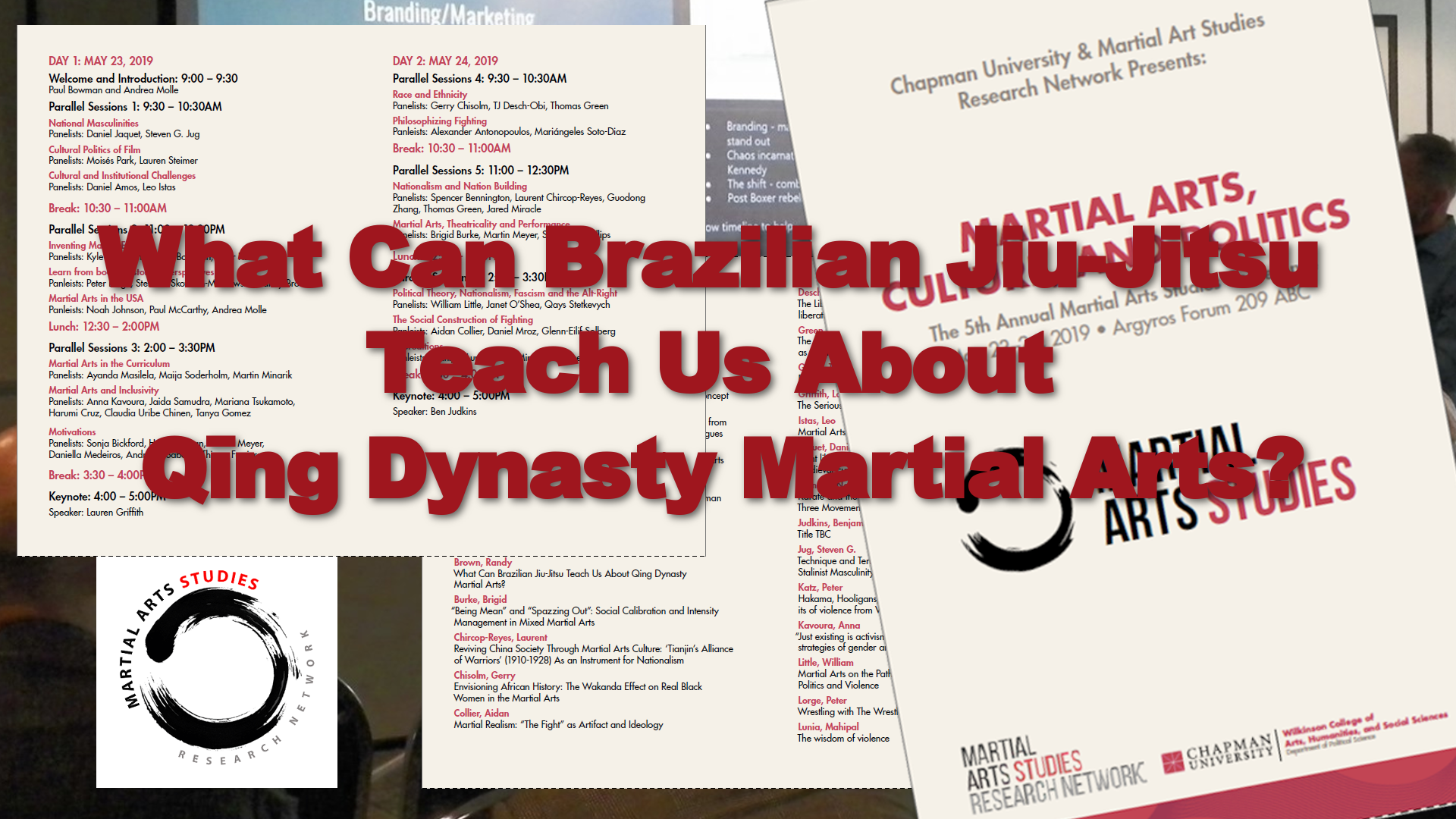
What Can BJJ Teach Us About Qing Dynasty Martial Arts? - Randy Brown - MAS Conference 2019
This podcast is an ‘audio only’ re-recording of a talk I gave at the 5th Annual Martial Arts Studies Conference held at Chapman University in Los Angeles, California in May 2019. For a complete experience, I recommend watching the video version so you can see the slides.
The event was hosted by Dr. Paul Bowman, and Dr. Andrea Molle. A two day extravaganza of martial arts history, politics, and culture. There is amazing research into the martial arts taking place around the globe today. It was an honor to be a part of this significant event, and contribute in some small way to the Martial Arts Research Network. Below is a copy of the abstract submission for my talk at the conference to help lay context before listening.
This podcast is an ‘audio-only’ re-recording of a talk I gave at the 5th Annual Martial Arts Studies Conference held at Chapman University in Los Angeles, California in May 2019. I do recommend viewing the full video version so you can see the slides.
The event was hosted by Dr. Paul Bowman, and Dr. Andrea Molle. A two day extravaganza of martial arts history, politics, and culture. There is amazing research into the martial arts taking place around the globe today. It was an honor to be a part of this significant event, and contribute in some small way to the Martial Arts Research Network. Below is a copy of the abstract submission for my talk at the conference to help lay context before listening.
Abstract
What Can Brazilian Jiu-Jitsu Teach Us About Qīng Dynasty Martial Arts?
The continually evolving art of Brazilian jiu-jitsu (BJJ) and the journey of this style throughout the 20th century can provide insights into key elements of the Qīng dynasty Chinese martial arts, helping to demonstrate similar developments in the ‘Chinese Boxing’ systems of that era. Specifically, by following the modern evolution of BJJ, it is possible to gain insights into the sudden appearance of totem styles or subsets across China, how these anomalies become styles in their own right, and how they survived and thrived for over a century. A martial arts cross-cultural comparison of style subsets within BJJ, which have developed since the early 1990s, can be juxtaposed with the pre-modern development of comparable ‘subsets’ within Qīng dynasty ‘Chinese boxing’. On the other hand, the survival and globalization of this stylization in China differs with how developments within BJJ propagate, where instead changes become rolled into a pool of common knowledge and do not take hold as independent systems or alternative styles outside of the core art. A question needs to be asked, did ‘Chinese boxing’ of the era, have a similar common pool of knowledge? Qī Jì guāng’s manual would hint at such. Within ‘Chinese Boxing’, attributes, feats, or skills defining one fighter over another became definitive styles of their own right due to events of the time, compared to a failure in modern times for these subsets to survive independent of BJJ, even though properly vetted in the crucible of worldwide tournaments. In the Qīng dynasty a confluence of events which included rebellions, opium wars, global humiliation and the collapse of a dynasty, began to solidify these subsets as styles in China. Eventually, cultural industrialization of Chinese martial arts, notably through the Hong Kong movies, ingrained these styles into popular culture with the result being securing their legitimacy to the public eye without any evidence of martial prowess.
Keywords:
Chinese martial arts, Brazilian jiu-jitsu, Qīng dynasty, animal styles, Chinese boxing

Episode 16 - Mining Junk - Are forms worth mining for techniques?
Forms are windows to the past. They can show not only a fighters techniques, system, and series of counters, and counters to an opponent's counter. They are a fascinating anomaly. Are the techniques within worth the…
Forms are windows to the past. They can show not only a fighters techniques, system, and series of counters, and counters to an opponent's counter. They are a fascinating anomaly. Are they worth the mining for these techniques and sequences within? Today I'll discuss my thoughts on this, and hopefully shed some light on this facet of Chinese martial arts training.

Episode 15 - What is Xing Yi Quan?
Forrest Chang and I discussed at great length a style of Chinese boxing known as xingyiquan. I thought I would add a follow-up explaining what Xing Yi Quan is, and share with you some of the history I uncovered while researching another project. Listen and find out more...
Forrest Chang and I discussed at great length a style of Chinese boxing known as xingyiquan. I thought I would add a follow-up explaining what Xing Yi Quan is, and share with you some of the history I uncovered while researching another project. Listen and find out more...
Episode 14 - Are Chinese Martial Arts Still Relevant? A Conversation with Forrest Chang
Are CMA (Chinese martial arts) still relevant in modern times? Are they worth saving? Over the winter, I had a chance to sit down and have a conversation with Forrest Chang of the Chinese boxing style known as xingyiquan. Forrest and I discuss the issues plaguing Chinese martial arts styles often…
Are CMA (Chinese martial arts) still relevant in modern times? Are they worth saving? Over the winter, I had a chance to sit down and have a conversation with Forrest Chang of the Chinese boxing style known as xingyiquan. Forrest and I discuss the issues plaguing Chinese martial arts styles often referred to incorrectly as Kung Fu. We tackle this topic, what produces better results, along with current CMA disruptor and MMA fighter Xu Xiaodong, the Shuai Jiao paradox and other changes happening in Chinese martial arts.

Episode 13 - Is Boxing Good for Soldiers in the U.S. Military?
Out of all the martial arts available, should ‘Boxing’ be used in hand-to-hand combat training for American soldiers who occupy combat arms roles?
Out of all the martial arts available, should ‘Boxing’ be used in hand-to-hand combat training for American soldiers who occupy combat arms roles? These are military occupations that have direct contact with enemy combatants. This especially pertains to infantry, military police, and special forces. While there are certainly benefits to boxing, here are my thoughts on why this may not be the best fighting style for troops to train, or even practice.

Episode 12 - Your 'Tai Chi' is not 'Supreme Ultimate'
Join me for this podcast where I discuss some hilarious mistranslations we use in martial arts.
I read a great article the other day on how improper the words gi and no-gi are in Brazilian Jiu-Jitsu. it was quite educational, and I highly recommend checking it out. I learned something myself. It also spurred me to finish putting together some thoughts on how WRONG it is to say Tai Chi. The actual term is Tai Ji Quan, or taijiquan. Check out this podcast, as it’s pretty funny when you dig into the meaning and how it is being used, errr, misused by us today in the west.
Episode 11 - “How Do I Tell if I'm Doing a Fake Martial Art?”
Fake is a fickle word, and martial arts training, or what defines martial arts training, is subjective. With that said, I’m up for the challenge and will attempt this person’s question and do my best to help any of you out there that have questions on your martial art.
Fake is a fickle word, and martial arts training, or what defines martial arts training, is subjective. With that said, I’m up for the challenge and will attempt this person’s question and do my best to help any of you out there that have questions on your martial art.
People do martial arts, or martial dance for a variety of reasons. Not everyone wants to fight, spar, or get hurt, but many want to know self-defense and how to protect themselves. It’s important when that is our objective, to know what we’re doing is legitimate, and works. When training/practicing an ‘art of violence’, there are certain things we can look for to ensure what we are spending our time and money on, is real.
Listen in to find out more...
Episode 10 - Answering Longtime Questions in Tai Chi
Go behind the curtain in this episode as I discuss my recent (2018) discovery of the application/intent behind a move that haunted me from years - High Pat on Horse. This is from Yang style…
Go behind the curtain in this episode as I discuss my recent (2018) discovery of the application/intent behind a move that haunted me from years - High Pat on Horse. This is from Yang style Tai Chi, or Taijiquan, or Yang’s Cotton Boxing, and quite possibly/most likely, existed back in the Ming dynasty, as evidenced by General Qi’s manual. That will be later in the podcast, and I’ll also discuss who was General Qi, the new field of academia in martial arts, and author Dr. Peter Lorge’s book - ‘Chinese Martial Arts from Antiquity to the Twenty-First Century’.
Credits:
Peter Lorge for the information on Qi Jiguang and his manual revisions, details, etc.
Douglas Wile and his book Tai Chi Ancestors for the drawings/translations of General Qi’s manual.
https://www.chineselongsword.com - for another translation/copy of General Qi’s manual on unarmed combat.
Episode 09 - “I’m thinking of choking you…” - Pontificating over a hot mocha.
A direct quote from one of my students as we were rolling during their private lesson today. Thinking out loud while enjoying a hot mocha. Join me for some fun and insight into this quote.
A direct quote from one of my students as we were rolling during their private lesson today. Thinking out loud while enjoying a hot mocha. Join me for some fun and insight into this quote.