

The Kicks of Mantis Boxing Training Course
Confuse. Overwhelm. Destroy.
Confuse. Overwhelm. Destroy.

Kick with Balance. Kick with Precision. Kick with Power.
Kicks are devastating. The power we can generate with the leg far outweighs the potential with our arms, and they provide a distinct reach advantage as a long range weapon. However, kicking requires far more energy which is in limited supply. Launching kicks creates weaknesses in our defense that allow for counter-attacks by our opponent. Kicking causes potentially catastrophic imbalances when we go to one leg. And kicks are only useful in very specific ranges of hand-to-hand combat; improper timing leads to unsuccessful attacks, or our own demise. Using one of the best weapons on our body that requires the most energy consumption to execute and failing to connect with it, is a bad equation in my world.
I’m Randy Brown, and after 21 years of martial arts training from tae kwon do, to kickboxing, to multiple styles of Chinese boxing (to include 3 styles of mantis boxing), I have developed a system of kicking to help you succeed where most kicking fails.
In my kicks of mantis boxing course you’ll learn:
The basic kicks of mantis boxing.
How to properly execute your kicks without losing balance.
Kicking strategy to maximize destruction, confuse and overwhelm your attacker.
Power generation.
Warm-ups for pre-training and increasing flexibility.
Proper range to throw each kick. And more importantly, when and how to switch gears and go from striking to kicking, or kicking to striking. A critical skill when it comes to any boxing art.
Take the mystery and confusion out of creating your own drills, or figuring out what to work by following my simple, easy to follow, training missions after each lesson. Curated by me personally to help you to integrate these powerful kicking methods into your skillset.
Includes:
14 Video Lessons shot in HD video
Training missions to get your repetition and skill training
Warm-ups for Kicking and Improving Flexibility
PDF download - Beginner’s Guide to Kicking by Randy Brown
*course included with Legacy Boxer and Supreme Ultimate Boxer memberships

The Strikes of Mantis Boxing Training Course
Stop someone in their tracks.
Gain Knockout Power!
Prevent damage to yourself when you hit.

Stop someone in their tracks.
Gain Knockout Power!
Prevent damage to yourself when you hit.
In this course you will execute the 3 palms and 5 fists of mantis boxing. Acquire proper technique and alignment to prevent injury to yourself when striking. Integrate stance and footwork training to begin laying the foundation for power generation in your strikes to maximize your damage potential. Increase your skill and power with your striking arsenal.
Finalize the course with 'precision strike training' - learn soft targets - where to hit, and how to hit someone to knock them out or shut them down.
Take the mystery and confusion out of creating your own drills, or figuring out what to work by following my simple, easy to follow, training missions. Curated by me personally to help you to integrate these powerful methods into your skillset.
Includes:
1.1 GB - 35 minutes of HD video.
Training Missions.
Excerpts on the importance of striking
Article on Effective Strike and Soft Targets
*course included with Legacy Boxer and Supreme Ultimate Boxer memberships

The Art of Counter-Striking
There are two types of fighters - offensive fighters, and counter-fighters. A list of descriptors for offensive fighters is comprised of - aggressive, confrontational, type-A personality, control freaks, etc. On the inverse, the counter-fighter may be described as - laid back, docile, relaxed, non-confrontational. I contest that, no matter what your style of fighting is, I will make the case that the counter-striking skills are crucial to both camps of fighters. For now, if you are an offensive fighter, skip ahead to the section below on Offensive Fighters. If you are a Counter-Fighter, then carry on to the next paragraph.

photo by Max Kotchouro
There are two types of fighters - offensive fighters, and counter-fighters. A list of descriptors that may indicate we are an offensive style fighter are comprised of, but not limited to - competitive, aggressive, confrontational, type-A personality, control freak. We know who we are! On the inverse, if we’re a counter-fighter, we may be described as - laid back, docile, relaxed, non-confrontational. I contest that, no matter what our style of fighting is, counter-striking skills are crucial to both camps of fighters. For now, if you are an offensive fighter, skip ahead to the section below on offensive fighters. If you are a counter-fighter, then continue on to the next paragraph.
Counter-Fighters
If we are a counter-fighter, then the following techniques are going to be our bread and butter. We are the ‘shield-bearers’, the ‘defenders’. After we attain a base proficiency in blocking then we will need to immediately gravitate towards applying counter-strikes. We cannot defend, or retreat forever. In order to prevent our aggressor from becoming emboldened and running us down, we need to hit them back from time to time to send a message.
What defines “a base proficiency in blocking?” This manifests from learning to trust our blocks; an absolutely crucial facet to counter-striking strategy. Slipping and ducking can apply here as well. When we’re new to the striking arts we learn to block, slip, duck, dodge, but in the interim we usually have one, and only one gear we know how to use in regards to our footwork - reverse. This is OK at first, as it hedges our bets on blocking and keeps us at a safer distance. Meaning we can block, but we’re essentially neutralizing our opponents attack with our footwork at the same time.
If we examine this move for move, our opponent advances with a strike and our footwork, ‘could’, if properly timed and spaced, eliminate the need to block. While this is a fair tactic, we cannot backup forever and our opponent can move forward further and faster than we can move backwards.
The solution comes down to taming our fear, or attaining some semblance of emotional control. We do this by either learning to take a punch (an ill advised solution), or by gaining proficiency in blocking, slipping, ducking, or a combination thereof. The latter cogent so that our defensive deflection is dependable and worthy of trust. Once we have achieved this skill, then we can venture forth into the counter techniques shown further below. First, we need to address those offensive fighters, whose skills are also necessary to us when faced off against another counter-fighter. Otherwise…there is just an uncomfortable stare down.
Offensive Fighters
If we’re an offensive fighter then our strategy/tactics/game are comprised of - going in, stealing the initiative; or obtaining the first-strike. Unsettling our opponent so they cannot gain first-strike capability on us. We prefer to dictate the pace and energy of the fight. For us, bridging tactics, rather than counter-striking are the key to our survival; the primary swords in our arsenal. In a battlefield scenario, we are the ‘cavalry’, or the ‘archers’. We launch the preliminary attack, engaging the enemy, gaining initiative, and disrupting their defense.
Let’s examine this more closely in a play by play:
We launch our first-strike attack on our opponent.
As we enter the fray they blast us in the leg with a powerful round kick to the soft tissue of the quadricep muscle (think charly horse). Or equally destructive, the femoral nerve on the inside of the thigh.
This counter-attack stops us in our tracks and we miss our attack opportunity, opting to retreat and recover our position instead of pressing forth.
The second attempt…ends with the same result. If our opponent is good, then they nailed us in the same target as the first time.
We may muster the courage to try once more with the same assault. For the sake of this scenario, we meet the same fate for the third time. Our leg is now feeling like rubber and we decide at this point to stop pressing the attack and try to nurse our wounds.
What’s next? Scroll back up to the section on counter-fighting because we just got schooled on why, as offensive fighters, we need to have a counter-striking game in our arsenal. Our opponent just turned us into a counter-fighter.
Counter-Strike Setups
In order to develop counter-striking as an intrinsic part of our game, there are some simple counters we can start with. From there we can increase the complexity. Let’s start with counters found in some of the old mantis boxing forms such as ‘upper block/punch’, and ‘upper block/chop’, and more:
Starter Counters
Upper Block to Straight Punch, or Thrust Palm
Upper Block to Chopping Fist (Hammer Fist)
White Snake Spits Tongue - Circle In Block to Spear Hand, or Eye Plunder
Circle In Block to Thrust Palm
Circle Out Block to Ear Claw
These are simple retaliatory strikes that flow naturally off of the blocks they accompany. The key to success with these counters is more about timing, proper range (may need to close the gap as part of the counter), and seeing them real time. The last being the most difficult, and only manifests from experience drilling with feeders, and light sparring.
Adding Complexity
The following are simple counters but rely heavily on an advanced awareness of our enemies position, proper guard, good blocks, and the aforementioned timing and awareness. The overall feeder (strike thrown from the opponent) that we’re looking for is easy, but reconnoitering the enemy footwork prior to execution is critical.
In regards to executing these techniques, it is imperative that the defensive guard facets of our game are in place before applying the following counters. See further below for common fail points with these two techniques. Hint: usually attributed to a failed guard component.
These next two counters are also prevalent in mantis boxing forms that have been handed down over the generations. They are, in my opinion, some of the better counters but they are mutually exclusive; related to one another only in a general category of counter-strikes, as they require unique entries by our opponent.
Monkey Steals Peach - Opposite Arm Attack
The setup we’re looking for to initiate monkey steals peach is as follows:
My left foot is forward and my opponent is matching/mirroring my stance with their left foot forward.
The strike initiates from their left (lead/opposite) hand as they shuffle in. As you’ll see in the video, use a parry (not a block) combined with a cross circle step to their outside line.
Counter with a groin slap.
Alternatively, my opponent is instead starting from a southpaw stance. In this case I would need them to step in vs shuffle in with their opposite hand (left hand strike in our example above). The end result is the same, I get the opposing arm and foot leading the charge.
Crazy Ghost Fist - Same Side Arm
The setup for crazy ghost fist is as follows:
My left foot is forward. My opponent’s right foot is forward placing us in a southpaw position.
The strike initiates from their right hand as they shuffle in. I use a parry rather than a block, guiding the hand off to the side, being sure not to aggressively push it away. This will cause my body to twist up and reduce my counter-punch power.
Coordinate the parry with a slip offline toward the outside of their lead (right) foot.
Shuffle forward and counter with cannon fist to the liver.
As with monkey steals peach, an alternate setup is for the opponent to start with left foot forward, but they step in, rather than shuffle in. We end up with the same right arm/right foot combo we need for the counter-strike opportunity to manifest.

Scenarios
When and where to apply monkey steals peach (MSP) vs crazy ghost fist (CGF).
A. CGF - opponent shuffles forward with lead hand strike from southpaw stance.
B. MSP - opponent steps in with a rear hand strike from southpaw stance.
C. CGF - opponent steps in with rear hand strike from matched stance.
D. MSP - opponent shuffles in with lead hand strike from matched stance.
Common Fail Points
Guard
In order to apply counters successfully, especially monkey steals peach and crazy ghost fist, our guard must be intact and operating to maximum efficiency. With even one component of our guard out of place things unravel very quickly when trying to block, never mind trying to apply a counter-strike. It is possible to trade shot for shot while staying in the pocket, but this is ill advised especially against a larger, stronger, or more skilled opponent. Proper guard positioning will not only shut down many of our openings, but also lead to a successful block|counter response.
Guard Components:
Hands up - fingertips no higher than eyebrows. Preferably lower.
Elbows tucked - covers the liver and stomach targets
Staggered arms - 1 arm in, 1 arm out. This is assisted by a bladed body position and staggered stance.
Shoulder Line - our hands are lined up on the opponents shoulders creating an open channel down the centerCrossing Zones
This is usually a bi-product of our guard failing. Having to cross zones in order to block because our hands were down, or not lined up with the opponents shoulders. Crossing zones ties up our arms and forces us into awkward positions that spin wildly out of control. We’re forced at this point to bail out if we can, and try to reset our position to neutral.
Out of Neutral Position
Allowing the opponent to gain our centerline before they close range can lead to a crisis we have to contend with rather than looking for counter-strikes. While it is still possible to counter from a bad angle, our position is so poor that our strike will lack power and we’ll quickly pay for any minor success by stumbling, falling, tripping, or succumbing to the rain of blows that is sure to follow from our opponents superior positioning. It is imperative we pay close attention to keeping neutral positioning until the engagement takes place.

HEAVY ASSAULT! - Circle and Chop, or Haymaker and Hammer
HEAVY ASSAULT - Go heavy, or go home! This striking combination, plucked right from the catalog of Mantis Boxing techniques passed down for centuries, is to overwhelm the opponent with big, destructive, blows. Connecting with the first one is ideal and effective, but if they duck, or move back, the second…
HEAVY ASSAULT - Go heavy, or go home! This striking combination, plucked right from the catalog of Mantis Boxing techniques passed down for centuries, is to overwhelm the opponent with big, destructive, blows.
Connecting with the first one is ideal and effective, but if they duck, or move back, the second strike, by design, takes advantage of the built up energy from the first strike to fell them with the second.
Advance with the Circle Punch, aka Haymaker (see video on Circle & Hook) to attack from the side door. Try to connect with your partners Effective Strike targets to increase your targeting accuracy. Use your footwork and body torque to maximize power (on pads).
Have your partner duck, or shuffle back to counter the first strike. This is where the Chopping Fist comes in. Now unwind that transverse core rotation, and hip torque, and unleash it back where it came from.
The Chopping Fist will come over the top and downward, again looking for Effective Strike targets to practice with on our partner. With pad drills, ramp up the power to work your speed, and might in your technique.
As you get the striking combination down, start paying close attention to your guard hand. I have seen this combination used twice in the UFC over the past couple of years, to amazing effect. Unfortunately, one fighter Roy 'Big Country' Nelson, didn't use his guard hand and his opponent connected with an uppercut in between.
Timestamps:
00:40 - Technique Explained
1:33 - Watch the Counter-Strike!
2:46 - Footwork
3:14 - Pad Drills
Gear
You can find some of the items we use in the video by following our affiliate links:
Assassin Pads
Punching Bag
Gloves
--
Leave your comments and questions below. Don't forget to SUBSCRIBE and GET HOOKED!

Hook vs Circle Punch - What's the Difference?
What's the difference between a Hook Punch and a Circle Punch? Are they really that different? Yes, and yes.
The Hook Punch is used at a closer range, similar to an uppercut. It works well when you are striking in tight, or engaged in a Clinch (Lǒu 摟). In here, a long range strike will extend beyond my opponent. We position the arm in a tighter hook shape to help…
What's the difference between a Hook Punch and a Circle Punch? Are they really that different? Yes, and yes.
The Hook Punch is used at a closer range, similar to an uppercut. It works well when you are striking in tight, or engaged in a Clinch (Lǒu 摟). In here, a long range strike will extend beyond my opponent. We position the arm in a tighter hook shape to help land on our targets such as the temple, kidney, liver, ribs, stomach, and jaw.
The technical position when throwing a hook punch is critical. When bare knuckle striking, there are no wraps to support the wrist, so technique has to be spot on in order to prevent breaks, sprains, and fractures in our own hands/wrist.
The wrist is held in a straight line, and we use the transverse core rotation of the upper torso to connect the punch, versus extending the arm and bending the wrist which is dangerous to our own hand. Thumb position is up.
When the range to our opponent is further out, and we are still throwing straight punches, this is where the Circle Punch really shines. It allows us to attack the side doors as well as down the middle; utilizing the principle of - Randomized Striking.
Connecting with a Circle Punch has the added benefit of increased power generation through a looser whipping action. The punch is thrown relaxed; the arm builds up speed before connecting. If this impacts the temple, jaw, occipital lobe, bracchial nerve, or ear, it can have devastating consequences.
Because of this, when our opponent sees a Circle Punch steaming for the side of their head, they are more likely to open the center doors trying to defend; thereby allowing our other punches to land.
The hand position for the Circle Punch is wrist straight, thumb pointing down.
Timestamps:
0:42 - Technique
4:12 - Pad Drills - Hook Punch
5:29 - Pad Drills - Circle Punch
6:12 - Bag Drills
6:44 - Bag Drills - Circle Punch
7:10 - Bag Drills - Hook Punch
Gear
You can find some of the items we use in the video by following our affiliate links:
Assassin Pads
Punching Bag
Gloves

The Scraping Fist
The Scraping Fist - like a low uppercut, or body shot. One of the advantages of this punch, is the fact that unlike throwing a straight punch…
The Scraping Fist - like a low uppercut, or body shot. One of the advantages of this punch, is the fact that unlike throwing a straight punch toward the body which comes in from a high angle, this punch comes from underneath by dropping the elbow, making it harder to block.
It's a great punch to sneak in shots to the body, especially when using the principle of Changing Levels/Varying Targets. . But it can be dangerous trying to pull it off at the wrong place/time.
Here are some tips along with pads drills, and bag drills later in the video for practicing the scraping fist on your own, or with a partner.
1:20 - Technique
4:56 - Pad Drills for Focus Mitt, Thai Pad training
7:24 - Bag Drills for Punching Bags
Gear
You can find some of the items we use in the video by following our affiliate links:
Assassin Pads
--
Leave your comments and questions below. Don't forget to SUBSCRIBE and GET HOOKED!

The Straight Punch - Throwing the Forward and Reverse Punch
The Straight Punch - devastating and destructive! Forward and Reverse punch are a good place to start when learning to punch in Mantis Boxing, or other striking arts. They are destructive, and can easily be modified to open hand strikes if necessary.
The following video shows the in's and out's of...
The Straight Punch - devastating and destructive! Forward and Reverse punch are a good place to start when learning to punch in Mantis Boxing, or other striking arts. They are destructive, and can easily be modified to open hand strikes if necessary.
The following video shows the in's and out's of starting to punch with these two strikes and some of the pitfalls to watch out for.
Using footwork with punches, increases the power, improves range, and helps keep us mobile instead of fixed. Check out pad drills, and blocking drills, or use these on a heavy bag to train on your own.
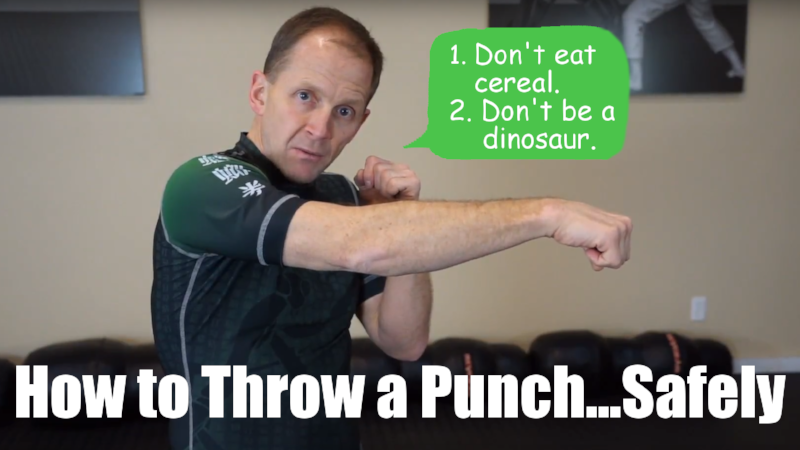
How to Throw a Punch...Safely
Having an improper structure, leaving a finger misplaced, or snapping our elbow, can all cause lasting damage, injuring ourselves more than the object we are trying to hit.
Whether we are hitting bags, pads, mitts, makiwara boards, or sparring partners, it's important to keep these tips in mind to keep us punching without injury for years to come.
Having an improper structure, leaving a finger misplaced, or snapping our elbow, can all cause lasting damage, injuring ourselves more than the object we are trying to hit.
Whether we are hitting bags, pads, mitts, makiwara boards, or sparring partners, it's important to keep these tips in mind to keep us punching without injury for years to come.

Why is BJJ Easier than Boxing/MMA?
"Why is BJJ easier than Boxing?" This was a question proposed to me last year when we were taking submissions for the Swamp Talks videos. Truth be told, it was a question that made me uncomfortable at first, as I assumed it would be misconstrued. This question, out of all of them, really stood out to me and made me think.
It made me think about something I hadn't previously considered. Something that was clearly...
Learning to Walk Again With Martial Arts

"Why is BJJ easier than my stand-up fighting art?" This was a question proposed when we were taking submissions for a podcast. Truth be told, this question out of all, made me uncomfortable. I assumed it would be misconstrued by the internet tigers, and they would all pounce. “What do you mean BJJ is easy!?!?!” This question, out of all of them though, really stood out to me.
It made me think about something I hadn't previously considered. Something that was clearly on the mind of more than one of my students who train multiple fighting modalities. At first, I opted not to address this question, even though I left it on the list. I needed more time to think about it. To ponder the implications. It wasn't until a few months later that I had formulated a decent answer and can now commit to writing it out. The question:
“Why is it so difficult to get the stand-up game compared to BJJ?” Let's break it down by each element and hopefully make some sense of it. BJJ is not easy, and I know that was never the intent of the questioner, but it is certainly easier than learning stand-up fighting.
Crawl. Walk. Run.
When fighters get frustrated with footwork, I ask them - "Did you walk out of the womb?" A rhetorical question, to set up the greater lesson - First we laid on our back kicking our legs. Then we laid on our belly for a while doing push-ups. Next we started to crawl. Then we started to use our arms to climb, and stand. Once our legs gained strength, we began to take our first steps.
After falling quite a few times, we got the walking thing down. Later we started to run. Fast forward to here and now. We are learning to walk all over again, in a way that makes us effective boxers. But rather than laying there kicking our legs for a while, we are insisting we should be able to run right away. Therein lies the problem.
You Monkey!
Monkey Staff - 2003
At our roots we are primates. Our instinctive method of striking is large, powerful swings that maximize our anatomical structure. This creates power, but leaves little in the way of protection.
In martial arts (boxing, kickboxing, karate, etc.), we learn a new way of striking. Ways completely counter to our instincts, and some that will build off of them. These new methods we learn can provide power while simultaneously offering a guard for helping to protect our own head in a fight.
Striking seems simple from the outside. I believe that is why I see so many people baffled by the amount of time it takes to get good at it.
I read a blog post from Dan Djurdjevic yesterday speaking about 'what it means to be a beginner' (see his post here). In his article he brought up boxing, and the amount of time before a boxing coach thinks you are moderately skilled at striking. This was new to me as I am not in the western boxing circuit that focuses solely on striking (no kicks, takedowns, elbows, or knees like mantis boxing). Dan claimed, 4 years for proficiency. That coaches do not consider you close to stepping into a ring with a pro-fighter until much later. This is a martial art modality built around 'STRIKING AND FOOTWORK ONLY'. Yet four years of training before an amateur level is achieved by the average person.
It is healthy to have realistic expectations. A heavy bag routine a few days/week can help increase our striking game and cut down on the mistakes we make. Remember, it's about building motor function. The more we punch, the easier it becomes to tweak and fix.
Building Blocks
We may have come with a natural affinity for striking, even if a coach tells us it is the wrong way to fight. But when it comes to blocking, we will definitely have more limitations to proficiency. Our natural instincts tell us to shield up, turn into a ball, or flail wildly.
When we enter martial arts, these motions are new, and we have to refine and work on them. Which includes technical elements, structure, timing, position. The training time for this can be fairly quick with proper partner training, but is not enough by itself. Unfortunately we can't stand there and block all day long. Eventually they will find a hole in our defense.
Your 'Other' Left Foot
‘Soooooo…we thought we knew how to walk...?’ Since we spend a large part of our life moving around on our feet, you'd think footwork would be a given. Nope. On the contrary, building a proper stance and then learning how to move in that stance, takes a lot of repetition for it to become second nature. Until we achieve said proficiency, we will have holes in our game that are easy to capitalize on for a moderately skilled opponent.
Shuffling, stepping, circling, angling, cross circle steps, spin outs, change steps, are a lot of meat on the table. In order to polish these, we'll need to spend time working it out. The nice thing is, we don't NEED a partner to practice footwork. Just a small open space.
Just for Kicks
As if all the aforementioned challenges were not enough, now we're thinking we should be able to throw kicks with ease. To go from a bi-ped day in and day out, to now standing on one leg while breathing, relaxing, and kicking someone hard enough to make them think twice about attacking us again. This one is definitely outside the normal realm of human motion and fighting instincts.
Kicking is going to be a skill that takes on a focus on it's own. There are entire martial arts built around this one modality (see tae kwon do). As with striking, if we have a bag we can beat on, it will do leaps and bounds to help us get our kicking to a decent skill level. Once we have the repetition, and we aren't falling on our ass every time we lift one leg off the ground, then we can grab a partner and focus on targeting, plus timing.
Kicks expend more energy, and create bigger liabilities (depending on the type of kick). Wasting them on targets that are not open can bleed out our endurance, and leave us sucking wind. Knowing when and where to throw the kick is the key to the leg game.
Throwdown!
Next on our list is another completely foreign skill that we did not come pre-packaged with. Beyond the basic charge and tackle, throwing another human being is an art form. Also, as we saw with kicking, evidenced by the fact that there are entire martial arts styles built around this pillar as well. Styles such as Shuai Jiao, and Judo. Both comprised of techniques not inherent to human instinct.
Learning the technique is one thing; building the timing for the perfect execution is a highly advanced skill that requires years of practice and sparring.

Chin Na class. Averill's Martial Arts. circa 1999
Locked Up
Joint locks (Chin Na) are another highly technical aspect of martial arts. They require a certain finesse to be effective and become proficient in. There are tons of limb locks out there, but knowing how, when, and on who we can use them is sometimes confusing, and almost mythical. Combine this with timing these off a punch, or grab, and the difficulty increases exponentially.
"Repetition is the mother of all skill." This is the truth with joint locks especially. The more we train them, the better we will get, and the more sensitivity we will have to make adjustments when things change on the fly. Check out Size Matters for more on the intricacies of joint locks and why they usually do not work.
Hooked Up
Once the range changes, we now have to deal with the clinch and getting tied up with hooks. Learning to escape and dominate the clinch, as well as throwing elbow strikes, and knee strikes, is yet another skill we throw in the mix. Like kicking and punching before, practicing these on a heavy bag, or throwing dummy can help knock off some of the repetition and get our skills kick started, but we'll definitely need to apply it with a partner to get the full benefit.
So, "Why is BJJ easy?"
Part of my discomfort with this question was, as I said in the beginning, that I knew it would be misconstrued. I understood what the individual really meant to say, but I was afraid others might take it as "BJJ is EASY!?!?! Say, What?!?!?" That was not the implication in the question.
BJJ is not easy, and the person asking the question struggled plenty with that training as well. The elements of the question have merit though. Why does it seem easier to become skilled in BJJ than with stand-up arts?
Brazilian jiu-jitsu, at least most sport BJJ, is heavily focused on the ground game. That means we are working on a single plane. Our body weight is fully supported across a wider surface than two feet can come close to attaining. This allows for ease of movement with our arms and legs available to focus on attack, and defense, rather than balance, mobility, striking, kicking, defense, and grappling all at once.
Additionally, unlike all the items we listed in stand-up that have nothing to do with our instincts - jiu-jitsu is much akin to our natural instinctive body movements, and innate self-defense skills. Like tiger cubs that practice sparring before leaving the safety of their mother, so to do we practice fighting when we are young, pliable, and less likely to hurt one another, and ourselves. We can see this when we watch untrained siblings go at one another in the living room of our home. They have a natural inclination towards wrestling, grappling and that style of movement. If they had fur and tails we’d think they were monkeys.
We Don't Need Another Hero
We all have hero's we see in films, or in the ring/cage. We see people we admire for their skills. But that's it, we see the results. The results of their effort. What we do not see, is the countless hours of training they had to go through to get there. The blood, sweat, tears; the pain, the setbacks, the injuries.
Many people find Bruce Lee to be an inspiration. There exists a seemingly invisible effort behind his movements, joined by every other icon we may have - Mike Tyson, Muhammad Ali, Rhonda Rousey, Holly Holm, etc. When we see them, we see them in their prime, or entering their prime. We see them after years/decades of training, practicing, sweating, sacrificing.
There is no 'short cut' to gaining "mad skillz". We have to do the work. In order to do the work, we have to enjoy the art, the people we train with, and stay focused on our goals. If we do not enjoy the process, then we need to vacate the space and find another sport we enjoy.
The Sum of All Parts
So in summary, if we look at the base elements I listed above, we can quickly see how things can seem overwhelming and hard to accomplish. It's normal. Any skill we wish to achieve in life, takes time to master.
On top of each individual component of stand-up fighting being an art in and of itself, trying to tie all the pieces together while our brain is in the early stages of learning, is thrilling, and yet seemingly insurmountable at times. Push through this and we will be rewarded.
When we walk into a stand-up martial art like mantis boxing, at it's essence - we are being told that we do not know how to walk, talk (lingo/jargon), punch, kick, grapple, or throw. We are starting fresh. This is a great time, and wonderful feeling that we’ll one day miss when we are more experience. After a few months, when the newness wears off, we start to feel the deck is stacked against us. Things we took for granted in everyday life, are now being retrained, and in the interim, someone else is taking advantage of our newly realized deficiencies. This can be overwhelming, humbling, and at times seem unattainable. It isn’t.
Take a deep breath, relax, and focus on enjoying the process, the people we train with, and have fun with learning. If we think in terms of belts/time, or years to mastery, we will forget why we started doing this in the first place. We’ll talk ourselves out of the arts altogether. Live in the moment. Enjoy the journey.
Thank you Max Kotchouro for some of the photos and video.