

Defending the Worst Position Ever!!
The High Mount combined with striking is a deadly combination. This is by far, one of the worst positions you can get stuck in on the ground. The traditional BJJ escape for mount - bridge, trap, and roll doesn't work quite yet, and meanwhile our opponent is raining punches on us, and bringing the thunder like Poseidon.
All too often, we panic in this situation and end up flailing, or trying to grab arms. Here we show a technique we call - 'Shield Up / Shimmy Up' to help you deal with this problematic position. We have to work from where we are, not where we want to be.
The High Mount combined with striking is a deadly combination. This is by far, one of the worst positions you can get stuck in on the ground. The traditional BJJ escape for mount - bridge, trap, and roll doesn't work quite yet, and meanwhile our opponent is raining punches on us, and bringing the thunder like Poseidon.
All too often, we panic in this situation and end up flailing, or trying to grab arms. Here we show a technique we call - 'Shield Up / Shimmy Up' to help you deal with this problematic position. We have to work from where we are, not where we want to be.
Like the video? Don't forget to hit subscribe.

Training Your Elbows and Joint Locks (Chin Na)
Joint locks (Chin Na) are fun!!! If you are into pain that is. ;-) Seriously, standing submissions are very cool; unfortunately, they can be extremely difficult to pull off for real.
Here is a more advanced drill to help you train ways to...
Joint locks (Chin Na) are fun!!! If you are into pain that is. ;-) Seriously, standing submissions are very cool; unfortunately, they can be extremely difficult to pull off for real.
Here is a more advanced drill to help you train ways to flow your fighting into those nifty locks. In order to make this drill easier, you'll want to have some knowledge of elbow strikes, and joint locks before doing this.
As Vincent and I throw elbow strikes, it forces the other person to counter the strike and place themselves in a position where we can setup a joint lock, rather than trying to attack a completely resistant opponent. This is a softening the target, or creating a distraction so we can affect the lock.
Enjoy!
Like the video? Don't forget to hit subscribe.
►SUBSCRIBE on YouTube: https://www.youtube.com/mantisboxers

How to Start Martial Arts
As we get more people contacting us, and joining classes of late, I thought it was a good time to send around this video again. Max put this episode together a few years ago as part of his Swamp Talks series. Enjoy the sound effects. [Gunshots were not an intentional part of the production]
How to get started in martial arts. Here are some tips and advice on what to look out for as you search for your first, or subsequent martial arts school.
Enjoy the sound effects. [Gunshots were not an intentional part of the production]
Types of martial arts vary, but this can apply to any of them. Here is a list of some of the more common styles you may find in your quest in the USA:
Boxing (western and Chinese) - often depicted in modern times as the sport with two contestants wearing trunks and padded gloves facing off in a ring. Original roots encompass a far broader definition that included grappling, and weapons. Something more similar with Chinese boxing styles like mantis, eagle claw which include kicking, grappling, and joint locks/chokes/submissions in addition to striking with fists, palms, fingers, and elbows.
Kickboxing - a combination of striking and kicking. Also more sport oriented with rules to protect combatants from serious injury.
Wrestling - as with boxing, in modern times this calls forth distinct imagery in our minds of two combatants on a mat grappling one another to the ground and looking for a pin. Wrestling’s roots are far more pervasive and have origins to every continent on the globe. Greco-Roman which is more common in our minds today, to catch wrestling, to folk-style wrestling that changes slightly from culture to culture whether in Asia, Europe, Africa, or the Americas.
Jiu-Jitsu (Brazilian and Japanese) - jiu-jitsu origins hearkens back to the combat arts of the samurai which included but were not limited to hand-to-hand combat methods such as throws, joint locks, and ground finishing moves (submissions). Eventually this migrated to Brazil in the 1900’s where it was blended with catch-wrestling methods and focused more heavily on the ground fighting component of hand-to-hand combat.
Judo - a descendant of Japanese jiu-jitsu that focused on the grappling and ground fighting elements of jiu-jitsu.
Karate - an Okinawan fighting art that originated by blending methods from Southern China with the indigenous grappling methods of the Okinawan people. Also included weapons in addition to hand-to-hand combat applications.
Shuai Jiao - a Chinese throwing art similar to Judo but lacking the ground fighting elements. Descendant from Bokh, and other folk wrestling styles found in Mongolia and northeast Asia.
Tae Kwon Do - a Korean martial art developed in the mid 1900’s that focuses heavily on kicking.
Hapkido - also a Korean martial art that focuses more on locking and throwing methods.
Aikido - a Japanese martial art centered around falling, throwing, and locking an opponent.
Tai Chi - an old style of Chinese boxing that has been converted to a form of health practice and physical education since the early 1900’s. Prior to that it was a hand-to-hand combat art that included striking, kicking, throwing, and joint locking/chokes.
Kempo - an American martial art that early on focused on practical self-defense. Combined methods from all forms of Asian fighting arts as well as boxing and kickboxing.
Krav Maga - an Israeli hand-to-hand combat system designed specifically for commandos/special forces. Techniques are straightforward and practical, relying heavily on strength and speed to overwhelm the opponent.

Emotional Control - A Core Fighting Principle
‘Emotional Control’ - this often sought after, and rarely attained, side effect from martial arts training. We envision the wise old master sitting quietly in meditation, only to turn into a verifiable badass the moment the movie needs an action star to save the day.
What we don’t see, is that emotional control doesn’t really come for free, or as an automatic trait of just taking martial arts classes a few times per week. It doesn't come with...

Serenity Now!!!
Update (1-7-19) - I recorded a new podcast on this topic. Click below to access it.
‘Emotional Control’, this often sought after and rarely attained side effect from martial arts training. We envision a wise old master sitting quietly in meditation, serene, placid, only to turn into a verifiable badass the moment the movie needs an action star to save the day. Undertaking martial arts, consuming supplemental materials in our journey such as movies, television, or in Asian style martial arts, wu xia, or even religious or philosophical teachings that were, tacked on to the art at times. We can experience teachings and practices that espouse control over the body, mind, and spirit, and yet, fail to show us the way.
What we don’t see is, emotional control does not come for free, nor as an proxy trait of simply being enrolled in martial arts classes a few times per week year over year. Emotional control does not come with sparring, nor does it come without sparring. This skill only comes from proper training, and constant diligence in applying said training.
Being punched, slapped, kicked, or choked induces a highly emotional reaction for most of us. Especially if we have experienced some sort of trauma or abuse in life. For others, the act of hitting someone else is a highly emotional act, and may even cause unforeseen responses in us such as: anxiety, fear, hesitation, and more.
These reactions caused by different catalysts are each, common for some, and completely foreign to others. What they share in common is, learning to control ourselves when we are experiencing these combative acts, and overcoming the body and/or minds’ natural response so that we can still function and apply our skills under duress. Sparring, the glue that binds martial arts training, allows us to confront things within ourselves that we may never see otherwise. In my experience, the mats teach us more about ourselves than we can learn in any other activity we undertake. If attended to, and cultivated we can take that knowledge, and experience growth not just physically but mentally, and spiritually.
REQUIRED TRAINING
If someone studies martial arts but never spars, they simply cannot know what it is like to function under stress until it is too late; they have not been inoculated to violence. On the opposing side, if someone spars all the time and isn’t taught to control their emotions (rage, fear, jealousy, inferiority, retaliation, pity, etc.), they will fail to develop this skill of emotional control.
Rage and anger can cost us a fight, I have won, and lost fights entirely due to this lack of control. Here one of many examples:
One sunny summer day in the early 1980’s, there was a concrete bandstand in the center of a small town in New Hampshire, USA. I was 10 years old. A friend and I were playing on the elevated deck of the bandstand when another friend arrived. I was sitting on the railing about 10 feet of the ground when he suddenly and violently pushed me off the edge.
I fell, slamming into the ground below. He raced down to revel in his glory and laughed uncontrollably as my other friend stood by. I felt the pain, but what overtook my body was an intense broiling rage. My heart raced, my vision closed to tiny tubes as if I were peering at my target through the scope of a snipers rifle; adrenaline coursed through my veins giving me a primal strength my youthful body had never felt. I attacked with all the savage ferocity my tiny preadolescent body could muster.
My opponent, a student of karate, laughed and remained calm in face of my oncoming barrage. He deftly applied his superior range and agility, side stepping my furious charge and throwing me to ground like a doll of rags. I sprung to my feet again and again, each time he would deflect, sending me into the dirt face first. This only angered me more, causing me to go back with increased fury.
Eventually my newfound ally adrenaline fled the front lines, leaving me spent and broken in the coarse hot dirt, starkly aware that with my greatest of efforts, I was utterly useless and defeated. At the time, I could not see that my excessive, wild, and animalistic attacks were causing my own demise.
Emotional control does not mean we are immune to feeling fear, anger, or the other emotions that accompany the chaos of engaging in conflict with another human. It means that we experience these feelings, and we continue function without letting them control us, without allowing them to inhibit us, or prevent us from defending ourselves.
In order to build this skill in training we need to spar, to test our skills to ensure that they work. However, doing this improperly, or too soon, can have permanent adverse effects much akin to trauma.
How do we train Emotional Control?
If sparring is necessary to build emotional control, how do we do so without putting ourselves in the fire of all out conflict and no holds barred fighting? How do we lower the cost of failure in sparring in order to build fighting skills along with emotional control?
There are a few mandatory components to ensure effective results. First though, is understanding what all of us will do if/when we are introduced to sparring too early in the training process.
Slow to learn, fast to test.
Each an every one of us walking into martial arts training has two attributes we come through the door with regardless of whether or not we are absent of skill. These attributes become a crutch that we fall back on whenever we are faced with stress, anxiety, fear, aggression, or the unknown. These attributes are speed and power.
You can easily say, “I’m not strong.”, or “I’m not fast.”, but when push comes to shove, you will move fast and go hard, it is instinctive. In order to properly train skills we need to remove these elements from the training process. Slow things down so we have time to figure things out, to diagnose, to recognize mistakes.
When I was first introduced to this idea, I latched right on to it. Some research on the human brain, learning methods, teaching techniques over the years, all reinforced this in various ways. But the place I learned it didn’t enforce it, only said it over and over like lip service. I spent years saying it in my own gym, telling students to slow down, to stop using strength. Things improved but it was never reliable.
There was one way to mitigate this, and it truly works.
Talk
Yes, talking. It is that simple. Before sparring with someone, especially if we are nervous, try talking with them for a moment. Ask how they are doing. Talk about a recent movie, or current event. Find a way to break the ice, to create a connection between the two of you. This can change the future.
What follows next, is a vastly different approach to the sparring match than what would have happened had we gone into the match amped up, nervous, scared, etc. Silence is deafening. Especially in the training hall. Help one another. Point out what we like about the other's technique or skills.
When I learned this principle from a Mantis Boxing coach I was already a coach myself. I was traveling across the country to train two to three times per year with this group. I only sparred with members of this group on those trips. The rest of the time I was sparring with my own students, and friends, which changes the dynamic of using this principle, especially when you’re the only one who knows it. I was always the one using it to help my students acclimate to sparring.
Aside from when I was first shown it, I never really benefited from this being used to help me, but I gained a invaluable insight from this process. As I traversed my Brazilian Jiu-Jitsu path, more times than I can count I would attend class, team training, or visit another school to train at, invariably I would get paired up with the meanest looking player in the room.
The coach would pair us off, and having already scouted the room beforehand, I knew who was trouble. They would usually have a disgusted or angry face on, and no one would go near them to even talk to them before class. Looking at them, I could ascertain that if I were paired up with them it was going to be all out war in the ensuing match. Instead, I fell back on this skill I had built from coaching.
As it so happened, I would usually end up being paired off with these folks. When the coach called out our names I would go up, shake hands, and sit in front of them or aside them on the mats. As we waited for the coach to finish pairing people off, then for the bell to go off, or after the bell if there was no time, I would ask their name, where they are from, or what they do for work. Something to break the tension.
It turns out, with the exception of one person out of all the times this happened, and it was many, the individual was super nice, and we found something in common after talking for a few minutes. The result? The match would be relaxed, smooth, and injury free. Excellent experiences and the beginning of new friendships.
What I came to realize is, these individuals were just as nervous, anxious, afraid, not of my hulking 5’6” demon frame, but of sparring with people they didn’t know, or wondering if they were going to get smashed again today, or even worse…injured. By the look on their face it was easy to assume they were angry, or mean, but this was simply a mask, their mask, to hide the real underlying emotion - fear. Once someone took the time to say hello, they became completely different people and showed their true colors.
TALK BOX
You can even talk while sparring. I know this seems silly, and it can be quite difficult at first, but later this becomes a crucial training tool. By talking we learn to stabilize our emotions while getting hit or hitting someone else. Removing the stress from the situation allows the brain freedom to learn, and the ability to maintain a good 'speed' for gaining, and advancing skill.
We want to focus on relaxing, and gaining this coveted emotional control. Later on when we have achieved this and sparring is less of a stress to us, we can focus on trying to fix things while we’re sparring. At this stage, we'll be in a different place skill-wise. As our training progresses, so too does our ability to control our emotions. We train, not only to be able to handle ourselves physically in bad situations, but also to inoculate ourselves to physical contact so if and when things go bad outside the gym, we react without thought, we perform as our training has prepared us, without our emotions getting in the way.
UPDATES
All of the above is true and I still stand by it. However, I will add that in the past two years we have taken another step to ensure success. We no longer allow sparring until students have gone through the entire curriculum one time. By giving people skills to fall back on, rather than relying on speed and power when faced with the unknown, we’ve been able to reduce injury, increase camaraderie, and begin building emotional control from the ground up, rather than what we were doing prior.
At the time of this article, and since first learning and instituting this in my gym back in 2006, the success rate was pretty poor from student to student. This was due to sparring early on. We had not replaced the attributes with skills, or instituted a few other necessary practices that have shown extremely high success rates. When it is complete, I’ll post a link to my recent talk on this at the Martial Arts Studies conference in Cardiff, UK. Stay hooked.
YOU ARE NOT ALONE
In the meantime, check out my friend Ando’s vlog on this same topic. Ando is an extremely high level martial artist, and incredibly adept coach who has spent decades perfecting his teaching methods. Take a few moments to watch this great video he put together on how he deals with emotions in the training process. You will laugh, and perhaps cry along with him as you watch. I highly recommend following his channel to see some of the great work he puts out.

The Easy Principle To Achieve Your Fitness Goals
Yesterday I was meeting with a professional from a different part of the health, wellness, fitness industry who mentioned her gym membership(s) going to waste. Her story may be familiar to some of you, so I thought I would share it, and offer some of my personal tips to stave off similar circumstance.
Yesterday I was meeting with a professional from a different part of the health, wellness, fitness industry who mentioned her gym membership(s) going to waste. Her story may be familiar to some of you so I thought I would share it and offer some of my personal tips to stave off similar circumstances you may find yourself in.
I will call her Suzie for the purposes of this article. Suzie is currently a member at 2 different gyms, and goes to neither. She continues to claim she will eventually go, but laments the fact that she ‘has to’. This cycle of negativity keeps Suzie from attaining her goals, and only perpetuates this cycle of wasting money and prolonging, or worse, never reaching one’s goals. This is an all too common occurrence but one that can be fixed with an easy principle.
Find A Passion

It sounds simple but elusive I know. In order to exercise most of us need to be motivated. In order to be motivated we have to 'want' to be doing the activity that will help us achieve our fitness goals.
This is so important, that I want to TYPE IT IN CAPS SO IT GETS YOUR ATTENTION. You can't turn over a new leaf by saying that you are going to start running a couple days/week when you despise running, and expect that you will miraculously have the willpower to go out and run. Especially when you leave work at 4:30p, and it is already dark, raining; snowing, freezing cold, and the nice warm house with a couch and TV are beckoning.
There's no rational reason any of us would choose that unless we were super excited about running. If running is your passion, then that should be your go to method of fitness during 'sacred time'. If rock climbing is more your calling, then strap in and tackle those rock walls.
There are so many things to do that involve movement - hiking, biking, swimming, roller-blading, street hockey, racket ball, tennis, orienteering, skiing, snow-shoeing, kite boarding, diving, hang-gliding, martial arts such as boxing, kickboxing, judo, Brazilian jiu-jitsu, etc., etc., etc. The most significant part of this - MOVE!

Nonsense
Here is a saying I have heard countless times over the past 18 years - “I have to get in shape first.” This is absolute nonsense. I can tell you this, every single time I have heard those words uttered from someone’s lips, they have never returned.
Do what you love. Don’t wait. Do it safely, but do it now. Even if you have to stop every 20 seconds, or take advantage of more specialized training to reach your goals, you will rise to occasion and start to acclimate to the sport/activity that inspires you. Reverse your reasoning and step forward into what will keep you coming back every day.
Falling Off the Wagon
If we already have an activity we are passionate about, but we just aren't attending it and sticking to it, that is different problem. One solved by breaking the rut we’re in and re-establishing a routine.
Setting a consistent week to week schedule that is what I like to call - 'sacred time', (time that is uninterruptible by other nonsense or static) is crucial. For example: doctor appointments, legal, car registration, etc. We don't let other things get in the way of those, but we'll let someone's phone call interrupt our health and wellness time.
Sacred time is your time to take care of you. We do our best to establish this, and then leave it be; unhindered by the comings and goings of the rest of life. It takes a little time, and the right mindset to get into this, but once you do, you will quickly understand the importance of it.
Some people can let their schedules stay in flux and maintain discipline, but most of us need a solid day/time that we go do something, and we don't miss it unless it is an emergency. If someone asks us to do something during that time, we can simply respond with - "I have an appointment." They don't need to know that you are going to roller derby, laying waste to leather bags in kickboxing, choking people in Jiu-Jitsu, or running half-pipes with your skateboard friends. They simply hear "appointment" and know that you are busy.
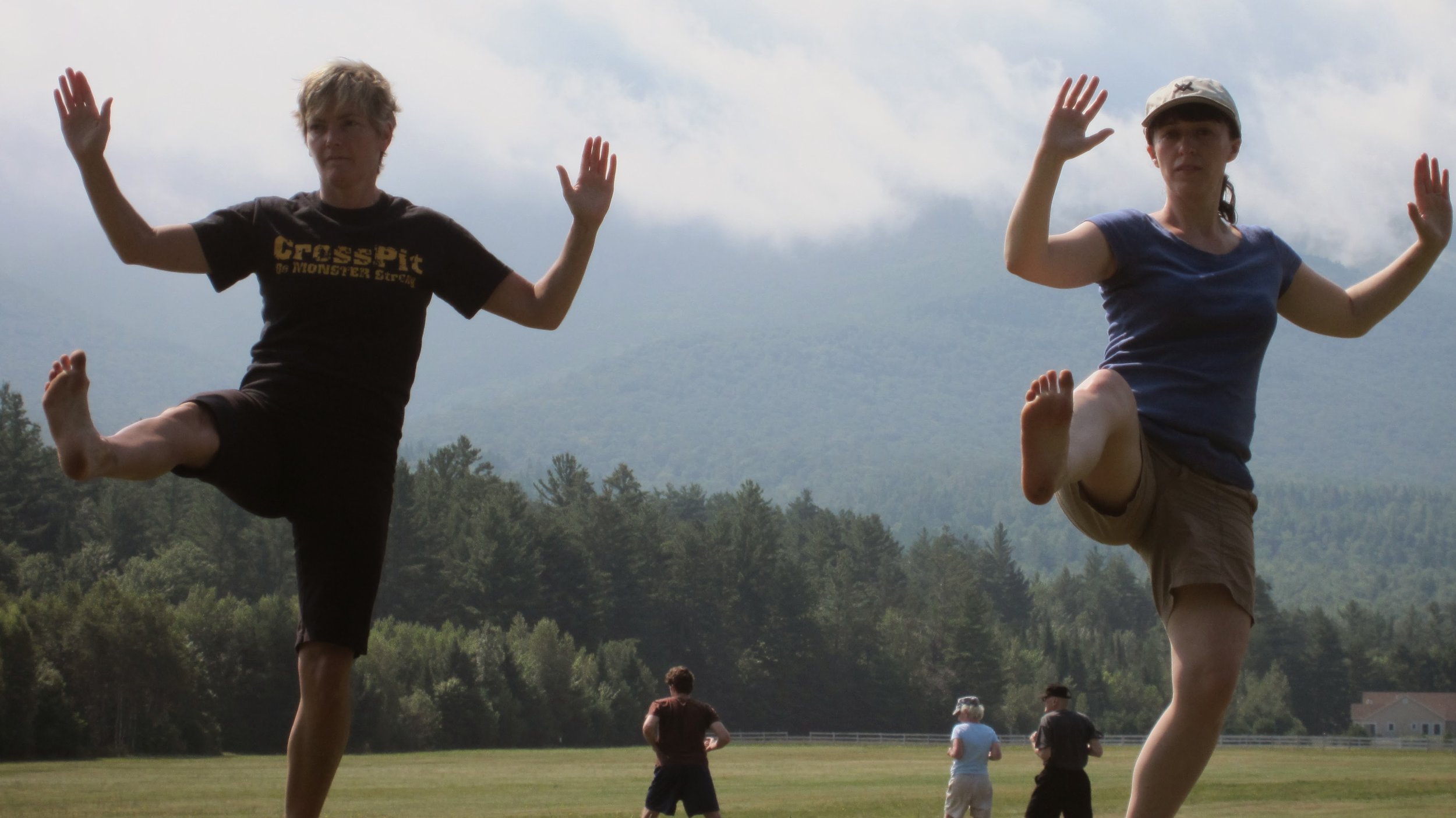
MOVE! MOVE! MOVE!
The human body is designed to move. The more studies come out on stagnation the more we learn that sitting at a desk all day, or lounging around too much equals bad news for our bodies, and our waistlines.
"The increased risk of death linked with sitting for eight hours a day was eliminated for people who were physically active for at least one hour a day."
You can see in this Norwegian study cited in this article on CBS News (and many other news sites) showing that prolonged sitting increases our propensity for all sorts of ailments, disease, and early deaths.
Find a Tai Chi class, Yoga, Pilates, stretching. Anything. But...and I can't stress this enough, enjoy what you are doing so you want to go back and keep doing it. If you hate it, resent it, or are even luke warm about it, then you won't want to go. It is time to ditch it and move on. Cut your losses.
This leads to a final point - when we have our 'gym membership' and we don't go, or keep telling ourselves "next week", then we feel anxious, depressed, discouraged, or a failure. What good is that doing to our lives? Exercise helps combat these feelings, but if it is the cause of them, then we need to reassess.
Personally, I am partial to contact sports such as martial arts, along with high intensity training in short intervals. Some people prefer 90 to 120 minutes of running, or 30 minutes of Yoga. What you do is up to you, but find what you enjoy and find a place to do it with good people around you that are on the same path and motivate you to keep going. We become who we surround ourselves with, so community can be a highly valuable tool in our progression.


Increase Your Martial Arts Learning Potential
"I don't like this move."
"This technique isn't for me."
These are examples of things I hear from students from time to time. Usually they are unaware I am listening, and I like to keep it that way so they feel free to express themselves in the process of learning. I myself have said similar things in the past while going through the process.

"I don't like this move."
"This technique isn't for me."
These are examples of things I hear from students from time to time. Usually they are unaware I am listening, and I like to keep it that way so they feel free to express themselves in the process of learning. I myself have said similar things in the past while going through the process.
One such time, I was on a trip to San Diego to train with a Mantis Boxing coach for a few days back in 2008. On this particular trip, he was passing on to me, his entire 8 Step Mantis Boxing throwing curriculum as taught to him by Sifu James Shyun.
I was excited to go through this material, and we spent the entire afternoon at Sifu Mike Dasargo's school going through all 20 of the throws and their variations. During the session, I remember getting to one throw, what we call Thigh Lift Throw (see photo) and absolutely hating it.
I felt so disconnected from the movement, and I was laying out reasons why this throw wasn't for me, and why I would never use it. I convinced myself to learn it, practice it, but I put it in a category for something that will work for someone else's body type, but not mine.
I returned from San Diego and set out practicing all the material from that weekend. I spent months going over everything, and working on integrating some of it into my fighting. Obviously some takedowns worked better than others, but I practiced them all.
Fast forward a couple of years and I was hit in the head by an 'epiphany stick'. Also known as that voice in your head saying - "Look at you dumbass." I noticed the throw I was successfully using the most, was none other than...the Thigh Lift Throw. The one throw out of all of them that I despised, turned into something I relied upon heavily in my fighting repertoire.
I realized how silly I had been, and I picked up the pieces to move on, vowing never to make that mistake again. I can't say for sure that I have been completely successful in that undertaking, but I can be certain that I stop myself whenever I hear those words enter my mind.
This single experience helped me beyond measure when approaching the learning of a different art - Brazilian Jiu-Jitsu. There were many times I was attending a camp, workshop, or class, and felt that what we were learning was way beyond my level. Instead of getting angry and throwing my "sucker in the dirt" (Sifu Puyot), I categorized what I was learning as 'something for later', and committed myself to participating in the workshop with full focus, and effort so my partners could get the most out of the workshop too.
The things we struggle with the most, will occasionally turn into some of our best work. As we go through the process of learning and meet these moments of difficulty, if we step back and observe ourselves in the moment, as well as what we are learning, we can approach things with an open mind and empty cup.
If we try our best, ask questions, assist our partners, and prepare ourselves to see that material again in the future, we will be better prepared at that time to receive the knowledge and we will not become bogged down with bitterness and despair.
We should never discount what we are being taught as something - "not for us", or - "that will never work for me", etc. In doing so we limit our potential for growth.
No DISCOUNTS!!!

Speed Kills
Whether you are Boxing, rolling in Jiu Jitsu, or Wrestling on the mats, speed is a factor that can destroy, or enhance your training depending on how you use it. Here's a quick rundown on the benefits of controlling speed to enhance your training.
In martial arts there is a significant importance placed on speed. Why shouldn't there be, this trait is often times what gives one fighter an advantage over another right? Yes. The problem is, speed in 'training', has more negative effects than positive.
All too often speed is the culprit that inhibits our learning and growth when training how to fight. This is easily explained by the emotional state of the fighter who is stressed out in unfamiliar territory; confused, and/or trying to multi-task. Once we can slow down the training/sparring, we see that there is much to learn when we play things out at a decreased pace.
Example
While footwork training two students are going too fast for their skill level. One has never done the drills at all and is green as a Mantis. At the speed they are going, the two of them are wandering all over the ring with no concept of where they are, and why they are moving. Just moving for the sake of moving. They are failing to use all of their newly trained footwork skills, the same skills that they just trained earlier in the class; instead opting for speed. This causes them to revert back to what they had done the most, thereby losing possible advantages gained by reinforcing the lesson learned in class.
When we are learning something like footwork, if someone says, "Freeze!", can you explain the reason you stepped where you did on the last step? Can you describe the advantages and disadvantages of your current position? Can you map out the last 3 moves before you landed there? Or, what your opponent has to do from here to counter you?
If not, then you could benefit greatly from decreasing speed. Slowing down the footwork allows us to see our mistakes. We can then either do it over again, or move on knowing next time not to repeat our previous mistake because we were running at a speed where we could analyze instead of just react.
This principle applies to other aspects of combat training as well, and is not restricted to just footwork. Blocking is a great example. Our partner is throwing punches at us. We are blocking away. They speed up. We start getting hit more often than not. Now we're in survival mode, not training/learning mode. If our partner slows the pace down to 'success, success, fail, success, fail, success' from 'fail, fail, fail, success, fail, success, fail, fail' then we are able to learn and fix. Once we start succeeding too consistently it's time for our partner to ramp the speed up a notch or two till we again fail once in a while.
SPEED IS A MUST!
Do not mistake this as advocating an abolition of speed, as speed is a necessary component when introduced at the right time in the training process. If training is slow all the time, you will never build up the reactions, kinisthetic feedback, or gain the confidence to block for real. So speed has to be a part of the training.
Speed is used heavily to test skills, to determine if we have attained and retained a technique, movement, skill, reaction, but has to go away if failure is the higher percentage of results, or if new material is introduced.
When going fast, we have no ability to analyze our actions. We are throwing our training to the 'Fates'. Speed increases with skill, not the other way around.
"Fast as you can, slow as you must!" and "Slow to learn. Fast to Test." - unnamed source
The DO OVER
A highly productive training environment is evident when sparring/rolling and you are able to ask your partner for a 'do over'. Yes, a 'do over'. A chance to go back one, two, or three positions and try the same move over again to see why you failed. Perhaps you got your De La Riva hook in, but you were too slow and missed the sweep, only realizing after the fact. It could be months before you end up there again, so repeating the setup then and there is a perfect way to try again.
A real fight doesn't give you that opportunity, but our training environment, and friends in the dojo are able and willing to help. This produces better fighter's than an ultra competitive atmosphere where no one ever wants to see their partners succeed. In martial arts, we're only as good as those around us. If you don't help elevate your partners/classmates, then your skills will eventually plateau until you or someone else helps others rise up.
(original post - April 11, 2009 - updated September 14, 2016)

Why is BJJ Easier than Boxing/MMA?
"Why is BJJ easier than Boxing?" This was a question proposed to me last year when we were taking submissions for the Swamp Talks videos. Truth be told, it was a question that made me uncomfortable at first, as I assumed it would be misconstrued. This question, out of all of them, really stood out to me and made me think.
It made me think about something I hadn't previously considered. Something that was clearly...
Learning to Walk Again With Martial Arts

"Why is BJJ easier than my stand-up fighting art?" This was a question proposed when we were taking submissions for a podcast. Truth be told, this question out of all, made me uncomfortable. I assumed it would be misconstrued by the internet tigers, and they would all pounce. “What do you mean BJJ is easy!?!?!” This question, out of all of them though, really stood out to me.
It made me think about something I hadn't previously considered. Something that was clearly on the mind of more than one of my students who train multiple fighting modalities. At first, I opted not to address this question, even though I left it on the list. I needed more time to think about it. To ponder the implications. It wasn't until a few months later that I had formulated a decent answer and can now commit to writing it out. The question:
“Why is it so difficult to get the stand-up game compared to BJJ?” Let's break it down by each element and hopefully make some sense of it. BJJ is not easy, and I know that was never the intent of the questioner, but it is certainly easier than learning stand-up fighting.
Crawl. Walk. Run.
When fighters get frustrated with footwork, I ask them - "Did you walk out of the womb?" A rhetorical question, to set up the greater lesson - First we laid on our back kicking our legs. Then we laid on our belly for a while doing push-ups. Next we started to crawl. Then we started to use our arms to climb, and stand. Once our legs gained strength, we began to take our first steps.
After falling quite a few times, we got the walking thing down. Later we started to run. Fast forward to here and now. We are learning to walk all over again, in a way that makes us effective boxers. But rather than laying there kicking our legs for a while, we are insisting we should be able to run right away. Therein lies the problem.
You Monkey!
Monkey Staff - 2003
At our roots we are primates. Our instinctive method of striking is large, powerful swings that maximize our anatomical structure. This creates power, but leaves little in the way of protection.
In martial arts (boxing, kickboxing, karate, etc.), we learn a new way of striking. Ways completely counter to our instincts, and some that will build off of them. These new methods we learn can provide power while simultaneously offering a guard for helping to protect our own head in a fight.
Striking seems simple from the outside. I believe that is why I see so many people baffled by the amount of time it takes to get good at it.
I read a blog post from Dan Djurdjevic yesterday speaking about 'what it means to be a beginner' (see his post here). In his article he brought up boxing, and the amount of time before a boxing coach thinks you are moderately skilled at striking. This was new to me as I am not in the western boxing circuit that focuses solely on striking (no kicks, takedowns, elbows, or knees like mantis boxing). Dan claimed, 4 years for proficiency. That coaches do not consider you close to stepping into a ring with a pro-fighter until much later. This is a martial art modality built around 'STRIKING AND FOOTWORK ONLY'. Yet four years of training before an amateur level is achieved by the average person.
It is healthy to have realistic expectations. A heavy bag routine a few days/week can help increase our striking game and cut down on the mistakes we make. Remember, it's about building motor function. The more we punch, the easier it becomes to tweak and fix.
Building Blocks
We may have come with a natural affinity for striking, even if a coach tells us it is the wrong way to fight. But when it comes to blocking, we will definitely have more limitations to proficiency. Our natural instincts tell us to shield up, turn into a ball, or flail wildly.
When we enter martial arts, these motions are new, and we have to refine and work on them. Which includes technical elements, structure, timing, position. The training time for this can be fairly quick with proper partner training, but is not enough by itself. Unfortunately we can't stand there and block all day long. Eventually they will find a hole in our defense.
Your 'Other' Left Foot
‘Soooooo…we thought we knew how to walk...?’ Since we spend a large part of our life moving around on our feet, you'd think footwork would be a given. Nope. On the contrary, building a proper stance and then learning how to move in that stance, takes a lot of repetition for it to become second nature. Until we achieve said proficiency, we will have holes in our game that are easy to capitalize on for a moderately skilled opponent.
Shuffling, stepping, circling, angling, cross circle steps, spin outs, change steps, are a lot of meat on the table. In order to polish these, we'll need to spend time working it out. The nice thing is, we don't NEED a partner to practice footwork. Just a small open space.
Just for Kicks
As if all the aforementioned challenges were not enough, now we're thinking we should be able to throw kicks with ease. To go from a bi-ped day in and day out, to now standing on one leg while breathing, relaxing, and kicking someone hard enough to make them think twice about attacking us again. This one is definitely outside the normal realm of human motion and fighting instincts.
Kicking is going to be a skill that takes on a focus on it's own. There are entire martial arts built around this one modality (see tae kwon do). As with striking, if we have a bag we can beat on, it will do leaps and bounds to help us get our kicking to a decent skill level. Once we have the repetition, and we aren't falling on our ass every time we lift one leg off the ground, then we can grab a partner and focus on targeting, plus timing.
Kicks expend more energy, and create bigger liabilities (depending on the type of kick). Wasting them on targets that are not open can bleed out our endurance, and leave us sucking wind. Knowing when and where to throw the kick is the key to the leg game.
Throwdown!
Next on our list is another completely foreign skill that we did not come pre-packaged with. Beyond the basic charge and tackle, throwing another human being is an art form. Also, as we saw with kicking, evidenced by the fact that there are entire martial arts styles built around this pillar as well. Styles such as Shuai Jiao, and Judo. Both comprised of techniques not inherent to human instinct.
Learning the technique is one thing; building the timing for the perfect execution is a highly advanced skill that requires years of practice and sparring.

Chin Na class. Averill's Martial Arts. circa 1999
Locked Up
Joint locks (Chin Na) are another highly technical aspect of martial arts. They require a certain finesse to be effective and become proficient in. There are tons of limb locks out there, but knowing how, when, and on who we can use them is sometimes confusing, and almost mythical. Combine this with timing these off a punch, or grab, and the difficulty increases exponentially.
"Repetition is the mother of all skill." This is the truth with joint locks especially. The more we train them, the better we will get, and the more sensitivity we will have to make adjustments when things change on the fly. Check out Size Matters for more on the intricacies of joint locks and why they usually do not work.
Hooked Up
Once the range changes, we now have to deal with the clinch and getting tied up with hooks. Learning to escape and dominate the clinch, as well as throwing elbow strikes, and knee strikes, is yet another skill we throw in the mix. Like kicking and punching before, practicing these on a heavy bag, or throwing dummy can help knock off some of the repetition and get our skills kick started, but we'll definitely need to apply it with a partner to get the full benefit.
So, "Why is BJJ easy?"
Part of my discomfort with this question was, as I said in the beginning, that I knew it would be misconstrued. I understood what the individual really meant to say, but I was afraid others might take it as "BJJ is EASY!?!?! Say, What?!?!?" That was not the implication in the question.
BJJ is not easy, and the person asking the question struggled plenty with that training as well. The elements of the question have merit though. Why does it seem easier to become skilled in BJJ than with stand-up arts?
Brazilian jiu-jitsu, at least most sport BJJ, is heavily focused on the ground game. That means we are working on a single plane. Our body weight is fully supported across a wider surface than two feet can come close to attaining. This allows for ease of movement with our arms and legs available to focus on attack, and defense, rather than balance, mobility, striking, kicking, defense, and grappling all at once.
Additionally, unlike all the items we listed in stand-up that have nothing to do with our instincts - jiu-jitsu is much akin to our natural instinctive body movements, and innate self-defense skills. Like tiger cubs that practice sparring before leaving the safety of their mother, so to do we practice fighting when we are young, pliable, and less likely to hurt one another, and ourselves. We can see this when we watch untrained siblings go at one another in the living room of our home. They have a natural inclination towards wrestling, grappling and that style of movement. If they had fur and tails we’d think they were monkeys.
We Don't Need Another Hero
We all have hero's we see in films, or in the ring/cage. We see people we admire for their skills. But that's it, we see the results. The results of their effort. What we do not see, is the countless hours of training they had to go through to get there. The blood, sweat, tears; the pain, the setbacks, the injuries.
Many people find Bruce Lee to be an inspiration. There exists a seemingly invisible effort behind his movements, joined by every other icon we may have - Mike Tyson, Muhammad Ali, Rhonda Rousey, Holly Holm, etc. When we see them, we see them in their prime, or entering their prime. We see them after years/decades of training, practicing, sweating, sacrificing.
There is no 'short cut' to gaining "mad skillz". We have to do the work. In order to do the work, we have to enjoy the art, the people we train with, and stay focused on our goals. If we do not enjoy the process, then we need to vacate the space and find another sport we enjoy.
The Sum of All Parts
So in summary, if we look at the base elements I listed above, we can quickly see how things can seem overwhelming and hard to accomplish. It's normal. Any skill we wish to achieve in life, takes time to master.
On top of each individual component of stand-up fighting being an art in and of itself, trying to tie all the pieces together while our brain is in the early stages of learning, is thrilling, and yet seemingly insurmountable at times. Push through this and we will be rewarded.
When we walk into a stand-up martial art like mantis boxing, at it's essence - we are being told that we do not know how to walk, talk (lingo/jargon), punch, kick, grapple, or throw. We are starting fresh. This is a great time, and wonderful feeling that we’ll one day miss when we are more experience. After a few months, when the newness wears off, we start to feel the deck is stacked against us. Things we took for granted in everyday life, are now being retrained, and in the interim, someone else is taking advantage of our newly realized deficiencies. This can be overwhelming, humbling, and at times seem unattainable. It isn’t.
Take a deep breath, relax, and focus on enjoying the process, the people we train with, and have fun with learning. If we think in terms of belts/time, or years to mastery, we will forget why we started doing this in the first place. We’ll talk ourselves out of the arts altogether. Live in the moment. Enjoy the journey.
Thank you Max Kotchouro for some of the photos and video.
Embrace the Suck!!!
Another article on the ‘inner demons’ that hinder our training. “I’m not getting any better…”, or “Why do I suck at this?”
I want to take a few minutes today and try to shed some light on this obscure 'suck zone' we go through, and perhaps offer you some perspective to help you not only get through it, but optimize your progression. “Arrrrgghh!!! Why Can't I Get This!?!?!", "Why is that person getting this so much faster than I am?", "Why do I feel so stupid, or uncoordinated?"
These are common questions I hear, or see, as a coach/mentor/instructor. In order to understand why martial arts, or any
Frustrated with your progress or lack thereof? Embrace the Suck!
I want to take a few minutes today and try to shed some light on this obscure 'suck zone' we go through, and perhaps offer some perspective to help you not only power through it, but optimize your progression.
"Arrrrgghh!!! Why Can't I Get This!?!?!"
"Why is that person getting this so much faster than I am?"
"Why do I feel so stupid, or uncoordinated?"
These are common questions I hear, or see, as a coach/mentor/instructor. In order to understand why martial arts, or any new activity requiring physical prowess [other sports apply here] is giving us a hard time, we have to look at the human brain.
Over the past decade and a half, I have taught highly intelligent people. By and large, most of them extremely intelligent. And yet, when forced to freeze a motion and are asked, many cannot tell you where their arm is located in that moment in time if they do not stop and look at it. I have lost count of the amount of times I have given a correction to someone, and received an incredulous look while stating - "I am leaning, really?!?!?!"
What many of us fail to recognize in ourselves, or cut ourselves slack for, is our level of physical activity going into the arts. So maybe we played sports in high school...then we went to college, got a job, started a family, and then realized at 35 we haven't been active in 17 years and need to so something, anything to do to get moving.
Maybe we are 16 years old and have lived in front of a video game console our whole life; never really using our body. Maybe we are 65 and deciding to take up Tai Chi to stay active, but we spent a bulk of our life parked at a desk job since we were in our 30’s. To our brain, there is a common thread here.
The human brain is incredibly conservative. If something is not being used, then the brain ignores it. Don't exercise? Our muscles atrophy. Don't stand/walk put a load on your skeletal system? Our bones atrophy; after only 18 hours (on a molecular level). It doesn't take long to regress with our physicality, and the brain does the exact same thing.

FRUSTRATED???
We have pathways connecting neurons in our brain, and each pathway connects one piece of information to another, to another; creating a network, or a web of interconectivity. This happens with physical activity as well. Compare it to our high school Algebra experience. That thing we said we would never use in life. Let’s say we were right, and we never used it after leaving school. Now, when we try to do Algebra at the age of 25, 30, 35, it doesn't work so well. The same thing happens with our body and physical movement.
When we have a group of common connections with shared threads, it is due to our brain building relationships. Connecting one neuron to another neuron to build a 'network'. Think of it as a power grid; transmitting electricity from node to node. If one node goes down, other connections still exist. Except...this power grid automatically shuts down lines that are not being used in order to save energy.
Unfortunately, if we stop using a pathway, the brain starts overwriting these connections it no longer deems relevant. Pathways grow dormant, and new information that is relevant to whatever we are doing in our life HERE and NOW, is what is going to take precedence.
If physical activity is not at the forefront of our life, then atrophy sets in; physical AND mental. The brain does not waste time and energy trying to keep things 'alive' that are not useful to its purpose. If we were a star athlete in college, we will still have pathways for those actions in our prior sport, but they have faded; and continue to fade over time. If we return to the sport in our 30's, we will probably stumble a bit in the beginning, but will likely pick things back up relatively quickly after the initial grind.
The Neural Network

Neural Network
Our brain is full of billions of neurons. When we start training in martial arts, we may develop a neuron for a block, or a punch that we learned. We practiced the block, we know the block, and it is now a reflexive part of us. We practiced punching for hours on end as well.
Now, when someone punches us, we block successfully, but we don't punch, or there is a delay before we punch. Why? No connection...yet.
After practicing for a while we see similar circumstances. One day we are comfortable enough with our blocking, and punching enough that when someone in class takes a familiar swing at us, we suddenly match up an opening we see in their guard when we are offensively punching, with the opening we see after blocking one of their strikes at us. We then throw a counter punch.
After an action like this, our brain now creates a connection from the ‘punch’ neuron, to the ‘block’ neuron and we become accustomed to seeing that opportunity in the future, and responding that same way the next time. Voilà! Progress.
Now, let's add a piece to the puzzle. Person A punches. We block. We counter punch, but suddenly our punch misses. The person slips the punch. Now we stand there for a second unsure what to do next. Why? We don't have the connection laid yet. This is a new situation that has occurred. We have to build a new path from here. This is like trying to cross from Boston to San Diego in our car, but there is no map. We have to try road after road, retracing steps and getting familiar with paths so we can venture down new paths from there.
Grappling example: We learn how to do an armbar. Neuron is mapped. We learn how to triangle choke from guard. Neuron mapped. Now we are fighting with an opponent in our guard and we go for an armbar. An armbar that we may be quite successful at and have trained thoroughly over and over.
Our opponent pulls the arm before we can secure it. We lose the submission and have to start over with something else. Or instead, we take that triangle choke we practiced a thousand times and we learn how to snap that on as they counter the armbar. We have successfully mapped a connection between these two submissions and our next response is to immediately counter their counter, with another submission. Something that is impossible to do when we have not mapped out either neuron, or built the connection between them.
The more we train, the more we experience on the mats, failures most importantly, the more neurons we build connections to as we find solutions. Eventually, we get a web of connections and when faced with unfamiliar stimuli, we have a wider net to catch it in, and formulate a ‘creative’ response based on all the other connections in our web. The better we get, the more likely we are to have a 'proper' response to this new threat or action. The more we can ‘see’.
A.I.
When I was studying Artificial Intelligence, the coolest subject I had in college, and yet somehow turned to the most boring in practicum (still unclear how one can do this), we learned about neural networks. One of the early mistakes made by pathfinders in the field was to try and code every potential outcome into the machine in advance.
While this may work with a simple 3 instruction test, they quickly found it was impossible to train every single scenario/outcome that can happen. Even some of the simplest tasks would take years of coding and massive amounts of storage. Impossible for hardware at the time.
The solution, was to go from ‘trying to program every response possible’, to ‘building neural networks’ - nodes with pathways, interconnected so the computer could train as it goes through a series of pass fails - what is now known as 'machine learning'. Learn through added stimuli, the same way we learn as humans - through trial and error.
Fighting is chaos incarnate. The supercomputer residing inside our skull would take 100's of years to try and calculate all the possible responses in fighting. Instructors training students in this way, would result in absolute disaster. Instead, we train principles. We train using sparring and rolling to create randomness and variability, causing us to error out, and learn a mistake. The results we get are far superior.
This explains why someone becomes more proficient the longer they train. They see more options, form more connections, and become more and more adaptable.
Coaches Perspective
"Your left foot. NOOOO!!! YOUR OTHER LEFT FOOT!!!"
From a coach's perspective, it can be extremely frustrating to tell someone to move their left, or right foot, and have them unaware of where their leg is. I have been in schools where teachers have thrown out students and told them - "Get out!!! This is not for you."; completely giving up on the student due to their lack of coordination.
I wholeheartedly disagree with this approach; even though at times past I confess to watching students and wondering if they were ever going to get it. We never know where someone is going. We all have our own struggles, some earlier in the process than others. Sometimes these same individuals turn out to be the hardest workers because of the struggles they faced early on.
They could become the next coach, mentor, or even a champion; the next in line to pass on the art. If we turn them off of martial arts for good because they didn't get it right away, then the loss of potential is immediate, and sometimes everlasting. Encourage, guide, support.
Patience, understanding, and empathy are easier said than done, but they are necessary tools when teaching our art to ALL those who wish to receive it. Someone with long periods of physical inactivity, is going to take longer to get up to speed with basic movement than a seasoned athlete. We each face our own struggles.
MILITARY TRAINING vs. CIVILIAN

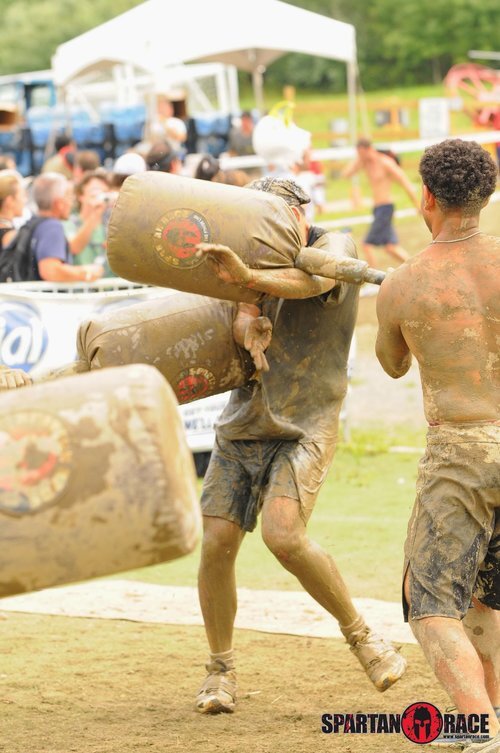
Holly - playing in the mud at Spartan Race 2014
The drill instructors in boot camp have one hell of a job to do - 8 weeks to turn goofy, uncoordinated, immature, head up their a$$ teenagers into lean, mean, fighting machines.
This is not an easy task, and our lives, and the lives of those around us, depend on getting it right. And quickly. However, we are a captive audience; by choice, or not.
When teaching adults/civilians, who are not REQUIRED by some threat to stand there and take our bull$%&^, we have to be somewhat flexible in our demands. We can do this by drawing out the timeline for success. We can't just scream, degrade, and humiliate them until they get it; like boot camp. If we are training people for combat in a condensed period of time, then absolutely.
However, in that case we likely are not teaching in-depth martial arts that require years of training to explore high levels of skill. We would be focused on simplified fighting systems like Xing Yi, Krav Maga, or some other streamlined hand-to-hand combat system. Simplified, and meant for short training not mastering high levels of skill.
High Skill Competition Training
If we are training competitively, or training a team to compete, then this can also change the game. Pushing people, and people wanting you to push them, become an interwoven dynamic to increase performance, and achieve higher gains.
This process is voluntary on both sides, and usually involves a higher degree of focus and effort on the part of the competitor. Skills increase over time, and people compete at the level/age bracket they are currently at. As they gain higher skill and aptitude, they move up in rank and compete against more advanced opponents.
The Long Term Approach
If we are teaching out of our garage, do not need to sustain ourselves from a vibrant school, or we are trying to train people as quickly as possible, then we can cherry pick our students, and kick out (directly, or indirectly) the one's that won't get up to speed fast enough for our taste, or goals.
But...if we are interested in creating a strong community of martial artists that help one another grow and learn to a high level over time, a group that accepts people of all skill and talent levels among their ranks, then we need to keep in mind that not everyone has been training for these arts their entire life. Some will need more time and patience in the process.
One approach I like to use in thinking about this - drawing. When we want to draw a human face, we don't start by drawing every freckle, line, or hair. We start with a rough circle for the head, and rough circles for the eyes, nose, mouth, ears. Then, we begin to create finer and finer circles and lines. Adding more and more detail as we go, and erasing/removing unnecessary lines. Martial Arts is no different. We don't need to feel like our ROUGH DRAFT is supposed to be the final MASTERPIECE.
All black belts are not created equal. All black belts are not created in the same amount of time.
No SECRETS
There really are no secrets. The solution is simple, but not easily achieved. The longer we train, the more we surround ourselves with other people who train, the more we watch; the more we read, ponder, discuss; the more 'consumption', will directly affect the pace at which we move up the skill ladder.
This obviously takes other traits and behaviors such as discipline to keep showing up, perseverance to get up after each failure and try again, and overall grit to stick through the lows and not just ride the highs. Combine this with continuing to build that neural network, and you have the recipe for success. Eventually creating a web in your brain that is ready to catch anything that flies through it.
Many people come and go from activities. If we keep showing up, keep training, we will keep evolving. Sometimes the successful people we see in various fields, were not the best at what they do, but they are the one's that kept showing up.
Stay the course. All will be revealed with time and effort.
--
Photos courtesy of Max Kotchouro
Bibliography:
Buonomano, Dean. Brain Bugs: How the Brain's Flaws Shape Our Lives. New York: W.W. Norton, 2011. Print.
"The Brain That Changes Itself: Stories of Personal Triumph from the Frontiers of Brain Science Paperback – December 18, 2007." The Brain That Changes Itself: Stories of Personal Triumph from the Frontiers of Brain Science: Norman Doidge: 9780143113102: Amazon.com: Books. N.p., n.d. Web. 20 Nov. 2015.
Form vs. Function: A Lesson in How to Get Worse at Martial Arts
Fifty. That's the number of kung fu forms I had accumulated after 7 years of training. This was a combination of empty hand and weapon forms from a myriad of Chinese boxing styles. Some of you reading this, may think this is somehow a great achievement; I found it disparaging and detrimental to my martial arts training. Something that led to a decline in my skills, and ability to run/teach a new school with eager students.
Forms are choreographed sequences of martial movements. In Karate they are call kata. In wu shu (aka - kung fu) they are called tao lu. Historically forms were used as a database to store a boxers martial arts techniques. A way to practice techniques when one did not have a partner available to train with.
Why were forms used in traditional Asian martial arts, and why do we not see them in boxing, muay thai, judo, wrestling, Brazilian jiu-jitsu, etc.?
A majority of the population in China and surrounding areas were illiterate. There were no videos, photos, etc. for people to pass on information. These choreographed sets were at times used as a method of transmission from one boxer to another, or as a storehouse for a boxers arsenal of hand-to-hand, or weapon combat methods.
Forms were also used for thousands of years in China, as callisthenics training for troops, or intimidation of an enemy army prior to engagement on the battlefield. Forms have a long, deep history in Chinese martial ritual/training, and are often for this reason, difficult for practitioners to separate their importance, or lack thereof, from the true underlying point - the practice of methods of violence.
This factor has played into why Chinese martial arts has gone off the rails in an extremely destructive train wreck. Function became absent from forms, and forms became the pedestal in which one’s art was judged. Like judging the quality of a significant other based on their make-up they wear, or their clothing, rather than who they are as a person.
After 7 years of training in Chinese martial arts, I had little practical knowledge of the kung fu applications locked within these forms. My only exposure to ‘real’ methods of attack and defense, were routine uncoached sparring, often way too hard and fast to be productive at anything other than hurting one another, and joint locking (qin na), which I trained as an entirely separate component from the normal class schedule.
I had zero idea what the moves inside my forms were designed to do. Additionally, I could barely keep 20 forms fresh in my head without having to run back to the video documentation I would compile so that I could keep records of what I had learned.
As far as handling myself in a fight after all this training? If I am honest about it, I would say on a good day, I could have handled myself against the average joe, but against a knowledgeable trained fighter? No chance. This was upsetting too me, and continued to gnaw deep in my bones as years passed, especially after all the hard work and countless hours of training I had done. What was the point? I wanted to know how to fight, not dance.
Whenever we would spar in classes, there was no cohesion of any kind between applications in the forms, and our fighting. Again, they seemed to exist independently of one another, with any sort of homeostasis lacking. It is as if one had absolutely nothing to do with the other. I began to question everything I had been doing. I stared long and hard into my art, and myself. Years before I had studied tae kwon do and found it lacking. I sought out kung fu 'specifically', so I could be a badass martial arts fighter. That was not happening.
Another growing problem with collecting forms - the more of them I learned, the worse I actually became at martial arts. Even though my mistakes were aplenty in the first years of training, as I progressed ever closer to competing in Nationals, I felt that my abilities and precision with my forms grew markedly worse than it was in year 1.5 to 2 years into training. Even when I won two gold medals and a silver at Nationals, I felt scattered, all over the map, and certainly unable to allocate enough time and focus on any one thing to master it.
This frustration caused me to look for answers through the annals of history. As I scrolled through text, after text, I recognized a pattern - zero, or limited numbers of forms to each style. Nowhere in the history of these Chinese boxing styles did I see 50 forms, 30 forms, and certainly not 125 forms which some boast about in their curricula. Instead, I found at their roots - ba gua: 1 form; tai chi: 0 forms; eagle claw: 3 forms; praying mantis boxing: 2, maybe 3 forms depending on who you talk to. Xing yi: 0 forms, Hung gar: 1 form.
This was a significant revelation to me at the time, and I began to recognize the gaping flaw in my own training practices. Immediately I started throwing away forms I did not want. Show forms, acrobatic forms, and anything that seemed too contrary to the other forms I decided to keep. I also began researching the styles of kung fu that were of most interest to me, as I had encountered and practiced many at this point. These included - mantis boxing, eagle claw, long fist, southern fist, hung gar, tai chi, and over 17 types of Chinese weapons.
It had come down to this - ‘I had to narrow my focus’. I chose praying mantis (my original style) and tai chi. I kept tai chi only because the two were so similar to one another that I was able to focus on both in tandem. Following this pruning of the tree of knowledge, I sought out experts in those prospective styles to fill in the gaps years of misspent training had created.
That training ultimately served me well in the long run, but I could not help but feel discouraged and somewhat angry about all the time I had spent chasing these trivial, or ephemeral things I thought were going to make me better. I felt like Gollum in The Hobbit, or Lord of the Rings, ever chasing the ‘shiny precious’s’ down every crevasse of Mordor imaginable.
Eventually I found people with the knowledge that I truly sought, and the know-how to show me how to do what I enjoy most - breaking things apart and figuring out how they work. With this knowledge I have been able to reconnect the past to the present and have a new found appreciation for forms and the depth of knowledge that they often hold.
It’s amazing how many of the true fighting applications have been lost from Chinese boxing arts. But now, it is easy for me to understand why. If we took a string of 10 BJJ moves that we would apply based on our attacks, defense, and the opponent countering, and we then remove our partner, we have a form. A BJJ form.
If I took said form and taught that to a student, but did not show the application to each move, yet I was precise and particular about each detail being correct and just so, ensuring the individual were handed something that would work if needed, two things would result:
They wouldn't be able to use it for real, and…
After I taught them and was no longer watching over them, they would change something through forgetfulness, laziness, or just plain desire to do a move differently than the way it was originally taught.
Now that same student teaches that form to someone else. What happens then…? The fighting application is lost. Possibly for good, if no one else is carrying it on. One generation. Lost. That is all it takes.
Without function, a form is just an empty shell subject to the flaw of human transmission. It reminds us of the game telephone. Where people sit in a circle and one person whispers in the next persons ear, and each person is supposed to repeat it around the circle until it comes back to the originator. It is never the same sentence.
So ultimately, form should always match function, and function should be realistic and achievable in full speed all out combat. This keeps integrity in the system, and keeps our martial arts honest.
If we are in a style with forms, how many is the right number? I would counter with - how many applications do you need in your style? An average form in Chinese boxing has 30 to 50 moves in it. If the form is a specialization set, e.g., its primary mission is kicks, then it may be lacking when it comes to offense/defense in a real fight.
If the forms is a boxers arsenal, then it will likely contain strikes, kicks, throws, and counters that they considered their primary method of fighting.
How many forms do you need in a 'forms-based’ format? If you only do forms, and do not practice how to use the techniques inside, how many forms/routines can you remember, or reasonably practice before seeing your skills drop. This is completely arbitrary, but for me, when my training had a heavy forms focus, 3 to 5 was plenty.
In 2004 when I traveled to Pennsylvania for the Nationals Qualifiers, I had three forms I competed with. Once I qualified, I decided for Nationals I was going to compete with 5 forms. This expansion was a mistake. Although I did well in the two of the three divisions I competed in at qualifiers, the other sets suffered. I had less polish on them.
If you practice forms, and you know each of the applications, consider testing these on a live and resistant partner(s) to keep the applications intact as intended. Making sure they can stand up to someone throwing multiple punches not just stepping in and throwing one strike.
If you have no idea what your forms do, but you want to learn:
If possible, seek out good teachers in your style that might know the answers. This saves you time/energy of reinventing the wheel.
If that is not an option, then find a martial art based in real technique such as boxing, kickboxing, muay thai, jiu-jitsu, judo, wrestling, shuai jiao, sumo, etc. This way you can have a solid self-defense system to accompany your forms.
If your style is multi-faceted, take up boxing for a while to learn more about hands, upper body, positioning, and footwork. Kickboxing, muay thai, or silat for kicking power, and skills. Take up judo or shuai jaio to learn throws, trips, takedowns. Wrestling, and/or BJJ for grappling experience. Learning BJJ has helped me unlock so much more understanding of my mantis boxing.
Above all else - SPAR! Not point sparring either. Test your skills and you will have invaluable lessons to help you weed out bad techniques from the good.

Size Matters - In Qín Ná (擒拿)
“Having spent years studying these locks, I found it awkward to pull some of them off in 'live' situations. A great many of them if attempted, would have landed the practitioner in a world of hurt from their opponent. Simply from the person reacting by punching them with their free hand/arm. This article attempts to clarify some of the misunderstanding of how and why Qín Ná does, or does not work.” - Excerpt from an article published in the Journal of 7 Star Mantis Volume 3, Issue 3 on the Chinese Joint Locking method known as Chin Na, or Qín Ná (Capture and Seize 擒拿).

Why Qín Ná works, and does not work.
Original article can be found here
Qín Ná (Capture and Seize 擒拿) - the Chinese art of bone and joint locking found in many styles of Kung Fu including Tángláng Quán (Praying Mantis Boxing 螳螂拳).
The human body has a plethora of ways that it will, and will not bend. Qín Ná capitalizes on these anatomical weaknesses with the objective of controlling, or destroying one's opponent. Locks exist for every joint, from the head to the toes; and quite possibly 20 to 50 variations of each one depending on who you talk to, or what reference you use.
Having spent years studying these locks, I found it awkward to pull some of them off in 'live' situations. A great many of them if attempted, would have landed the practitioner in a world of hurt from their opponent. Simply from the person reacting by punching them with their free hand/arm. This article attempts to clarify some of the misunderstanding of how and why Qín Ná does, or does not work.
qīng Dynasty and Republican Era
Much of the documentation I have been able to find on Qín Ná, comes from the late Qīng Dynasty (late 1800's when China's Martial Arts practice was in decline), and the Republican Era; with some emerging during the Communist reign.
These sources are often littered with a ridiculous amount of locks; and include locks that are completely irrelevant to fighting. I recall one technique involving a hair grab from the front - the victim is attempting a forward hand press lock with no leverage to counter the attacker grabbing hair on the front of his head. A simple counter-attack to the persons groin would suffice, yet here lies an ineffective lock.
Forms - Our Window to the Past
Forms are perhaps our oldest and most reliable documentation of Kung Fu's history of techniques. They are our library or catalog of applications that are relevant to each system or style. Given the lack of documentation on Chinese Martial Arts through the ages, we have to rely on forms as our window to the past.
If you look at the majority of Kung Fu forms they are comprised of strikes (fists, elbows, knees), kicks, throws, and locks. The locks however, typically focus on gross motor movements; attacking the most accessible joints - elbow, shoulder, hip, and knee. Earlier in my training I studied close to 25 to 35 hand forms, and rarely, if ever, have I found a small binding lock within those forms.
Motor Function and Stress
The primary reason Qín Ná often fails to work, or has no place in certain situations, is our motor function skills. According to the National Police Association the level of accuracy in gun fights across the nation was reported at 12% for 2008. These are individuals that train to use their weapons over and over; yet there is a problem hitting their targets when under intense pressure; proving we as human beings lack accuracy and fine motor skills under stressful situations.
In the world of Qín Ná - humans in the midst of situations such as physical altercations, use gross motor function and react with adrenaline coursing through their system; the heart rate is up, breathing becomes erratic, palms sweat. These factors alter the reality of trying to attempt a finite lock on someone as they attack; grabbing a hand out of mid air becomes increasingly difficult.
Training the same technique over and over through repetition, helps eliminate this problem, but only if the training approaches live scenarios in it's charter.
In essence, if the locks are simply practiced with compliant partners, and/or in fixed sequences such as line training, then we will find them unreliable in combat. To counter this, we can train the locks with 'feeder drills' that lead to random sparring to increase effectiveness.
Size
The where, when, and on who, of locks is the most crucial element of lock training. What we cannot recover from, is attempting a lock on a larger and stronger opponent when we tried to use the wrong lock on them. This is typically where we get punished trying to use joint locks.
A human body, is a human body; no matter what size the person is. Aside from certain individuals who are double jointed, locks will work no matter how big the person is. The problem isn't whether a joint will lock, the problem is, a larger person also has larger muscles.
It becomes increasingly more difficult to manipulate these larger muscles when we are a smaller fighter. We need the appropriate strength to turn and position the joint, and then apply the lock. The battle becomes strength on strength, instead of technique winning the day.
As an analogy - joint locks will work on animals just as they will work on people, but you will see drastically different results if you attempt a lock on a dog vs. a horse. The two animals are not only different sizes and weights, but possess far different strength potentials. 12 dogs to pull a sled vs. 1 horse to pull a wagon. In the human world of Qín Ná, there is no difference. If you attempt a lock on a much larger opponent, they will resist with strength and then counter with a punch, grab, or counter lock.
Working with different sized partners can give us insight and kinisthetic feedback to this phenomenon. Learning to move from compliant to resistant training will train us on how to detect, and become sensitive to, the when and where of applying locks; so that when we meet someone that resists, we know automatically to switch to another lock, or resume striking to soften the target.
Target Fixation
Military and civilian pilots have a term - 'Target Fixation'. For a military aviator it is most prevalent when we are diving and attacking a ground target. We become so fixated on our target, we fail to realize our altitude reduction, and leave insufficient time to pull the aircraft out of the dive - thereby crashing into the target itself, or the ground.
This same principle applies to joint locks. It is a common occurrence when we train Qín Ná in fixed patterns, to get lock fixation. As we attempt a lock, and the initial attempt fails, we become fixated on making the lock work. We continue attempting to apply the lock while our opponent is at first resisting, and then changing position; then starting to hit us, throw us, or reverse the lock.
We can avoid these situations by dynamic lock training, or principle based lock training. Instead of opponent throws X punch or Y grab, we train the principles of locking by themselves; direction, fulcrum, refined technique. Then once we have an understanding of these, apply feeder drills to train dynamic locking and counter locking.
In this type of training, opponent attacks, we counter and apply X lock, and our opponent resists and/or applies Y counter, and then we can apply our counter. The lock, the counter, and the counter to the counter, so each of us learns to move fluidly from one joint lock technique to another, or even transition back to striking.
Since fighting is random, it only makes sense for us to recreate this randomness in our training without full on fighting. If we try to apply in sparring, stress will take over and we operate in survival mode rather than learning mode.
Small vs. Large Binds
We can narrow locks down to two major categories:
- Large Binds - locks attacking major joints such as the elbow, shoulder, knee, ankle.
- Small Binds - locks that attack small joints such as the wrist, fingers, toes.
The key is for us to know when and where to use each of these locks. Given that stress is involved in a live situation, and as previously stated, gross motor function is more likely - large binds should be used for initial contact. The larger joints take larger motions, which fits into our first response to an aggressive act. Gross movement is more reliable and quite possibly why we see these in the Kung Fu Fighting Forms and a lack of small binding locks.
Small binds are more appropriately used when we are responding to a grab, in the clinch, on the ground, or finishing the opponent after softening them up with a throw. When we are tied up (grappling) with an opponent and have access to the occasional finger, toe; wrist, or ankle, then small binds are extremely effective. After we have thrown the opponent and they are stunned, we have access to time and movements that were otherwise difficult to pull off and can score a small bind as well if appropriate.
Leg Locks
Leg Locks are effective when we are able to pull them off; keeping in mind that the legs are proportionally stronger than the upper body of a human being. When we are attempting to lock up an opponents legs, we are fighting strength, maneuverability, and multiple weapons - other foot/leg, arms.
These are best attempted after a throw, or when our opponent is least expecting it - such as rolling in a ground fight. Basic knee bars can be applied as a counter to a kick, but attempting to maintain the lock on the ground after you have tripped them, is foolhardy at best. Our arms alone lack the strength to keep their knee from bending, and once they bend it, they will be more than willing to use their fists on our head.
I mention these due to our applications of trapping a kick and trying to apply a leg lock in the air. This works to effect a takedown, but enters problems when trying to maintain that lock on the ground without using larger parts of our body as the fulcrum and lever such as the hips or torso.
In conclusion, Qín Ná is a highly effective and rich part of our art and can be of great benefit. Training and practicing with appropriate measure is crucial to success, as well as understanding when it is appropriate to use each lock. We are wise to avoid the over complication that is commonly seen in much of the reference material on Qín Ná. Seek out the K.I.S.S. method (Keep It Simple Stupid) when locking and you will find success.

Southpaw and The Crazy Ghost Fist
There is a long history of ancient cultures including the Greeks, Romans, and Chinese, that prejudice left-handed use, or left-handed people. It is seen as - sinister, wicked, evil, and many of the words for such are derived from the word left in these languages.
In Chinese culture, the major philosophies and religions believe in the universe spinning from left to right; things must always start on the left and move toward the right to remain in harmony. This is expressed in many of the Traditional…
There is a long history of ancient cultures including the Greeks, Romans, and Chinese, that prejudice left-handed use, or left-handed people. It is seen as - sinister, wicked, evil, and many of the words for such are derived from the word left in these languages.
In Chinese culture, the major philosophies and religions believe in the universe spinning from left to right; things must always start on the left and move toward the right to remain in harmony. This is expressed in many of the Traditional Kung Fu forms that we see and is heavily documented in Tai Chi manuals. The symbol for Yin Yang depicts this cycle as well.
In stand-up martial arts - a majority of boxers place their left foot forward in fighting, just as a majority of baseball players stand on the left side of the plate at bat. By and large, right-hand dominant people outnumber left-hand dominant people, but this does not give cause to ignore the significance of this change of position when faced with a 'southpaw'.
The term 'southpaw' is typically used to define a left-handed boxer. A fighting position, or stance where one fighter has their right foot forward versus the traditional pose of the left foot forward used by right-handed boxers. Of more interest to us, are the advantages and disadvantages of this opposing, or unorthodox stance.
Why Staggered and not Square
Before we discuss that, let's hammer out why someone stands one foot in front of the other in the first place.
A squared up stance in hand-to-hand combatives can be good from a power based perspective. You give equal power to both arms, as well as equal reach. Some self-defense systems teach this at their core. The cost however outweighs the benefit.
Being square is something you can be successful with in martial arts such as Wrestling, Shuāi Jiāo, or Judo; striking arts change the game. The square position exposes our centerline to our opponent, giving access to vital targets on our body such as the solar plexus, liver, bladder, groin. These can be game-over strikes if they land on us.
By taking up a staggered stance and slanting the upper body, what we call 'blading', we decrease our profile (smaller target), but strikes are more easily deflected off the angle of the body, protecting these sensitive targets. An opponent is then required to circle to the inside line in order to access our centerline. This is easily read by veteran boxers.
Southpaw
In a staggered stance where both fighters are aware of the advantages and disadvantages of being square versus bladed, there is another, deeper component that becomes a major liability - when one fighter is on the opposite foot.
Meaning, boxer A has their left foot forward, and boxer B has their right foot forward - this is where southpaw becomes the challenge. Here are some of the pros and cons to the southpaw position:
Pros of Southpaw
- Easier to attack the flank - kidneys, ribs, temple, ear, and occipital lobe, brachial nerve; all exposed from outside angle.
- Cuts off the opponents second hand from attacking when on the outside line.
- Sets up significant number of trips, sweeps, take-downs.
- If dominant hand is forward - offers a stronger jab stunning the opponent.
- If on the inside line, it squares up the opponent, offering clear shots with the power hand to solid vital targets. in the face and body.
- Exposes the opponents groin to attacks with kicks, grabs, strikes, knees.
Cons of Southpaw
- When on the inside line we are in reach of both hands and susceptible to attacks not normally possible when directly in front of your opponent.
- Opponent can attack our flank hitting vital or destructive targets.
- Groin is exposed to kicks.
- Legs are side by side if opponent is on our inside line, making us more vulnerable to double leg takedowns, crashing tide, leg wraps, etc.
- Fighting southpaw allows our opponent to sweep our foot when we shuffle in, and if we circle to their inside, we are walking right into their power punch.
- This position also affects 'our' own range; placing the forward punch closer to our opponent, yet keeping our reverse punch so far away that it is often too far, or awkward to throw unless the other person makes a mistake.
Training Habits
In training, it is common to fight one-sided. In other words people choose a side to train and often ignore the other side, giving it less attention. In these formats a righty will spend most of their time fighting other righty's, while a lefty, or southpaw, will spend most of their time fighting righty's. This gives the lefty an advantage over the righty. They spend a far more time in this position and are then able to develop superior tactics and strategies from such.
Be aware of this tendency, and train diligently to overcome this challenge by putting yourself in weaker positions on purpose. This will allow you to adapt to this change and be hypersensitive to it in sparring/fighting.
Know your weaknesses and capitalize on your gains
What to do on the outside line
If you are on the outside you want to remain there if possible, providing you have the correct angle. In this position you should be lighting up your opponent with hooks to the head, ribs, and kidney while attacking the inside line with your other hand using effective combinations.
Look for throws that work from here. Side Leg Scoop, and Tiger Tail Throw, Reaping Leg are all obvious choices.
What to do on the inside line
- Strike up the middle high and low while being aware of any position changes made by your opponent that may put you at risk.
- Kick or Punch to the groin.
- Attack with Double Leg Takedown.
The Crazy Ghost Fist of Mantis Boxing
Mantis Boxing's Crazy Ghost Fist - The first move in the core form known as Bēng Bù (Crushing Step 崩步). This move is a perfect example of proper use of the southpaw position.
Our opponent punches. We move to the outside line while blocking the arm and striking the ribs/liver with a reverse punch.
Check out this video on how it's applied.
Southpaw can be a great advantage, or a horrible liability depending on your skill level and how you use it. As a rule, when I teach beginners I leave it out.
It's more important to understand the basic orthodox stance first, and change stance with the opponent in the early stages. This keeps your blocking system intact. Once a boxer is comfortable with this position, then we begin to explore the Southpaw advantage.

Bridging - How to Close Distance in a Fight
You charge in on your enemy, filled with the hope that you can capitalize on that weak spot you spy in their guard. As you are about to land your punch, suddenly, without warning, BAM!!!! POW!!!! SMACK!!! His strike has met you mid-stride and square in the nose. As blood begins to rush down your face you pause and wonder, why you were unable to hit that giant hole that invited you to enter to begin with?
"You charge in, filled with the hope that you can capitalize on that opening you spy in their guard. As you are about to land your punch, suddenly, without warning, BAM!!!! POW!!!! SMACK!!! A strike has met you mid-stride and square in the nose. As blood begins to rush down your face you pause and wonder...'Why was I unable to hit that giant hole that was wide open, and they were able to hit me'?"
If you have fighting experience then you are likely all too familiar with the above scenario. After countless bouts, sparring matches, fights, most of us have found tricks of the trade that allow moderate success at gaining the advantage as we move in on our opponent (bridge).
Alternatively, some have decided to become counter-fighters, and instead of risking the in-fortuitous disaster, patiently await their opponents charge knowing full well the advantage will be their's.
To help avoid circumstances such as these, here are some solid tactics to incorporate into your training so that you may gain control over this most unsure of moments in fighting; the moment when you go from out of range, to in range. The moment we call - 'bridging'.
The following are a few definitions:
'Bridging' - the act of moving from outside of striking or kicking
range to inside striking or kicking range.
'Critical Distance' - The line that separates the two ranges. Critical Distance is determined by the range just outside the reach of your opponents longest weapon - their rear leg.
'Bridging Tactic' - a method of occupying the enemies mind, body, or both, so that they are unable to move or launch a counter attack the moment you cross the 'Critical Distance' line.
As we explained in above scenario - the danger with bridging is vulnerability when moving or transitioning. Timing (another bridging method) works in this regard. If you are in the midst of steaming headlong into your opponent's waiting defense, while preoccupied with striking, then you are vulnerable. The solution is to incorporate Bridging Tactics into your fighting toolkit to give you the advantage.
Here are some examples for executing an advantageous bridge:
Overwhelm
These tactics involve rushing style attacks that overwhelm the opponent.
Pi Quan
Circle and Chop
Beatdown Chop
Chopping Fist Advance
Flying
Flying Palm
Mandarin Duck Kick
Other
Sān sài bù - 3 Section Step
Distractions
Distractions rely on proper timing to execute. These can vary and you can certainly add more to this list. Here are the primary ones we cover.
Fake Leg Attack Hand
Flag Hand
Smack Hands
Experienced practitioners will also focus on more advanced bridging methods such as:
Feints*
Fakes*
Hiding Motion in Motion
Range Manipulation
*Note: according to veteran coach I worked with, that had been in many fights, these bridging methods have less of a chance of working on people in a street fight situation, who have never been hit. They do not respond as expected because there is no correlation of the fake attack with the actual end result.
Feint
A body movement that simulates a move or shift in one direction while then moving in another direction. This works as a great precursor to an attack when used at the proper range. As the enemy flinches, plants, or reacts in some regard, they are locked into their movement and unable to react to the real attack that immediately follows the lie.
Example on how to Feint-
Pretend to move left with your body and then quickly move right. When your opponent moves to gain advantage or reposition themselves for defense they create openings in their guard. Strike the targets now available, or shoot for the takedown on the exposed side.
Common Pitfalls -
Body movement is jerky and unrealistic. Opponent doesn't believe it.
Feinting, and then moving in the same direction you feinted. This gives your opponent warning of where you are going to move and nullifies the tactic.
Fake
A false strike that triggers the opponents block or counter. Again, as the opponent flinches, you immediately follow the flinch with your real strike to a different target.
Example -
Throw a forward punch (jab) but do not follow through with it. Done properly the opponent should emit a jerk-type response and attempt to block the non-existent punch. More experienced fighter's may resist the temptation, but may blink or twitch instead. Immediately strike the opponent in a different target right after they jerk, blink, or twitch.
Common Pitfalls -
If there is too much of a time break between the fake and the real attack the opponent will have reset and snag the actual strike.
If you try to attack the same target as the fake attack then the opponent will likely block because their hand is already in that region and they previously witnessed an attack to that target a split second before, so they are now expecting a real one.
The fake doesn't look real. You have to sell the fake, as if it is the real deal, without over exposing the limb for them to grab, or seize.
Distraction
An act of motion, sound, or use of surroundings that will trigger a response from your opponent; causing them to momentarily flinch or become distracted.
Example on how to Distract-
Make a loud noise by yelling, stomping, or banging your gloves together. Upon witnessing your opponents twitch immediately bridge and enter past the critical distance and attack. In a street situation, the distraction may be throwing an item such as keys, coins, sand, or an object.
Common Pitfalls -
Too quiet, or not convincing.
Too much lag time between the distraction and the bridge.
You have tried it too many times without following up with a live attack. The opponent is not appropriately conditioned to it and will not respond, making them dangerous if you try to enter.
When bridging, the tactic either works, or does not work. This is immediately determined by whether or not they blocked your attack, moved out of range, or sprawled before you got there. If unsuccessful, the bridging tactic needs to be corrected or refined by training your ability to perform a realistic fake or feint so your partner believes the lie.
Range Manipulation
To be continued...