
Research Notes: (Open) Praying Mantis Boxing vs. Supreme Ultimate Boxing
Sure enough, they were the same character. This lead to further research and comparisons, and soon I had a series of principles and sub-principles that drew a solid link between the two styles. The English translations people used can vary, but the character is found to be the same for each style. Below is a work in progress but it is far enough along that I can share it.
Current document status: open and active.
Edited - 3-2020
Brothers in Arms: A Comparitive Analysis of Praying Mantis Boxing vs Supreme ultimate boxing (Tai Chi)
Although tánglángquán (praying mantis boxing 螳螂拳) and tàijíquán, also known as tai chi (supreme ultimate boxing 太极拳) have very different purposes in today's world, they share a plethora of similarities beyond just common fighting arts from the late Qīng dynasty in China. So much so, that I believe that they are intertwined in history.
Shared techniques, principles, and geographic location all hint to a broader cross-pollination of Chinese boxing techniques in this time period, and region. The reality is these styles have more in common with one another than any defining uniqueness.
For the past few years I have been working intermittently on this project and from time to time come back and update these notes with more findings, and observations. I noticed similarities with praying mantis boxing and supreme ultimate boxing back in 2012 while researching texts. At the time, I was doing an article on one of the keywords of mantis boxing - Kao (Lean), and I recalled the 13 characters of tàijíquán had the same keyword.
I decided to do a character comparison between supreme ultimate boxing and mantis boxing, and see if it was the same 'kao'. Sure enough, they were the same character. I quickly then asked myself, ‘if these were the same, were their other keywords they had in common?’
This lead to further research and comparisons, and soon I had a series of principles and sub-principles that drew a solid link between the two styles. Showing clearly that they held more similarity with one another than not. The English translations people use can vary, but the Chinese character for many of the keywords is found to be the same for each style.
Below is a work in progress but it is far enough along that I can share it.
Note: when I refer to Taijiquan, I am referring to my background in Yang style Cotton Boxing. The name was changed in the late 19th or early 20th century when the practice shifted to fitness/health, from practical fighting art.
The original names of Chen, and Yang family styles (see below), were very different than the broad characterization of tàijíquán they are muddled in nowadays. From my research it has been hard to locate any evidence of the term tàijíquán in relation to these 2 families and their boxing systems prior to the second half of the 19th century when the Wu brothers wrote about it.
The Wu’s studied with Yang Lu Chan, patriarch of the Yang family. Who had trained with the Chen family but used his own combination of 37 techniques later known as Yang style tàijíquán but what Yang referred to as mianquan, or cotton boxing.
I’ve been able to trace (thanks to the translations of other researchers that speak Chinese) that the Wu’s later studied with Yang’s son after he passed away. Eventually they separated into their own style, and from all outward appearances, then began branding it as tàijíquán, or Supreme Ultimate Boxing.
One can quickly surmise that if the Wu’s called it such, that the grandson to the founder of the Yang family’s boxing system himself, Yang Cheng Fu, who incidentally is the most influential in the spread and recognition of tàijíquán in the world today, would lay claim to that name since the Wu’s learned their art from his family/grandfather.
From there the Chen family catching wind to this, could certainly take notice and say, ‘how can you be the ‘Supreme Ultimate’ Boxing if Yang Lu Chan learned from us?’ Thus, I believe the chain reaction that caused them to possibly take on the name/moniker of tàijíquán across all families.
Regardless of the chicken and the egg argument, the fact remains that the keywords used by tàijíquán share many common terms/principles with tánglángquán. Speaking to a larger overriding argument that there was more in common with all styles of Chinese boxing as a whole rather than differences.
The following are examples of the crossover between these two arts from northern China and the Yellow River region:
12 Keywords
of
Praying Mantis Boxing
(Táng láng quán 螳螂拳)
13 Keywords
of
Supreme Ultimate Boxing
(Tài jí quán 太极拳)
Arrow-Quiver (bīng 掤)
Stroke (Luō 擠)
Press/Squeeze - (Jǐ 擠)
Press/Push, Keep a hand on (àn 按)
Split (Liè 挒)
Elbow (Zhǒu 肘)
To Retreat (Tuì 退)
Left
Right
Central Equilibrium
Shared Keywords
Includes the primary keywords listed above, sub-principles listed in the tàijíquán manuals, and some tánglángquán correlating evidence.
Hook (Gōu 勾)
A predominant tool in tánglángquán and the first keyword, yet absent from the keywords in tàijíquán. However, it is still used in tàijíquán, and seen in techniques such as strum pipa, single whip, and snake creeps down. Hook, is also listed within sub-principles in tàijíquán manuals. Similar usage in application of ‘single whip’ vs ‘slant chop’, the initiation of pluck, requires a grab, or a hook. Hooking was not unique in Chinese boxing, and is quite prevalent in many of the various ‘styles’ from the region, including numerous shuai jiao applications. It would be more difficult to explain why ‘hooking’ wouldn’t exist, rather than why it does.
Pluck (Cǎi 採)
The ‘pluck’ principle is not only present in Chinese arts, but exists in styles from around the globe. In wrestling styles of the west it is commonly referred to as a ‘snap down’, but the arm variation of pluck, while included in the Chinese variant, exists in the west as a separate method known as a ‘drag’. This keyword runs strong in tánglángquán, and tàijíquán and it used heavily in conjunction with hooking, or splitting.
Enter (Jìn 進)
To enter as in a doorway. To advance. This keyword is shared between both tánglángquán, and tàijíquán, and other styles as well. The entire premise with xíngyìquán (mind intent boxing 形意拳) for example, is to go forth and blast someone with full intent. The concept of advancing in xíngyìquán is more in line with tánglángquán. Within tàijíquán, we see the concept of yielding and retreating displayed more prominently in their framework. I would attribute this less to any sort of superior approach, and more to do with the framers incorporation of taoist, or Chinese philosophical beliefs in general, into the tàijíquán agenda. The concept of Enter is straight forward - go in. Do not dally. Press the attack into the opponent to overwhelm them.
Lean (Kào 靠)
Both ‘styles’ work inside and outside of the clinch. Whenever we’re engaged in this range, we should be leaning forward to prevent easy takedowns, or being uprooted with minimal effort. The lean principle can be applied this way, but…it’s true measure is within the application of throwing techniques such as crashing tide, or white crane spreads wings. In both praying mantis boxing, and supreme ultimate boxing, the designer of the framework for these arts that later became known as the keywords, sought to convey significant value to this character and its importance.
Connect (Zhān 粘) | Cling (Nián 黏)
[In process] - Correlation between - Connect/Cling found in tánglángquán vs Stick/Adhere/Connect/Follow within tàijíquán. The significance of sticking.
Adhere (Tiē 貼)
Any grappling based art, or hand-to-hand combat system that includes grappling, whether on the ground, or stand-up, would be remiss not to include such a principle. This is further supported by this character being prominently listed in both tánglángquán and tàijíquán which use grappling and clinch work in their application. Tiē, is an emphasis on sticking, but closer in than the aforementioned sticking highlighted in both arts with Zhān, and Nián.
Elbow (Zhǒu 肘)
One of the core forms of mantis boxing is known as 8 Elbows, or Ba Zhou. The use of elbows is highly prevalent in Mantis Boxing. This correlates to the emphasis placed on the ‘elbow strike’ in tàijíquán in it’s prime principles.
Notes on ‘Ward Off’
The first keyword of taijiquan is often called - Peng (ward off). I was unable to prove this to be true in my research. Much of my findings indicated a schism in the tai chi community at large, over what the original Chinese character was. Some claim it to be peng, others bing, what I used above. What is the most important factor here is the Chinese character. If the community cannot agree on what the original character was then any translation or meaning of the first keyword is null and void. We cannot translate that which we do not know, or are incapable of agreeing upon. This coupled with Yang Lu Chan, founder of Yang family style taijiquan, being recorded as illiterate, makes it even more preposterous to claim original intent here.
Additional Commonalities
Kicking Methods
The two styles share their kicking strategy in common. Some of the kicks found in both styles are the ‘heel kick’, ‘toe kick’, and ‘cross kick’.
Striking & Blocking
The two styles share common striking attacks and counters.
‘Deflect, Parry, Punch’ from supreme ultimate boxing is also found in mantis boxing forms.
Both styles depend on an upper block combined with a counter strike down the middle; known as ‘bend bow shoot tiger in tàijíquán, or ‘pao quan’ in xíngyìquán. This move shows up repeatedly in tánglángquán forms such as Tou Tao (White Ape Steals Peach).
The use of the 'chopping fist' shows up in both styles. This appears to have been Yang Lu Chan’s primary offensive attack/bridge. I suspect, based on the expression and representation in the original Chen style form, known as ‘cannon fist’ that this is similar. This attack method is used repeatedly in styles of Chinese boxing found in the north and south, to include, but not limited to praying mantis boxing. Other styles/sets relying heavily on this include - gongliquan, lianbuquan, tongbei, changquan, choy li fut, etc.
The Beng Quan (Crushing Fist) is used predominantly in both mantis boxing and Yang’s mianquan (cotton boxing). This attack is commonly found in mantis boxing forms, such as Beng Bu, Lan Jie, Ba Zhou, and Tou Tao, and more.
White Snake Spits Tongue is also a shared attack in both systems. Parry and counter-strike to the eyes, or throat.
Throwing/Tripping Methods
The crossover here is expected to be heavy. I will name them as they come to mind, but given the prevalence of the Mongol influence in the north, and the wrestling techniques of the Steppe peoples permeating the local cultures, it is likely this will be one of the strongest areas of similarity and crossover. Many of the movements are even evidenced back to the 1500’s in Qi Jiguang’s unarmed boxing set used to train troops in the Ming dynasty.
Techniques
Snake Creeps Down is the same move/attack as found in tánglángquán’s piercing hook method.
Single whip in tàijíquán is the same method known as slant chop in tánglángquán.
Grasp Sparrow Tail:
Stage 1 - rowing hook variant (see below).
Stage 2 - known as double sealing hands in mantis boxing.
Stage 3 - known as ‘crashing tide’ in mantis boxing.
Stage 4 - double push takedown found in an opening move of mantis boxing form known as lanjie, which evidence points to meihuaquan origin.Step Up to Seven Star is a second variation of ‘crashing tide’ that is found in another mantis boxing form. The same move, expressed with variation on the leg execution based on grappling pressure of opponent. The monkey stance or bow stance version is heavy forward momentum when going from striking to takedown. The seven star variant is when adhering to the opponent in the grapple and using forward pressure (lean) and trapping the leg to prevent the step out.
Strum Pipa is known as ‘white ape invites guest’ in mantis boxing.
Diagonal Flying is a shuai jiao move known as a rowing hook. The flying diagonal is one variant.
Golden rooster rises up is also a rowing hook variant and is found in lan jie form in mantis boxing.
to be continued…
Two Roads Same Path
The two styles took very different paths as time passed, yet originated with a similar intent. Yang tàijíquán was very condensed; using one form to house the entire system of 37 applications.
Tánglángquán, on the other hand, had 2 or 3 original forms (allegedly), and later became bloated as more and more forms were piled on. The system split into multiple lines as did tàijíquán, except each branch with a multitude of varying forms, rather than a single representation, further diluting the art.
Tàijíquán, was also transformed into the health practice commonly known as Tai Chi today and was used for physical education. This took place in the early 1900’s; spearheaded by Yang Cheng Fu. It was excellent for all ages, and those who could not perform high impact exercise thus keeping it fairly intact through the ages.
Tàijíquán had already been split into different family lines (Chen, Yang, Wu, Wu Hao, and finally Sun). It split again post-transformation from fighting to fitness. The original Chen family style (Cannon Boxing), and Yang family style (Cotton Boxing), were combative and extremely condensed. See my article on ‘The Dirty History of Tai Chi’ for more details, and a bibliography of sources.
Praying mantis boxing, was also absorbed into the national movement for better health and fitness. Jin Woo, Nanqing Guo Shu Institute are examples, but with a different methodology. They added pre-requisite forms known as fundamentals training prior to being able to focus one’s studies on mantis boxing, or another style. In Jin Woo, practitioners performed sets at a faster, and more athletic pace, to a fault; as this later became a standard by which your ‘art’ was judged, versus the original combative intent.
In the end, it saved neither from becoming obsolete, broken, and losing their teeth. Lucky for us, the forms, and the keywords/principles survived; making reassembling the arts still possible.
Below are maps to show the provinces in China where these styles originate. Eastern Henan Province, Shandong, and Hebei province.
As Douglas Wile points out in his book - ‘Lost Tai-Chi Classics of the Late Ch'ing Dynasty’,
“the Yellow River basin was a hotbed for martial arts training and fighting. Many famous boxers emerged from this region and went on to be accredited with founding of their own fighting systems.”
Crossover of techniques and principles that work, or the use of a technique that defeated another opponent, would surely be picked up and used among anyone in the know.
The common use of bēng quán (crushing fist 崩拳), pào quán (cannon punch 炮拳), and pī quán (chopping fist 劈拳) in Xing Yi Quan, Tang Lang Quan, and multiple family styles of Tai Ji Quan offers a clear example of this cross-pollination of techniques.
Maps
Yantai, Shandong, China. Birthplace of Tánglángquán
Chen family village. Henan, China. Birthplace of Tàijíquán
Dai family biaoju company. Xingyiquan Region
Research Bibliography and Character Sources:
Lost Tai-Chi Classics of the Late Ch'ing Dynasty, Douglas Wile, 1996, SUNY Press
Mastering Yang Style Taijiquan - Fu Zhongwen, translated by Louis Swaim 1999, North Atlantic Books
The Essence and Applications of Taijiquan, Yang Chengfu, translated by Louis Swaim, 2005, North Atlantic Books
Brennan, Paul. 2013. EXPLAINING TAIJI PRINCIPLES 楊班侯 attributed to Yang Banhou [circa 1875] - https://brennantranslation.wordpress.com/2013/09/14/explaining-taiji-principles-taiji-fa-shuo/

The Easy Principle To Achieve Your Fitness Goals
Yesterday I was meeting with a professional from a different part of the health, wellness, fitness industry who mentioned her gym membership(s) going to waste. Her story may be familiar to some of you, so I thought I would share it, and offer some of my personal tips to stave off similar circumstance.
Yesterday I was meeting with a professional from a different part of the health, wellness, fitness industry who mentioned her gym membership(s) going to waste. Her story may be familiar to some of you so I thought I would share it and offer some of my personal tips to stave off similar circumstances you may find yourself in.
I will call her Suzie for the purposes of this article. Suzie is currently a member at 2 different gyms, and goes to neither. She continues to claim she will eventually go, but laments the fact that she ‘has to’. This cycle of negativity keeps Suzie from attaining her goals, and only perpetuates this cycle of wasting money and prolonging, or worse, never reaching one’s goals. This is an all too common occurrence but one that can be fixed with an easy principle.
Find A Passion

It sounds simple but elusive I know. In order to exercise most of us need to be motivated. In order to be motivated we have to 'want' to be doing the activity that will help us achieve our fitness goals.
This is so important, that I want to TYPE IT IN CAPS SO IT GETS YOUR ATTENTION. You can't turn over a new leaf by saying that you are going to start running a couple days/week when you despise running, and expect that you will miraculously have the willpower to go out and run. Especially when you leave work at 4:30p, and it is already dark, raining; snowing, freezing cold, and the nice warm house with a couch and TV are beckoning.
There's no rational reason any of us would choose that unless we were super excited about running. If running is your passion, then that should be your go to method of fitness during 'sacred time'. If rock climbing is more your calling, then strap in and tackle those rock walls.
There are so many things to do that involve movement - hiking, biking, swimming, roller-blading, street hockey, racket ball, tennis, orienteering, skiing, snow-shoeing, kite boarding, diving, hang-gliding, martial arts such as boxing, kickboxing, judo, Brazilian jiu-jitsu, etc., etc., etc. The most significant part of this - MOVE!

Nonsense
Here is a saying I have heard countless times over the past 18 years - “I have to get in shape first.” This is absolute nonsense. I can tell you this, every single time I have heard those words uttered from someone’s lips, they have never returned.
Do what you love. Don’t wait. Do it safely, but do it now. Even if you have to stop every 20 seconds, or take advantage of more specialized training to reach your goals, you will rise to occasion and start to acclimate to the sport/activity that inspires you. Reverse your reasoning and step forward into what will keep you coming back every day.
Falling Off the Wagon
If we already have an activity we are passionate about, but we just aren't attending it and sticking to it, that is different problem. One solved by breaking the rut we’re in and re-establishing a routine.
Setting a consistent week to week schedule that is what I like to call - 'sacred time', (time that is uninterruptible by other nonsense or static) is crucial. For example: doctor appointments, legal, car registration, etc. We don't let other things get in the way of those, but we'll let someone's phone call interrupt our health and wellness time.
Sacred time is your time to take care of you. We do our best to establish this, and then leave it be; unhindered by the comings and goings of the rest of life. It takes a little time, and the right mindset to get into this, but once you do, you will quickly understand the importance of it.
Some people can let their schedules stay in flux and maintain discipline, but most of us need a solid day/time that we go do something, and we don't miss it unless it is an emergency. If someone asks us to do something during that time, we can simply respond with - "I have an appointment." They don't need to know that you are going to roller derby, laying waste to leather bags in kickboxing, choking people in Jiu-Jitsu, or running half-pipes with your skateboard friends. They simply hear "appointment" and know that you are busy.
MOVE! MOVE! MOVE!
The human body is designed to move. The more studies come out on stagnation the more we learn that sitting at a desk all day, or lounging around too much equals bad news for our bodies, and our waistlines.
"The increased risk of death linked with sitting for eight hours a day was eliminated for people who were physically active for at least one hour a day."
You can see in this Norwegian study cited in this article on CBS News (and many other news sites) showing that prolonged sitting increases our propensity for all sorts of ailments, disease, and early deaths.
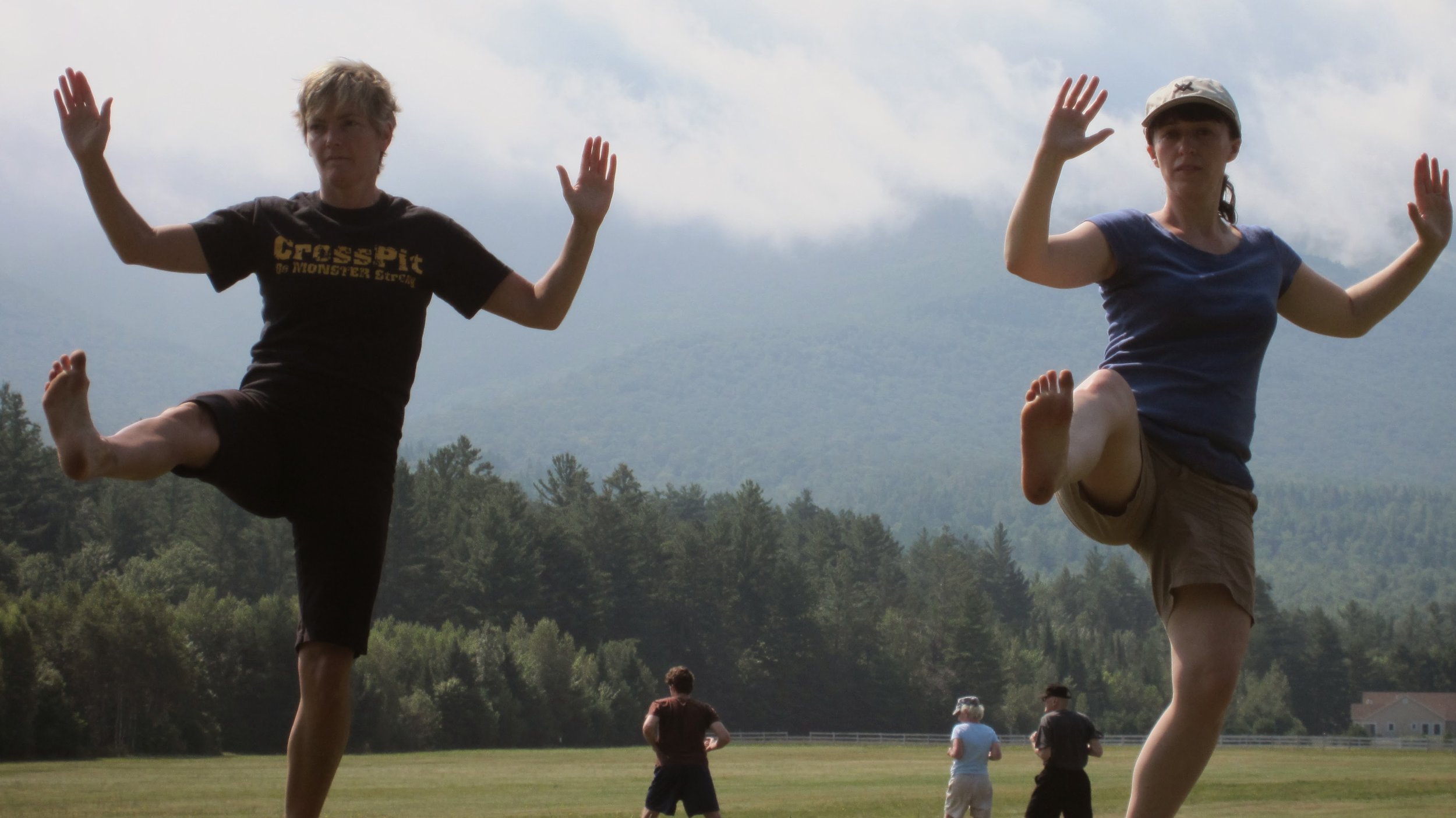
Find a Tai Chi class, Yoga, Pilates, stretching. Anything. But...and I can't stress this enough, enjoy what you are doing so you want to go back and keep doing it. If you hate it, resent it, or are even luke warm about it, then you won't want to go. It is time to ditch it and move on. Cut your losses.
This leads to a final point - when we have our 'gym membership' and we don't go, or keep telling ourselves "next week", then we feel anxious, depressed, discouraged, or a failure. What good is that doing to our lives? Exercise helps combat these feelings, but if it is the cause of them, then we need to reassess.
Personally, I am partial to contact sports such as martial arts, along with high intensity training in short intervals. Some people prefer 90 to 120 minutes of running, or 30 minutes of Yoga. What you do is up to you, but find what you enjoy and find a place to do it with good people around you that are on the same path and motivate you to keep going. We become who we surround ourselves with, so community can be a highly valuable tool in our progression.
