

Failing to Learn: Encouraging Failure in Brazilian Jiu-Jitsu, MMA & other Combat Martial Arts to Fuel Success
Since it burst onto the public scene in the early 1990s, Brazilian Jiu-Jitsu has garnered immense respect worldwide for its efficacy. BJJ later gave rise to the entertainment industry known as MMA. However, adult practitioners of BJJ and other combat sports have an exceptionally high attrition rate.
Why does BJJ succeed at producing high levels of skill, but only for the select few who survive the gauntlet? Why is the retention rate so low, and what causes students of this esteemed art to fall by the wayside without achieving empowerment, fulfillment, and skill?
Randy Brown 2024
ABSTRACT FOR THE 9th Annual MARTIAL ARTS STUDIES CONFERENCE - CARDIFF, ENGLAND, UK
Since it burst onto the public scene in the early 1990s, Brazilian Jiu-Jitsu has garnered immense respect worldwide for its efficacy. BJJ later gave rise to the entertainment industry known as MMA. However, adult practitioners of BJJ and other combat sports have an exceptionally high attrition rate.
Why does BJJ succeed at producing high levels of skill, but only for the select few who survive the gauntlet? Why is the retention rate so low, and what causes students of this esteemed art to fall by the wayside without achieving empowerment, fulfillment, and skill?
A structural flaw in the training approach is frequently the primary cause alongside the many other reasons they may have. In contrast, an analysis of modern Eastern Martial Arts training methods that employ non-contact exercises, or cooperative/semi-cooperative drills such as push hands or sticky hands found in Chinese martial arts, frequently hold a higher retention level primarily mitigated by reducing the "cost of failure," but are not heralded for their efficacy in today's combat arenas.
The teaching concepts presented will demonstrate efficient ways to support students' failures during the learning process, coach them to view failure as a learning opportunity, and, indirectly, positively impact the atmosphere, culture, and degree of success that each student experiences when learning a martial art. Additionally, the concepts will highlight and/or eliminate elements that are highly detrimental to the teaching of practical self-defense techniques, student retention, and the empowerment of those who seek out martial arts instruction.
DISCLAIMER: The following paper was written for publication in 2024 based on personal experience in training and teaching kung fu, tai chi, tae kwon do, and Brazilian jiu-jitsu, 1991 to 2024. Attendees who were present for the 9th Annual Martial Arts Studies Conference in Cardiff, England, UK requested that I share this as a written paper. Although this was originally intended solely as a presentation, I was convinced by their strong voices that this information, and my reflection upon years of coaching and teaching would serve the broader Brazilian Jiu-Jitsu, MMA, and martial arts community at large. The following version is written for warriors and coaches. Those on the mats everyday who need this the most. A second scholarly version co-authored with David Glover, PhD., is in the final review stage. It will hopefully be coming out later this year (2026).
INTRODUCTION
Failure is a necessary component to human learning, we require it in order to find the optimal solutions and paths to navigate subjects we commit to learning. However, when we pull back the veil of excitement of said practice, and take a closer look at the martial art Brazilian Jiu-Jitsu (BJJ), and the intense training regimen commonplace in many gyms, it raises the question: 1) is there far too much failure baked into the learning process?, and 2) Is the training too costly physically, or emotionally to those who undertake it?
When examining the high attrition rates found within the style, especially when compared to traditional martial arts such as kung fu, karate, and taekwondo it exposes legitimate evidence indicating such. If this IS true, how can we still benefit from the use of failure in the learning process, but lower the physical and emotional cost, thereby helping more people reach their goals and enjoy the art?
BRAZILIAN JIU-JITSU RANKING STANDARDS
The following data is from my own gym. It is comprised of a relatively small sample size. I began tracking this data 8 to 10 years ago for the purposes of belt promotions. The data is incomplete. At times people joined my gym and left before I had updated my roster. The real numbers, are significantly worse than what I will show, yet these liberal numbers still lay bare a distinct problem that reaches well beyond my gym, and across the wider martial art world.
What caused me to examine this data, was a video with Rener Gracie discussing how only 10% of white belts achieve their first rank in BJJ - the Blue Belt. This encouraged me to look at my own data in comparison. It is important to recognize that this problem is not unique to BJJ but rather, any style of combat martial arts that introduces students to sparring at an early stage.
The ‘time in rank’ for Brazilian jiu-jitsu is based strictly on ‘minimum time in rank’ standards established by the IBJJF for their competitions, combined with arbitrary averages within my own gym and those I trained in on my way to black belt. ‘Time to promotion’ however, is completely subjective from coach to coach, gym to gym, and student to student.
The average time to achieve each rank:
Blue Belt - 2 to 4 years
Purple Belt - 3 to 6 years
Brown Belt - 7 to 8 years
Black Belt - 8 to 10 years
BJJ ATTRITION RATES
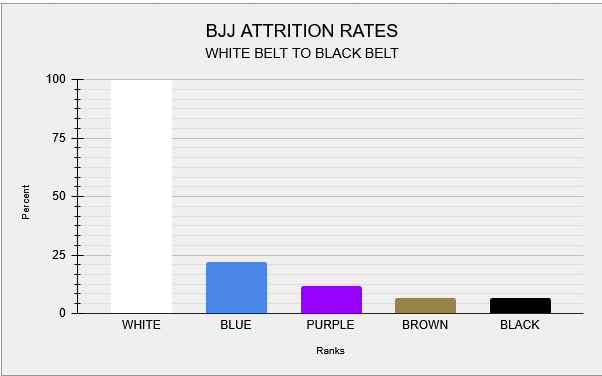
Attrition from rank to rank is seen in the chart below using the data from my own gym. These are the rates of attrition for each rank from white to black:
22% of white belts made it to their first rank of blue belt.
11.7% of white belts made it to purple belt, or 53% of blue belts.
6.5% of white belts made it to brown belt, or 56% of purple belts.
There was zero attrition from brown to black.
COMPARATIVE ANALYSIS FOR PERSPECTIVE - US ARMY SPECIAL FORCES
The US Army has a branch of special forces known colloquially as the Green Berets, named for the color and style of cap they wear with their uniforms. During the green beret selection process there is a phase of training designed to weed out and eliminate those who are unsuitable for the job. The success rate of people who pass this phase of training is, 40% on average (Pavelko, Jeff Lieutenant Colonel, 2017).
These are frontline war-fighters who use their combat skills day to day, often fighting when the rest of us are unaware battles are even underway. Juxtapose that with the average martial artist, who is undertaking their training as a hobby more than for immediate survival. Although survival and self-defense are still at the forefront of goals established by many practitioners, the necessity of using these skills in day to day life is often less imperative.
When we compare and contrast, Special Forces and Brazilian jiu-jitsu, it certainly raises a legitimate question – why are those who are using combat as a job, and going through a training phase designed to eliminate inadequate candidates, encountering a higher success rate than those engaging in the ‘sport/hobby’ of Brazilian jiu-jitsu? And by a magnitude of two to four times the success rate.
This observation, while idealistic, is based on the assumption that each professional Brazilian jiu-jitsu coach, those performing their duties for monetary gain, 1) by and large wishes to retain as many students as possible so as to make a living, and 2) help as many people as possible achieve their goals.
WHY DO PEOPLE START BRAZILIAN JIU-JITSU?
When interviewing new students, there are several reasons for individuals starting BJJ: self-defense, confidence, fitness, cool factor, friend, or family member showed them an inspiring technique, or ‘Joe Rogan told them they should’ on his highly successful podcast. Based on personal Interviews conducted with new prospects and students from 2011 to 2024 who came to my gym, the primary reason is for ‘self-defense’.
THE PURPLE BELT

At the rank of blue belt the average practitioner can do things in singular form in various instances in the fight – 1 submission, 1 escape, 1 guard pass, etc. However, when faced with adversity, strength, resistance, or an opponent who outweighs them or is much larger and/or stronger, the singular technique often fails to work and a backup is necessary.
The rank of purple belt is where we see the ability to adapt and overcome begin to really take hold. The ability to do things in series – a submission is countered, they have a back-up. The first escape attempt fails, they try another. They lose the dominant position, and immediately switch to a new position without hesitation, maintaining control over their foe. Boiled down, upon hitting a wall they are able to find another solution or, the capability to exhibit a level of control over an adversary and purchase ‘time’. Time to observe the problem, orient to a new position, decide, and attack. In my opinion these are necessary skills to adapt to the chaos of a violent attack.
Using the purple belt as the measure of success for helping students reach their goal of self-defense from BJJ training, we see that less than 12% met this goal.
WHY DO PEOPLE QUIT BJJ?
In exploring Brazilian jiu-jitsu we can separate the reasons practitioners quit into two larger categories: generic, and those specific to combat sports. The ‘generic’ category is comprised of attrition factors seen in any martial art or hobby. Especially ones that require such a lengthy commitment to achieve a high level of skill. These include:
Employment factors such as job relocation, promotions with larger time commitments, demotions, or job loss.
Family factors such as marriage, divorce, having children, or a family member who becomes ill and requires more care.
Financial factors like buying a home, or losing a home.
Declining health of the participant due to illness, or injury sustained outside of training.
Experimented with something new and decided it was not for them.
The reasons above are not of interest to us at this time for the purposes of this paper. The next category is of serious importance and central to the use of failure in the learning process of martial arts.
INJURIES - THE HIGH COSTS OF FAILURE IN BJJ
jensen-et-al-2017-table-1
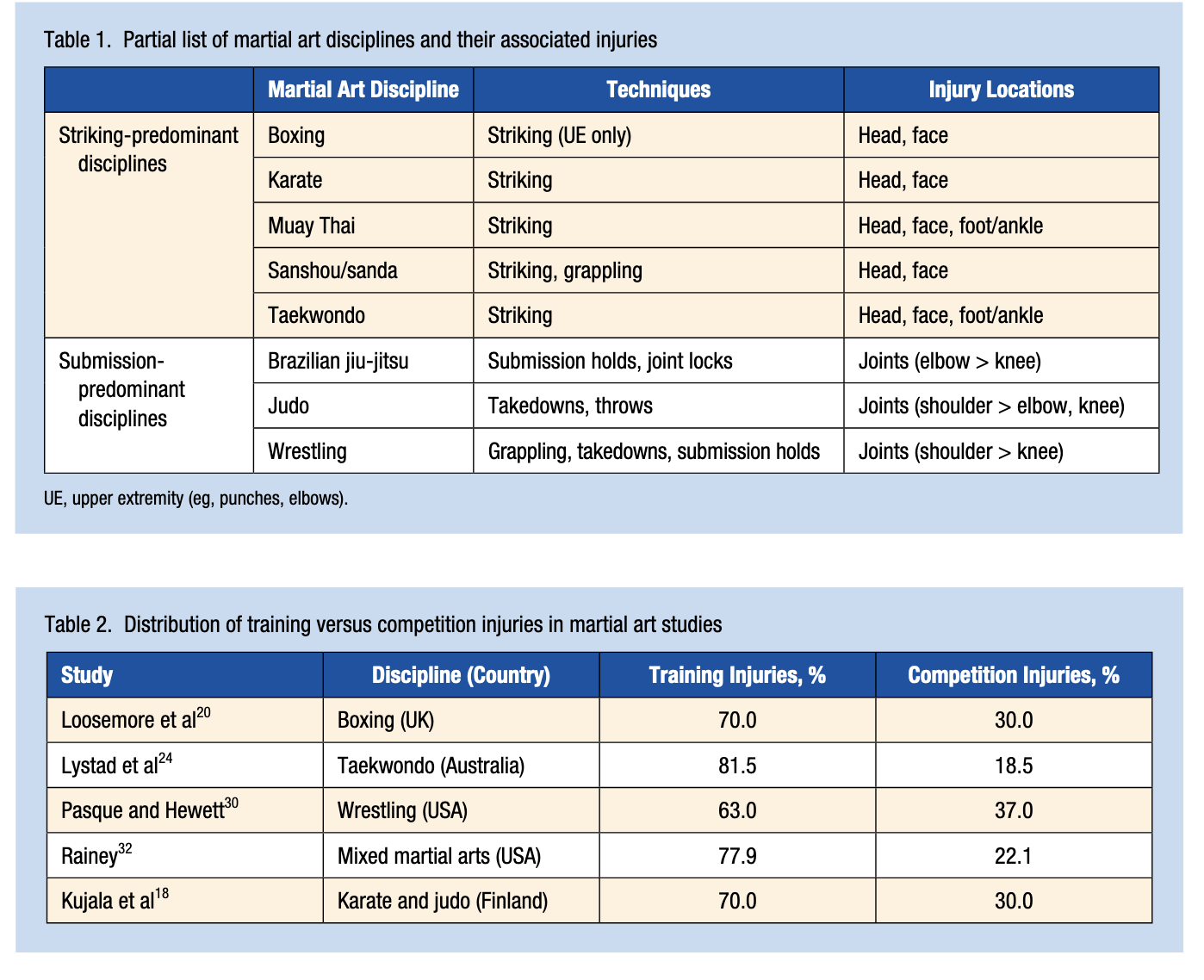
Injuries or, the fear of being injured, are primary culprits for people quitting and leaving BJJ. Even if they enjoy it. When we look around BJJ gyms, we see a bevy of taped fingers, braces for knees and elbows, and the odor of sports medicine sprays as ample evidence in support of this argument.
If a direct or severe injury is not sustained, it is the intensity in which some individuals train that causes the fear some individuals experience — a fear of getting injured. This will drive people to quit, or sit on the sidelines. Due to a majority of gyms taking a — ‘sport’ focus (no striking), it is commonplace to see aggression and intensity increased due to a false sense of security that is born of an environment free of strike-based attacks.
In other words, people take more risks (Risk Homeostasis), and execute the art with more strength and speed than they should. Falsely believing it is ok to execute sparring hard and fast because they’re not hitting one another. No one had a parent or driving instructor tell them when learning to drive, “Put the car in gear, now push that pedal on the right all the way to the floor.” This would quickly and magnificently end in a catastrophe. Going fast and hard on the mats creates a similar risk, albeit one that often takes longer to manifest into serious injury than doing so in a car.
BEHIND THE CURTAIN
My own injuries (of the more serious type), include — torn supraspinatus tendon, torn shoulder labrum, dislodged bone fragments (shoulder), advanced arthritis (shoulder), broken toes, ripped ear, crushed trachea — all before I ‘officially’ began BJJ training. These were my first three attempts at finding a Brazilian jiu-jitsu teacher/gym. Once I found a gym that was of a higher caliber, the injuries lessened but still occurred, as is par for the course.
Over the course of the next seven years while working toward my BJJ black belt, the following injuries were accumulated — torn left Lateral Collateral Ligament (down to fishing line), several broken toes, HPV contamination, broken teeth, numerous neck injuries. I later ended up with a torn right LCL after this period.
It is noteworthy to mention that all of the above happened during routine training regimens/sparring in the competition gym I trained in. I sustained no long term or significant injuries while: attending team trainings around New England, visiting gyms in other areas of the USA, BJJ training camps, or BJJ competitions. This does not indicate a problem in the gym I trained in, but rather the amount of time spent there versus the other venues.
In comparison, decades of mantis boxing/MMA landed me some scrapes, bruises, and a few concussions. Hundreds of hours of flight time in Hang-gliding/Para-Gliding since 2001 (arguably far more dangerous), has resulted in only a few minor injuries more akin to scrapes and bruises than anything severe.
WHY I SHOULD HAVE QUIT BJJ
The following essay details my initial, and catastrophic attempts at starting Brazilian Jiu-Jitsu. This is why I strongly advocate that you choose your martial arts based on 1) the coach, 2) the students/community, 3) the style. In that order. The essay provides insight into my motivations to being a better coach, and trying to share the art of BJJ with others, while reducing injuries and the fear of injuries.
A CURE, OR A POISON?
According to the Bureau of Justice Statistics which tracks victimization statistics in the USA annually, the likelihood of being the victim of stranger violence in 2026, is .0108%, or roughly 1 in 93.
With commonly accepted training practices found in BJJ gyms that include routine sparring, we can refer to studies done on ‘injuries in Brazilian Jiu-Jitsu’. These show that we have a 68% of being injured within a three year period (31% chance annually). Injuries that keep you from training for 2 weeks or more. This is further broken down — 79% of all BJJ injuries happen while sparring.
If the goal is self-defense, and the training has a 30x greater chance of hurting someone than they have of being the victim of a violent attack, it would indicate that the cure is worse than the disease, and that you are safer not training BJJ for self-defense purposes. It is my firm belief there are other highly important reasons to train BJJ and other combat sport martial arts aside from self-defense, which is beyond the scope of this paper. Comparing this data however is a reality-check when it comes to how we train, and should serve as the impetus for all of us who are coaches to do better at increasing retention and reducing injuries on the mats.
*This is a recent addition to the paper and links to the studies will be added shortly.
“BOYS DON’T CRY”
Humiliation is an often unspoken and more emotional reason practitioners have for quitting the art of BJJ. Tapping out, an action we perform when caught in a submission hold, is an admission to another person that they defeated us. While this is a necessary part of the learning process, so we may ‘learn from failure’, when an individual is first introduced to any combat art, but specifically Brazilian jiu-jitsu, “this can be an extremely humiliating process for those not accustomed to ‘failure as a learning tool’ modality.” (Eskreis-Winkler, L., & Fishbach, A. 2022). It offers further damage to the psyche if an individual is using everything they have, and it conjures nothing but defeat.
The following behaviors were witnessed when observing classmates in several BJJ gyms over the years — indicators such as – people repeatedly sitting out from rolling/sparring rounds any chance they can get, some leaving the mats rushing to the bathroom holding back tears, or at the outset of sparring rounds; asking another person — “Can we go really slow?” Expressing hesitation to spar/roll with certain individuals.
Another meme source in the BJJ online world — those who begin a round by listing several injuries they have, the purpose of which being — to secretly express a desire to not get hurt or humiliated, or a passive request for the other person to treat them with more care; especially when facing someone they perceive to have superior size, strength, skill, or aggression.
These factors are more emotional than physical, but become extremely important when presenting the argument that there is ‘too much failure’ in the process of learning BJJ. What is even more evident, is these last two examples often result in the person requesting to “go slow”, or listing their litany of injuries, goes into full attack mode as soon as the bell goes off. This is a clear sign of a lack of emotional control, and fear taking over, rather than some Machiavellian plan to defeat all teammates they encounter.
“Constant persistent failure is counter-productive to the learning process. If failure is persistent, especially when undertaking an activity with a high cost of failure like combat sports, then the probability a person will quit is exponentially higher.” (Lee, S., & Park, J. 2024) Pain, whether it is physical, mental, or emotional, is a natural enforcer to ‘stop’ the thing which is causing the pain.
Persistent failure falls in the mental and emotional categories, and therefore it is often overlooked by coaches, mentors, and even the individuals themselves who do not want to appear weak in the eyes of their peers, or mentors. This makes it extremely difficult for coaches to know the true reason a person has for quitting, as the individual is often reluctant to admit this, or they may not have processed exactly why in their own mind.
DEFENSIVE REACTION
A coach or mentor can easily dismiss a student as weaker, or too weak to handle the training, due to one or more of the factors above. Even becoming defensive when faced with this criticism or behavior rather than empathetic. Perceived more as a threat to their status, teaching method, and livelihood rather than a cry for help.
Appearing indifferent to the plight of the majority, one can see coaches and senior practitioners, myself included, entrench themselves in ideas such as: “It works for me.”, or “This is the way I was trained.”, or “This is the way we’ve always done it.”. Without realizing how many injuries we ourselves have sustained over time. Or recognizing that we are one bad injury away from being in a similar situation, or unable to do what we love. If a gym is successful financially, and their roster is full, there is little to no incentive to peel back the layers and look for a problem, or address these issues.
HIGHER RETENTION WITHIN TRADITIONAL CHINESE MARTIAL ARTS
If we contrast BJJ with traditional Chinese martial arts training, which typically includes the use of forms training (tao lu), shadow boxing, sticky hands (qi shou), and push hands (tui shou), we see much higher retention rates in the classes. The focus on solo skills training, movement patterns, or partner exercises produces an environment with a very low cost of failure. By and large when people quit in these gyms, it is due to one of the generic reasons above in my experience. Providing it is not an issue with the instructor or teammates. However, despite having a better retention rate there is an inherent problem with the transmission methods of Traditional Chinese Martial Arts. For that we first need to define what martial arts is.
WHAT IS MARTIAL ARTS?
The definition of martial arts itself is arbitrary, and subject to the viewpoints of the practitioner, training group, and coach. (Bowman, MAS 2024) Before delving into the deficiencies and failures of the modern-traditional Chinese martial arts curricula, I’ll establish a measurement criteria by defining what martial arts means (to me), and why the aforementioned goals individual students establish for beginning their martial arts training, are not being met according to these standards.
As a coach and practitioner I define martial arts using the following three criteria:
SEEKING WEAKNESS - the constant and never ending quest to find our own weaknesses in — skill, technique, timing, etc., and the overarching goal of shoring up these weaknesses once found. The mats/dojo/wuguan/training hall/garage/backyard, or wherever we train, this environment informs us of where we are deficient not only in hand-to-hand combat, or weapon combat, but likely it reflects and translates directly to psychological and emotional weaknesses we have off the mats in our day to day life. This constant struggle and exploration allows us a vehicle to continue to improve and strengthen who we are as human beings.
ORGANIZING CHAOS - the idea of a martial art itself as the ‘organization of chaos’. Fighting another human being can be defined as — ‘chaotic’. This word describes succinctly the randomness, challenges, and disarray that happens within combat with another human being. During the engagement we cannot possibly know what the other person will do, or how they will go about attacking us. Through training martial arts skills and techniques, controlling ourselves, our actions, tactics, positions, and emotions, we can limit the options available to an opponent. Thereby reducing the number of possibilities they have to attack us and organizing the chaos into a more manageable state.
INOCULATION TO METHODS OF VIOLENCE - the third definition of martial arts is the ‘inoculation to methods of violence’. Through trust in our partners and teammates we engage in the act of inoculating ourselves, and one another, to the wide range of possible attacks that could happen to us in a real world situation. This exposure allows us to learn and adapt appropriate responses to these acts of violence through repetition, and control failure. Training effective means of mitigating and possibly dominating these risky scenarios. Martial arts training halls ‘should be’ a safe environment where we can engage in such practices so as to build skills to deal with circumstances that could otherwise kill us outside of the training hall where ‘TAP!!!’ is no longer an option.
A martial art that fails to meet any or all of these criteria leaves the practitioner feeling insecure in their abilities, or provides a false confidence in one’s capabilities. Creating a ‘skills fantasy’ versus ‘skills actual’. When practitioners engage strictly in solo and restricted partner training routines found in Traditional Chinese Martial Arts (and others), they fail to achieve the goal of learning ‘self-defense’, as is evident by the lack of participation and/or success of Traditional Martial Arts in modern combat sport arenas, challenge matches by amateur fighters, and sparring.(See early UFC/MMA fights, challenge matches versus traditional ‘masters’ in China, et al Personal Experience sparring with taekwondo and kung fu from 1999 to 2006, and versus practitioners of these arts from 2006 to 2024)
These failures are not exclusive to specific styles, or schools of Asian martial arts. The same outcome can be reproduced when sparring with practitioners of combat sports such as: boxing, kickboxing, etc. from gyms that focus strictly on bag and mitt work, kickboxing workout classes with ‘no partner work or sparring’, and any other martial art style focused on technique and void of sparring.
To be fair, combat sports suffer their own inherent weaknesses due to overly specialized training. Training modalities that lock practitioners into sport rule-sets, reducing their exposure to the chaos they will likely face in a real world self-defense scenario.
“When faced with a situation outside of their specialty, an attack the martial artist has not been inoculated to, the fighter often hesitates, or pauses to question what is currently happening, or why they are not effective at their skills, etc.” (Buonomano 2012) This can place the combatant ‘behind in the fight’ versus an aggressor, who shows no such reluctance or hesitation in the battle.
Examples:
A boxer facing a kicker. Each time the boxer approaches, they get blasted in the leg. Unfamiliar with this attack due to sport rules, they hesitate, and question what just happened.
A Muay Thai fighter with a light fighting stance for mobility and kicking facing a Greco-Roman wrestler only interested in shooting the takedown. The muay thai fighter suddenly finds themselves on their back while getting smothered with pressure. With no tools to deal with this, delay, and likely panic sets in.
A BJJ Purple Belt with a focus on sport rules fighting a striker. They pull guard on the striker ready to go to work. The strike begins to ground and pound and the BJJ practitioner is now in uncharted territory with no map.
All of these scenarios reproduce similar outcomes. The mind of the fighter facing an unfamiliar, unscripted condition they have not been inoculated to. The fighter/grappler/wrestlre now falls back on whatever tools or attributes they had prior to gaining skills — speed and power. It is observed that quite often after being indoctrinated into sport fighting, the practitioner even forgets basic fighting and survival tools they may have used before taking up martial arts training e.g., hair pulling, groin strikes, eye pokes, etc.
WHY DO PEOPLE GET INJURED IN BJJ?
When people start Brazilian jiu-jitsu or any martial art, especially individuals with no prior training, there are two phenotypes, or innate attributes that have dramatic effects on sparring — 1) power, and 2) temperament, which manifests as speed. When a student is faced with stress, fatigue, fear, a lack of skill to deal with a situation, or the aggression or speed of a partner, or the perception of such even if it is not happening, then they will inherently fall back on using one or both of the aforementioned attributes as a survival mechanism. Therefore, the introduction of speed and power into the act of sparring in a gym is the primary culprit that leads to injuries and such a high cost of failure in Brazilian jiu-jitsu, and other combat sports such as MMA.
WHEN SUCCESS IS NOT SUCCESS
The use of ‘strength’ and/or ‘speed’ to bring success to prevent a ‘TAP!’, a hit, or a takedown, only reinforces to our brain that we are using the correct behavior/response to help us not just succeed, but more importantly — survive.
Example: A practitioner taps out a teammate four times in a rolling session. The following week the victim decides they are not going to get caught again by this person. They approach their next sparring session with all the resistance they can muster. If they are successful they reinforce the use of speed and power as behaviors, rather than skill. This delays the learning of skills. Additionally, they are vastly increasing the likelihood of injury as the person who was tapping them out is receiving that speed and power, and adds speed and power of their own. Couple that with some amount of skill and this leads to catastrophic injuries in a ‘learning’ environment.
THE FALLACY OF — ‘ALL OUT’ WAR
An all too common misconception with BJJ training that ripples throughout the community is as follows:
“What’s great about BJJ is that we can go 100%!”
This is categorically false and one of the primary culprits that leads to torn ligaments, shoulder injuries, blown knees, back hips/backs, and accidental collisions, e.g., when a knee is suddenly smashing in one’s face in an unintended transition. We only need to look at sports science for the first indication that this is the wrong way to approach training Brazilian Jiu-Jitsu. Good training is pushing an athlete into a 60 or 70% range, rather than trying to ‘max’ every workout.
This brings us to how to train in healthier ways not only for the body, but for the mind and spirit.
SOLUTIONS
How can we encourage failure in learning to fight while lowering the cost of failure, allowing students the freedom and enjoyment of training and gaining new skills? The following methods have been found in my own gym, to increase retention, drastically lessen injury and the fear of injury, as well as build improve teamwork and camaraderie on the mats for everyone in the class.
Although new numbers will take years for an accurate comparison, the following guidelines are the principles I use in my gym which have been successful at affecting positive change that was evident within months, and continues to show promise after now 4 years of using these methods:
PROBLEM SOLVE APPROACH - Present students with problems not solutions. Avoid over-coaching. Let people work together to solve problems and embrace the struggle together. This has shown increased ownership over the learning process and increases enjoyment of successes when they achieve them. We can accomplish this with a variety of methods: 1) show a move, let others figure it out, 2) set up a situation and ask them to try and solve it before revealing answers. Provide hints where needed, or to prevent massive detours down non-productive paths. Use a light touch.
CURRICULUM - Build a curriculum to teach by. An outline is sufficient, and does not need to be specific down to the lesson plan which can often put the teacher into a cruise control mode. Preventing innovative thought or organic evolution to the process that may spawn from a looser structure each time the same subject matter is taught. If I teach the same curriculum I developed 15 years ago, then I am failing to share 15 year of further growth, knowledge, development that I can bring to bear to help people avoid pitfalls and mistakes.
Brazilian jiu-jitsu is quite easy to build a curriculum for, especially for white belts. We use the 4 Dominant positions template - mount, side mount, back mount, guard (closed/open) as a platform. We add how to control someone, or positional control, a handful of submissions from each position, and then how to escape said position.
STAY ON TASK - Once we have a curriculum stay focused on each ground position for months before moving on. Start with solo drills to give students a way to practice off the mats, then introduce ‘one’ submission. Add from there week by week, all the while the student is getting reps on the moves they have already learned establishing pattern recognition (what to use where), gaining coordination, strength in the right places, learning to relax in the moves, and becoming adept at the technique while being exposed to other submissions they may never otherwise see. Repetition is the mother of all skill.
STRESS TEST - Prior to leaving a position behind, spend 1 to 2 weeks stress testing the position — ‘positional sparring’. Each student starts in the position and tries to pull off the submissions when the person under them, or in their guard, is non-compliant. Escapes work the same way. Using resistance to test the escape to see if they can still get out, or at least apply the correct principles under duress. While success here is welcome, it is not the point of the test. The goal here is to give the person exposure to what a resistant adversary feels like. Helping them understand that things are not always as easy as they appear without the risk of full on sparring.
NO STRINGS! - Avoid showing off some fancy move, or a high level sequence to set the person up to pull off a submission. After introducing a technique in this way, most students cannot execute the submission when the time comes in live rolling. All of the time and repetition was spent on the chain, or sequence that lead up to the submission or sweep, rather than on the submission itself. By showing chains of movements to arrive at the point of the lesson, we are only distracting them and inhibiting learning rather than instilling how to finish the move in the first place.
Example: We start our lesson off with something like — “Today we are going to work on the keylock (americana) from side control. Start in your opponent’s guard then grab the belt —> walk the knees back —> round the back to break the guard. Now knee slice pass to the side mount —> execute the keylock.”
This can be drilled for the usual 10 to 20 minutes before rolling begins. As soon as it is time to roll the outcome is more like this:
The student starts in guard, grabs the belt as they were shown, and the person under them punches them in the face. Now they are asking themselves what the hell just happened, and why the coach didn’t talk about that.
We can use sport rules only for the example:
The student starts in guard, grabs the belt to start their break, and the person on the bottom reaches into their collar and starts choking them. The same questions arise: “What do I do now?”, “Why didn’t the coach talk about this?”
Did the student go home that day remembering the keylock and how to execute it from side control? No. They instead went home thinking about all the times they were tapped out in the subsequent X number of rounds of sparring, and wondering what they can do to stop that from happening the next time. Are they learning through failure, and coming up with questions? Yes, but we’re not providing a new skill, but rather constantly putting out fires, and reinforcing the use of primitive skills, or attributes.DELAY SPARRING/ROLLING - Remove sparring for white belts until they have gone through the entire curriculum one time. For my gym this takes roughly 2 years for both the Mantis Boxing, and BJJ cycles. There is still periodic and strategic pressure testing with resistance drills, and positional sparring as I mentioned. This is by far the most important piece, and was the hardest for me to institute. I was not taught this way and refused for years to institute it in my own gym even though deep down I knew it was the right call. Once I took this step, change began almost immediately. This action allows for:
Ample time for students to replace ‘power’, and ‘speed’, with skill so when it comes time to spar, they do not fall back on the fight, flight, freeze response and rather, institute the new responses with the skills they’ve invested two years into learning.
Builds trust and camaraderie amongst teammates. Martial arts is an individual sport/activity vs a team sport like soccer, or football. However, we need a team, or partner(s) in order to progress and evolve. Without such we have very limited chance of successfully understanding these arts we practice. By removing sparring, and thereby developing skills and trust, the next step is possible. The introduction of sparring will require ultimate trust and strong bonds within teammates, or we risk backsliding into raw emotion and out of control bouts within the gym.
MENTOR SPARRING - Once a student has gone through the curriculum one complete cycle institute mentor sparring to help them achieve pattern recognition and acclimate to all the moving parts working together. Mentor sparring is established with the following parameters:
One-Offense / One-Defense: Before the round starts establish ‘one person on offense’, and ‘one person on defense’ parameter. This can be determined by the participants or coach, and allows each person to know what their primary role is. This prevents accidental clashing where both sides are competing for position and are failing to help one another, increasing the likelihood of injury with those new to sparring.
Setups: The mentor sets up opportunities for the newer individual to apply skills they have learned. Examples of this are: they are in the mount and they leave their arm out so the person sees the arm bar. Another would be rolling to the turtle to give the person an opportunity to take the back, and then execute the lion killer choke after rolling them. Dropping a hand to leave the head open for a strike. This is done in a variety of situations on an as needed basis.
Pauses: The mentor pauses in positions their partner fails to recognize, or when a mistake is made, giving the student time to recognize the pattern and take action. The lower the skill level the longer the gaps. A purple belt may still need a pause to assimilate a new skill learned, but likely the gap will be much smaller than that same move for a white belt. No matter what rank or skill level, if the fighter is not recognizing the pattern, and definitely does not know what to do in that situation, the mentor can then give them a nudge, or a hint as to what they are missing so they can recognize the next time. Good practice is for the mentor to set up that same situation a couple more times (if time allows in the round), so the person can repeat the correct solution.
No Gear!: If striking and kicking are part of your training, remove all pads and gloves from the sparring rounds. Gloves, helmets, pads result in people taking more risks in sparring. This is known as ‘Risk Homeostasis’ and is well studied in football and driving. Additionally, within combat sports, it is my experience that helmets, pads, and gloves cause people to hit harder and go faster. Each time they hit someone, they do not get the expected response (pain and disruption), so they naturally add more intensity in order to compensate. Not only do helmets specifically, encourage injuries (concussions & CTE), the use of them retards the learning rather than encouraging it. People take more risks and eat more punches, mistakenly thinking they are ‘protected’.
Speed: In BJJ I recommend 40 to 50% as the upper limit of intensity and speed for high level practitioners to avoid injuries and keep the stress level low for optimal learning. This is what is often referred to as ‘flow rolling’. With newer practitioners lowering that to 20 to 30% is better for their experience and progression. When people begin sparring, it may be necessary to keep it to 5 to 10% in order for their minds to catch up.
White Belts — 5 to 10%
Blue Belts — 20 to 30%
Purple Belts — 30 to 40%
Brown/Black Belts — 40 to 50%
Stress Test: Slow to learn, fast to test. When do we go 100%? In competition or real-world altercations ONLY. In the gym? Never. When striking, kicking, and throwing — Full power/speed can be viewed as the equivalent of training with live bullets. When ground grappling — during positional sparring stress testing, with caveats. When the practitioners are isolated and there is less movement involved it is possible with good teamwork to push the edge and maximize resistance. If executing escapes from an inferior position for example, upon successful escape the position is ‘reset’, the test is started anew. There is no opportunity for continuation and therefore it reduces the likelihood of accidental injury.
De-escalation Method: Even under the best circumstances humans have bad days, or there is something in our past that is revealed on the mats and causes us to overreact, or unintentionally speed up or use more force. While slowing ourselves down can sometimes be enough, there is a safety risk in doing so and we must be careful when attempting that. The preferred method is:
When faced with a teammate showing clear signs of duress, the following ‘unorthodox’ technique is used to bring them back to center. Start talking to them while sparring, or say you need a break for a minute. Begin small talk such as — “What did you do this weekend?”, “Seen any good movies as of late?”, or “Is this a busy time of year for you?” There are many such questions, the key is to take their mind off of the current fixation and allow them to relax and use skills.
We have used this heavily in our gym over the years. This tool is used more frequently when trying to get people sparring earlier, before they have had time to replace instinct with skill.
RESULTS AND CLOSING STATEMENTS
In closing, I challenge that we must ask ourselves who is setting these standards of what Brazilian jiu-jitsu training looks like? Who is running classes and coaching others? Whose job is it to help the students reach their goals? Who continues to perpetuate this ineffective cycle? It is not the 94% who quit along the way. It is not even the 6.5% that made it to black belt as not all of them go on to teach. It is the even smaller percentage that go on to coach. Change must start with us.
A majority of practitioners are not trying to be the best competition jiu-jitsu grappler in the world, and yet our training practices and sparring formats exhibit such patterns, and our attrition is worse than the elite military units. Without self-reflection, interviewing students who leave, or taking stock of retention data, we as coaches can become entrenched in the status quo. “It worked for us so why is this a problem?”
We made it through the gauntlet, and it feels good to be a member of such an elite group of people that made it to the highest levels of BJJ, one of the few who overcame a monumentally difficult task over such a long period of time and in the face of extreme adversity. Yet, is the destruction of bodies, minds, and spirits, in our purview of coaching and teaching others the art of Brazilian jiu-jitsu? Or is our objective to help students achieve success and reach their own goals of learning to defend themselves?
It is unrealistic and idealistic to believe we can eliminate all injury from martial arts training, but we can vastly decrease the propensity for such, while reaping the benefits from sparring. Over the past two years I have instituted the changes I laid out above. It has shown my students, those who I am fortunate enough to get to teach, that sparring can be fun. An activity we enjoy and learn more from than any other part of our training. It is the glue that binds our skills, teaches us to adapt, and produces confidence in our abilities. And we have shown it can be done without compromising efficacy, while also reducing injuries, improving confidence, and building solid skills across the entire team.
We have witnessed an epic change in the atmosphere of the team these past couple years. We graduated a crew of 5 new blue belts, all with increased competency. Each of them acclimated well to the sparring classes, and rely on skills when they spar rather than using speed and power as their primary tools. Camaraderie is now the norm, rather than competition. Team members have become invested in one another's success, not just their own and by proxy the failure of others they train with, and constantly compete against.
We replaced power and speed with skill, and skill is the new normal. Knowledge, understanding and abilities have gone up drastically, and retention, even though it will be years to compare the data, has flipped 180 degrees.
References
Zhou, Q., Mao, J. Y., & Tang, F. (2020). Don't Be Afraid to Fail Because You Can Learn From It! How Intrinsic Motivation Leads to Enhanced Self-Development and Benevolent Leadership as a Boundary Condition. Frontiers in psychology, 11, 699. https://doi.org/10.3389/fpsyg.2020.00699
International Brazilian Jiu-Jitsu Federation (IBJJF) (2013-2024). Graduation Standards. https://ibjjf.com/graduation-system
Pavelko, Jeff Lieutenant Colonel (2017). US Special Operations Command, USSOCOM IMPLEMENTATION PLAN PROGRESS, 6 (SFAS Table 2012-2015 et al). https://dacowits.defense.gov/Portals/48/Documents/General%20Documents/RFI%20Docs/June2017/SOCOM%20RFI%202.pdf
Eskreis-Winkler, L., & Fishbach, A. (2022). You Think Failure Is Hard? So Is Learning From It. Perspectives on Psychological Science, 17(6), 1511-1524.https://doi.org/10.1177/17456916211059817
Lee, S., & Park, J. (2024). Giving up learning from failures? An examination of learning from one's own failures in the context of heart surgeons. Strategic Management Journal, 1–32. https://doi.org/10.1002/smj.3609
Russel, Stuart; Norvig, Peter (1995) Artificial Intelligence: A Modern Approach, Prentice Hall.
Ibrahim Abou Halloun, David Hestenes; The initial knowledge state of college physics students. Am. J. Phys. 1 November 1985; 53 (11): 1043–1055.https://doi.org/10.1119/1.14030
Ibrahim Abou Halloun, David Hestenes; Common sense concepts about motion. Am. J. Phys. 1 November 1985; 53 (11): 1056–1065.https://doi.org/10.1119/1.14031
David Hestenes; Toward a modeling theory of physics instruction. Am. J. Phys. 1 May 1987; 55 (5): 440–454.https://doi.org/10.1119/1.15129
Hanford, Emily (Host). (2012) Physicists Seek To Lose The Lecture As Teaching Tool [Audio Podcast]. National Public Radio. https://www.npr.org/2012/01/01/144550920/physicists-seek-to-lose-the-lecture-as-teaching-tool
Buonomano, Dean (2012) Brain Bugs: How the Brain's Flaws Shape Our Lives, W.W. Norton & Company
Bowman, Paul (2024). Opening Talk Martial Arts Studies Conference 2024, Cardiff University, Cardiff, UK. https://youtu.be/PuTWMS0z1XQ?si=hsdyKJsFjbpAiZnS
Naureen, Z., Perrone, M., Paolacci, S., Maltese, P. E., Dhuli, K., Kurti, D., Dautaj, A., Miotto, R., Casadei, A., Fioretti, B., Beccari, T., Romeo, F., & Bertelli, M. (2020). Genetic test for the personalization of sport training. Acta bio-medica : Atenei Parmensis, 91(13-S), e2020012. https://doi.org/10.23750/abm.v91i13-S.10593
Varillas-Delgado, D., Del Coso, J., Gutiérrez-Hellín, J., Aguilar-Navarro, M., Muñoz, A., Maestro, A., & Morencos, E. (2022). Genetics and sports performance: the present and future in the identification of talent for sports based on DNA testing. European journal of applied physiology, 122(8), 1811–1830. https://doi.org/10.1007/s00421-022-04945-z

What Is Martial Arts?
The following three components encapsulate what defines martial arts, the art of war, or warfare:
SEEKING WEAKNESS
ORGANIZING CHAOS
INOCULATION TO METHODS OF VIOLENCE
This article defines each of these three attributes central to the purpose of martial arts.
MARTIAL ARTS, THE ART OF WARFARE
The following three components encapsulate what defines martial arts, the art of war, or warfare:
SEEKING WEAKNESS - the constant and never ending quest to find our own weaknesses, in skill, technique, timing, etc and the overlying goal of shoring up these weaknesses once found. The mats, dojo, wu guan, training hall, garage, backyard, firing range, or wherever we train, this environment informs us of where we are deficient, not only in hand-to-hand combat, or weapon combat, but likely it reflects and translates directly to psychological and emotional weaknesses we have outside the training environment and in our day to day life. This constant struggle and exploration within, allows us a vehicle to continue to improve who we are as fighters, warriors, and human beings.
ORGANIZING CHAOS - the idea of a martial art itself as the organization of chaos. Fighting another human can be defined perfectly as ‘chaotic’. It describes succinctly the randomness, challenge, and disarray that happens within combat with another human being. In this engagement we cannot possibly know definitively what the adversary will do, or how they will go about attacking us. Through training martial arts skills and techniques, we can limit the options available to an opponent, thereby reducing the number of possibilities, and organizing the chaos into a more manageable state. If we can train ourselves effectively, we limit the options the opponent has, thereby narrowing the possibilities. Once we achieve the limitation the possibilities, we train the appropriate defenses and counter-attacks to each. This makes the final definition even more crucial to success.
INOCULATION TO METHODS OF VIOLENCE - the third definition of martial arts is the inoculation to methods of violence. Through trust in our partners and teammates we engage in the act of inoculating ourselves and one another, to the wide range of possible attacks that could happen to us on the battlefield. This raw exposure allows us to learn and adapt appropriate responses to these acts of violence through repetition, and train effective means of mitigating and possibly dominating these risky scenarios. Martial training environments ‘should be’ a safe environment where we can engage in such practices with the intent to build skills to deal with circumstances that could otherwise kill us, rather than induce stress which inhibits growth and the gaining of new skills.
A martial art that fails to meet these three criteria leaves the practitioner feeling insecure in their abilities, or provides a false confidence in one’s capabilities, thereby creating a ‘skills fantasy’ versus ‘skills actual’.

A Daemon in my Dojo
The afternoon sun turns to shadow early as the solar cycle wanes and we fast approach the winter solstice. I was finishing my training and sitting down to meditate when the visitor walked in.
A new visitor arrived in my dōjō today, a stranger from a far off land. It is the beginning of autumn in the year 2012. Dōjō, or ‘way place’ in Japanese, a place to study the way of ‘something’, typically martial arts. In Chinese martial arts we call it a wǔ guǎn (wǔshù guǎn), or martial hall, the place in which we gather for the study martial arts.
The afternoon sun turns to shadow early as the solar cycle wanes, and we fast approach the winter solstice. I was finishing my training and sitting down to meditate when the visitor walked in. Lately I have been consistently practicing meditation as a post training routine to clear the mind, to take inventory, and to stay grateful.
It has been thirteen years since I began practicing Praying Mantis Boxing (tángláng quán), and a bit over a year since undertaking the art of Brazilian Jiu-Jitsu (B.J.J.). I recently competed in my first BJJ competition as a newish white belt. Currently, I am training and coaching six days per week, as has been the case for the past eight years. When I’m not teaching or occasionally unfurling my wings to deftly dance off a cliff to reach for the clouds above, I pen articles on martial arts as thoughts and ideas materialize that may be of use for others on this path. I have been cross training in other arts for a few years, nothing serious prior to BJJ, but enough so that I have been experiencing modalities outside of Chinese boxing arts; seeing a broader picture.
I sit regulating my breathing, trying to focus my mind. A bright warm light washes over me as the door opens. The stranger interrupts with abrupt words that leap forth like a flash of briny sea water surging to shore on the rush of high tide. These noises flood my brain. At first I am annoyed at this intrusion, and try to ignore it for a moment of solitude. Then, I pause to listen to what he said to me.
As my mind churns over the information it feels as if this visitor is casting a bright spotlight into the deepest umbra in my brain. He begins to spout emphatically about Bēng Bù, crushing step for short, but the longer meaning is – steps to cause the enemy to collapse and fall into ruin. Bēng bù is a shadow boxing set found in styles of mantis boxing, I have been practicing this set since 2005 learning five or more versions from the various lines of mantis boxing, part of my quest to decipher the true intent behind the shadow boxing shell transmitted through mantis boxing lineages for the past one hundred years, or more. I’ve vigorously searched for the hand-to-hand combat applications originally intended by the creator(s), wanting my own continuation of this boxing style to be effective in fighting. Something I have rarely seen thus far.
Eventually I settled onto one version of bēng bù that I train a few times per week, occasionally spending time mulling over the potential applications within my head. The stranger's words snap like a bolt of lightning crackling through my mind. Riding along the spectrum of light his question crackles forth: “Why is bēng bù, like so many other Mantis Boxing forms, begun with and finished with the move, ‘Mantis Catches Cicada’?”, he continues on, “This is not a finishing move to end a fight, so why would this technique of all of them be laid out in form after form almost as bookends?”, “Is this just stylization? Is it a meaningful application?” His questions intrigue my mind, I begin chasing the lightning along its incongruous path.
Code breaking comes to mind, more specifically ciphers. I reply to the stranger, “A cipher used to crack open an ancient codex. A boxing form, in this case crushing step, a set of choreographed moves from a boxer of old, is this the codex and Mantis Catches Cicada the cipher? Perhaps this move is ‘the key’ to unlock the applications within the form?” I begin traversing the halls of the labyrinth in my mind, searching every corner, opening every door, looking at each move in bēng bù from a ‘two hooks’ (neck and arm, or colloquially known in fighting circles as a ‘clinch’ position.
The dialogue and the air around this impromptu visitor, ripple with electricity in the air. I struggle to keep pace with the trove of possibilities his questions raise. As I peruse the catalog of choreography in each road of the set, I conclude that some of the bēng bù boxing moves could certainly function from this position, but others clearly not. The questions then enter my mind, “Where is he from?”, “What, or who, is the source of visitors knowledge?”, “How did he happen upon my dojo?”. I asked his name. “Wang”, he replied.
Wang was a pesty guest, talking incessantly his entire visit. “Does he ever shut up?”, I wondered to myself silently. A wave of empathy washed over me, he did travel from afar, and spent so much time alone unable to talk to anyone about this subject matter. A topic that must be yearning to escape the prison of his mind.
Wang spoke day and night, following me home after classes. He had nowhere else to stay on his visit, I felt compelled to open my home to him, annoyed at times, but grateful for his illuminating thoughts and inquiries.
During his stay I rarely caught a wink of sleep. Wang sat next to my bed at night incessantly rambling till the sun came up. With no choice I lay awake listening to the chatter, staring at the ceiling, throwing off the sheets in exasperation, pacing the room, and spending nights shadow boxing while Wang rolled on. I caught a wink of shuteye here and there, only to rise early again the next day. A true insomniac, Wang did not sleep, obsessed with his ideas which spawned forth like seven hundred baby mantids hatching from an ootheca in the midsummer garden.
With seemingly nowhere else to be, Wang stayed for weeks, revealing a series of mantis boxing positions and hand-to-hand combat applications I had never considered before. I immediately went to task testing these in drills, sparring, and grappling as Wang sat looking on in satisfaction. A new world arose around me; a schism manifested, a cataclysmic shift in my worldview of fighting.
Wang, seeing my progress, bid me farewell for the time being, proclaiming as he exited my dojo, “Perhaps I’ll return, but for now, you need to chew for a while before we can dine again.” I bowed to Wang in gratitude, and wished him well on his travels. Thus concluded my first visit with the daemon who sojourned to my dojo.
Discovering the 12 Keywords of Mantis Boxing
The above short story is an allegory based on real events. An episode in my life back in 2012 consiting of an explosion of ideas and thoughts. The dōjō is not the one I train and coach inside night after night, but rather the one I spend far more time in, the one inside my mind.
My daemon, Wang, is based on Wang Lang the mythical founder of mantis boxing. The man accredited with the origin of this boxing style hundreds, or thousands of years ago, depending on who you listen to. You can read more about Wang Lang in an article I wrote on his possible accreditation to the art here: The Apotheosis of Wang Lang
Prior to this experience I had little in the way of instruction or conversance with the 12 keywords of Mantis Boxing. I certainly knew of them, as most serious and long term practitioners of the art do, but I had yet to delve into them. From my observations and experiences any information regarding these keywords, and conversations surrounding them amongst mantis boxers and coaches, devolved into arguments over what the ‘correct’ keywords are, and their true meaning.
The thoughts I had on ‘mantis catches cicada’ were real. However, while this was a ground-breaking revelation that sparked an age of discovery, and helped lead me onto a fruitful path, years later I debunked this theory when my research exposed mantis catches cicada as nothing more than a — brand moniker, rather than an actual fighting technique. A mantis boxing en garde to proclaim, ‘We do mantis.’ This moment in time though, when all these thoughts began to appear, shifted my brain into thinking of each move from a whole new pillar of fighting — wrestling/grappling.
My daemon helped me to see the first three of the twelve keywords of mantis boxing with new eyes. I began to commit pen to paper, to record these thoughts as they manifested. It crawled from my pores with an unstoppable force. We took photos. I wrote my first quasi-article on ‘What is Praying Mantis Boxing’, now titled The Heart of the Mantis, a rough experience. This idea that wrestling was an integral part of mantis boxing was scoffed at by the mantis boxing community, and some were extremely rude in their rebuttals. I charged forth anyway, fully committed and stalwart in my belief that I was on the right path. As with any new endeavor, I was getting my legs under me as I awoke from a slumber.
Over the ensuing years Wang would come by for a visit from time to time. If I was not paying attention he would splash hot tea on my brain, burning me so I would once more bring my full attention to bear on what he had to say. As I continued boxing, grappling, and progressing in BJJ I unlocked more and more positions and fighting applications. An increasing number of the keywords unlocked before my eyes.
I noticed a similarity with other grappling arts and recalled Gichin Funakoshi remarking in his book Karate-Do that I read back in 1999, that Kara-Te (way of the Tang Hand) was a blend of techniques Okinawan nobles would bring home from southern China during the Tang dynasty, and blend them with their indigenous fighting arts. Years later finding out those indigenous arts were wrestling.
As we sat in the garden sipping tea on one of Wang’s visits, he asked me: “What were China’s indigenous fighting arts?” I began to delve into the history of the Chinese martial arts ecosystem as a whole, coming across...Bokh, the Mongolian wrestling arts still alive to this day. This was enlightening especially since many techniques looked similar to postures found within Mantis Boxing (and other styles) forms of Chinese martial arts that I had studied over the years, to include: taijiquan, eagle claw, long fist, and more.
Bokh, and its history/influence on Chinese culture when the Mongols invaded and took over China during the Yuan dynasty, made me grossly aware that Mantis Boxing along with other Northern Chinese Martial Arts styles that I had studied over the years, contained a great deal of stand-up grappling, or wrestling. This realization has evolved over time as my understanding has grown, now aware that the Manchu were heavily vested in wrestling culture, ruling China for over 250 years during the Qing dynasty; the last of the dynastic eras of China. From there a growing realization of Han wrestling, jacket and no jacket wrestling from the Shaanxi, Shanxi provinces, along with a broader understanding of how much wrestling was part and parcel to so many cultures the world over, almost integral to our DNA as a species.
I could now see that a bulk of these ‘systems’ from northern China seemed to revolve ‘around’ grappling as a primary pillar, using methods and tools to facilitate ways to clinch and grapple an opponent, to throw or trip them to the ground.
The other primary art I trained and taught at the time of writing the above essay, was Taijiquan, specifically Yang family style which was originally known as small cotton boxing. The principles within that style also screamed grappling and I began to dig into the 13 keywords of Taijiquan, performing a comparative analysis of mantis boxing and supreme ultimate boxing after finding so many parallels. This is a working document that I return to from time to time over the years - Brothers in Arms: Mantis Boxing versus Supreme Ultimate Boxing
Arriving at ‘my’ 12 Keywords of Mantis Boxing
Hook, Clinch, and Pluck were the first lessons from Wang Lang. These were followed by Lean. Lean was particularly elusive at first simply because myself being a striker/kicker I failed to see why we would want to lean in a fight, only to give our opponent a shorter distance to hit us in the head. Once applied to grappling and the close distance fight, leaning becomes integral to our survival.
The other keywords were increasingly harder to unravel, with growing absences between visits from my daemon. Long arduous periods of contemplation and frustration, times where I would continue to ask questions into an endless vacant void. From time to time though, my daemon would once more return, once more shredding the thick overgrown vegetation of confusion with razor sharp claws.
Once I could see through the adeptly graven undergrowth, and light shine upon the darkness once more, new techniques would reveal themselves. Eventually, a keyword, or two, would whisper from the lips of my daemon and wisp through the tattered leaves in the garden.
Adhere was the next to become apparent, especially due to its significance in BJJ, where controlling, or consuming space from an enemy while grappling on the ground was so significant. The same was true in stand-up grappling.
Strike was not as simple as it seemed. Ultimately, it is simple ‘to hit’, but why would something so obvious be a keyword? My daemon laughed at me, “If you don’t strike as you Enter, you’ll meet your doom.” he said. “If you do not strike to Connect, you will fail to find your enemies limbs, and meet their fists as you arrive.” “If you do not strike in the clinch, be prepared to receive…injury!”, he laughed harder.
Connect & Stick were the next keywords to be codified. Wang Lang, ever the sarcastic ethereal daemon, made disgusting references to gum, saliva, and the various stages of sticking, to bring these epiphanies to life. “That’s the easy part, but knowing when and how to use them without being punished is another issue entirely.” Offensive application versus defensive utilization was worthy of deep study, otherwise a broken nose would ensue.
Beng, to collapse and Fall Into Ruin came to me in the garden one day. Wang Lang was hanging out on the branches of my kale plants attempting to capture unsuspecting wasps, butterflies, and bees. As his hook snapped out to strike an unsuspecting passerby, he did not crush this victim with his deft strike, but caused it to collapse and fold in upon itself, crumbling to the ground below.
Beng was such a loud lesson that I had to write an article for it and publish it in a magazine for all to see. The idea that causing the opponent to collapse and fall into ruin using various methods, was revelatory to say the least. Especially since one of the core forms of mantis uses this in its name.
Wicked, or in other words, to be ‘sly, deceitful, or tricky’. Wang Lang just flat out hit me over the head with a heavenly strike on this one. What is a fake, or feint when boxing, if not a ruse to open up the opponent and land a strike? A loud noise, bang, or yell - are they not a diversion to enrapture our opponent for a brief moment so that we may gain unfettered access to enter and annihilate them? The use of pluck to force an opponent in the opposing direction of our throw, trip, or takedown, gain freedom to adhere and lean as we barrel forth into a takedown; is that not beguiling?
Wang Lang was rather condescending on that last one, especially since I had been using these tools for years yet failed to see the connection to the keyword he left etched in history.
Hang was another slap on the head, or ‘duh’ moment. Hang was pointed out by my daemon genius spirit. He vaingloriously proclaimed to me - “If you don’t root, lower, ‘hang’ on your adversary when engaged with hooks in the clinch, you’ll get tossed and trampled like you tried to wrestle an elephant!!!”
The Keys to the Style? Or Keys to the Stylist?
The 12 keyword formula of Tángláng Quán (Praying Mantis Boxing 螳螂拳) houses the principles that help define the art. These characters, or variations of them, have been passed down through the common vernacular of Chinese boxing methods in northern China. While not unique to mantis boxing, and evidence of their existence in other styles of the region and time period exist, they can establish a definitive strategy for mantis boxers; much more so than a collection of tao lu (forms) that have no consistency from one branch of the style to the next.
Replication of these keywords does exist among the various lineages of mantis boxing, especially in the first few keywords. No matter the style, many of the more obvious in name keywords such as: Strike, Crush, Hook, Enter, Lean, Clinch, Pluck can be witnessed in Mantis Boxing forms. Those which are harder to mimic in the air - Connect, Stick, Adhere, Hang, and Wicked, are absent in the forms from all indications, and are found rather through live training and sparring practice.
Many of the grappling specific keywords exist in various forms of martial arts still alive today. Although lost within Mantis Boxing lines, one needs simply look at other unarmed combative styles to find evidence of not only their existence, but also significance when it comes to fighting.
An art, of any type, is not defined by hard and fast rules, but is open to interpretation and adaptation by the artist. Keywords of a style, or system of boxing, are a series of principles to guide the practitioner. The definition of these principles and what they mean is highly variable and intimately related to the boxer using and/or coaching them.
The keywords can change from boxer to boxer, allowing for wide adaptation and freedom of expression, and each boxer can select which they rely on more than others. As long as the boxer adheres to a loose framework which includes the hook and pluck keywords, as well as the connecting and sticking specifically, then the stylist is still manifesting an art which mimics the fighting traits of the praying mantis.
These 12 keywords I pass on represent the foundational core of my mantis boxing art. Which strikes, kicks, throws, trips, submissions, you choose to use when you fight can vary widely from my own. And yet, with common principles we bond together as martial artists, share, and reward one another’s successes.
It took me six years to unlock what these keywords mean to me. Use them to discover your own methods. Keep what is valuable to you, discard what is not. Practice with it, fight with it, and your own truth will be one day be revealed to you. Validity in martial arts is not established by the opinion of others, but rather it is, and should be, measured by the success of the actions and execution of our methods.
To learn more about my 12 Keywords of Mantis Boxing you can find a course I have available that combines video instruction with more detail in written explanations and descriptions of each of the 12 keywords.

Research Notes (Open): Power Building Boxing (功力拳, Gōng Lì Quán)
Gōng Lì Quán is a unique boxing set from northern China that is found included as a training routine amongst a variety of boxing styles in the north, to include, long fist, eagle claw boxing, and praying mantis boxing. It likely mixed with the latter two styles when it was included as….
Gōng Lì Quán, or Power Building Boxing is a unique boxing set from northern China, included as a training routine amongst a variety of boxing styles in the north to include: long fist, eagle claw boxing, and praying mantis boxing. This form likely intermixed with the latter two styles when it was included as part of the Jīngwǔ Athletic Association’s fundamental wu shu curriculum in the early 20th century.
At Jīngwǔ, gōngliquán was one of six mandatory ‘empty hand’, and four ‘weapon’ sets taught to practitioners. These ten sets were required as a prerequisite to the study of other styles of Chinese boxing: xingyiquan, bagua, taijiquan, eagle claw, or mantis boxing; considered by Jīngwǔ founders to be more ‘advanced’ styles.
FIRST DISCOVERY
I first came across gōnglìquán whilst studying Eagle Claw Boxing back in 1999/2000. Although it is often included in mantis boxing, Gōnglìquán was not included in the style of mantis boxing I was learning at the time. My introduction to Eagle Claw Boxing was the first version of this set that I learned.
The research I’ve done on this set over the years has predominantly been focused on the physical execution of the movements, the variations of the boxing set from one style to the next, and the combat applications of the movements within the set. Back in 2006 I delved deeper into gōnglìquán with the intent to reverse engineer the combat applications.
As is common with Kung Fu, Gōnglìquán was passed on to me as an empty shell, a form of shadow boxing or choreographed series of movements. At the time that I first attempted to figure out the secrets hidden within the set I lacked the knowledge and skill to properly dissect it. My expertise at the time was rooted in striking, kicking, and submissions (qin na), not wrestling, or grappling.
In my attempt to analyize this set I learned eight different versions, comparing and contrasting each set with one another. The goal to keep the redundancies while discarding anomalous moves that were likely performance based rather than combative. A student of mine, Adria Kyne, fluent in Mandarin, helped with translations. We set about attempting to decipher a couple of books on gōnglìquán. Since most of the text was written in ryhme, or verse, relevant to one ‘in the know’ regarding local idioms, these translations were sadly of little benefit in unlocking the true intent behind these moves at the time. As years passed, I continued practicing and teaching the set until a final seminar I taught in 2012.
TRIMMING THE FAT
Since 2012, I’ve rarely turned an inkling of a glance in the direction of gōnglìquán. I no longer train or teach forms, my time is consumed with fighting application and sparring which I find much more rewarding and a far superior vehicle for teaching the arts to others. Gōnglìquán became a distraction from my work on mantis boxing sets, keywords, and taijiquan combat applications so I left it on the side of the road while I traveled on.
However, a recent discussion began weeks back on the eve of the last day of the 9th Annual Martial Arts Studies Conference in a pub in Wales, UK between another high level Chinese boxer and myself. As we traded ideas and tossed one another around the bar, the conversation brought my attention back to this boxing set I left behind so long ago.
Our didactic discourse has included many subjects in the field of Chinese boxing, but repeatedly returned to the element of Chinese ‘wrestling’, transmitted within these boxing sets. If a reader is not yet aware of the level of influence folk wrestling has had on the formation of these boxing sets passed down for over a century, you are in for an amazing discovery.
THE WANDERING WARRIOR
During the pandemic, Vincent Tseng (Black Belt - Mantis Boxing) began his deep dive into gōnglìquán while he was in Taiwan studying Shuai Jiao during the lockdown. Vincent reached out to me at the time to discuss his rekindled interest in the set. We noted the high probability of the set being wrestling-centric. I supported his endeavors as Vincent went to work on forming his own analysis of gōnglìquán that you can find on his YouTube channel — The Wandering Warrior.
While Vincent and I did converse on his project at the time, and he graciously shared his videos with me, which I thought were excellent, I was in full on survival mode at the time trying to — keep our team training remote, building online courses, streaming classes, and meeting everyone’s needs during the pandemic, while at the same time rehabbing our derelict house. My attention to Vincent’s work, while committed and sincere, was short lived.
At the time I was also tearing apart (again) Beng Bu and Luan JIe, two of the core boxing sets from mantis boxing. Re-interpreting their techniques. My headspace for reverse engineering combat methods from forms was 100% devoted to these sets and no longer on gōng lì quán. For this project I have specifically avoided revisiting Vincent’s extensive work to avoid any cross contamination of our different analyses. Once this project is complete I plan to go back and revisit Vincent’s work and compare commonalities to see where our interpretations intersect.
REKINDLED INTEREST
Graham Barlow of The Taichi Notebook has an extensive background in Xingyiquan, Taijiquan, and Choy Li Fut, a southern style of Chinese martial arts. Graham is also a black belt in Brazilian jiu-jitsu. He and I can speak seamlessly on Chinese martial arts, BJJ, and grappling/wrestling and as such were comparing notes. In Choy Li Fut, Graham points out there is what some practitioners refer to as choy li fut’s ‘signature move’: sau choy.
A similar move to this is found inside gōng lì quán, what we call 3 Rings Trap Moon. As Graham and I talked it inspired me to take another look at gōng lì quán with the knowledge, experience, and eyes that I have now. Immediately some new and intriguing ideas on the combat applications came to light. It would appear based on my analysis, that the ‘entire set’ consists of wrestling techniques, which is counter to any translation I, or others, have attempted in the past.
Boxing Sets
It is important to remember that sets like this were a vehicle or storehouse for a boxer’s system of moves. Many boxers of old spent a bulk of their practice time alone and not in classes or gyms as we do today. This set’s name translates as: power building boxing. One who is practicing the set uses the movements within to train the creator’s ‘boxing’ techniques in a manner akin to exercise — a creative way to transmit the movements to others without reading and writing. Skills which were rare at the time.
The use of hyper low stances, calisthenics, exaggerated movements, and dynamic tension allow for a self-contained training system, alongside a library, or storehouse of techniques. Below are videos with Mantis Boxing black belt and BJJ brown belt Tom McNair.
Gōng Lì Quán Videos
Tyrant King Lifts Ritual Tripod | Throw in Well
Coming soon…
Horse Dragon Deep Sea
Coming Soon…
Collide Elbows, Double Bump
Twining Silk Legs
Lock Neck Through Sky
a.k.a. — Sweeping Moon Off The Wind Over Clouds, and Overturn Sack. This move is executed with slight variations from version to version. Here we depict Lock Neck Through Sky and Overturn Sack variations.
Cast Off Hand/Capture Hand
Next Up. Stay Hooked!
Pluck Eggplant
This move is another counter to the counter when committing to 3 Rings Trap Moon attacks. Rather than stepping back, the opponent steps around the leg to maintain position.
Three Rings Trap Moon
Make Coil Squeeze Pound/Lock Neck Carry On Head
Up Next. Stay Hooked!
Slant Chop aka Single Whip
Up next. Stay Hooked!
Gōng Lì Quán Boxing Set Demonstration (Tao Lu) - 2012
Gōng Lì Quán Boxing Method
Tyrant King Lifts the Ritual Tripod
Letter Hand Throw in Well
Bow Stance Horizontal Fist
Horse Dragon Deep Sea
Letter Hand Throw in Well
Horse Dragon Deep Sea
Double Cross Waist
Double Bump (L)
Collide Elbows, Double Bump (R)
Lock Neck Through Sky
Twining Silk Leg (L)
Twining Silk Leg (R)
Collide Fist
Cast-off Hand
Pluck Eggplant
Collide Fist
Cast-off Hand
Three Rings Trap the Moon (R)
Three Rings Trap the Moon (L)
Three Rings Trap the Moon (R)
Three Rings Trap the Moon (L)
Collide Elbows, Double Bump (L)
Collide Elbows, Double Bump (R)
Collide Elbows, Double Bump (L)
Cast off Hand
Capture Hand, Collide Fist, End Cast-off Hand
Make Coil Squeeze Pound
Lock Neck Carry On Head
Cast-off Hand, Collide Fist
Capture Hand, Collide, Fist
Slant Chop Fist
Jump step, Clap Palm, Collide Fist
Pierce Palm
Servant Stance Navel Eyebrow Palm
Pierce Palm
Collide Fist
Translating ‘Fist’ (Quán 拳)
As Chad Eisner points out in his translation of Qi Jiguang’s treatise on unarmed combat found on Judkin’s Kung Fu Tea blog, the character ‘Quan’ 拳 is used in various ways, especially when discussing Chinese martial arts. At times it is used as ‘fist’, and at other times as ‘boxing’. When used in conjunction with other characters such as in this case Gōng 功 and Lì 力, it more specifically refers to a system of “unarmed techniques/combat” which denotes anything from striking to kicking to grappling or wrestling techniques. It is not confined to punching.
Gōng Lì Quán Grappling ‘System’ Breakdown
The following is a breakdown of the moves within the choreographed set, categorized by technique types found within the Gōng Lì Quán ‘system’. I now refer to it as a system after discovering the inclusion of: ji ben gong training (fundamentals), grip defense, combined with the series of throwing/tripping/sweeping methods embodied in the form. Gōng Lì Quán by all indications is a self-contained training system for the creators’ grappling/wrestling methods.
“When our only tool is a hammer, every problem is a nail.”
Any instances of what appears as a strike or a kick found within the set, can be dismissed with almost complete certainty as being a punch or a kick. These techniques used in such a manner would prove to be disastrous in a real fight.
Upon deeper examination of the set through the lens of grappling methods common to the region, each move can be explained and shown to be effective wrestling methods. Many of these techniques still exist in shuai jiao as well as other wrestling arts found in China and surrounding cultures.
Grips, Grip Defense, & Jibengong
These are techniques centered on deflection, parrying, blocking grip attempts, and/or breaks.
Tyrant King Lifts the Ritual Tripod
Letter Hand Throw in Well
Bow Stance Horizontal Fist
Horse Dragon Deep Sea
Double Cross Waist
Cast off hand
Capture hand
Throws, Trips, Sweeps
Collide Elbows, Double Bump
Lock Neck Through Sky
Twining Silk Legs
Collide Fist
Pluck Eggplant
Three Rings Trap Moon
Lock Neck Carry On Head
Slant Chop
TBC…
Gōng Lì Quán Historical Record
Anyone with more information on the roots of Gōng Lì Quán is welcome to email me, or leave a comment below. Your contributions will be greatly appreciated and added to the post with accreditation.
While little in the way of solid facts exist around Gōng Lì Quán’s origin prior to Jing Wu, there are numerous oral sources naming Cangzhou, Hebei as the place of origin. Some sources claim it arrived on the scene early in the Qing dynasty, but this is uncorroborated. Of note is, Cangzhou being central to Baoding and Tianjin, both major Chinese wrestling centers throughout several dynastic periods in China’s history.
The Taiping Institute lists over 33 styles of empty hand and weapon sets they claim originate from Cangzhou. Gōng Lì Quán being among them. There are no sources listed for these attributions so it is difficult to know if this is revisionist history, or if Cangzhou is actually home to a large number of Chinese martial arts ‘styles’ that have survived till modern times; if survival includes the empty shells known as forms (tao lu).
NATIONAL STRENGTHENING & REFORMATION
As is well documented at this point in martial arts scholarship much of modern Chinese martial arts was changed, morphed, and re-appropriated from fighting to physical education as part of the nationalist efforts of the government of China in the early twentieth century, with the goal to strengthen her populace after repeated humiliations with the west — lost wars with western and eastern powers, corruption, disasters, famines, rebellions, and drug epidemics.
Amongst these efforts was the creation of institutes chartered with the task above, and modeled after and in direct competition with the YMCA. Jing Wu was one of these institutions. At the inception of Jing Wu they included a revamped Chinese martial arts as part of the curriculum, alongside many other sports and activities with the express goal of physical education.
Tasked with establishing a curriculum to represent the nation’s martial arts, and attempting to consolidate over 100 or 100’s of styles, it is my view that they initiated a ‘culling of styles' in an effort to represent this diverse kingdom in a manageable way. Many of these styles: red boxing (hongquan), plum boxing (meihuaquan), ba ji, power boxing (gongliquan), etc etc etc) contain a common vernacular of movements, making a strong case for why they were excluded.
If a style did not stand out as 'unique', or have a strong brand or history already attached to it (mantis, eagle, bagua, xingyi, taiji), it is easy to believe it was chopped up for parts. Whereby similar movements found to overlap other styles tossed into a larger bucket of ‘Northern Shaolin Long Fist’, or an overly simplified North/South context. Simplifying a convoluted and confusing history that was not relevant to the government's purposes, or in line with the mission at large.
Fast forward to the 1950s and this categorization was further propagated and reinforced by the PRC when they created modern Wushu and the creation of standardized sets (forms) being bundled into long fist and southern fist. It is plausible to see why gōnglìquán, a set from Cangzhou, if the oral accounts are to be believed, with large extended movements similar to other longfist-style movements, was included alongside other styles from the north. Add to this that gōnglìquán does not have a significant number of unique techniques, roughly sixteen moves, making it even easier to include it in a broader system, especially when some of these same moves are found in taijiquan, tanglangquan, and yingzhouquan.
EMPTY SHELL WRESTLING
By the time of JingWu’s creation it is possible the fighting applications of the techniques within gōnglìquán had already been lost to time making the boxing set even less distinguishable from other routines.
Of interest is, JingWu had a wrestling program independent of these basic wushu routines. This leads me to further believe that the combat methods of gōnglìquán were already lost, although it is possible it varied enough from the wrestling curriculum that whoever dictated that program’s training regimen had a distinct bias for an altogether different style of Chinese wrestling. The intriguing question is: if the combat methods inside the form were still known, why would a fighting form full of wrestling moves from Cangzhou, be taught without…the wrestling?
PERSONAL PROJECTION
If one throws out all of the included evidence that points to gōnglìquán being comprised of wrestling moves rather than strikes and kicks, and disagrees with the video demonstrations above, if gōnglìquán truly is not wrestling, meaning that I am only projecting my own knowledge, experience, and research onto this set with revisionist intent, then we have an incredibly strong argument that this set would fall under the experiences of General Qi Jiguang and other author’s survey of Chinese boxing styles during the Ming dynasty -
“These flowery styles had lost the foundation of boxing and strayed very far from some presumably simple and original form.“
The reason being, none of these techniques stand up to battle testing in a boxing and kicking context. A bevy of examples found in books, videos, YouTube, over the past 30 years or more, demonstrate these moves being applied as such. Each and every example under careful scrutiny fails to stand up as effective in real fighting vs fantasy boxing, or kung fu movie fighting.
Anyone using these techniques as strikes and kicks will meet with utter failure even against novice street fighters or strongmen, never mind seasoned fighters and grapplers from other styles even within regional borders, and across the globe.
THE NORTHERN SHAOLIN ‘MYTH’
In modern writings gōnglìquán is categorized as being a “Northern Shaolin”, and/or “Long Fist (chang quan)” boxing set. It is more likely that this inclusion amongst Shaolin is part of the overarching oversimplified duality of Shaolin versus Wudang, or Northern styles versus Southern styles classified early in the twentieth century and later reinforced by the People’s Republic of China in the mid twentieth century.
The Shaolin Temple is 416 miles (617km) SW of Cangzhou. Essentially equivalent to a trek from Boston, Massachusetts to Washington D.C. There is a significant distance between these areas. Although it is too easy to assume zero to low probability of boxing and wrestling pollination between such great distances in the 1800s. Reflexively we think of things in modern day settings where a majority of us would never dream of walking 416 miles to get to a destination. We think of travel in terms of automobiles, trains, and planes, failing to recognize that humans have been far more migratory as a species for thousands and thousands of years, and the 1800’s was well traveled.
China is no exception. It is impossible to rule out that someone from Shaolin traveled to Cangzhou and disseminated their martial knowledge there. However, Shaolin was not known by us for wrestling, gōnglìquán is not recorded as being taught at Shaolin, and Cangzhou has both wrestling, and gōnglìquán as part of its heritage. Peter Lorge in his book Chinese Martial Arts From Antiquity to the Twenty-First Century dispels the excessive credit and significance of Shaolin’s influence on China’s martial arts history as a whole, citing a 900 year gap in Shaolin even being mentioned in regards to martial arts, and only reappearing in the Ming dynasty when they help battle pirates — with weapons.
Lorge goes on to elaborate that the connection between Shaolin and martial arts was becoming more prevalent during the Ming. Lorge also makes clear that the focus of these martial arts was predominantly based on weapon combat rather than unarmed, as weapons were more effective at defending Shaolin’s lands and assets. Furthermore, he points to temples such as Shaolin being refuge for travelers on their journeys, where it would be more likely techniques were brought here, or learned here during someone’s stay.
We can conclude that while not improbable for someone of the time to travel to pick up fighting methods and disseminate those in another region hundreds of miles away, the gōnglìquán Shaolin origin falls apart when we compare the histories and styles of both areas, look at the types and methods of combat being transmitted in each, and fail to have any substantial evidence of gōnglìquán existing at Shaolin, not even oral records.
Jīngwǔ
Jīngwǔ was created in 1910 as part of a national reformation movement. This was another attempt at using Chinese martial arts to help combat a weakened populace and culture. Chinese martial arts were not viewed highly prior to this, in part due to the humiliating defeat of the boxers vs the western powers during the Boxer Uprising. Chinese martial arts was often tied to nefarious groups with less than noble intentions. This is an oversimplification of an intricate and complex problem with many tendrils attached. The purposes here are not to rehash the history of Jīngwǔ, or the Boxer Uprisings, but to trace gōngliquán’s path to modern times. I’ll end my commentary on the wider implications with another quote from Ben Judkins:
“This basic social pattern started to undergo a fundamental shift in the wake of theBoxer Uprising(1899-1901). In the modern era (dominated by firearms) the original military applications of the martial arts started to look outdated to a number of educated social elites. Actual military and police personnel had reasons to continue to be interested in unarmed defense, but these sorts of concerns rarely bothered arm-chair reformers or “May 4th” radicals. In fact, many of these reformers and modernizers wanted to do away with traditional hand combat. To them boxing was an embarrassing relic of China’s feudal and superstitious past.
For the martial arts to succeed in the 20th century they would need to transition. They had to be made appealing to increasingly educated and modern middle-class individuals living in urban areas. It would be hard to imagine a group more different from the rural farm youths that had traditionally practiced these arts. But this is the task that the early martial reformers of the 20th century dedicated themselves to.”
NOTE: If a reader is interested in a deeper understanding of the time period where Chinese martial arts transformed from a fighting art to a form of physical education, commercialization, and a coupling with more esoteric and religious practices, I highly recommend reading Joseph Esherick’s ‘The Boxer Uprisings’ for a better understanding of the late 1800’s into early 1900’s China. For extensive detail on what would become The Republican Era, and the Nanjing Era, I recommend the plethora of articles written by Ben Judkins in his prolific blog Kung Fu Tea. The references at the end house several sources that can satisfy your thirst for knowledge.
Jīngwǔ had a large charter when it came to fitness, Chinese martial arts was only a part of it. The YMCA is truly the best comparison as a member could take up tennis, fencing, wrestling, etc etc etc. When it came to martial arts though, Jīngwǔ had a basic curriculum and then an advanced track. The martial arts were taught as forms (taolu) and combatives/sparring were not the focus. The goal was fitness and exercise.
Their directive was noted in an English article published in the Jīngwǔ 10th anniversary journal:
“Ten years ago [1909] when the Association was founded, the press and the general public criticized and called it a place for breeding “boxers.” The gentlemen interested, however, were not discouraged, knowing the need of physical culture for the 400 million and the value of “kung fu” as gymnastics.”
Gōngliquán was one of six mandatory ‘empty hand’, and four ‘weapon’ sets taught to practitioners before they could advance. These ten sets were required as a prerequisite to the study of other styles of Chinese boxing: xingyiquan, bagua, taijiquan, eagle claw, and mantis boxing; considered by Jīngwǔ founders to be more ‘advanced’ styles.
When assembling the curriculum for Jīngwǔ, Judkin’s writes:
“the institutional structure of the modernist Jingwu Association tended to absorb sets from various arts rather than presenting them as distinct, self-contained, lineages.”
While I am still searching for more information on the curriculum development for the martial arts program at Jīngwǔ, and specifically why each set was chosen, we can see that gōngliquán was obviously chosen, and did not have a Shaolin heritage that was necessarily tied to it. Nor was it the purpose of Jīngwǔ to promote this narrative as seen in Tse’s writing about Ying Hon Lan’s research, and Andrew Morris’ book on this period:
“Yin details how the martial arts were at their lowest ebb during the 1900s due to successive failures on the battlefield, the Boxer Rebellion, and the elimination of the Imperial martial examination in 1901.17 From this low point, Yin describes how martial arts became a sport discipline in schools and in the standing armies of various warlords by the 1910s and 1920s.
This work is one the first to draw extensively from the primary sources within the Republican Era Guoshu Periodicals Collection. Yin uses a variety of primary sources to recreate the rich martial arts milieu in Republican China, while the roles of martial arts as a form of physical exercise (as promoted by the Chin Woo Athletic Association) have also been covered in Andrew Morris’s Marrow of a Nation.”
Performing a quick internet search of ‘Shaolin gongliquan’ finds a plethora of martial arts schools claiming the set to be Shaolin while coincidentally reproducing the exact or near simulacra of the basic curriculum of Jing Wu established in Shanghai in the summer of 1910. This attribution to Shaolin or longfist is extremely tainted, and is by all appearances being revised onto Shaolin, not by Jing Wu, but rather the later division of Chinese boxing into Northern & Southern styles established by the Kuomintang (KMT) and the Guoshu Institute in the late 1920’s and early 1930’s.
Modern kung fu practitioners continue this cycle of syncretism by selling a story of a wrestling set from Cangzhou with no connection to Shaolin or longfist (changquan), as being an art that is now Shaolin, or ‘northern long fist’, while presenting absolutely zero evidence of this being true. Simply a regurgitation of a narrative built 100 years ago to suit the purposes of a government organization of the time.
The inclusion of the above historical detail on Jīngwǔ is important to our purposes as it establishes the official written record of when gōngliquán appears on record, how it connects to other styles such as eagle claw and mantis boxing, and the critical aspect of — Chinese martial arts at-large, but specifically the forms found in Jīngwǔ, no longer being taught with martial application included. Rather instead, strictly taught as exercise sport. With this established we can focus on how a style known as changquan came to be, and parse out if gōngliquán is, or is not, a part of this style.
CHANGQUAN (LONGFIST)
Longfist has a separate and congruent history alongside gōnglìquán, with some claims linking it back to Emperor Taizu of the Song dynasty (960-1279). General Qi Jiguang in his 1560 survey during the Ming dynasty (1368-1644) mentions: “Taizu’s stances of the long fist”, but the reference is to ‘stances’ not a style, or even fist methods.
There is a bottomless void when it comes to searching out any real scholarship that has been done on the history of this style. In all likelihood this is due to it being fabricated as a ‘style’ in the early 1900’s as part of the reformation movement. Of note is that, a majority of the narrative is espoused by lineages linked to Han Qing Tang and the Nanqing Guoshu Institute which we’ll cover later on.
According to the changquan Wikipedia page the actual historical term can only be traced back to the second half of the 1800’s, coincidentally the same time other styles of boxing in China began to revise their histories and/or brand themselves. This is when we also see an explosion in the commercialization of Chinese martial arts. A quote from the wiki page points to this much later creation of longfist:
“The Long Fist of contemporary wǔshù draws on Chaquan, “flower fist” [sic meihuaquan], Huāquán, Pao Chui, and "red fist" (Hongquan)”.”
This helps make a case that the ‘long fist’ style was born out of the Nanqing Guoshu Institute and is not an ancient style that existed from the Song dynasty. It also explains why these other styles that are the formation of longfist, and popular in the Qing dynasty, disappeared or at the least, lost substantial popularity and flirted with extinction. Post Nanqing Guoshu Institute is when we see the shell of the northern Shaolin as a system arriving on scene, and gōnglìquán now included as a part of this style.
TAIZUQUAN
There is a style called Taizuquan which still exists today, but lacks any mention of a set known as gōnglìquán while mentioning many others. A quick review of the wikipedia page on Taizuquan, summarizing the bare-hand sets in the style, shows an absence of gōnglìquán. There’s little point in this research to delve further into this style as it appears to have no bearing on gōnglìquán.
SHAOLIN BURNING - THE CENTRAL GUOSHU INSTITUTE
The Nanqing Guoshu Institute is important in establishing when, where, and why I believe gōnglìquán ended up being classified as Northern Shaolin Longfist.
Albert Kayter Tse writes in the opening paragraph of his dissertation — Unfulfilled Potential: The Central Guoshu Institute in Republican China 1928-1948:
The Central Guoshu Institute 中央國術館 (1928-1948) in Nanjing was a martial arts entity funded by the Nationalist government to ‘promote better physical health to the population through martial arts practice.’ With its prestige and funding, the Central Guoshu Institute opened a nation-wide network of martial arts schools, held two national marital arts tournaments, published books and journals researching and preserving martial arts, participated in exhibition tours of Southeast Asia and the 1936 Olympics in Berlin, and trained a new generation of martial arts masters. In 1937, with the outbreak of the Sino-Japanese war, the Institute relocated several times before disbanding in 1948 on the eve of the Communist takeover.
1928 to 1938 is known as the ‘Nanjing decade’, a period in the Republican Era of China’s history. Before we go further let's establish a few facts:
1911 - Jingwu was created in 1911 in Shanghai and later opened a branch in Hong Kong. Gōnglìquán is included in the curriculum.
1927 - Shaolin temple burned.
1927 - 1950 - Chinese Civil War
1928 - Nanjing Guoshu Institute created. Later includes Shaolin styles in its curriculum. Gōnglìquánis not included in the curriculum of Nanjing Guoshu Institute.
1937 (technically 1931) to 1945 - Second Sin0-Japanese War, also known as World War II.
The Shaolin temple burned to the ground in 1927 under orders from Chiang Kai Shek, leader of, at the time, the National Revolutionary Army and after 1928 the leader of the Republic of China. The head abbott of the temple gave sanctuary to his friend, a rebel general fighting against Chiang’s Northern Expedition to reunite China. After losing he fled to the temple seeking refuge. According to records, when Chiang’s soldiers arrived to rout the general, the monks of the temple fought back, losing to superior firepower. Chiang’s general ordered the temple burned and Shaolin history and manuscripts were lost in this fire. (Yang Jwing-Ming, (2009, December) History of Shaolin Longfist)
Gōnglìquán was already included in the Jingwu curriculum 16 years prior to the Shaolin fire and 17 years prior to the creation of the Guoshu Institute. There is no indication that Shaolin was connected to Jingwu.
The Nanqing Guoshu Institute was created in 1928 by General Zhang Zhiziang. In a biography of her father, Zhang Runsu wrote:
“The defining moment of how Zhang conceived of the plan for the Central Guoshu Institute is explained: while convalescing from an injury in 1926, the newly retired general used martial arts as a form of rehabilitation. During this time, he came to feel that the martial arts would be suitable for the entire Chinese populace.”
Once again we see that the focus of these institutions that heavily influenced modern Chinese martial arts, was anything but combat application, and they continued to propagate toothless tigers for ulterior purposes.
It is important to note that gōnglìquán was not included in the Nanjing Guoshu Institute curriculum as we can see below from Tse’s dissertation where he cites a 1933 recruitment article:
“in the Zhongyangribao 中央日報 on 9 December 1933 shows the numerous styles students were expected to master in three short years for the training programme”
Kicking methods
Beginner, Intermediate, Advanced, Tantui 彈腿Striking courses
(Xingyiquan 形意拳, Tai Chi Chuan 太極拳, Baguaquan 八卦拳, Bajiquan 八極拳, Chaquan 查拳, Xinwushu 新武術, Lianbuquan 練步拳, Zaquan 雜拳, Xingquan 行拳, Chuojiao 戳腳, Pigua 劈掛)Weapons courses
Double-edged sword: (Qingpingjian 青萍劍, Sancaijian 三才劍, Kunwujian 昆吾劍, Longxingjian 龍形劍, Houbeijian 猿臂劍)Single-edge sword: (Meihuadao 梅花刀, Baguadao 八卦刀, Maodao 苗刀, Yingzhandao 應戰刀, Piguadao 劈掛刀)
Pole: (Shaolingun 少林棍, Kunyanggun 群羊棍, Xinwushugun 新武術棍, Tongzigun 童子棍)
Spear: (Duanmenqiang 斷門槍, Daheqiang 大合槍, Suokouqiang 銷口槍)
Whip: (Taishibian 太師鞭)
Competition-based courses
(Sparring, Weapons, Wrestling, Boxing, Bayonet, Pijian 劈劍)Elective courses
(Mianquan zuoluohan 綿拳醉羅漢, Zuibaxian 醉八仙, Zuiquan 醉拳, Houquan 猴拳, Joint locking methods)Special courses
(Qigong 氣功, Tieshashou 鐵砂手, Hongshashou 紅砂手, Swimming, Sprinting, Baseball)Military courses
(Fundamentals of instructing, Combat instructing)
Of note from the figure above, is mention yet again of wrestling but with no specifics or names.
Nanjing Guoshu Institute lasted until 1938 when the Sino-Japanese War (World War II) came to China. Tse writes:
“During the Sino-Japanese War, the Central Guoshu Institute, reduced to a handful of staff members and students, relocated with the Nationalist government to the Chinese interior. Lacking official funding, the Central Guoshu Institute existed in name only until it was disbanded in 1948 on the eve of the Communist takeover.”
Here we see a gap in the transmission of knowledge from the Guoshu Institute in mainland China until the creation of the People’s Republic of China post World War II, and post Chinese Civil War. Given the inclusion of gōnglìquán in styles such as mantis and eagle claw we can see clearly that it was transmitted to these systems directly through Jing Wu.
Decades later we see gōnglìquán coupled with another form straight out of the Guoshu Institute called, lianbuquan (continuous boxing). Lianbuquan is a subject for a separate deep dive. What is important for our study is that the two of these forms show up in modern times under the moniker of Shaolin Longfist, but neither of them are Shaolin, nor Longfist in origin.
Was this related to the Shaolin vs Wudang narrative built by the Guoshu Institute? If so, why would the Guoshu Institute, a government sponsored institution, be inclined to then use Shaolin in its directives or branding, especially after the government burned it down?
SHAOLIN VS WUDANG – A TOXIC CHOICE AT THE GUOSHU INSTITUTE
At the inception of the Guoshu Institute Zhang Zhijiang started a classification of Chinese martial arts systems within the institute that resulted in an immediate and toxic battle that spans decades later into modern times. Tse writes:
“Courses began on 11 May 1928 with an initial intake of 70 to 80 students. Two departments handled the martial arts instruction: wudangmen, shaolinmen. During the early 20th century, Chinese martial arts were typically grouped into styles derived from the Wudang mountains, or from the Shaolin Monastery. The two martial arts sects were diametrically opposed: Wudang focused on internal cultivation, valued softness and was affiliated with Daoism; whereas Shaolin focused external cultivation, valued hardness, and was affiliated with Buddhism. The two departments were headed by two acclaimed masters: the Wudang section by Sun Lutang, and the Shaolin section by Wang Ziping.
It did not take long, however, before internal discord broke out. As the two sects were traditional rivals, the students of either department often clashed with each other in the fledgling institute.”
“The tension between the two departments reached a boiling point, with department heads and the teaching directors facing off against each other to see whether Wudang or Shaolin was superior. With the entire student body watching, Wang Ziping and Gao Zhendong fought fiercely, followed by the teaching directors fighting with bamboo spears. Wang, unhappy with being embroiled in this conflict, eventually resigned and returned to private life in Shanghai.”
This segregation and oversimplification of the rich and varied styles of Chinese boxing and their unique heritage was seared into the minds of those who attended the Guoshu Institute. The Republican Era is one of the most prolific periods for written material on the Chinese martial arts. Thus the impact of those who attended the institute, or were instructors there, who went on to write curriculum and instruction manuals propagated this idea of Shaolin vs Wudang, or Buddhist vs Taoist categorization. The ridiculousness of this is apparent when reading Judkins’ account of Meir Shahar’s book on Shaolin taking notice of Shaolin during the late Ming dynasty, and we find Shaolin at the time incorporating Taoist philosophy and medicine into their practices.
What is amazing to me is how impactful and permanent this became in the Chinese martial arts demographic. After the chaos it caused in the institute, they abolished the classification system by July of the same year, a mere two months after the doors opened.
“By July, the dual-department arrangements were abolished. The Central Guoshu Institute was rearranged into teaching, publishing, and general-affairs divisions.” (Tse)
Of note when permeating the details of the Guoshu Institute, is the fact that later instructors in the institute focused on Western Boxing and Chinese Wrestling for combat methods rather than homegrown martial arts systems. This is important as it shows that all of the other ‘striking’ styles in the institute with Chinese heritage - xingyiquan, taijiquan, baguaquan, bajiquan, chaquan, xinwushu, lianbuquan, zaquan, xingquan, chuojiao, pigua, were not being passed on with combat methods training, only forms training.
This is significant as it proves that by this period in Chinese martial arts history, when it comes to organizations like Jingwu and the Guoshu Institute which were responsible in large part for not only carrying on many of these styles, but elevating their fame and popularity post Chinese Civil War, the fighting application of each style was no longer being transmitted within the halls of these organizations. While it is difficult to ascertain with certainty exactly when such transmission stopped, we can at least see by this point that it is gone. Anyone passing on these systems from this point on, is transmitting empty shells of deceased fighting methods.
A few noteworthy quotes from Tse’s work highlight these points. The first of which is his recounting of the 1928 National Guoshu Examinations (a tournament) where people competed in Chinese weapons demonstrations as well as empty-hand demonstrations. These were non-contact and executed as choreographed routines known as forms or taolu. As we can see from the following quote, Chinese boxing was already dead at the Guoshu Institute:
“Second, of the top 15 examinees, three brothers Zhu Guofu (widely viewed as the winner), Zhu Guozhen, and Zhu Guolu won based on their sparring experience. Well versed in traditional arts (Xingyiquan, Shaolinquan, wrestling and Tai Chi), it was their ‘unofficial’ training in Western boxing which offered them the ability to train against resisting partners while attacking at full intensity with padded gloves.” (Tse, pg 35)
As we can see, when it came to sparring and combat, the participants relied on western boxing rather than their homegrown martial arts styles. The next quote emphasizes the purpose of the institute overall, and why this was acceptable to the government:
“By the late 1930s, the consensus model of physical education best suited for ‘saving the nation through physical exercise’ was a combination of Western military calisthenics, modern sport and guoshu. As such, the Central Sports College’s mandate exactly suited the needs of the times.” (Tse, pg 33)
The negative view of the Chinese boxers after the early 1900’s, plus a desire to modernize and incorporate more western practices to defeat the negative reputation of a weak China on the world stage, there was a gravitation to the western practices that were seen as superior to things beyond just Chinese martial arts. However, the martial arts suffered greatly as the early 20th century was the disintegration of combat application being handed down to the following generations. Much of which was henceforth passed on as empty shells for the next hundred years and more.
Was the labeling of these two sets as Shaolin Longfist even more recent than we think? Could they have been categorized as such after the PRC was born?
To be continued…
REFERENCES
Kennedy, B., & Guo, E. (2010). Jingwu. Blue Snake Books.
Peter Allan Lorge. (2012). Chinese martial arts : from antiquity to the twenty-first century. Cambridge University Press.
Tong Zhongyi. (2005). The Method of Chinese Wrestling. North Atlantic Books.
Reevaluating Jingwu: Would Bruce Lee have existed without it? (2012, August 15). Kung Fu Tea; Kung Fu Tea. https://chinesemartialstudies.com/2012/08/15/reevaluating-jingwu-would-brucle-lee-have-existed-without-it
Cangzhou Martial Arts | 沧州武术 – Taiping Institute. (2024). Taipinginstitute.com. http://taipinginstitute.com/cangzhou-martial-arts
Qi Jiguang (1560/1580). Jixiao Xinshu 紀效新書 New Treatise on Military Efficiency.
Zhu, Jianliang. (2023). A Study on the Evolution of Chinese Wrestling, the Characteristics of the Project and Its Value. Global Sport Science. 1. 10.58195/gss.v1i1.36.
Graceffo, A. (2018). The Wrestler’s Dissertation.
Wikipedia Contributors. (2024, July 16). Changquan. Wikipedia; Wikimedia Foundation. https://en.wikipedia.org/wiki/Changquan
Wikipedia Contributors. (2023, February 22). Taizuquan. Wikipedia; Wikimedia Foundation. https://en.wikipedia.org/wiki/Taizuquan#Taizuquan_Changquan
Bringing Northern Styles South: A Brief History of the Liangguang Guoshu Institute. (2018, December 13). Kung Fu Tea; Kung Fu Tea. https://chinesemartialstudies.com/2018/12/13/bringing-northern-styles-south-a-brief-history-of-the-lianguang-guoshu-institute/
The Book Club: The Shaolin Monastery by Meir Shahar, Chapters 5-Conclusion: Unarmed Combat in the Ming and Qing dynasties. (2012, December 7). Kung Fu Tea; Kung Fu Tea. https://chinesemartialstudies.com/2012/12/07/the-book-club-the-shaolin-monastery-by-meir-shahar-chapters-5-conclusion-the-evolution-of-unarmed-martial-arts-in-the-ming-and-qing-dynasties/
Martial Classics: The Complete Fist Canon in Verse. (2018, October 26). Kung Fu Tea; Kung Fu Tea. https://chinesemartialstudies.com/2018/10/25/martial-classics-the-complete-fist-cannon-in-verse/
Tse, A. K. (2019). Unfulfilled Potential: The Central Guoshu Institute in Republican China 1928-1948 [PDF Unfulfilled Potential: The Central Guoshu Institute in Republican China 1928-1948].
Yang, J.-M. (2009, December 30). History of Shaolin Long Fist kung fu. YMAA. https://ymaa.com/articles/history-of-shaolin-long-fist-kung-fu
“Zhongyang guoshuguan she shifanban,” Zhongyang ribao (Nanjing), December 9, 1933.
Lives of Chinese Martial Artists (4): Sun Lutang and the Invention of the “Traditional” Chinese Martial Arts (Part I). (2020, December 17). Kung Fu Tea; Kung Fu Tea. https://chinesemartialstudies.com/2020/12/16/lives-of-chinese-martial-artists-4-sun-lutang-and-the-invention-of-the-traditional-chinese-martial-arts-part-i-2/
Secondary References
Yin Honglan. Jindai zhongguo wushu de zhuanxing yanjiu Research on the Transformation of Contemporary Chinese Martial arts]. Shenyang: Dongbei daxue chubanshe, 2016.
Morris, Andrew D. Marrow of the Nation – A History of Sport and Physical Culture in Republican China. Berkeley: University of California Press, 2004.
Zhang Runsu, ed. Zhang Zhijiang zhuanlüe [A Short Biography of Zhang Zhijiang]. Shanghai: Xuelin chubanshe, 1994.

Guest Appearance: Mantis Boxing, BJJ, Self-Defense and heresy in martial arts (Ep31 - The Tai Chi Notebook Podcast).
Good Afternoon All, Back here in New England after spending a week at Martial Arts Studies Conference 2024 in Cardiff, UK. The conference was exceptional, but more on that later. For now, I’ll highlight one of the many outstanding encounters of the trip. I had the distinct pleasure this past week of meeting and sitting down with…
Good Afternoon All, Back here in New England after spending a week at the Martial Arts Studies Conference 2024 in Cardiff, UK. The conference was exceptional, but more on that later. For now, I’ll highlight one of the many outstanding encounters of the trip.
I had the distinct pleasure this past week of meeting Graham Barlow of The Tai Chi Notebook Podcast, and Blog. I had seen Graham’s blog a few years ago but never had the honor of meeting him. Graham is a long time practitioner of Chinese martial arts: Tai Chi and Choy Li Fut to name a couple. He then migrated as I did to Brazilian jiu-jitsu where he now spends his time teaching and sharing his passion with others.
Graham and I had tons to talk about, and the dialogue continued when opportunity arose between panels or at the end of the day. Without spoiling it, I’ll now introduce you to one such moment when Graham suddenly pulled out a recorder, and invited me to an impromptu podcast which he pulled off masterfully.
Enjoy the discussion, it goes in my bucket of favorite chats.
Ep31: Mantis Boxing, BJJ, Self-Defense and heresy in martial arts
The Tai Chi Notebook Podcast
For more good stuff from Graham
Find him on YouTube:
https://www.youtube.com/channel/UC1SJdsrGOYU45CFU9naMHHg/
Find his website and podcast:
http://www.thetaichinotebook.com/
Facebook:
@TaiChiNotebook

Tai Chi Underground - Project: Combat Methods
Check out this exciting video project on the combat applications of Tai Chi. Have you wondered what the original purpose and intent was behind these moves? What it was before it became a form of physical fitness? Here are my interpretations based on decades of research conjoined with training and competing in combat martial arts.

Find out why I am making Tai Chi videos…
The Dirty History of Tai Chi
You can read more on the history of Tai Chi in the following article:
Tai Chi Chuan(Supreme Ultimate Boxing?) vs Tang Lang Chuan (Mantis Boxing)
Here is a research project I’ve been tinkering with for years. A comparison of Praying Mantis Boxing with Supreme Ultimate Boxing — two martial art styles, their commonalities, shared fighting techniques, and symbiotic combat principles that point to a common theme in Chinese martial arts styles.
Tai Chi Combat Methods
STRUM PIPA
Known as - Strum Pipa, Strum the Lute, or Play Guitar, this move is found in the first road of the Yang style Tai Chi long form, as well as the 24, and other sets. The move is performed twice in the form and mimics a person playing a lute/guitar/pipa. This redundancy of 2x could be an indication of this moves multiple primary combat methods. One method is depicted in this video, others will appear as parts of the other moves in this series. Often when viewing this move in tai chi today, it has been simplified with the hands and looks identical to Raise Hands Upward, which has a very different application.
HIT TIGER
Hit Tiger -- found in the section 2 of the Yang tai chi long form. Often portrayed with large sweeping arm rotations. The movements in the form were exaggerated (large frame) but originally had a shorter frame as depicted here. More in line with the application.
BEND BOW SHOOT TIGER
Bend Bow Shoot Tiger is the final movement of the Yang long form that closes out section 3. The move can easily be mistaken as a block/counter-strike, except the footwork and angles are all off. As with many moves found inside Chinese martial arts forms, a punch is not exactly a ‘punch’.
RETREAT ASTRIDE TIGER
Retreat Astride Tiger appears in the third road of the Yang Tai Chi long form. By outward appearances, the move can be mistaken for White Crane Spreads Wings. The two have very different fighting applications.
BRUSH KNEE
Brush Knee appears in the 1st road of the Yang Tai Chi Long Form. It is repeated 5x in this road, and 4 more times in the remainder of the form. Clearly, a significant fighting technique to the author of the form.
In road one, Brush Knee is interspersed with Strum Pipa . Brush Knee - Strum Pipa - Brush Knee (3x) - Strum Pipa - Brush Knee. Why do you think this is? (easter egg)
See the Unseen - In 1911 this style was converted to a health practice from a fighting art as part of the reformation period in China. A tool to help strengthen the populace using their now defunct martial arts (due to firearms and changes in warfare).
As such, having people balancing on one leg without a partner to grab is challenging. Therefore what is represented in the form is an 'abbreviation' of Brush Knee's true fighting intent shown here.
From A Few Years Prior
Grasp Sparrow’s Tail
Grasp Sparrow Tail, the one and only. Yang Lu Chan's masterpiece sequence from Qing dynasty Chinese Boxing. This is Yang's Cotton Boxing (miánquán 棉拳), or more widely known as Taijiquan (Tai Chi). The Yang style long form is riddled with this move. I have spent years trying to figure out how this move worked, and it is one of the handful of Cotton Boxing techniques that has continued to elude me. Until now. This is by far an amazing discovery. I am very thankful for whatever daemon's have been visiting me of late, and showing me these moves. A few weeks ago I was watching Sonny from Beijing Shuaijiao (check out his channel for more good stuff), play around with Part Horses Mane; another move from Yang style. I noticed something he was doing and it sparked an idea to play out. Thanks to Holly, Vincent, Don, and Thomas for putting up with my ramblings and pushing them around for a few days while I worked on it. Apologies for those in Whole Foods that had to witness the disruptions. Without further ado, check out the video Max shot so we could put this out there for all that have studied Tai Chi and wondered what these moves do. There are more coming, but this is by far one of the coolest sequences that shows how high level Yang Lu Chan really was. You don't develop chains like this, unless you are at a high level in your game.
Embrace Tiger Return to Mountain
Yang's Cotton Boxing has innumerable combinations of moves that transition from one to another. Here we show the use of 'Needle to Sea Bottom', to setup 'Embrace Tiger Return to Mountain'. Embrace Tiger is similar to 'Grasp Sparrow Tail'. The entry is different, but then the next three moves are the same/similar.
Diagonal Flying
When grappling in the flank position, and tied up, Flying Diagonal showed up as a good counter to our opponent’s counter for Double Seal Hands, or in general - if our opponent postures up while in this position. Check out these nuances and details to add Diagonal Flying into your arsenal.

Ground Fighting Basics I - Master Your Foundation
Gain core strength.
Improve mobility and program your reflexes.
Master the building blocks to win the day.
A house built on a poor foundation…is bound to collapse and fall into ruin.
Our martial skills are no different.
Gain core strength.
Improve mobility and program your reflexes.
Master the building blocks to win the day.
The problem with a subpar foundation in any martial art is that it leads to failed technique and a breakdown of applying our skills effectively and efficiently.
When we’re on the ground, this is exacerbated by the weight, strength, and will of larger opponents coupled with gravity keeping us stuck and unable to move. Even a smaller opponent with a higher skill level can prevent us from being able to escape.
Failure to adopt solid basics can cause our brain to stop in the middle of a bout, attack and have to think what to do next.
Take the Shortcut
The short path to a better ground fight game, is to master the basics of Brazilian jiu-jitsu. Programming your body to know how to respond properly to external stimuli. How to react with fluid and natural movements.
Confused moments, or lack of knowledge costs us precious seconds that we need in order to gain position and win submission on an opponent.
As I began learning Brazilian jiu-jitsu I found many of my natural instincts from training other martial arts for over a decade, were wrong. Dead wrong.
The natural reactions and movements I had for striking, kicking, and throwing arts caused me to end up in worse positions on the ground, and to ultimately tap out. Even before getting my black belt in BJJ, I strove to make the process easier for my students. To remove some of the guesswork. To help them build a solid bedrock to grow their art.
Start off on the RIGHT foot
In this course, I’ve assembled the foundation you need to improve your ground fighting skills. The road to mastering your ground fighting game lies in these key movement patterns that will come to save you time and time again from devastating loss.
These drills and exercises are perfect for solo practice while building strength, conditioning, muscle memory, and solid kinesthetic movement patterns.
The training tools of champions. Building these into your training routines will provide large gains on the mats while giving you an incredible core workout.
Let's get started!
Course includes:
Easy to follow video lessons breaking down each of your necessary skills.
A pre-planned training mission to take the guesswork out of what to train and how to practice these necessary skills.
FREE PDF doc Basics of BJJ - breaking down the art of Brazilian jiu-jitsu. Making it easier than ever to understand what your goals are, and how to understand not only the overall objective, but the terminology to navigate the art.

The Kicks of Mantis Boxing Training Course
Confuse. Overwhelm. Destroy.
Confuse. Overwhelm. Destroy.

Kick with Balance. Kick with Precision. Kick with Power.
Kicks are devastating. The power we can generate with the leg far outweighs the potential with our arms, and they provide a distinct reach advantage as a long range weapon. However, kicking requires far more energy which is in limited supply. Launching kicks creates weaknesses in our defense that allow for counter-attacks by our opponent. Kicking causes potentially catastrophic imbalances when we go to one leg. And kicks are only useful in very specific ranges of hand-to-hand combat; improper timing leads to unsuccessful attacks, or our own demise. Using one of the best weapons on our body that requires the most energy consumption to execute and failing to connect with it, is a bad equation in my world.
I’m Randy Brown, and after 21 years of martial arts training from tae kwon do, to kickboxing, to multiple styles of Chinese boxing (to include 3 styles of mantis boxing), I have developed a system of kicking to help you succeed where most kicking fails.
In my kicks of mantis boxing course you’ll learn:
The basic kicks of mantis boxing.
How to properly execute your kicks without losing balance.
Kicking strategy to maximize destruction, confuse and overwhelm your attacker.
Power generation.
Warm-ups for pre-training and increasing flexibility.
Proper range to throw each kick. And more importantly, when and how to switch gears and go from striking to kicking, or kicking to striking. A critical skill when it comes to any boxing art.
Take the mystery and confusion out of creating your own drills, or figuring out what to work by following my simple, easy to follow, training missions after each lesson. Curated by me personally to help you to integrate these powerful kicking methods into your skillset.
Includes:
14 Video Lessons shot in HD video
Training missions to get your repetition and skill training
Warm-ups for Kicking and Improving Flexibility
PDF download - Beginner’s Guide to Kicking by Randy Brown
*course included with Legacy Boxer and Supreme Ultimate Boxer memberships

Summary Boxing Set - Training Course
My Mantis Boxing Set + Combat Techniques
Advance your skills, coordination, balance, reaction speed, and more.

Learn my Mantis Boxing
A friend of mine, another martial arts instructor, asked me a question a few years ago during a lengthy debate on ‘forms in martial arts and their efficacy’. A conversation we later recorded for everyone’s benefit.
He asked,
“if you die (I’m quite sure he was plotting to kill me), how will your students know what your methods, or system was?”
His argument was accompanied by a challenge to create my own form. A boxing set that represents all, or at least most, of my mantis boxing methods for all of you.
So I took my experience learning over 50 of these boxing forms early on in my training, and used this to lay the framework for my very own set. My Summary Boxing Set, or Zhāi Yào 摘要. Which literally means a summary.
This set is comprised of a wide variety techniques hailing from the 4 pillars of mantis boxing - strikes, kicks, throws, and submissions. Includes combinations & counters. Trips, takedowns, chokes, and locks. All methods that I use in sparring. Tested for years on my mats by me, and my students.
This is a perfect way for you to practice these techniques on your own, or with a partner and continue to advance your skills, coordination, balance, reaction speed, and more. Training your body to recognize and tweak these movement patterns (fighting techniques) so when it comes time to use them for real, your body is not stopping to ask your mind - “how do I move my arm, leg, etc to pull this off?”
Isn’t this Free?
Sneak peek of a few of the exciting mantis boxing moves you’ll learn in this course!
You may be asking yourself, “Didn’t you release this boxing set for free to the entire world on YouTube? What is the point of this course?”
Good question. One I would be asking in your shoes. The answer is simple.
Combat Applications!!!
Any martial art form, kata, taolu, boxing set in and of itself, is an empty shell. Without the functional component behind the parts and pieces inside the shell, it is nothing more than a nominally useful martial dance routine.
Know the WHAT, and WHY!
Inside this course you will not only learn my summary boxing set, you’ll see what the moves do in combative applications and how to apply them. In my experience, an invaluable treasure. A storehouse of knowledge for you to refer to as you train with me. Something I ‘never’ had in my years of training all manner of styles of Chinese boxing from a variety of teachers. In that time I only ever had one mantis boxing coach that carried form and fighting together under one roof.
A fact that may seem inconsequential to many of you whose first martial art experience was training with me, where your in-person classes are filled with drilling application with a partner, followed by sparring. This lexicon is something I believe you will come to appreciate over time and will help you to visualize what the moves do as you practice, or to train them with a partner and learn how to really use mantis boxing.
One last thing - I hope you enjoy this set as much as I did creating it for you.
Randy
*course included with Legacy Boxer and Supreme Ultimate Boxer memberships

The Plum Blossom Connection To Mantis Boxing
Praying Mantis Boxing (táng láng quán 螳螂拳) upon closer inspection, has a deeply rooted past that is intersected and conjoined with the plum boxing. There are a multitude of references in names of mantis boxing sets, movements within forms, and even branches of the mantis boxing style that split off from the main line and went on to brand themselves more specifically as plum blossom praying mantis boxing. It goes beyond mere symbolism. To understand this we have to…
Symbolism

Plum Blossom - logo design - Randy Brown - 2006
The plum flower (méi huā 梅花) is a prolific symbol in Chinese culture. The flower is one of the very few blossoms to appear in the early spring when snow is still a possibility. There are countless images in Chinese art culture depicting the plum blossom emerging through snow covered branches. The symbolism of this particular flower is powerful, a metaphor for ‘strength through adversity’, or ‘overcoming hardship’.
Upon close inspection, Praying Mantis Boxing (táng láng quán 螳螂拳), a style from Shandong province in northern China, has a deeply rooted past that intersected and conjoined with plum boxing, another popular style of the time and region. There are a multitude of references found within names of mantis boxing sets, specific movements within forms, and even branches/lines of the mantis boxing style that split off from the main line, going on to brand themselves as ‘plum blossom’ praying mantis boxing. This goes beyond mere symbolism and speaks to something greater. To understand this we have to delve deeper into the region, politics, and time period where the style originated, and discuss another style of boxing known as, Plum Boxing.
Plum Flower Boxing
Plum Flower Boxing (méi huā quán 梅花拳), or méi quán, is a folk style of boxing from the border regions of Jiangsu, Anhui, Shandong, Henan, and Hebei province in northern China. It began during the Qing dynasty, and by the collapse of the Qing in the early 1900’s, it had thousands of followers; although this description is rife with technicalities.
For one, the word styles is in question. In the early and mid Qing dynasty boxers rarely stayed with one teacher for any significant length of time. ‘Styles’ as a construct were few and far between outside of family units. A boxer’s repertoire was an amalgamation of techniques from various teachers and counterparts across the north China plains. Joseph W. Esherick writes of this in his book on the origins of what is commonly known as the Boxer Rebellion, which he more aptly describes as a series of ‘uprisings’.
As we get to the late Qing, when plum boxing is gaining in popularity, we see more styles begin to take significant roles in the Yellow River region in the 1860’s. Esherick notes,
Boxing was particularly popular in this area - both as recreation for young men, and as a means of protecting one’s home in an increasingly unstable countryside.
He also quotes a Linqing gazeteer. They said,
The local people like to practice the martial arts — especially to the west of Linqing. There are many schools: Shaolin, Plum Flower and Greater and Lesser Hong Boxing. Their weapons are spears, swords, staff and mace. They specialize in one technique and compete with one another.
Shaolin boxing was tied to the ‘bandit-monks’ as Chinese historian Peter Lorge describes them. Temple monks hired local ruffians and bandits to protect their land holdings and crops. They were monks only in title and appearance, but more accurately put — armed enforcers for the temple.
Red Boxing (Hong Quan) was the preferred boxing methods of security guards, escort masters, and family bodyguards in the northern provinces. Albeit this was not the style of origin for a bodyguard who began the 6 Harmony Praying Mantis Boxing line in the generations to follow.
Plum Flower Boxing has a variety of descriptions tied to it, all of them accurate in their own rights. The synopsis - a ‘style’ only in the loosest sense of the word. More accurately - a series of boxing methods used for self-defense, but more for exhibition in village marketplaces. It was named not for a style so much as the time of year these exhibitions normally took place — in early spring before the field work began. A period during which, spare time was more plentiful for the agrarian society, and the plum blossoms were appearing on the trees. The ‘plum boxers’ would arrive in the markets touting their skills. (Esherick, 1987)
Dr. Peter Lorge, a Chinese historian wrote
“many local styles [of Chinese martial arts] subsumed themselves under the rubric of Plum Blossom Boxing when it became famous [due to its association with the Boxer Rebellion] at the beginning of the twentieth century” (2012:208; see also Zhang and Green 2010)
Dr. Tom Green, and Dr. Zhang Guodong write extensively on the folk aspect of Mei Boxing in their research (Zhang and Green 2010) on the style, and its integration in local villages that survives even to today.
By the end of the 19th century plum boxing had thousands of practitioners. Shandong, the birthplace of mantis boxing, was replete with plum boxing practitioners, and the now known style was taught by one of the famous patriarchs and leader in the boxer uprisings - Zhao Sanduo. Esherick writes heavily on Zhao and his role with the rebellion. Ben Judkins follows up in great detail as well.
The significant point of immediate interest for our purposes, is to note the popularity of the style as well as its migratory nature. This was not simply limited to one small region in China. The style spread from village to village, city to city as the 1800’s progressed on towards the turn of the century. If we stick with the concept of styles being a construct of a series of techniques learned from multiple sources, or as Green puts it - “a common vernacular in the region”, then we can understand why one style or boxer, would absorb the methods of another so seamlessly. As with modern day martial arts, and the popularity of videos on fighting technique for almost any style you can think of - we practitioners seek out and use what works. Efficacy is at the forefront. This concept is not unique or exclusive to human beings in the 21st century, and it would be hubris to believe so. It would be especially present when dealing with violent and chaotic regions where your life and the life of your family depended on these skills, as existed during this time period.
The Collapsing Empire
Crane on a Snow-Laiden Plum Tree - ink on silk - Attributed to Lu Fu, second half of the 15th century -after 1505
There are questions as to the ‘true’ age of praying mantis boxing. For now we’ll assume that mantis boxing was an actual ‘style’ prior to the late 19th century.
Liang Xuexiang, the lineage holder in Shandong Province, China during the late Qing dynasty. Liang returned from Beijing in 1855 to his village in Laiyang county (Yushankuang) two days walk south of Yantai. At this time the region to the west of the village was in the fifth year of catastrophic flooding of the Yellow River. The Taiping Rebellion was raging in the south. The second Opium War, known as The Dart War would begin the following year in 1856.
Liang Xuexiang was a biaoshi (escort master) prior to retiring, and possibly a soldier in the Qing military (although I have yet to verify this with more than one source). I am told by another credible source that he was a silk merchant in Beijing prior to returning to his village. It is worthy of noting, according to Chircop-Reyes and his paper on Merchants, Brigands, and Escorts, a biaoshi was hired based on factors which included their martial arts lineage.
In 1875, Liang was in his mid 60’s when his life intersected with the next (4th) generation of mantis boxers. The boxers who would then go on to diverge the style from it’s core lineage, and propel it onto separate paths into the present day. Liang, with his experience as a biaoshi, may have been considered a village protector upon his return, or just passing the time in his later years teaching for fun.
During 1875, a majority of the Shandong province was gripped by severe drought that had begun two years prior in 1873, and was still ongoing. Four years of mass famine would follow this drought claiming the lives of 9.5 to 13 million people within five northern provinces of the north China plains which included Shandong. An estimated 8 to 12% of the population.
Opium was ravaging the populace, as well as continued western encroachment and pressure. Yantai was home to one of the treaty ports that was forced open by the western powers at the Treaty of Tianjin (1858) following the Dart War. The White Lotus Rebellion was off and on in the border regions of Shandong, and banditry was a significant problem in northwest and southwest of Shandong. Militias were growing in popularity to quell these threats.
The Qing rulers were meanwhile engrossed in fending off a multi-pronged attack on their rule from outside powers and internal rebellion, as well as corruption which all told, compromised their ability to maintain power. An economic fallout from the catastrophic floods, major rebellions fought in the south and the west that sapped their military strength; foreign powers beating down their door, and the eventual Japanese invasion during the Sino-Japanese war (1894-95). This invasion included battles in Shandong next door to Yantai, in Weihai Wei.
The Qing military at it’s apex was remarkably powerful and adept with the 8 banner armies of the Manchu. By this time however, they had become lazy and unkempt. The Green Banner army, comprised of Han Chinese, not Manchu bannermen, was now the leading force to deal with rebellions and fight off foreign incursions with any significant effect. The Qing military lacked technological advancement, and the western powers made short work of the Qing army in any altercation. Likewise, Japan during the Sino-Japanese war, sunk the much larger Chinese fleet in its entirety in a single day.
The intrusion of Catholic and Protestant missionaries, their willfulness at not only converting villagers, but influencing the political establishment, caused a growing resentment toward these religions, their leaders, and their followers alike. Thus was the climate of Shandong during the 1800’s as Plum Blossom Boxing spread, and mantis boxing was branded.
The rise of Méi Huā Quan
As mentioned, méi quan was the name of a growing martial art in northern China well before and during the lives of the 4th generation of mantis boxers that followed Liang Xuexiang. Liang is noted as training under Zhao Zhu, who trained under Li Bingxiao - known as ‘two hooks Li’, the likely progenitor of the mantis boxing lineage around the turn of the 19th century, if there was one. His existence is difficult to verify, and his name has questionable translations.
Those who would become the fourth generation of mantis boxers, to teach others, were the following: Liang Jingchuan (Liang’s son), Jiang Hualong, Song Zide, Sun Yuanchang, and Hao Lianru. They were all friends with one another in Yantai.
How were these boxers tied to Liang Xuexiang? They are claimed in the mantis oral records as being students of Liang. Upon deeper inspection though, this is a more difficult question to answer. At the time they met Liang they were the following ages: Hao was still a child at 11 years old. Jiang and Song were 20 years old; both had experience in other boxing styles prior to meeting and ‘training’ with Liang, according to their biographies.
Is it possible Jiang and Song, and the other boxers their age, were in Liang’s employ as escort guards rather than martial arts students? That is, if Liang was still operating as a security boss at this time. There is no known evidence of when Liang ended his service in this career so this is difficult to answer.
Another possibility is, they were bodyguards for Liang and his family, who was now in his 60’s during an extremely chaotic time in Shandong. One experienced in the field of protective services would certainly recognize the need for such in times of strife.
Militias were also becoming more and more commonplace in Shandong due to the growing criminal activity. Was this group a militia? Was their symbol the mantis? Was Liang the militia leader? He was a respected escort-master who may well have been looked to as a local leader. More questions, few answers.
Another question, were they a gang of hoodlums brought together by ill circumstances to bully and harass others? Asserting their will over those weaker than themselves? This last part is doubtful due to Song, and another friend of theirs, Wang Rongsheng, being from wealthy families.
Perhaps, during the height of a major catastrophic event, and surrounded by a collapsing dynasty, Liang was simply teaching martial arts to this next generation for a hobby? Silly, when we lay it out that way, but entirely possible.
We have no definitive reason why any of these boxers, with the exception of Wang Rongsheng came to claim Liang as their teacher. We can however look at the obvious connection to the plum blossom society, and how this popular boxing wave came to influence mantis boxing as it progressed toward the 1900’s. Possibly determining when praying mantis boxing began to change.
The Boxer Uprisings
Plum blossom boxing was highly popularized by the time these 5 boxers were in their 30’s and 40’s. The style was also directly, or indirectly tied to the Boxer Uprisings many years later. According to Dr. Peter Lorge, and Dr. Tom Green, méihuāquan was a popular style, or group of martial artists of the time, which also held a folk religious element along with it.
Plum blossom boxing was spread through marketplaces when their followers/practitioners visiting villages and cities in the northern regions of China. Said boxers would meet up with other martial artists and share techniques in a cross collaboration. The art spread through various provinces such as - Henan, Hebei, and Shandong [Green 2016].
Dr. Ben Judkins mentions these plum boxers in his extensive writings on Martial Arts as Brand. Judkins writes, “Talent attracts talent.” which could help explain why these younger, accomplished boxers with prior experience in other styles, ended up tied by lineage, to two biaoshi (escort masters) that came before them - Li San Jian, and Liang Xuexiang.
Judkins further writes -
“However it would appear that there have been numerous cases where local martial artists wished to capitalize on the marking[sic] power of the dominant style or “brand” but for one reason or another could not officially enter the new institution or retrain. The very rapid spread of Plum Blossom Boxing across northern China in the late 18th and 19th century is a good example of this.
Members of this style, sometimes associated with millennial folk religious movements, were a common fixture on training grounds and at village markets in a number of northern provinces. Today there are a very large number of “alternate lineages” within the Plum Blossom tradition, some of which share more commonalities than others. Practitioners of the art occasionally point to this proliferation of clans as evidence of the great age of the art. However, we actually have some good documentation on the history of this particular style.
It appears that in the second half of the 19th century a relatively large number of small local fighting styles, some of them more closely related than others, started to declare themselves “Plum Blossom” schools by fiat, essentially appropriating what was a regionally very successful brand, without having to totally overhaul their teaching structures. In this way the total number of unique local styles in the region was reduced, and the relationship between the name “Plum Blossom” and any fixed body of techniques was stretched and twisted”
Jiang Hua Long and his friend Song Zi De were the first to claim the moniker of the plum blossom, branding the style as ‘Plum Blossom’ Praying Mantis Boxing. Hao Lian Ru was the blood brother of Liang’s son, Liang Jingchuan, who was much older than him and the 1st disciple of Liang Xue Xiang. Hao later went on to distinguish his line of mantis as something different than the others - Tài Jí Méi Huā Táng Láng Quán, or ‘Supreme Ultimate Plum Blossom’ Praying Mantis Boxing.
Tai Ji is oft used as a way to define something as ‘the source of all things’. This was likely a way for Hao to declare (or brand) that he was in fact the 1st of Liang’s disciples. The closest to the core. However, when this happened is debatable. Such political pettiness is likely to have happened after Liang Xuexiang’s death in 1895 at 85 years old.
If Lorge is correct that much of the plum blossom moniker came after the Boxer Rebellion, then we can narrow this down to sometime after 1902. If Liang Xuexiang was the bearer of the mantis torch prior to all of these boxers, and it was not a brand invented after his passing, then it is likely the plum blossom blend of techniques also did not appear until after his passing, and after the boxer uprisings.
The references to the plum blossom go deeper as we explore a few of the mantis boxing tào lù (forms, or choreographed boxing sets). Although this is subject to debate, these boxing sets are the commonly believed ‘older’ sets from mantis boxing. They exist in all of the main lines with the exception of 6 harmony mantis, which came later in the 5th generation by conjoining with a different boxing style altogether (Liuhe).
Mantis Boxing Sets - Tào Lù
A note on these boxing sets before we establish their plum blossom connection. The common forms that exist between the lines of — plum blossom praying mantis boxing, supreme ultimate praying mantis boxing, and qī xīng (Seven Star 七星) praying mantis boxing, are all different from one another in execution. None of them have the same moves/patterns within the choreographed set of fighting moves. This makes it next to impossible to tell which version is ‘correct’, or an original, and further solidifies the fact that boxing techniques and styles of the time, were fluid.
We can however rule out seven star mantis as being the original, since Wang Rongsheng never studied under Liang Xuexiang. Wang’s claimed teacher, Li Sanjian practiced Red Boxing (Hong Quan), not mantis boxing. Li San Jian was in his 70’s in 1888 when Wang started training with him, and died a few years later in 1891. So it is difficult to assess how much ‘knowledge’ was transferred to Wang from Li in that time, and if fighting was the true nature of their relationship.
It is also important to note that Wang was from a wealthy family, and thereby did martial arts as a hobby rather than as means of employ. Li San Jian however, was a famous fighter and biaoshi. Wang, also ‘purchased’ his degree in the 1890’s (a common form of corruption taking place at this time due to the imperial examination system being extremely difficult to pass). Wang failed the exams three times previous to purchasing his degree. Wang, and his family quite possibly hired Li Sanjian for his protection services/knowledge, and Wang could have studied with him during this time. But their relationship is unknown to us, and not relevant to our current, and further exploration of the plum blossom connection to mantis.
Ultimately, finding the original quickly narrows down to — Plum Blossom Praying Mantis (Jiang and Song), Tai Ji Mantis (Sun Yuanchang), or Tai Ji Plum Blossom Praying Mantis (Hao Lianru). Perhaps Hao and Sun’s ‘taiji' mantis is closer to the true mantis, if there ever was such a thing. Or, at least closest to Liang Xuexiang’s teachings? Perhaps this is why they named branded it with the taiji? As in ‘closest to the source’.
The fact that the forms (taolu) from each of them is also different, tells us that even within this ‘style’ of mantis boxing, the forms were subject to independent interpretation rather than a dogmatic system of practice. Due to the appearance and consistency of all three of the core boxing sets (albeit executed differently from one another) in ‘seven star’, ‘taiji’ and ‘plum blossom’ lines of mantis boxing, allows us to trace the forms Luán Jié (Intercept 攔截), Bā Zhǒu (8 Elbow 八肘), and Beng Bu (Crushing Step 崩步) at least as far back as this 4th generation of boxers.
I have no known record of who created these forms at the time of this writing. There is uncorroborated claims that Liang Xuexiang wrote three manuscripts and listed some of these sets within. Until I can verify that, it is unsubstantiated. We may never know.
Because these boxing sets show up in plum blossom praying mantis, supreme ultimate praying mantis, and seven star praying mantis, we can conclude that they either a) existed prior to this generation, and were taught by Liang Xuexiang, or b) were created by this generation and spread down each branch from there; each style having different versions of the form based on the boxer teaching it. Having no verifiable written records makes it difficult to pin down an absolute origin, but it is important to note Esherick’s writings again here as a refresher - ‘boxers and their methods were more fluid and subject to variation from boxer to boxer.’
Wang Rongsheng, the founder of the seven star praying mantis branch was close friends with the ‘plum blossom’ praying mantis boxing founders, and around the same age. Wang assuredly learned mantis boxing from these boxers, his friends, since he did not learn it from Li San Jian. This we can discern from a close study of our mantis boxing timeline, and exactly when he is noted as meeting his claimed teacher, Li San Jian.
Since the boxing sets Crushing Step, Intercept, and 8 Elbows are often the topic of discussion when it comes to ‘original forms’, I’ll focus on these in more detail while additionally notating other forms that offer significant points of interest, if in name only.
Note: These observations are based on the versions of the form(s) that I learned and witnessed via other boxers. Mantis forms are ripe with variations from one line to the next, even at times within the same branch/line. Thus making it extremely difficult to make any statements in absolute terms.
Lán Jié (Intercept 攔截)

The same double block is found in Gongliquan.
The version of Lán Jié that I learned, as well as others I see out there, is precipitated by a strange movement pattern performed in the air. This pattern makes little sense out of context, but the pattern in the air is clearly a plum flower. An homage to plum blossom boxing and a strong indication that this set was assembled by this 4th generation of boxers, or at least this was tacked on.
The opening move of the form that follows the salutation is synonymous with a version of the plum blossom boxing set -> double rising hooks followed by double palms/waist chop. This is the same opening move of the plum blossom form/boxing set that still exists today. Instead of hooks (another brand as I discuss in The Mantis Hand was nothing more than a Mantis Brand) the plum blossom version uses two upper blocks with fists. Similar to gongliquan (power building boxing).
By itself one could argue that this was just a technique that was common to the region at the time. However, when placed immediately after the opening symbolism and combined with other factors that follow, it stands to reason that it came from plum boxing rather than the other way around.
Other common techniques overlap with plum boxing as well: crashing tide, closing door kick, recede/block/kick, block/circle/trap strike, seize leg, lifting hook to the topple, and more. All show a) there was a common vernacular, or library of techniques, (see What Can BJJ Teach Us About Qing Dynasty Martial Arts? - Randy Brown - MAS Conference 2019) in the region at the time, and b) given the redundancy of these two sets and plum boxings popularity compared to mantis, that Lán Jié was likely created after the plum blossom boxing craze.
Given the heavy influence and symbolism of plum boxing within this set, it is far more likely this form was created or altered after the boxer uprising when forms proliferation truly began. However, this is difficult to know for sure without documented dates of creation. Another commonality with this set as well as other mantis sets like crushing step, and others (yet not Ba Zhou), is the repeated engarde position found in the meihuaquan (see photo).


Bēng Bù (Crushing Step 崩步)
Bēng Bù (Crushing Step 崩步) is a prevalent tào lù (boxing set 套路) of praying mantis boxing. It stands as one of the more popular fighting sets on record for the style. It is also a common boxing set practiced by a few of the branches. Although the name translates as 'Crushing Step', this is a bit of a misnomer.
This form also embodies the influence of plum blossom boxing. The ‘engarde’ position known as ‘mantis catches cicada’ shows up in bēng bù right at the beginning — second move. In Crushing Step as well as in other mantis sets, this engarde position is branded with the mantis hooks instead of the signature open palms found in plum blossom boxing as seen above. This clearly disrupts the idea that this was a combative move in and of itself. A heart crushing blow to many of us who spent great efforts trying to ‘decipher’ the fighting application of that move.
In the end, it is nothing more than a branded engarde position taken from plum blossom boxing. It could also be commonly used by boxers from varying styles accustomed to duels at the time. Although, in my experience with studying over 50 forms from a variety of northern Chinese boxing styles, it does not appear that often in other sets/styles.
Additionally, the end of Crushing Step, and Intercept, both have a 180 degree turn to this ‘mantis catches cicada position, or engarde with hooks. The plum boxing set ends with the exact same 180 degree turn, the exception being the use of open palms vs hooks.
The Tiger Tail Kick
Plum Flower Maiden Dancing from Pole to Pole. Circa 1880. Source: Wikimedia (though I believe that Stanley Henning was the first person to publish this image in his essay for Green and Svinth.)
At the end of the first road of bēng bù, there is a move often referred to as a ‘tiger tail kick’. There are versions of crushing step with one instance of this move as you start the second road, and other variations end the first road with this move, and then repeat it in the opposite direction before heading into the second road of the form. Regardless, its roots lie in plum boxing.
Thanks to another article done by Ben Judkins on his Kung Fu Tea blog, I found a drawing of this exact same move. The article - “Research Notes: “Background of Meihuaquan’s Development During Ming and Qing Dynasties” By Zhang Guodong and Li Yun” discusses the influence meihuaquan had on the area of Shandong during the late 1800’s. This same ‘tiger tail kick’ move, as seen in the drawing from 1880, is inside the meihuaquan forms as well as Crushing Step.
This influence on a staple mantis boxing form such as bēng bù draws into question the age of the form, and perhaps points to a newer origin story for this boxing set thought to be at one time over a thousand years old.
Bā Zhǒu (8 Elbows 八肘)
Bā Zhǒu is claimed to be one of the older sets in the lineage. By outward appearance, although mutated from line to line, it seems to be one of the only forms consistent among seven star, supreme ultimate plum blossom, and plum blossom mantis. It would therefore hint that this form [whichever version is original], is handed down by Liang Xue Xiang, and perhaps those before him.
Additionally, and perhaps more significantly — in review of the various versions of this form ascribed to the different branches of mantis boxing, there is a distinct lack of the ‘plum blossom influence’ in the set unlike crushing step, and intercept. In a closer look at this 4th generation of boxers when they fractured into separate lines, based on this evidence it is highly likely in my opinion that this is the oldest mantis boxing set.
Bēng bù and lán jié are suspicious when we see the heavy plum blossom boxing influence represented within them. In both seven star, and plum blossom mantis boxing lines. This can further be brought into question as we look to what other significant geopolitical factors took place in this region/time period.
Rebel Boxers
These plum boxers were subsequently connected to the Boxer Uprisings as we travel closer to the turn of the century. Zhao San Duo, a famous plum boxer and rebel of the time, they were connected to the uprisings not necessarily in ways that would seem obvious. Judkins writes regarding the plum boxers/sect in his article on Zhao San Duo, “the group expelled anti-Christian, and anti-Qing extremist factions.” They were, as well as other martial artists of the time, called upon to engage as a militia group in times of need.
However, Judkins cites the work of Joseph Esherick on the Boxer Uprisings and goes on to further mention the following specifically about Zhao San Duo -
“Esherick reports one very interesting example of “image policing” in his discussion of the relationship between Plum Blossom boxing and the aftermath of an outbreak of anti-Christian violence in 1897 (The Origins of the Boxer Uprising. California UP, 1985. pp. 151-159.).
Zhao San-duo was a noted local Plum Blossom teacher who had a few thousand students and disciples (including many yamen clerks and secretaries) in the Liyuantun region of Shandong. He was probably not a wealthy individual, but his father was a degree holder and he seems to have had some amount of local influence. While he initially resisted being caught up in local events, he ultimately could not withstand the demands to back his fiends and students in the face of persistent communal violence.
During the spring of 1897 he was effectively pressured by his students to become involved in a dispute between the local community and the area’s Christian population. A church (still under construction) was attacked, homes were looted and many people were injured in the clash (one person was reported to have been killed). The Christians were effectively driven out of the local community and the site of their former church was reallocated as a village school.
This action was well received locally and local officials were sympathetic to Zhao and his cause. However, from that point forward he increasingly aligned himself with radical (and sometimes even anti-Manchu) figures. This trend worried the other elders of the local Plum Blossom clan. They did not want to be associated with community violence, anti-Christian violence or even the suggestion of sedition.
These elders met repeatedly with Zhao. However, when it was clear that he would not change his path they agreed to part ways, but forbade him to teach or practice under their name. In effect, worried about the damage and disgrace that he would bring to a very successful brand, the Plum Blossom clan excommunicated the increasingly revolutionary Zhao.
He selected a new name for his style, the Yi-he Quan (Boxers United in Righteousness). This should sound very familiar to students of late 19th century Chinese history. Just as the elders feared, the subsequent actions of the Yi-he students in the Boxer Uprising severely damaged the fortunes of martial artists around the country.
The above is a significant indicator as to not only the popularity of plum blossom boxing at the time, with Zhao having “a few thousand students”, but what would ultimately also come to affect our mantis boxers in Shandong.
We see not only the influence of plum boxing on mantis boxing, but this further evolves into a new intersection with the Boxer Uprisings and the political leanings of at least one of our boxers. As the Righteous Harmonious Boxers as they were called, grew in popularity, so too did their influence on Jiang Hualong. Was Jiang involved in the uprisings? Or was he just an admirer of how they stood up to the western powers who were forcing their way into China, and specifically Shandong? Or was Jiang a supporter of the yi-he boxing movements anti-Christian agenda?
The following forms are noteworthy due not only to their connection to the plum blossom, but the boxer uprisings as well. Whether this is due to religious, cultural, or rebellious reasons is unknown, but it offers further evidence of our boxers being influenced or connected with meihuaquan.
Plum Blossom Fist - creator unknown
Plum Blossom Road (Meihua Lu) - Jiang and Song
Righteous Harmonious Fist - Jiang Hualong
Flower Arranging - Wang Rongsheng
Double Flower Arranging - Wang Rongsheng’s forms
Of particular interest is Jiang Hualong’s set - Righteous Harmonious Fist. According to Brian Kennedy and Elizabeth Guo in their book ‘Jing Wu The School That Transformed Kung Fu’, any association with the boxers involved in the Boxer Uprisings in the early twentieth century would have been considered detrimental to one’s reputation. While we have no record of what year this form was created, if it were prior to the reformation period and the creation of Jing Wu, it raises an interesting question as to why Jiang would keep the name, given any association with the Rebel Boxers was perceived as negative.
Jiang died at the age of sixty-nine in 1924 during a period when Jing Wu was battling the disparaged reputation of Chinese martial arts, and attempting to shed negative associations and convince the public that any black marks such as the boxer rebellion, outlaws, bandits, and overzealous warlords of the past, were not the true martial arts of China. Whatever was going on in the mantis boxing sub-culture in the early 1900’s, it did not affect Jiang Hualong enough for him to shed the name of his set and associations it may conjure in the minds of the public. This could lead us to believe he had strong associations himself with the boxer uprisings, their charter, or anti-western opinions.
Conclusion - A chronology of strife
If we look at the ages of our boxers and the regional and political conflicts they intersected with, we can begin to see a pattern evolve. These boxers met Liang Xuexiang as young adults and became branded as ‘mantis boxers’. Perhaps they were attracted to him due to Liang’s status and reputation carried from years of running escorts/bodyguard services. Liang’s reputation appears to be significant at least in his village/county.
Liang’s home in Laiyang/Haiyang is now a nationally protected treasure. The village sees visitors from around the world that come to see Liang Xuexiang’s dwelling and grave site, and to meet his descendants.
Liang Xuexiang’s house/courtyard. 2020 - https://kuaibao.qq.com/s/20200103A0GKCS00
After meeting Liang Xuexiang our boxers experience (in chronological order)
Continued western encroachment in Yantai, and across Shandong
Catholic and Protestant interference in politics on a macro and micro level causing great upset in the populace of Shandong.
An opioid epidemic - by the 1890’s the once proud and famous Manchu Bannermen that were some of the strongest military in the world, were now reduced to corrupt drug addicts.
Drought across the plains wiping out crops for years to follow.
Mass famine following the droughts
Another famine
Japanese invasion/war on the Shandong peninsula.
Another famine
Boxer uprisings
National restrengthening movement
Collapse of the last remaining dynasty in China’s history
As our mantis boxers age they likely pick up the plum blossom banner to become part of the growing popularity of this quasi-religious movement. And yet in aligning with this banner, do not discard the mantis boxing brand. This could indicate the power of the mantis brand handed down by Liang, or his influence alone. The mantis was obviously a valuable enough symbol to our boxers that they continued to carry this banner as they adopted new branding and grew their influence in Shandong and beyond.
As we reach the end of the 19th century we see rebellious factions appear. One of our boxers is somehow directly or indirectly linked to the more extremist part of the plum blossom society, the yi he boxers who are ultimately exiled for their actions against Christians and converts. Was Jiang Hualong the one naming forms afters these boxers and their movement a part of uprisings? Further study of Jiang Hualong is required to try and answer this question.
Once the Qing dynasty collapsed we are now in a time period where martial arts in China undergoes a significant reskin. No longer a fighting art, now a form of physical education. Teachers vie for commercial students, popularity, reputation. Mantis boxing is propelled on a path to become a worldwide martial art as it travels south to Shanghai and enters the now infamous - Jin Woo Athletic Center to become a part of China’s national movement to regain face. From there to Hong Kong and half a century later it traverses the globe.
This southern migration was spearheaded by a student of a student to mantis boxer Wang Rongsheng who started the Seven Star line of mantis boxing. This 3rd generation ‘seven star’ student was Luo Guangyu. This lends itself to yet another question — Wang was not part of the original group mentioned above who trained with Liang. Yet his mantis, not the mantis of those who studied under the direct descendant was the branch/style (Seven Star) chosen to go south and represent these mantis boxers from the north. Why?
Wang’s version of mantis also carries with it hallmarks of the plum blossom boxing style. It is therefore conclusive that this integration with mei boxing took place before mantis reached Jin Woo in 1913. Due to none of the orginal sets matching from one branch to the next, it is difficult to ascertain an exact point in time when these two ‘styles’ converged. Quite possibly it was even before Wang adopted the mantis brand from his friends.
Bibliography
Esherick, Joseph W. The Origins of the Boxer Uprising. University of California Press, 1987
Lorge, Peter. Chinese Martial Arts from Antiquity to the Twenty-First Century. Cambridge University Press, 2011.
Guodong, Zhang & Green, Thomas & Gutiérrez-García, Carlos. (2016). Rural Community, Group Identity and Martial Arts: Social Foundation of Meihuaquan. Ido Movement for Culture. 16. 18-29. 10.14589/ido.16.1.3.
Judkins, Ben. Lives of Chinese Martial Artists (13): Zhao San-duo—19th Century Plum Flower Master and Reluctant Rebel - https://chinesemartialstudies.com/2017/04/20/lives-of-chinese-martial-artists-13-zhao-san-duo-19th-century-plum-flower-master-and-reluctant-rebel-2/
Guodong, Zhang & Green, Thomas (2018). “I Am the Greatest Boxer”: Articulating Group Identity through Chinese Folk Drama - https://www.researchgate.net/publication/326005437_I_Am_the_Greatest_Boxer_Articulating_Group_Identity_through_Chinese_Folk_Drama
Research Notes: “Background of Meihuaquan’s Development During Ming and Qing Dynasties” By Zhang Guodong and Li Yun - https://chinesemartialstudies.com/2015/06/01/research-notes-background-of-meihuaquans-development-during-ming-and-qing-dynasties-by-zhang-guodong-and-li-yun/
Kennedy, Brian, Guo, Elizabeth Jing Wu The School That Transformed Kung Fu, Blue Snake Books 2010

Sweeps - Throws on the Ground - BJJ Training Course
Tossing an opponent like a salad. Pulling off a sweep in ground fighting is an exhilarating moment that fills us with monumental sense of victory. What comes next? These powerful moves are fundamental to our jiu-jitsu arsenal, yet are so often applied at the wrong time, or wrong place. In this course I’ll give you the tools to not only train your sweeps on your own, or with a partner, but how to successfully pull them off in live rolling.
Toss your opponent like a salad!
Pulling off a sweep in ground fighting is an exhilarating moment that fills us with monumental sense of victory. It’s second only to a submission.

You’re on the ground opponent in your guard. You learned how to sweep but when the moment comes to try it, they don’t budge. Why? Or, you get the sweep, and they quickly retake a position on you. Why?
These powerful moves are fundamental to our jiu-jitsu arsenal. Some of the best moves we have. Yet they are so often applied at the wrong time, wrong place, or with a lack of follow-up. In this course I’ll give you the tools to not only train your sweeps on your own, or with a partner, but how to successfully pull them off in live rolling, and to keep the opponent from coming back for more.
No experience necessary!
*course included with Legacy Boxer and Supreme Ultimate Boxer memberships

Crushing Step (Bēng Bù)
Last week kicked off the new course I’m teaching on the mantis boxing set known as Crushing Step. Each week in live stream classes I’ll be taking you step-by-step through the fighting applications of this old boxing set; thought to be one of the originals of the style.
Join me as I give you an in-depth view of how these striking, kicking, and takedown applications work, and how to practice each move on your own.

Crushing step is a mantis boxing sequence of hand-to-hand combat moves that is all too often handed down without the fighting applications included (empty shell). Or, the set is taught with ineffective fighting methods that do not function when pressure tested against even the most novice resistant, non-compliant partner, never mind a highly trained martial artist.
In this course I’ll be taking you step-by-step through not only the boxing set known as crushing step, but the self-defense applications of each move. Striking, kicking and grappling methods that have been resistance tested in a crucible of live sparring by myself and my students for years.
Whether you are already a mantis boxer that previously learned this set, but lack the fighting applications that go along with it, or a beginner boxer looking for a functional form of martial arts and self-defense, this course will fulfill your goals.
Join me as I give you an in-depth view of how these striking, kicking, and takedown applications work, and how to practice each of the moves on your own, or with a partner.
More on Crushing Step…
Bēng Bù (Crushing Step 崩步) is a prevalent tào lù (form 套路) of tángláng quán. It stands as one of the more popular fighting sets on record for the mantis boxing style, and is a commonality between a many of the branches of mantis boxing after it split during the turn of the 19th to 20th century.
Although the name translates as 'Crushing Step', this is a bit of a misnomer. Bēng means - ‘to collapse and fall into ruin’. Rather than an actual crushing ‘step’, Bēng Bù is more specifically about the ‘steps to Bēng’. The set is a series of techniques leading to the ‘collapse and fall into ruin’ of our opponent. This can be represented at times with single moves in the form such as crazy ghost fist, but there are many interconnected sequences of techniques as well. A series of counters to counters, ultimately leading to the enemies collapse. Think about Rule of Three from our 12 boxer principles.
While execution and power generation of a bēng dǎ (crushing strike 崩打) is riddled throughout the set, the overarching theme is…
Complete Course Releasing Soon

The Origins of Wang Lang of Tángláng Quán - 螳螂拳
Wang Lang (王朗) was a military folk hero/warlord in the Eastern Han dynasty (25CE - 220CE). Born in Tancheng County in the south of Shandong near the border of Jiangsu province. Wang Lang’s deeds are recorded and as with other famous figures in Chinese history, Wang was later memorialized and embellished upon in a famous novel Romance of the Three Kingdoms. How did Wang Lang become entwined with the history of Praying Mantis Boxing (Tángláng Quán - 螳螂拳) almost 2 millenia later? Is this the same Wang Lang, or was there someone else who founded this boxing style who went by the same name?
Wang Lang (王朗) was a military folk hero/warlord in the Eastern Han dynasty (25CE - 220CE). Born in Tancheng County in the south of Shandong near the border of Jiangsu province. Wang Lang’s deeds are recorded and as with other famous figures in Chinese history, Wang was later memorialized and embellished upon in a famous novel Romance of the Three Kingdoms.

Sacrificing to heaven and earth, the oath at the peach garden, Romance of the Three Kingdoms/Chapter 1 - An illustration of the book - From a Ming Dynasty edition of the Romance of the Three Kingdoms (金陵萬卷樓刊本) , 1591 - the original is kept in the library holdings of Peking University 1591
Wang’s bio according to Chine.de - An Encyclopaedia on Chinese History, Literature and Art
Wang Lang 王朗 (died 228 CE) courtesy name Jingxing 景興, was a high minister and Confucian scholar of the early years of the Wei period. He came from Tan 郯 in the commandery of Donghai 東海 (today's Tancheng 郯城, Shandong) and was, as proficient in the Confucian Classics, appointed gentleman of the interior (langzhong 郎中), then magistrate of Ziqiu 菑丘. In the turmoils of the Yellow Turban rebellion 黃巾起義 he became a follower of the warlord Tao Qian 陶謙, who promoted his appointment as governor (taishou 太守) of the commandery of Guiji 會稽. This region was contested, and Wang Lang had to ward off the warlord Sun Ce 孫策. The warlord Cao Cao 曹操 therefore decided to offer him the post of Grand Master of Remonstrance (jianyi dafu 諫議大夫), and made him concurrently military administrator of the Ministry of Works (can sikong junshi 參司空軍事). When Cao Cao, as factual regent of the empire, was made king of Wei 魏, Wang Lang was made governor of Weijun 魏郡 and "military libationer" (? jun jijiu 軍祭酒), later promoted to Chamberlain for the Palace Revenues (shaofu 少府), Chamberlain for Ceremonials (fengchang 奉常) and Chamberlain for Law Enforcement (dali 大理). When Cao Pi 曹丕 (Emperor Wen of Wei 魏文帝, r. 220-226) assumed the title of emperor, Wang Lang was appointed Censor-in-chief (yushi dafu 御史大夫) and given the title of neighbourhood marquis of Anling 安陵亭侯. Somewhat later he was made Minister of Works (sikong 司空) and promoted to Marquis of Leping Village 樂平鄉侯. Emperor Ming 魏明帝 (r. 226-239 CE) conferred upon him the title of Marquis of Lanling 蘭陵侯 and appointed him Minister of Education (situ 司徒). His posthumous title was Marquis Cheng 蘭陵成侯. Wang Lang wrote commentaries to the Classics Chunqiu 春秋, Xiaojing 孝經 and Zhouguan 周官 (Zhouli 周禮), and wrote numerous memorials to the throne. Most of his writings are lost.
Sources: Zhang Shunhui 張舜徽 (ed. 1992), Sanguozhi cidian 三國志辭典 (Jinan: Shandong jiaoyu chubanshe), p. 36. Ulrich Theobald Copyright 2016
In Romance of the Three Kingdoms Wang Lang
In the 14th-century historical novel Romance of the Three Kingdoms, Wang Lang died at the age of 76 in 228. Despite his age, he led a group of soldiers and set up camp to do battle with Zhuge Liang. In the novel, Cao Zhen was defeated by Zhuge Liang. Cao Zhen called for his subordinates to help, and Wang Lang decided to try and persuade him to surrender (even though Guo Huai was sceptical that it would succeed) and engaged Zhuge Liang in a debate, but was soundly defeated. Zhuge Liang among other things scolded him as a dog and a traitor, from the shock of which he fell off his horse and died on the spot. There is no record of this in history, and instead, it is said that he merely sent a letter to Zhuge Liang recommending that he surrender. The letter was ignored.
Luo, Guanzhong (14th century). Romance of the Three Kingdoms (Sanguo Yanyi)
The Apotheosis of Wang Lang (王朗)
The birth of mantis boxing has been well debated. Some claim it was a product of the Song dynasty (960–1279), while others place it in the Ming dynasty (1368-1644). The evidence however points to the Qing dynasty (1644-1912) as the likely period of birth, and Wang Lang is a contributing factor to the evidence.
How did Wang Lang become entwined with the history of Praying Mantis Boxing (Tángláng Quán - 螳螂拳) almost 2 millennia later? Is this the same Wang Lang, or was there someone else who founded this boxing style who went by the same name? I believe these are one and the same.
Wang, as with many famous generals in Chinese history, was deified. He became a god especially to those villagers and communities in the region near his birth. There is even a statue of Wang Lang located in Shandong province. There is however no mention in historical records of Wang Lang practicing or teaching something known as - praying mantis boxing. Wang existed long before mantis boxing appeared in the second half of the Qing dynasty. So how did Wang become the progenitor of this style in the 18th or more likely, the 19th century? Who incorporated Wang Lang into the mantis lineage, and why?
Was it Wang Rong Sheng (王榮生, 1854-1926) founder of the ‘seven star’ branch of praying mantis boxing? Even though Rongsheng had a different teacher (Li San Jian, also not a mantis boxer) than the other mantis boxers under Liang Xuexiang? Wang Rongsheng’s shared surname with the famous deity is likely a mere coincidence. Perhaps Wang Rongsheng’s family lineage tree did trace all the way back to the Han dynasty warlord. This is all conjecture. It is unknown who tied Wang Lang to Tanglangquan's history, but the time period can be narrowed down by other cultural factors which existed in Shandong province in the late 19th century, and from these a reasonable explanation of how this connection was made can be discerned.
Shen Quan
During the 1800’s boxers were highly prevalent in Shandong. Some were tied to religious sects, and mini uprisings, others to banditry. Most just trying to survive. Some were even recruited at times to fight the religious groups such as The White Lotus, and other sects. Foreign imports, and factories took many of the jobs in the cotton weaving industry Shandong was known for. A large portion of the population became unemployed, and economically depressed. Treaty ports such as Yantai (where mantis boxing was born), were affected even more by this foreign incursion of industry and lifestyle. This by proxy, caused a rise in banditry.
A mid-Qing (1700’s) emergence of Shen Quan (Spirit Boxing) in Shandong, whereby the practitioners recited incantations, danced wildly, and believed they had been possessed by a spirit/god that gave them courage, and even invulnerability, reappeared in the late 1800’s as the Boxer Uprising was beginning in full. The original founder of Shen Quan believed he had been possessed by a famous Tang dynasty general he knew from an opera. This same spirit-boxing was repopularized in Shandong during the late Qing when the region was collapsing economically and had been pummeled by droughts, famines, drug addiction, banditry, wars, and rebellions. A perhaps misguided means of ‘self’ control by villagers and peasants to pray for rain, or turn their deities ire toward their Manchu rulers, and later the western invaders.
At this time opera and folklore was highly popularized in local villages, towns. Famous stories were acted out such as Water Margin, Journey to the West, The Enfeoffment of the Gods, and The Romance of the Three Kingdoms. Wang Lang’s exploits were part of these tales, and Wang was a hero that would have had personal meaning to the locals of Shandong as he hailed from their homeland.
Joseph W. Esherick explains:
“most north China villages had a small temple to the local God (Tu-di shen), or perhaps to Guan Gong.”
Additionally, Esherick writes:
“There was one paramount occasion when these temples became a focus for community activity: the temple fair, held annually at temples in larger villages or market towns. The name for these - “inviting the gods to a performance” (ying-shen sai hui). The center of attention was an opera, for the benefits of the gods.”
It important to capture this in the entirety of what Esherick writes next:
“Above all, these occasions were welcomed for the relief they provided from the dull monotony of peasant toil. Relatives would gather from surrounding villages. Booths would be set up to sell food and drink, and provide for gambling. The crowds and opera created an air of excitement welcome to all. But the statement of community identity provided by opera and temple was also extremely important. It is important, too, that the gods were not only part of the audience: many of the most popular dramatic characters---borrowed from novels which blended history and fantasy---had also found places in the popular religious pantheon. Since few villages had resident priests, and few peasants received religious instruction at larger urban temples, it was principally these operas that provided substantive images for a Chinese peasant’s religious universe. This is why sectarian borrowing from popular theatre is so important. To the extent that sectarian groups incorporated gods of the theatre, they brought themselves into the religious community of the village---rather than setting themselves apart as a separate congregation of the elect.
The importance of village opera for an understanding of the Boxer origins can hardly be overstated. As we shall see below, the gods by which the Boxers were possessed were all borrowed from these operas. That many of the possessing gods were military figures is hardly accidental. From what little we know of the operas of west Shandong, it is clear that those with martial themes, for example those based on novels Water Margin, The Romance of the Three Kingdoms, and The Efeoffment of the Gods were particularly popular. This is to be expected given the popularity of the martial arts in the area, but it no doubt helped that Jiang Zi-ya (Jiang Taigong), the hero-general sent down from heaven to assist the founder of the Zhou dynasty in The Efeoffment of the Gods, was himself supposedly enfeoffed in the north Shandong state of Qi, and the heroes of Water Margin made their base in the western part of the province.
In many ways it was the social drama of the theatre which tied together elements of popular culture most relevant to the rise of the Boxers. Here was the affirmation of the community which the Boxers sought to protect. Here were the martial heroes who expressed and embodied the values of the young martial artists of this region. Here were the gods by which the Boxers were possessed---gods now shared by sectarians and non-sectarians alike. When the young boxers were possessed by these gods, they acted out their battles for righteousness and honor just as surely as did the performers on the stage.”
Was Wang Rong Sheng spirit boxing with the deity Wang Lang? Was it one of his friends, Jiang, Song, or Hao, the founders of the other branches of mantis boxing (plum blossom praying mantis boxing, supreme ultimate praying mantis boxing, supreme ultimate plum blossom praying mantis boxing) that emerged around this time? All of them acting together perhaps? Or was this something their teacher Liang Xuexiang being wiser, older, educated, and well traveled used to inspire the younger boxers under his charge?
Esherick continues”
“The martial artists that we have seen in the mid-Qing (Li Bingxiao for example) were men whose social world was outside the village community. Many led wandering lives as salt smugglers, peddlers, or professional escorts; others were primarily associated with the gambling and petty crime of market towns.”
Later in the Qing, Escherick points out, this changed as banditry became more prevalent. At this time young men were more often studying martial arts for self-defense, and protecting their communities and families. There was a movement toward community defensive efforts, and in more agrarian areas, crop defense.
Whatever the reasons for Wang Lang being assigned attributions as the creator of praying mantis boxing we can most likely determine from the popularity of spirit boxing and the trend in the late 1800’s that this period in time during the late Qing, when shen-quan was revitalized, was the period when Wang was incorporated into the lineage. We can view this same occurrence in Eagle Claw Boxing around the same time period to the northwest in Hebei province. Yue Fei, another famous general in Chinese history is credited with founding that style. Yue Fei also had no definitive connection to eagle claw boxing prior to this time period in the Qing.
In the second generation of the lineage charts in both mantis boxing and eagle claw, are similarly obscured. In both styles there is no definitive link between the founder and the next verified carrier of the torch. The two have very similar discrepancies within their histories after these deities supposedly invented them. The oral records claim the styles after being invented, then went into the Shaolin temple almost 900km (560 miles) to the west, and three to four weeks walking distance away from Yantai where mantis existed centuries later. There is no known record of mantis, or eagle claw styles being part of the Shaolin boxing system. Are we to believe these styles, if they did exist at Shaolin for a time, were suddenly spit back out hundreds of years later back in Shandong or Hebei?
It is much more plausible that these military legends, Yue Fei, and Wang Lang, were brought about into these styles in the late Qing as spirit boxing rose to prominence once more amongst the martial artists of the time. As we’ll see in the time period of Li Bingxiao (李炳霄 1731-1813 estimated), during the ‘High Qing’, martial artists did not stay with one teacher. They rather learned from a multitude of sources similar to a modern day university student, thus making it extremely difficult for the concept of ‘styles’ to gain root during this time unlike a few decades later.
This can explain the lack of history in between the founders, and the verifiable practitioners of these arts in the late Qing. Why they suddenly ‘disappear’ into temples in their lineage charts. Only to then reappear centuries later with traceable roots. It explains an oral history in mantis boxing that this style was an amalgamation of 18 different ‘styles’. This is far more believable and easier to comprehend in the realm of martial arts if each of these 18 ‘styles’ was a technique or two from each independent source the practitioner learned from. Finally, it can further explain why prior to the 18th and 19th century, there is no definable lineage for these arts.
Bibliography
Esherick, Joseph W. The Origins of the Boxer Uprising. University of California Press, 1987
ChinaKnowledge.de An Encyclopaedia on Chinese History, Literature and Art, edited by Ulrich Theobald - Sanguozhi 三國志(www.chinaknowledge.de), Wang Lang 王朗(www.chinaknowledge.de)
Luo, Guanzhong (14th century). Romance of the Three Kingdoms (Sanguo Yanyi)
You can purchase these books on my Amazon store and help fund research like this.
The Origins of the Boxer Uprising - https://amzn.to/3c3iz36
Romance of the Three Kingdoms vol. 1 - https://amzn.to/2McZZKT
Romance of the Three Kingdoms vol. 2 - https://amzn.to/3sOIZM0
Romance of the Three Kingdoms vol. 3 - https://amzn.to/3sW5wXl

Mantis Boxer Meets A Karateka - A Chat with Iain Abernethy
I have a great first-time conversation for all of you today. I’m joined by Iain Abernethy, a karateka from the UK. Iain runs a popular YouTube channel known as PracticalKataBunkai, is the author of multiple books, and DVD’s, and travels the world teaching Karate.
Over the past year or two…
I have a great first-time conversation for all of you today. I’m joined by Iain Abernethy, a karateka from the UK. Iain runs a popular YouTube channel known as PracticalKataBunkai, is the author of multiple books, and DVD’s, and travels the world teaching Karate.
Over the past year or two, many of you have reached out to me urging Iain and I to connect due to our similar approaches to the martial arts. Well it finally happened, and we have you to thank for this exceptional conversation. Thank you and enjoy.
If you haven't already - I highly recommend you follow Iain @ -
Website - https://iainabernethy.co.uk/
YouTube - https://www.youtube.com/user/practicalkatabunkai
Instagram - https://www.instagram.com/iainabernethy/

Fight Chat with Jerry Liu of Fight Commentary Breakdowns
Jerry Liu of 'Fight Commentary Breakdowns' & 'FC Chats' stopped by for a great discussion. Jerry runs some popular YouTube channels but has been a life long martial artist from Kung Fu as a kid, to Kempo, Muay Thai, and BJJ as he continues his journey. Join us as we go the rounds and attempt to change one another's minds, or agree on topics such as:
Jerry Liu of 'Fight Commentary Breakdowns' & 'FC Chats' stopped by for a great discussion. Jerry runs some popular YouTube channels but has been a life long martial artist from Kung Fu as a kid, to Kempo, Muay Thai, and BJJ as he continues his journey. Join us as we go the rounds and attempt to change one another's minds, or agree on topics such as:
‘Teacher : Student' ratios in Brazilian Jiu-Jitsu
Emotional Control and Sparring with Wild Partners
Concussions | CTE in Combat Sports
How to Spot Bad Self-Defense Courses
You can follow more of Jerry's content here:
-Fight Commentary Breakdowns - https://www.youtube.com/c/FightCommentaryBreakdowns
-Fight Commentary Chats - https://www.youtube.com/channel/UCPLNOnmT8MtZJzIMCElyHMg
-Instagram - https://www.instagram.com/fightcommentary/
-Fight Commentary Grappling - https://www.youtube.com/channel/UCQfBeZEQXbiGfgR_BEySSPQ

The Strikes of Mantis Boxing Training Course
Stop someone in their tracks.
Gain Knockout Power!
Prevent damage to yourself when you hit.

Stop someone in their tracks.
Gain Knockout Power!
Prevent damage to yourself when you hit.
In this course you will execute the 3 palms and 5 fists of mantis boxing. Acquire proper technique and alignment to prevent injury to yourself when striking. Integrate stance and footwork training to begin laying the foundation for power generation in your strikes to maximize your damage potential. Increase your skill and power with your striking arsenal.
Finalize the course with 'precision strike training' - learn soft targets - where to hit, and how to hit someone to knock them out or shut them down.
Take the mystery and confusion out of creating your own drills, or figuring out what to work by following my simple, easy to follow, training missions. Curated by me personally to help you to integrate these powerful methods into your skillset.
Includes:
1.1 GB - 35 minutes of HD video.
Training Missions.
Excerpts on the importance of striking
Article on Effective Strike and Soft Targets
*course included with Legacy Boxer and Supreme Ultimate Boxer memberships

His Dark Roots - Interview with Stephen Kesting
For this podcast my friend and BJJ Black Belt Stephen Kesting stops by to chat about his background in Judo, Kung Fu, and his eventual shift to BJJ. We also discuss the current state of BJJ, where it is heading, and wrap up with…
For this podcast my friend and BJJ Black Belt Stephen Kesting stops by to chat about his background in Judo, Kung Fu, and his eventual shift to BJJ. We also discuss the current state of BJJ, where it is heading, and wrap up with some technical advice for beginners and where to focus your efforts in BJJ early on. A great conversation that I know you will enjoy.
Stephen started his website grapplearts.com back in 2003 to share his passion for BJJ and help others learn through systematic practice and easy to follow instruction.
If you like this podcast with Stephan and I, you can listen to his podcast when I was a guest on his channel:
You can find and follow Stephan @
GrappleArts - Stephan’s website
Instagram - Stephan on Instagram
Check out Stephan's latest book - Non-Stop Jiu-Jitsu

Pandora's Box of Podcasts - Martial Arts Psychology with Sensei Ando
Today's podcast is with my good friend and martial arts aficionado, Sensei Ando of SenseiAndo.com, and Happy Life Martial Arts. We may very well have opened Pandora's Box here with this discussion. In his first appearance on my podcast, Sensei Ando and I discuss…
Today's podcast is with my good friend and martial arts aficionado, Sensei Ando of SenseiAndo.com, and Happy Life Martial Arts. We may very well have opened Pandora's Box here with this discussion. In his first appearance on my podcast, Sensei Ando and I discuss a variety of topics from fitness in martial arts, training failures, martial arts psychology, dissecting frogs, serial killers, bad teachers and whatever other manner of odd conversation that happened to introduce itself to this conversation. As always though, a rich and enjoyable conversation with Ando and something I'm sure all of you will enjoy.
If you liked this podcast, you might like a few more collaborations Ando and I have done:
#58: Randy Brown Interview [Podcast]
Tips to Manage Distance in a Fight with Randy Brown
#82: Are Forms and Kata a Waste of Time in Martial Arts? [Video + Podcast]
Clinch Escapes for Self-Defense
Coach Holly from Mantis Boxing working Scissor Clips with Ando
For more good stuff from Sensei Ando:
Find him on YouTube -
https://www.youtube.com/channel/UCA-fjIPMlUThsqi4mX_tDNw
Find his website and podcast -
https://www.senseiando.com/fight-for-a-happy-life/--
Instagram -
Video Courses -

Guest Appearance: Fight Commentary Chats w/ Jerry Liu
I recently had the privilege to be invited on Jerry’s new podcast - Fight Commentary Chats. Some of you may have come across Jerry already in your YouTube travels…
I recently had the privilege to be invited on Jerry’s new podcast - Fight Commentary Chats. Some of you may have already come across Jerry in your YouTube travels, he and his peers host a now popular martial arts channel on YouTube known as Fight Commentary Breakdowns.
Jerry and I had an awesome chat about our backgrounds and experiences, Chinese martial arts, MMA, fake masters and the recent challenge matches disrupting the old guard in Chinese boxing styles and forcing change. Strap yourself in and get hooked on this lively, content filled dialogue that is sure to entertain.
Check out more of Jerry’s videos or join him on social media at the following sites/apps:

10 Principles of Success for Boxers
Understand the liability, pluses, and minuses of each position and movement.
Increase our level of skill through easy to understand diagnostics.
Turn our failures into success.
So often in the fighting arts, we lack…
So often in the fighting arts, we lack principles or framework to improve our skills through critical analysis. A few artists/fighters/boxers, mainly those willing to take some beatings, are able to improve their skills, while others are left feeling like they just don’t have what it takes.
When we take our training to the sparring phase, whether on the mat, in the ring, cage, or a backyard, if we find that we are not getting better, that we are simply not improving as fast as we’d like, this manual and the tools enclosed, can make all the difference. Enjoy.
Understand the liabilities and gains, advantages and disadvantages, and the compromise of each position and movement in combat.
Increase your level of skill through easy to understand diagnostics that help you to improve and implement immediate corrective action.
Turn your failures into success.

James ‘Jocko’ Sutton’s gloves - 3x Golden Glove Champion
photos by Max Kotchouro