LEAN (Kào 靠) - 12 of 12 - The Keywords of Mantis Boxing
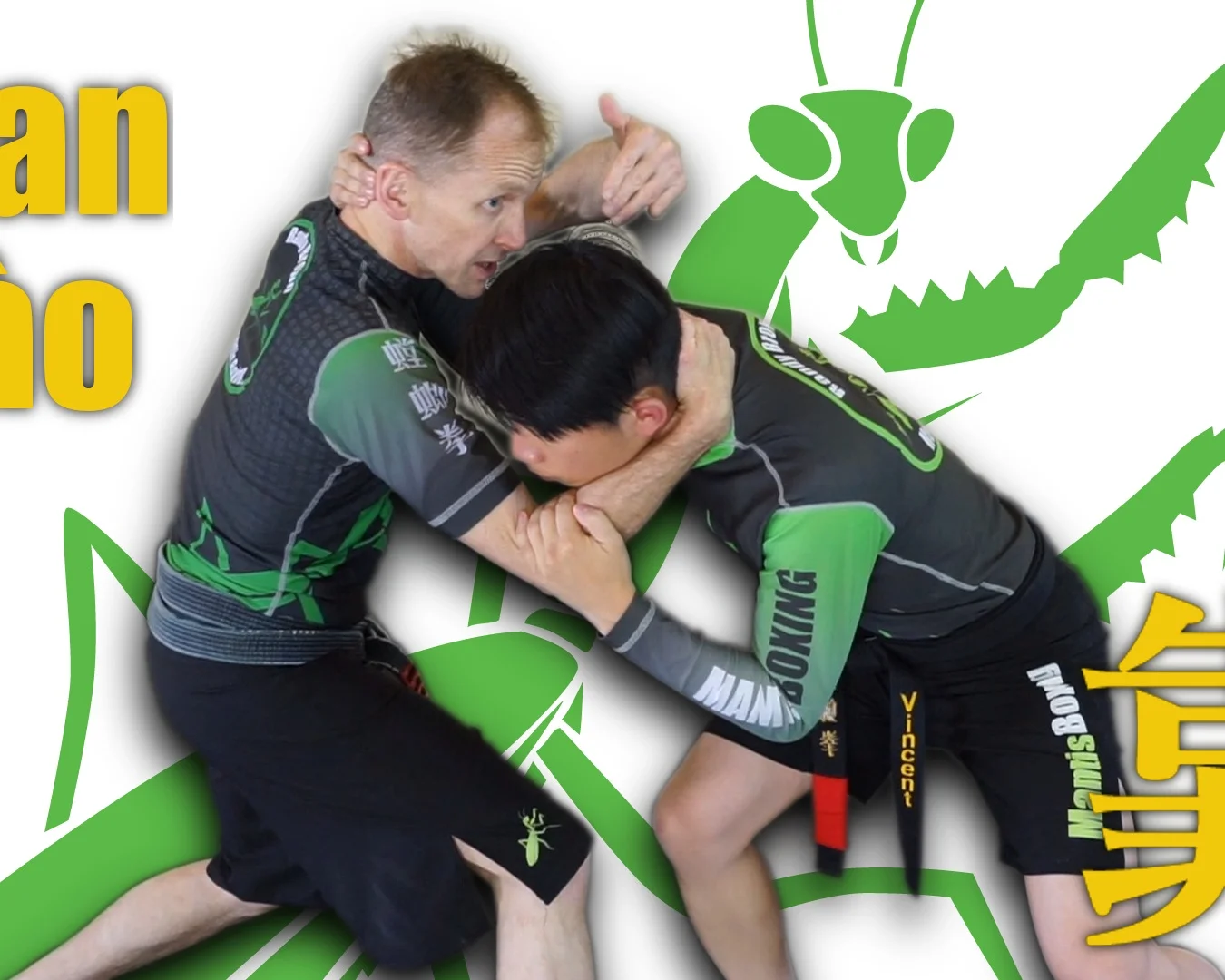
Lean (Kào 靠) - to lean against one’s opponent. Due to the heavy reliance upon grappling and clinchwork in Mantis Boxing, Kào is an important keyword when engaged close range with the enemy.
Postural Defense
Once we are entangled…
Lean (Kào 靠) - to lean against one’s opponent. Due to the heavy reliance upon grappling and clinchwork in Mantis Boxing, Kào is an important keyword when engaged close range with the enemy.
Postural Defense
Once we are entangled in the Clinch (Lǒu 摟), we lean in to protect our position, or risk being taken down, or pushed over. We use our foe as a support structure, leaning against them whilst engaged in grappling and clinchwork. This is synchronous with Adhere (Tiē 貼).
While we Adhere, we shore up our position by using Kào. If this becomes impossible, we should break range and secure a better position. Kào can shut down my opponent’s attempt at hip toss throws; dropping my CG making it difficult for him/her to get their hips (fulcrum) under my CG.
It also reduces chances for them using Crashing Tide; their posture would become compromised simply upon attempt. Another advantage provided by Kào, is buffering the double leg takedown. If we’re upright, our legs are within easy grasp, and shortens the time until their shoot. By leaning, I can sprawl easier and faster by dropping my CG and putting my weight down upon their shoulders.
Overall, if we can stay inside the clinch with a solid posture, and forward lean, we can use this pressure to time takedowns with applied force.
Applied Force
In addition to securing our position with solid posture, we can also use the shoulder to assist in our own throws. The shoulder is used heavily in a lean forward type motion to affect applied force. This assists in the execution of many takedowns such as Crashing Tide, Single and Double Leg Takedowns, Point at Star, Reaping Leg, Crane Spreads Wings, and more.

CRUSH (Bēng 崩) - 9 of 12 - The Keywords of Mantis Boxing
Crush (Bēng 崩) - to ‘collapse and fall into ruin’. Also known as 'crushing' in many Chinese Martial Arts usages. Bēng is used to attack the vital targets in the midsection of an opponent. Effective strike targets such as: the liver, stomach; ribs, and the real treasure - the solar plexus, or central palace in Taijiquan. All of these targets can…
Crush (Bēng 崩)
Crush (Bēng 崩) - to ‘collapse and fall into ruin’. Also known as 'crushing' in many Chinese Martial Arts usages. Bēng is used to attack the vital targets in the midsection of an opponent. Effective strike targets such as: the liver, stomach; ribs, and the real treasure - the solar plexus, or central palace in Taijiquan. All of these targets can disable an opponent with one hit. This is seen in countless boxing matches, UFC battles, Muay Thai fights, and Kickboxing bouts. What happens when you land a good strike on an opponent in one of these locations? They "collapse and fall into ruin".
Bēng, as a principle, can use a fist, a knee, a kick, all to accomplish the goal of - causing the opponent to - 'collapse, and fall into ruin'.
Aligning the Strike
If you examine the height of many of the stances found in Chinese Martial Arts forms, and in this case Bēng Bù, you'll see that the strike does not align with the opponent's face but rather with the solar plexus/lower rib region of a ‘standing’ opponent.
Dropping the stance aligns the punch to the effective strike targets (liver, stomach, solar plexus). Mantis Boxing uses the Horse-Riding Step (Mǎ Bù 吗步), Bow Step (Gōng Bù 弓步) to accomplish this alignment of the attack.
Punching to the face is certainly an effective attack, but it also hurts the striker if they aren't wrapping their hands, or wearing gloves. Styles of Karate have Makiwara boards, and Chinese Martial Arts has Iron Palm/Iron Fist to train the hands so as not to break/injure the bones while connecting with someone's hard skull.
Iron Fist training takes months/years to train. Conditioning the bones and skin is only accomplished through extreme dedication and commitment. It is faster to teach someone a technique to strike the vitals, meanwhile working on conditioning the hands for longer term strategies.
Keeping in mind: the human skull has evolved over millions of years to protect the brain inside of it. It's hard, and not meant to crumble at the first hint of danger. Quoting a bike-helmet study published in the Journal of Neurosurgery: Pediatrics, "235 kg (520 pounds) or 2,300 newtons of force would be needed to crush a human skull, almost twice as much force as human hands could possibly muster."
Plainly speaking, anyone who has punched another human in the skull with a bare hand can tell you - it hurts when you hit. Knowing this, it is easy to see why a striking principle like Bēng, is so prevalent in the martial arts.
One might be better served destroying an enemy in a soft target, rather than risk the injury of straight on face punching. This can be seen in other Mantis Boxing techniques aimed at the head region using alternate hand shapes: White Snake Spits Tongue, Spear Hand, Thrust Palm, Ear Claw, Slant Chop.
--
Leave your comments and questions below. Don't forget to SUBSCRIBE and GET HOOKED!

The Way of the Mantis Boxer
Check out this preview of an awesome video put together by…
Check out this preview of an awesome video put together by two of my students - Vincent Tseng, and Thomas McNair. They worked hard on this live format depiction of the 12 Keywords of Mantis Boxing.
Go to Vincent's channel to see the full video here - https://youtu.be/qPR83CZz8Bo.
More on the 12 Keywords of Mantis Boxing:
- Hook (Gōu 勾)
- Clinch (Lǒu 摟)
- Pluck (Cǎi 採)
- Connect (Zhān 粘)
- Cling (Nián 黏)
- Hang (Guà 掛)
- Wicked (Diāo 刁)
- Enter (Jìn 進)
- Crush (Bēng 崩)
- Strike (Dǎ 打)
- Adhere (Tiē 貼)
- Lean (Kào 靠)