

Failing to Learn: Encouraging Failure in Brazilian Jiu-Jitsu, MMA & other Combat Martial Arts to Fuel Success
Since it burst onto the public scene in the early 1990s, Brazilian Jiu-Jitsu has garnered immense respect worldwide for its efficacy. BJJ later gave rise to the entertainment industry known as MMA. However, adult practitioners of BJJ and other combat sports have an exceptionally high attrition rate.
Why does BJJ succeed at producing high levels of skill, but only for the select few who survive the gauntlet? Why is the retention rate so low, and what causes students of this esteemed art to fall by the wayside without achieving empowerment, fulfillment, and skill?
Randy Brown 2024
ABSTRACT FOR THE 9th Annual MARTIAL ARTS STUDIES CONFERENCE - CARDIFF, ENGLAND, UK
Since it burst onto the public scene in the early 1990s, Brazilian Jiu-Jitsu has garnered immense respect worldwide for its efficacy. BJJ later gave rise to the entertainment industry known as MMA. However, adult practitioners of BJJ and other combat sports have an exceptionally high attrition rate.
Why does BJJ succeed at producing high levels of skill, but only for the select few who survive the gauntlet? Why is the retention rate so low, and what causes students of this esteemed art to fall by the wayside without achieving empowerment, fulfillment, and skill?
A structural flaw in the training approach is frequently the primary cause alongside the many other reasons they may have. In contrast, an analysis of modern Eastern Martial Arts training methods that employ non-contact exercises, or cooperative/semi-cooperative drills such as push hands or sticky hands found in Chinese martial arts, frequently hold a higher retention level primarily mitigated by reducing the "cost of failure," but are not heralded for their efficacy in today's combat arenas.
The teaching concepts presented will demonstrate efficient ways to support students' failures during the learning process, coach them to view failure as a learning opportunity, and, indirectly, positively impact the atmosphere, culture, and degree of success that each student experiences when learning a martial art. Additionally, the concepts will highlight and/or eliminate elements that are highly detrimental to the teaching of practical self-defense techniques, student retention, and the empowerment of those who seek out martial arts instruction.
DISCLAIMER: The following paper was written for publication in 2024 based on personal experience in training and teaching kung fu, tai chi, tae kwon do, and Brazilian jiu-jitsu, 1991 to 2024. Attendees who were present for the 9th Annual Martial Arts Studies Conference in Cardiff, England, UK requested that I share this as a written paper. Although this was originally intended solely as a presentation, I was convinced by their strong voices that this information, and my reflection upon years of coaching and teaching would serve the broader Brazilian Jiu-Jitsu, MMA, and martial arts community at large. The following version is written for warriors and coaches. Those on the mats everyday who need this the most. A second scholarly version co-authored with David Glover, PhD., is in the final review stage. It will hopefully be coming out later this year (2026).
INTRODUCTION
Failure is a necessary component to human learning, we require it in order to find the optimal solutions and paths to navigate subjects we commit to learning. However, when we pull back the veil of excitement of said practice, and take a closer look at the martial art Brazilian Jiu-Jitsu (BJJ), and the intense training regimen commonplace in many gyms, it raises the question: 1) is there far too much failure baked into the learning process?, and 2) Is the training too costly physically, or emotionally to those who undertake it?
When examining the high attrition rates found within the style, especially when compared to traditional martial arts such as kung fu, karate, and taekwondo it exposes legitimate evidence indicating such. If this IS true, how can we still benefit from the use of failure in the learning process, but lower the physical and emotional cost, thereby helping more people reach their goals and enjoy the art?
BRAZILIAN JIU-JITSU RANKING STANDARDS
The following data is from my own gym. It is comprised of a relatively small sample size. I began tracking this data 8 to 10 years ago for the purposes of belt promotions. The data is incomplete. At times people joined my gym and left before I had updated my roster. The real numbers, are significantly worse than what I will show, yet these liberal numbers still lay bare a distinct problem that reaches well beyond my gym, and across the wider martial art world.
What caused me to examine this data, was a video with Rener Gracie discussing how only 10% of white belts achieve their first rank in BJJ - the Blue Belt. This encouraged me to look at my own data in comparison. It is important to recognize that this problem is not unique to BJJ but rather, any style of combat martial arts that introduces students to sparring at an early stage.
The ‘time in rank’ for Brazilian jiu-jitsu is based strictly on ‘minimum time in rank’ standards established by the IBJJF for their competitions, combined with arbitrary averages within my own gym and those I trained in on my way to black belt. ‘Time to promotion’ however, is completely subjective from coach to coach, gym to gym, and student to student.
The average time to achieve each rank:
Blue Belt - 2 to 4 years
Purple Belt - 3 to 6 years
Brown Belt - 7 to 8 years
Black Belt - 8 to 10 years
BJJ ATTRITION RATES
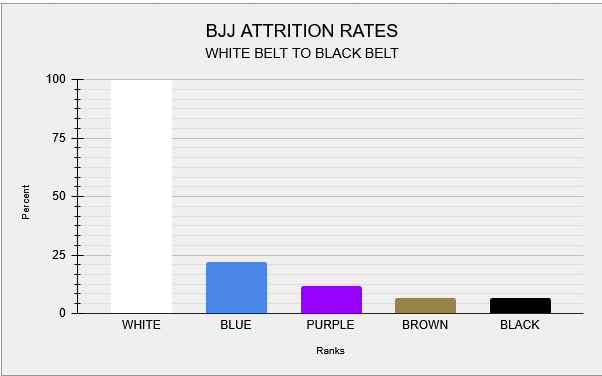
Attrition from rank to rank is seen in the chart below using the data from my own gym. These are the rates of attrition for each rank from white to black:
22% of white belts made it to their first rank of blue belt.
11.7% of white belts made it to purple belt, or 53% of blue belts.
6.5% of white belts made it to brown belt, or 56% of purple belts.
There was zero attrition from brown to black.
COMPARATIVE ANALYSIS FOR PERSPECTIVE - US ARMY SPECIAL FORCES
The US Army has a branch of special forces known colloquially as the Green Berets, named for the color and style of cap they wear with their uniforms. During the green beret selection process there is a phase of training designed to weed out and eliminate those who are unsuitable for the job. The success rate of people who pass this phase of training is, 40% on average (Pavelko, Jeff Lieutenant Colonel, 2017).
These are frontline war-fighters who use their combat skills day to day, often fighting when the rest of us are unaware battles are even underway. Juxtapose that with the average martial artist, who is undertaking their training as a hobby more than for immediate survival. Although survival and self-defense are still at the forefront of goals established by many practitioners, the necessity of using these skills in day to day life is often less imperative.
When we compare and contrast, Special Forces and Brazilian jiu-jitsu, it certainly raises a legitimate question – why are those who are using combat as a job, and going through a training phase designed to eliminate inadequate candidates, encountering a higher success rate than those engaging in the ‘sport/hobby’ of Brazilian jiu-jitsu? And by a magnitude of two to four times the success rate.
This observation, while idealistic, is based on the assumption that each professional Brazilian jiu-jitsu coach, those performing their duties for monetary gain, 1) by and large wishes to retain as many students as possible so as to make a living, and 2) help as many people as possible achieve their goals.
WHY DO PEOPLE START BRAZILIAN JIU-JITSU?
When interviewing new students, there are several reasons for individuals starting BJJ: self-defense, confidence, fitness, cool factor, friend, or family member showed them an inspiring technique, or ‘Joe Rogan told them they should’ on his highly successful podcast. Based on personal Interviews conducted with new prospects and students from 2011 to 2024 who came to my gym, the primary reason is for ‘self-defense’.
THE PURPLE BELT

At the rank of blue belt the average practitioner can do things in singular form in various instances in the fight – 1 submission, 1 escape, 1 guard pass, etc. However, when faced with adversity, strength, resistance, or an opponent who outweighs them or is much larger and/or stronger, the singular technique often fails to work and a backup is necessary.
The rank of purple belt is where we see the ability to adapt and overcome begin to really take hold. The ability to do things in series – a submission is countered, they have a back-up. The first escape attempt fails, they try another. They lose the dominant position, and immediately switch to a new position without hesitation, maintaining control over their foe. Boiled down, upon hitting a wall they are able to find another solution or, the capability to exhibit a level of control over an adversary and purchase ‘time’. Time to observe the problem, orient to a new position, decide, and attack. In my opinion these are necessary skills to adapt to the chaos of a violent attack.
Using the purple belt as the measure of success for helping students reach their goal of self-defense from BJJ training, we see that less than 12% met this goal.
WHY DO PEOPLE QUIT BJJ?
In exploring Brazilian jiu-jitsu we can separate the reasons practitioners quit into two larger categories: generic, and those specific to combat sports. The ‘generic’ category is comprised of attrition factors seen in any martial art or hobby. Especially ones that require such a lengthy commitment to achieve a high level of skill. These include:
Employment factors such as job relocation, promotions with larger time commitments, demotions, or job loss.
Family factors such as marriage, divorce, having children, or a family member who becomes ill and requires more care.
Financial factors like buying a home, or losing a home.
Declining health of the participant due to illness, or injury sustained outside of training.
Experimented with something new and decided it was not for them.
The reasons above are not of interest to us at this time for the purposes of this paper. The next category is of serious importance and central to the use of failure in the learning process of martial arts.
INJURIES - THE HIGH COSTS OF FAILURE IN BJJ
jensen-et-al-2017-table-1
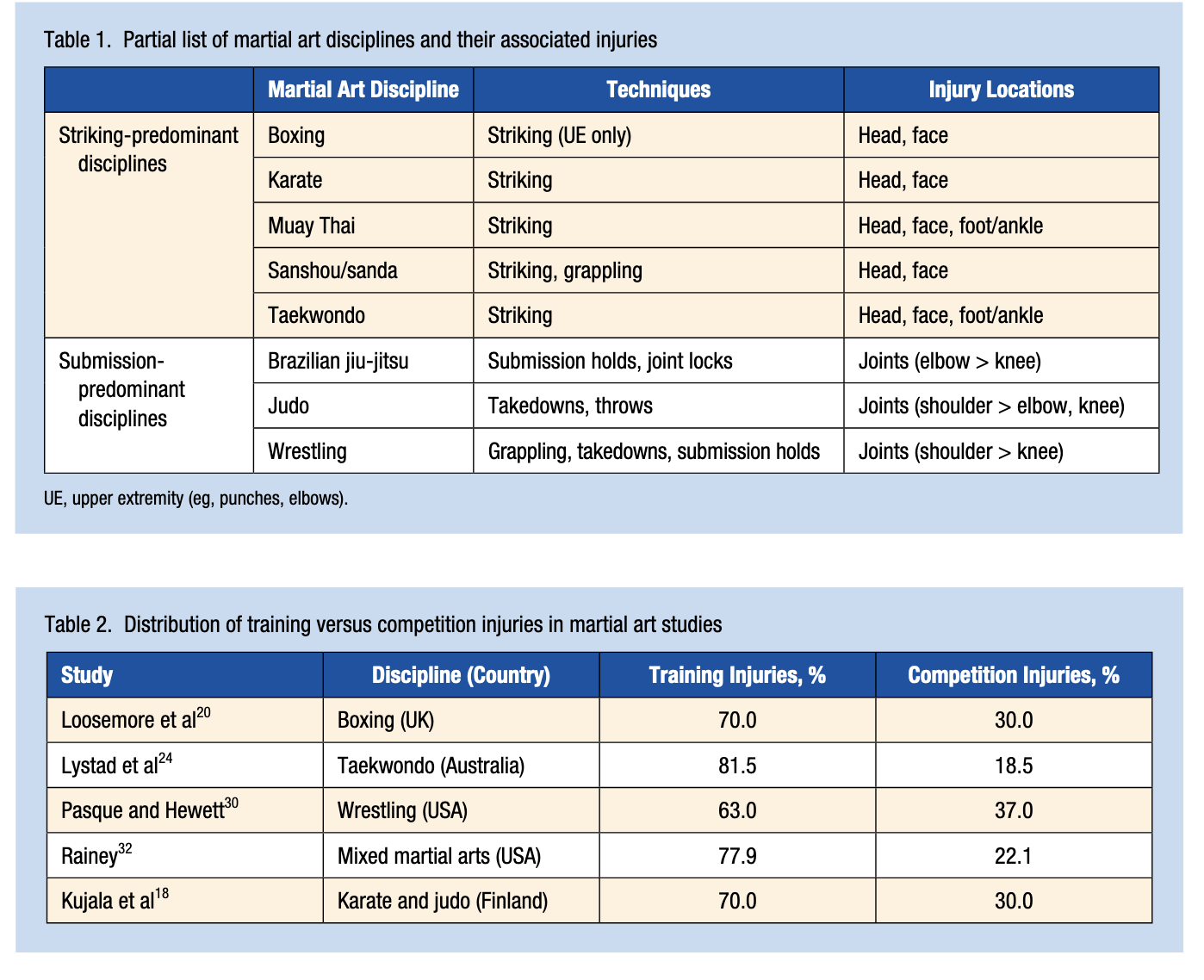
Injuries or, the fear of being injured, are primary culprits for people quitting and leaving BJJ. Even if they enjoy it. When we look around BJJ gyms, we see a bevy of taped fingers, braces for knees and elbows, and the odor of sports medicine sprays as ample evidence in support of this argument.
If a direct or severe injury is not sustained, it is the intensity in which some individuals train that causes the fear some individuals experience — a fear of getting injured. This will drive people to quit, or sit on the sidelines. Due to a majority of gyms taking a — ‘sport’ focus (no striking), it is commonplace to see aggression and intensity increased due to a false sense of security that is born of an environment free of strike-based attacks.
In other words, people take more risks (Risk Homeostasis), and execute the art with more strength and speed than they should. Falsely believing it is ok to execute sparring hard and fast because they’re not hitting one another. No one had a parent or driving instructor tell them when learning to drive, “Put the car in gear, now push that pedal on the right all the way to the floor.” This would quickly and magnificently end in a catastrophe. Going fast and hard on the mats creates a similar risk, albeit one that often takes longer to manifest into serious injury than doing so in a car.
BEHIND THE CURTAIN
My own injuries (of the more serious type), include — torn supraspinatus tendon, torn shoulder labrum, dislodged bone fragments (shoulder), advanced arthritis (shoulder), broken toes, ripped ear, crushed trachea — all before I ‘officially’ began BJJ training. These were my first three attempts at finding a Brazilian jiu-jitsu teacher/gym. Once I found a gym that was of a higher caliber, the injuries lessened but still occurred, as is par for the course.
Over the course of the next seven years while working toward my BJJ black belt, the following injuries were accumulated — torn left Lateral Collateral Ligament (down to fishing line), several broken toes, HPV contamination, broken teeth, numerous neck injuries. I later ended up with a torn right LCL after this period.
It is noteworthy to mention that all of the above happened during routine training regimens/sparring in the competition gym I trained in. I sustained no long term or significant injuries while: attending team trainings around New England, visiting gyms in other areas of the USA, BJJ training camps, or BJJ competitions. This does not indicate a problem in the gym I trained in, but rather the amount of time spent there versus the other venues.
In comparison, decades of mantis boxing/MMA landed me some scrapes, bruises, and a few concussions. Hundreds of hours of flight time in Hang-gliding/Para-Gliding since 2001 (arguably far more dangerous), has resulted in only a few minor injuries more akin to scrapes and bruises than anything severe.
WHY I SHOULD HAVE QUIT BJJ
The following essay details my initial, and catastrophic attempts at starting Brazilian Jiu-Jitsu. This is why I strongly advocate that you choose your martial arts based on 1) the coach, 2) the students/community, 3) the style. In that order. The essay provides insight into my motivations to being a better coach, and trying to share the art of BJJ with others, while reducing injuries and the fear of injuries.
A CURE, OR A POISON?
According to the Bureau of Justice Statistics which tracks victimization statistics in the USA annually, the likelihood of being the victim of stranger violence in 2026, is .0108%, or roughly 1 in 93.
With commonly accepted training practices found in BJJ gyms that include routine sparring, we can refer to studies done on ‘injuries in Brazilian Jiu-Jitsu’. These show that we have a 68% of being injured within a three year period (31% chance annually). Injuries that keep you from training for 2 weeks or more. This is further broken down — 79% of all BJJ injuries happen while sparring.
If the goal is self-defense, and the training has a 30x greater chance of hurting someone than they have of being the victim of a violent attack, it would indicate that the cure is worse than the disease, and that you are safer not training BJJ for self-defense purposes. It is my firm belief there are other highly important reasons to train BJJ and other combat sport martial arts aside from self-defense, which is beyond the scope of this paper. Comparing this data however is a reality-check when it comes to how we train, and should serve as the impetus for all of us who are coaches to do better at increasing retention and reducing injuries on the mats.
*This is a recent addition to the paper and links to the studies will be added shortly.
“BOYS DON’T CRY”
Humiliation is an often unspoken and more emotional reason practitioners have for quitting the art of BJJ. Tapping out, an action we perform when caught in a submission hold, is an admission to another person that they defeated us. While this is a necessary part of the learning process, so we may ‘learn from failure’, when an individual is first introduced to any combat art, but specifically Brazilian jiu-jitsu, “this can be an extremely humiliating process for those not accustomed to ‘failure as a learning tool’ modality.” (Eskreis-Winkler, L., & Fishbach, A. 2022). It offers further damage to the psyche if an individual is using everything they have, and it conjures nothing but defeat.
The following behaviors were witnessed when observing classmates in several BJJ gyms over the years — indicators such as – people repeatedly sitting out from rolling/sparring rounds any chance they can get, some leaving the mats rushing to the bathroom holding back tears, or at the outset of sparring rounds; asking another person — “Can we go really slow?” Expressing hesitation to spar/roll with certain individuals.
Another meme source in the BJJ online world — those who begin a round by listing several injuries they have, the purpose of which being — to secretly express a desire to not get hurt or humiliated, or a passive request for the other person to treat them with more care; especially when facing someone they perceive to have superior size, strength, skill, or aggression.
These factors are more emotional than physical, but become extremely important when presenting the argument that there is ‘too much failure’ in the process of learning BJJ. What is even more evident, is these last two examples often result in the person requesting to “go slow”, or listing their litany of injuries, goes into full attack mode as soon as the bell goes off. This is a clear sign of a lack of emotional control, and fear taking over, rather than some Machiavellian plan to defeat all teammates they encounter.
“Constant persistent failure is counter-productive to the learning process. If failure is persistent, especially when undertaking an activity with a high cost of failure like combat sports, then the probability a person will quit is exponentially higher.” (Lee, S., & Park, J. 2024) Pain, whether it is physical, mental, or emotional, is a natural enforcer to ‘stop’ the thing which is causing the pain.
Persistent failure falls in the mental and emotional categories, and therefore it is often overlooked by coaches, mentors, and even the individuals themselves who do not want to appear weak in the eyes of their peers, or mentors. This makes it extremely difficult for coaches to know the true reason a person has for quitting, as the individual is often reluctant to admit this, or they may not have processed exactly why in their own mind.
DEFENSIVE REACTION
A coach or mentor can easily dismiss a student as weaker, or too weak to handle the training, due to one or more of the factors above. Even becoming defensive when faced with this criticism or behavior rather than empathetic. Perceived more as a threat to their status, teaching method, and livelihood rather than a cry for help.
Appearing indifferent to the plight of the majority, one can see coaches and senior practitioners, myself included, entrench themselves in ideas such as: “It works for me.”, or “This is the way I was trained.”, or “This is the way we’ve always done it.”. Without realizing how many injuries we ourselves have sustained over time. Or recognizing that we are one bad injury away from being in a similar situation, or unable to do what we love. If a gym is successful financially, and their roster is full, there is little to no incentive to peel back the layers and look for a problem, or address these issues.
HIGHER RETENTION WITHIN TRADITIONAL CHINESE MARTIAL ARTS
If we contrast BJJ with traditional Chinese martial arts training, which typically includes the use of forms training (tao lu), shadow boxing, sticky hands (qi shou), and push hands (tui shou), we see much higher retention rates in the classes. The focus on solo skills training, movement patterns, or partner exercises produces an environment with a very low cost of failure. By and large when people quit in these gyms, it is due to one of the generic reasons above in my experience. Providing it is not an issue with the instructor or teammates. However, despite having a better retention rate there is an inherent problem with the transmission methods of Traditional Chinese Martial Arts. For that we first need to define what martial arts is.
WHAT IS MARTIAL ARTS?
The definition of martial arts itself is arbitrary, and subject to the viewpoints of the practitioner, training group, and coach. (Bowman, MAS 2024) Before delving into the deficiencies and failures of the modern-traditional Chinese martial arts curricula, I’ll establish a measurement criteria by defining what martial arts means (to me), and why the aforementioned goals individual students establish for beginning their martial arts training, are not being met according to these standards.
As a coach and practitioner I define martial arts using the following three criteria:
SEEKING WEAKNESS - the constant and never ending quest to find our own weaknesses in — skill, technique, timing, etc., and the overarching goal of shoring up these weaknesses once found. The mats/dojo/wuguan/training hall/garage/backyard, or wherever we train, this environment informs us of where we are deficient not only in hand-to-hand combat, or weapon combat, but likely it reflects and translates directly to psychological and emotional weaknesses we have off the mats in our day to day life. This constant struggle and exploration allows us a vehicle to continue to improve and strengthen who we are as human beings.
ORGANIZING CHAOS - the idea of a martial art itself as the ‘organization of chaos’. Fighting another human being can be defined as — ‘chaotic’. This word describes succinctly the randomness, challenges, and disarray that happens within combat with another human being. During the engagement we cannot possibly know what the other person will do, or how they will go about attacking us. Through training martial arts skills and techniques, controlling ourselves, our actions, tactics, positions, and emotions, we can limit the options available to an opponent. Thereby reducing the number of possibilities they have to attack us and organizing the chaos into a more manageable state.
INOCULATION TO METHODS OF VIOLENCE - the third definition of martial arts is the ‘inoculation to methods of violence’. Through trust in our partners and teammates we engage in the act of inoculating ourselves, and one another, to the wide range of possible attacks that could happen to us in a real world situation. This exposure allows us to learn and adapt appropriate responses to these acts of violence through repetition, and control failure. Training effective means of mitigating and possibly dominating these risky scenarios. Martial arts training halls ‘should be’ a safe environment where we can engage in such practices so as to build skills to deal with circumstances that could otherwise kill us outside of the training hall where ‘TAP!!!’ is no longer an option.
A martial art that fails to meet any or all of these criteria leaves the practitioner feeling insecure in their abilities, or provides a false confidence in one’s capabilities. Creating a ‘skills fantasy’ versus ‘skills actual’. When practitioners engage strictly in solo and restricted partner training routines found in Traditional Chinese Martial Arts (and others), they fail to achieve the goal of learning ‘self-defense’, as is evident by the lack of participation and/or success of Traditional Martial Arts in modern combat sport arenas, challenge matches by amateur fighters, and sparring.(See early UFC/MMA fights, challenge matches versus traditional ‘masters’ in China, et al Personal Experience sparring with taekwondo and kung fu from 1999 to 2006, and versus practitioners of these arts from 2006 to 2024)
These failures are not exclusive to specific styles, or schools of Asian martial arts. The same outcome can be reproduced when sparring with practitioners of combat sports such as: boxing, kickboxing, etc. from gyms that focus strictly on bag and mitt work, kickboxing workout classes with ‘no partner work or sparring’, and any other martial art style focused on technique and void of sparring.
To be fair, combat sports suffer their own inherent weaknesses due to overly specialized training. Training modalities that lock practitioners into sport rule-sets, reducing their exposure to the chaos they will likely face in a real world self-defense scenario.
“When faced with a situation outside of their specialty, an attack the martial artist has not been inoculated to, the fighter often hesitates, or pauses to question what is currently happening, or why they are not effective at their skills, etc.” (Buonomano 2012) This can place the combatant ‘behind in the fight’ versus an aggressor, who shows no such reluctance or hesitation in the battle.
Examples:
A boxer facing a kicker. Each time the boxer approaches, they get blasted in the leg. Unfamiliar with this attack due to sport rules, they hesitate, and question what just happened.
A Muay Thai fighter with a light fighting stance for mobility and kicking facing a Greco-Roman wrestler only interested in shooting the takedown. The muay thai fighter suddenly finds themselves on their back while getting smothered with pressure. With no tools to deal with this, delay, and likely panic sets in.
A BJJ Purple Belt with a focus on sport rules fighting a striker. They pull guard on the striker ready to go to work. The strike begins to ground and pound and the BJJ practitioner is now in uncharted territory with no map.
All of these scenarios reproduce similar outcomes. The mind of the fighter facing an unfamiliar, unscripted condition they have not been inoculated to. The fighter/grappler/wrestlre now falls back on whatever tools or attributes they had prior to gaining skills — speed and power. It is observed that quite often after being indoctrinated into sport fighting, the practitioner even forgets basic fighting and survival tools they may have used before taking up martial arts training e.g., hair pulling, groin strikes, eye pokes, etc.
WHY DO PEOPLE GET INJURED IN BJJ?
When people start Brazilian jiu-jitsu or any martial art, especially individuals with no prior training, there are two phenotypes, or innate attributes that have dramatic effects on sparring — 1) power, and 2) temperament, which manifests as speed. When a student is faced with stress, fatigue, fear, a lack of skill to deal with a situation, or the aggression or speed of a partner, or the perception of such even if it is not happening, then they will inherently fall back on using one or both of the aforementioned attributes as a survival mechanism. Therefore, the introduction of speed and power into the act of sparring in a gym is the primary culprit that leads to injuries and such a high cost of failure in Brazilian jiu-jitsu, and other combat sports such as MMA.
WHEN SUCCESS IS NOT SUCCESS
The use of ‘strength’ and/or ‘speed’ to bring success to prevent a ‘TAP!’, a hit, or a takedown, only reinforces to our brain that we are using the correct behavior/response to help us not just succeed, but more importantly — survive.
Example: A practitioner taps out a teammate four times in a rolling session. The following week the victim decides they are not going to get caught again by this person. They approach their next sparring session with all the resistance they can muster. If they are successful they reinforce the use of speed and power as behaviors, rather than skill. This delays the learning of skills. Additionally, they are vastly increasing the likelihood of injury as the person who was tapping them out is receiving that speed and power, and adds speed and power of their own. Couple that with some amount of skill and this leads to catastrophic injuries in a ‘learning’ environment.
THE FALLACY OF — ‘ALL OUT’ WAR
An all too common misconception with BJJ training that ripples throughout the community is as follows:
“What’s great about BJJ is that we can go 100%!”
This is categorically false and one of the primary culprits that leads to torn ligaments, shoulder injuries, blown knees, back hips/backs, and accidental collisions, e.g., when a knee is suddenly smashing in one’s face in an unintended transition. We only need to look at sports science for the first indication that this is the wrong way to approach training Brazilian Jiu-Jitsu. Good training is pushing an athlete into a 60 or 70% range, rather than trying to ‘max’ every workout.
This brings us to how to train in healthier ways not only for the body, but for the mind and spirit.
SOLUTIONS
How can we encourage failure in learning to fight while lowering the cost of failure, allowing students the freedom and enjoyment of training and gaining new skills? The following methods have been found in my own gym, to increase retention, drastically lessen injury and the fear of injury, as well as build improve teamwork and camaraderie on the mats for everyone in the class.
Although new numbers will take years for an accurate comparison, the following guidelines are the principles I use in my gym which have been successful at affecting positive change that was evident within months, and continues to show promise after now 4 years of using these methods:
PROBLEM SOLVE APPROACH - Present students with problems not solutions. Avoid over-coaching. Let people work together to solve problems and embrace the struggle together. This has shown increased ownership over the learning process and increases enjoyment of successes when they achieve them. We can accomplish this with a variety of methods: 1) show a move, let others figure it out, 2) set up a situation and ask them to try and solve it before revealing answers. Provide hints where needed, or to prevent massive detours down non-productive paths. Use a light touch.
CURRICULUM - Build a curriculum to teach by. An outline is sufficient, and does not need to be specific down to the lesson plan which can often put the teacher into a cruise control mode. Preventing innovative thought or organic evolution to the process that may spawn from a looser structure each time the same subject matter is taught. If I teach the same curriculum I developed 15 years ago, then I am failing to share 15 year of further growth, knowledge, development that I can bring to bear to help people avoid pitfalls and mistakes.
Brazilian jiu-jitsu is quite easy to build a curriculum for, especially for white belts. We use the 4 Dominant positions template - mount, side mount, back mount, guard (closed/open) as a platform. We add how to control someone, or positional control, a handful of submissions from each position, and then how to escape said position.
STAY ON TASK - Once we have a curriculum stay focused on each ground position for months before moving on. Start with solo drills to give students a way to practice off the mats, then introduce ‘one’ submission. Add from there week by week, all the while the student is getting reps on the moves they have already learned establishing pattern recognition (what to use where), gaining coordination, strength in the right places, learning to relax in the moves, and becoming adept at the technique while being exposed to other submissions they may never otherwise see. Repetition is the mother of all skill.
STRESS TEST - Prior to leaving a position behind, spend 1 to 2 weeks stress testing the position — ‘positional sparring’. Each student starts in the position and tries to pull off the submissions when the person under them, or in their guard, is non-compliant. Escapes work the same way. Using resistance to test the escape to see if they can still get out, or at least apply the correct principles under duress. While success here is welcome, it is not the point of the test. The goal here is to give the person exposure to what a resistant adversary feels like. Helping them understand that things are not always as easy as they appear without the risk of full on sparring.
NO STRINGS! - Avoid showing off some fancy move, or a high level sequence to set the person up to pull off a submission. After introducing a technique in this way, most students cannot execute the submission when the time comes in live rolling. All of the time and repetition was spent on the chain, or sequence that lead up to the submission or sweep, rather than on the submission itself. By showing chains of movements to arrive at the point of the lesson, we are only distracting them and inhibiting learning rather than instilling how to finish the move in the first place.
Example: We start our lesson off with something like — “Today we are going to work on the keylock (americana) from side control. Start in your opponent’s guard then grab the belt —> walk the knees back —> round the back to break the guard. Now knee slice pass to the side mount —> execute the keylock.”
This can be drilled for the usual 10 to 20 minutes before rolling begins. As soon as it is time to roll the outcome is more like this:
The student starts in guard, grabs the belt as they were shown, and the person under them punches them in the face. Now they are asking themselves what the hell just happened, and why the coach didn’t talk about that.
We can use sport rules only for the example:
The student starts in guard, grabs the belt to start their break, and the person on the bottom reaches into their collar and starts choking them. The same questions arise: “What do I do now?”, “Why didn’t the coach talk about this?”
Did the student go home that day remembering the keylock and how to execute it from side control? No. They instead went home thinking about all the times they were tapped out in the subsequent X number of rounds of sparring, and wondering what they can do to stop that from happening the next time. Are they learning through failure, and coming up with questions? Yes, but we’re not providing a new skill, but rather constantly putting out fires, and reinforcing the use of primitive skills, or attributes.DELAY SPARRING/ROLLING - Remove sparring for white belts until they have gone through the entire curriculum one time. For my gym this takes roughly 2 years for both the Mantis Boxing, and BJJ cycles. There is still periodic and strategic pressure testing with resistance drills, and positional sparring as I mentioned. This is by far the most important piece, and was the hardest for me to institute. I was not taught this way and refused for years to institute it in my own gym even though deep down I knew it was the right call. Once I took this step, change began almost immediately. This action allows for:
Ample time for students to replace ‘power’, and ‘speed’, with skill so when it comes time to spar, they do not fall back on the fight, flight, freeze response and rather, institute the new responses with the skills they’ve invested two years into learning.
Builds trust and camaraderie amongst teammates. Martial arts is an individual sport/activity vs a team sport like soccer, or football. However, we need a team, or partner(s) in order to progress and evolve. Without such we have very limited chance of successfully understanding these arts we practice. By removing sparring, and thereby developing skills and trust, the next step is possible. The introduction of sparring will require ultimate trust and strong bonds within teammates, or we risk backsliding into raw emotion and out of control bouts within the gym.
MENTOR SPARRING - Once a student has gone through the curriculum one complete cycle institute mentor sparring to help them achieve pattern recognition and acclimate to all the moving parts working together. Mentor sparring is established with the following parameters:
One-Offense / One-Defense: Before the round starts establish ‘one person on offense’, and ‘one person on defense’ parameter. This can be determined by the participants or coach, and allows each person to know what their primary role is. This prevents accidental clashing where both sides are competing for position and are failing to help one another, increasing the likelihood of injury with those new to sparring.
Setups: The mentor sets up opportunities for the newer individual to apply skills they have learned. Examples of this are: they are in the mount and they leave their arm out so the person sees the arm bar. Another would be rolling to the turtle to give the person an opportunity to take the back, and then execute the lion killer choke after rolling them. Dropping a hand to leave the head open for a strike. This is done in a variety of situations on an as needed basis.
Pauses: The mentor pauses in positions their partner fails to recognize, or when a mistake is made, giving the student time to recognize the pattern and take action. The lower the skill level the longer the gaps. A purple belt may still need a pause to assimilate a new skill learned, but likely the gap will be much smaller than that same move for a white belt. No matter what rank or skill level, if the fighter is not recognizing the pattern, and definitely does not know what to do in that situation, the mentor can then give them a nudge, or a hint as to what they are missing so they can recognize the next time. Good practice is for the mentor to set up that same situation a couple more times (if time allows in the round), so the person can repeat the correct solution.
No Gear!: If striking and kicking are part of your training, remove all pads and gloves from the sparring rounds. Gloves, helmets, pads result in people taking more risks in sparring. This is known as ‘Risk Homeostasis’ and is well studied in football and driving. Additionally, within combat sports, it is my experience that helmets, pads, and gloves cause people to hit harder and go faster. Each time they hit someone, they do not get the expected response (pain and disruption), so they naturally add more intensity in order to compensate. Not only do helmets specifically, encourage injuries (concussions & CTE), the use of them retards the learning rather than encouraging it. People take more risks and eat more punches, mistakenly thinking they are ‘protected’.
Speed: In BJJ I recommend 40 to 50% as the upper limit of intensity and speed for high level practitioners to avoid injuries and keep the stress level low for optimal learning. This is what is often referred to as ‘flow rolling’. With newer practitioners lowering that to 20 to 30% is better for their experience and progression. When people begin sparring, it may be necessary to keep it to 5 to 10% in order for their minds to catch up.
White Belts — 5 to 10%
Blue Belts — 20 to 30%
Purple Belts — 30 to 40%
Brown/Black Belts — 40 to 50%
Stress Test: Slow to learn, fast to test. When do we go 100%? In competition or real-world altercations ONLY. In the gym? Never. When striking, kicking, and throwing — Full power/speed can be viewed as the equivalent of training with live bullets. When ground grappling — during positional sparring stress testing, with caveats. When the practitioners are isolated and there is less movement involved it is possible with good teamwork to push the edge and maximize resistance. If executing escapes from an inferior position for example, upon successful escape the position is ‘reset’, the test is started anew. There is no opportunity for continuation and therefore it reduces the likelihood of accidental injury.
De-escalation Method: Even under the best circumstances humans have bad days, or there is something in our past that is revealed on the mats and causes us to overreact, or unintentionally speed up or use more force. While slowing ourselves down can sometimes be enough, there is a safety risk in doing so and we must be careful when attempting that. The preferred method is:
When faced with a teammate showing clear signs of duress, the following ‘unorthodox’ technique is used to bring them back to center. Start talking to them while sparring, or say you need a break for a minute. Begin small talk such as — “What did you do this weekend?”, “Seen any good movies as of late?”, or “Is this a busy time of year for you?” There are many such questions, the key is to take their mind off of the current fixation and allow them to relax and use skills.
We have used this heavily in our gym over the years. This tool is used more frequently when trying to get people sparring earlier, before they have had time to replace instinct with skill.
RESULTS AND CLOSING STATEMENTS
In closing, I challenge that we must ask ourselves who is setting these standards of what Brazilian jiu-jitsu training looks like? Who is running classes and coaching others? Whose job is it to help the students reach their goals? Who continues to perpetuate this ineffective cycle? It is not the 94% who quit along the way. It is not even the 6.5% that made it to black belt as not all of them go on to teach. It is the even smaller percentage that go on to coach. Change must start with us.
A majority of practitioners are not trying to be the best competition jiu-jitsu grappler in the world, and yet our training practices and sparring formats exhibit such patterns, and our attrition is worse than the elite military units. Without self-reflection, interviewing students who leave, or taking stock of retention data, we as coaches can become entrenched in the status quo. “It worked for us so why is this a problem?”
We made it through the gauntlet, and it feels good to be a member of such an elite group of people that made it to the highest levels of BJJ, one of the few who overcame a monumentally difficult task over such a long period of time and in the face of extreme adversity. Yet, is the destruction of bodies, minds, and spirits, in our purview of coaching and teaching others the art of Brazilian jiu-jitsu? Or is our objective to help students achieve success and reach their own goals of learning to defend themselves?
It is unrealistic and idealistic to believe we can eliminate all injury from martial arts training, but we can vastly decrease the propensity for such, while reaping the benefits from sparring. Over the past two years I have instituted the changes I laid out above. It has shown my students, those who I am fortunate enough to get to teach, that sparring can be fun. An activity we enjoy and learn more from than any other part of our training. It is the glue that binds our skills, teaches us to adapt, and produces confidence in our abilities. And we have shown it can be done without compromising efficacy, while also reducing injuries, improving confidence, and building solid skills across the entire team.
We have witnessed an epic change in the atmosphere of the team these past couple years. We graduated a crew of 5 new blue belts, all with increased competency. Each of them acclimated well to the sparring classes, and rely on skills when they spar rather than using speed and power as their primary tools. Camaraderie is now the norm, rather than competition. Team members have become invested in one another's success, not just their own and by proxy the failure of others they train with, and constantly compete against.
We replaced power and speed with skill, and skill is the new normal. Knowledge, understanding and abilities have gone up drastically, and retention, even though it will be years to compare the data, has flipped 180 degrees.
References
Zhou, Q., Mao, J. Y., & Tang, F. (2020). Don't Be Afraid to Fail Because You Can Learn From It! How Intrinsic Motivation Leads to Enhanced Self-Development and Benevolent Leadership as a Boundary Condition. Frontiers in psychology, 11, 699. https://doi.org/10.3389/fpsyg.2020.00699
International Brazilian Jiu-Jitsu Federation (IBJJF) (2013-2024). Graduation Standards. https://ibjjf.com/graduation-system
Pavelko, Jeff Lieutenant Colonel (2017). US Special Operations Command, USSOCOM IMPLEMENTATION PLAN PROGRESS, 6 (SFAS Table 2012-2015 et al). https://dacowits.defense.gov/Portals/48/Documents/General%20Documents/RFI%20Docs/June2017/SOCOM%20RFI%202.pdf
Eskreis-Winkler, L., & Fishbach, A. (2022). You Think Failure Is Hard? So Is Learning From It. Perspectives on Psychological Science, 17(6), 1511-1524.https://doi.org/10.1177/17456916211059817
Lee, S., & Park, J. (2024). Giving up learning from failures? An examination of learning from one's own failures in the context of heart surgeons. Strategic Management Journal, 1–32. https://doi.org/10.1002/smj.3609
Russel, Stuart; Norvig, Peter (1995) Artificial Intelligence: A Modern Approach, Prentice Hall.
Ibrahim Abou Halloun, David Hestenes; The initial knowledge state of college physics students. Am. J. Phys. 1 November 1985; 53 (11): 1043–1055.https://doi.org/10.1119/1.14030
Ibrahim Abou Halloun, David Hestenes; Common sense concepts about motion. Am. J. Phys. 1 November 1985; 53 (11): 1056–1065.https://doi.org/10.1119/1.14031
David Hestenes; Toward a modeling theory of physics instruction. Am. J. Phys. 1 May 1987; 55 (5): 440–454.https://doi.org/10.1119/1.15129
Hanford, Emily (Host). (2012) Physicists Seek To Lose The Lecture As Teaching Tool [Audio Podcast]. National Public Radio. https://www.npr.org/2012/01/01/144550920/physicists-seek-to-lose-the-lecture-as-teaching-tool
Buonomano, Dean (2012) Brain Bugs: How the Brain's Flaws Shape Our Lives, W.W. Norton & Company
Bowman, Paul (2024). Opening Talk Martial Arts Studies Conference 2024, Cardiff University, Cardiff, UK. https://youtu.be/PuTWMS0z1XQ?si=hsdyKJsFjbpAiZnS
Naureen, Z., Perrone, M., Paolacci, S., Maltese, P. E., Dhuli, K., Kurti, D., Dautaj, A., Miotto, R., Casadei, A., Fioretti, B., Beccari, T., Romeo, F., & Bertelli, M. (2020). Genetic test for the personalization of sport training. Acta bio-medica : Atenei Parmensis, 91(13-S), e2020012. https://doi.org/10.23750/abm.v91i13-S.10593
Varillas-Delgado, D., Del Coso, J., Gutiérrez-Hellín, J., Aguilar-Navarro, M., Muñoz, A., Maestro, A., & Morencos, E. (2022). Genetics and sports performance: the present and future in the identification of talent for sports based on DNA testing. European journal of applied physiology, 122(8), 1811–1830. https://doi.org/10.1007/s00421-022-04945-z

Are Head Hits in Boxing/MMA Good or Bad? The Truth...
Is getting hit in the head bad for us when we train in martial arts such as boxing, MMA, kickboxing, karate, muay thai, etc.??? Here is how I see it, and what I did to my students to make them train smarter. Being educated on the truth can keep us training safe for years to come.
Is getting hit in the head bad for us when we train in martial arts such as boxing, MMA, kickboxing, karate, muay thai, etc.??? Here is how I see it, and what I did to my students to make them train smarter. Being educated on the truth can keep us training safe for years to come.

The Art of Counter-Striking
There are two types of fighters - offensive fighters, and counter-fighters. A list of descriptors for offensive fighters is comprised of - aggressive, confrontational, type-A personality, control freaks, etc. On the inverse, the counter-fighter may be described as - laid back, docile, relaxed, non-confrontational. I contest that, no matter what your style of fighting is, I will make the case that the counter-striking skills are crucial to both camps of fighters. For now, if you are an offensive fighter, skip ahead to the section below on Offensive Fighters. If you are a Counter-Fighter, then carry on to the next paragraph.

photo by Max Kotchouro
There are two types of fighters - offensive fighters, and counter-fighters. A list of descriptors that may indicate we are an offensive style fighter are comprised of, but not limited to - competitive, aggressive, confrontational, type-A personality, control freak. We know who we are! On the inverse, if we’re a counter-fighter, we may be described as - laid back, docile, relaxed, non-confrontational. I contest that, no matter what our style of fighting is, counter-striking skills are crucial to both camps of fighters. For now, if you are an offensive fighter, skip ahead to the section below on offensive fighters. If you are a counter-fighter, then continue on to the next paragraph.
Counter-Fighters
If we are a counter-fighter, then the following techniques are going to be our bread and butter. We are the ‘shield-bearers’, the ‘defenders’. After we attain a base proficiency in blocking then we will need to immediately gravitate towards applying counter-strikes. We cannot defend, or retreat forever. In order to prevent our aggressor from becoming emboldened and running us down, we need to hit them back from time to time to send a message.
What defines “a base proficiency in blocking?” This manifests from learning to trust our blocks; an absolutely crucial facet to counter-striking strategy. Slipping and ducking can apply here as well. When we’re new to the striking arts we learn to block, slip, duck, dodge, but in the interim we usually have one, and only one gear we know how to use in regards to our footwork - reverse. This is OK at first, as it hedges our bets on blocking and keeps us at a safer distance. Meaning we can block, but we’re essentially neutralizing our opponents attack with our footwork at the same time.
If we examine this move for move, our opponent advances with a strike and our footwork, ‘could’, if properly timed and spaced, eliminate the need to block. While this is a fair tactic, we cannot backup forever and our opponent can move forward further and faster than we can move backwards.
The solution comes down to taming our fear, or attaining some semblance of emotional control. We do this by either learning to take a punch (an ill advised solution), or by gaining proficiency in blocking, slipping, ducking, or a combination thereof. The latter cogent so that our defensive deflection is dependable and worthy of trust. Once we have achieved this skill, then we can venture forth into the counter techniques shown further below. First, we need to address those offensive fighters, whose skills are also necessary to us when faced off against another counter-fighter. Otherwise…there is just an uncomfortable stare down.
Offensive Fighters
If we’re an offensive fighter then our strategy/tactics/game are comprised of - going in, stealing the initiative; or obtaining the first-strike. Unsettling our opponent so they cannot gain first-strike capability on us. We prefer to dictate the pace and energy of the fight. For us, bridging tactics, rather than counter-striking are the key to our survival; the primary swords in our arsenal. In a battlefield scenario, we are the ‘cavalry’, or the ‘archers’. We launch the preliminary attack, engaging the enemy, gaining initiative, and disrupting their defense.
Let’s examine this more closely in a play by play:
We launch our first-strike attack on our opponent.
As we enter the fray they blast us in the leg with a powerful round kick to the soft tissue of the quadricep muscle (think charly horse). Or equally destructive, the femoral nerve on the inside of the thigh.
This counter-attack stops us in our tracks and we miss our attack opportunity, opting to retreat and recover our position instead of pressing forth.
The second attempt…ends with the same result. If our opponent is good, then they nailed us in the same target as the first time.
We may muster the courage to try once more with the same assault. For the sake of this scenario, we meet the same fate for the third time. Our leg is now feeling like rubber and we decide at this point to stop pressing the attack and try to nurse our wounds.
What’s next? Scroll back up to the section on counter-fighting because we just got schooled on why, as offensive fighters, we need to have a counter-striking game in our arsenal. Our opponent just turned us into a counter-fighter.
Counter-Strike Setups
In order to develop counter-striking as an intrinsic part of our game, there are some simple counters we can start with. From there we can increase the complexity. Let’s start with counters found in some of the old mantis boxing forms such as ‘upper block/punch’, and ‘upper block/chop’, and more:
Starter Counters
Upper Block to Straight Punch, or Thrust Palm
Upper Block to Chopping Fist (Hammer Fist)
White Snake Spits Tongue - Circle In Block to Spear Hand, or Eye Plunder
Circle In Block to Thrust Palm
Circle Out Block to Ear Claw
These are simple retaliatory strikes that flow naturally off of the blocks they accompany. The key to success with these counters is more about timing, proper range (may need to close the gap as part of the counter), and seeing them real time. The last being the most difficult, and only manifests from experience drilling with feeders, and light sparring.
Adding Complexity
The following are simple counters but rely heavily on an advanced awareness of our enemies position, proper guard, good blocks, and the aforementioned timing and awareness. The overall feeder (strike thrown from the opponent) that we’re looking for is easy, but reconnoitering the enemy footwork prior to execution is critical.
In regards to executing these techniques, it is imperative that the defensive guard facets of our game are in place before applying the following counters. See further below for common fail points with these two techniques. Hint: usually attributed to a failed guard component.
These next two counters are also prevalent in mantis boxing forms that have been handed down over the generations. They are, in my opinion, some of the better counters but they are mutually exclusive; related to one another only in a general category of counter-strikes, as they require unique entries by our opponent.
Monkey Steals Peach - Opposite Arm Attack
The setup we’re looking for to initiate monkey steals peach is as follows:
My left foot is forward and my opponent is matching/mirroring my stance with their left foot forward.
The strike initiates from their left (lead/opposite) hand as they shuffle in. As you’ll see in the video, use a parry (not a block) combined with a cross circle step to their outside line.
Counter with a groin slap.
Alternatively, my opponent is instead starting from a southpaw stance. In this case I would need them to step in vs shuffle in with their opposite hand (left hand strike in our example above). The end result is the same, I get the opposing arm and foot leading the charge.
Crazy Ghost Fist - Same Side Arm
The setup for crazy ghost fist is as follows:
My left foot is forward. My opponent’s right foot is forward placing us in a southpaw position.
The strike initiates from their right hand as they shuffle in. I use a parry rather than a block, guiding the hand off to the side, being sure not to aggressively push it away. This will cause my body to twist up and reduce my counter-punch power.
Coordinate the parry with a slip offline toward the outside of their lead (right) foot.
Shuffle forward and counter with cannon fist to the liver.
As with monkey steals peach, an alternate setup is for the opponent to start with left foot forward, but they step in, rather than shuffle in. We end up with the same right arm/right foot combo we need for the counter-strike opportunity to manifest.

Scenarios
When and where to apply monkey steals peach (MSP) vs crazy ghost fist (CGF).
A. CGF - opponent shuffles forward with lead hand strike from southpaw stance.
B. MSP - opponent steps in with a rear hand strike from southpaw stance.
C. CGF - opponent steps in with rear hand strike from matched stance.
D. MSP - opponent shuffles in with lead hand strike from matched stance.
Common Fail Points
Guard
In order to apply counters successfully, especially monkey steals peach and crazy ghost fist, our guard must be intact and operating to maximum efficiency. With even one component of our guard out of place things unravel very quickly when trying to block, never mind trying to apply a counter-strike. It is possible to trade shot for shot while staying in the pocket, but this is ill advised especially against a larger, stronger, or more skilled opponent. Proper guard positioning will not only shut down many of our openings, but also lead to a successful block|counter response.
Guard Components:
Hands up - fingertips no higher than eyebrows. Preferably lower.
Elbows tucked - covers the liver and stomach targets
Staggered arms - 1 arm in, 1 arm out. This is assisted by a bladed body position and staggered stance.
Shoulder Line - our hands are lined up on the opponents shoulders creating an open channel down the centerCrossing Zones
This is usually a bi-product of our guard failing. Having to cross zones in order to block because our hands were down, or not lined up with the opponents shoulders. Crossing zones ties up our arms and forces us into awkward positions that spin wildly out of control. We’re forced at this point to bail out if we can, and try to reset our position to neutral.
Out of Neutral Position
Allowing the opponent to gain our centerline before they close range can lead to a crisis we have to contend with rather than looking for counter-strikes. While it is still possible to counter from a bad angle, our position is so poor that our strike will lack power and we’ll quickly pay for any minor success by stumbling, falling, tripping, or succumbing to the rain of blows that is sure to follow from our opponents superior positioning. It is imperative we pay close attention to keeping neutral positioning until the engagement takes place.

Double Seal Hands
It may not happen often, but when it does, it's good to have an answer for it. We're in the flank position, and our opponent is holding our wrists to shut down strikes. We're not in a good position for knees, elbows, or kicks. Many of the throws (Shuāi 摔) in our arsenal are shut down. What do we do?
It may not happen often, but when it does, it's good to have an answer for it. We're in the flank position, and our opponent is holding our wrists to shut down strikes. We're not in a good position for knees, elbows, or kicks. Many of the throws (Shuāi 摔) in our arsenal are shut down. What do we do?
Double Seal Hands! This armbar/joint lock setup (Chin Na or Qín Ná 擒拿) can be highly destructive to our opponent, and get us out of a bind and put them into one. There's a nice throw component I'll show that you can add on to the arm bar as well.
--
Leave your comments and questions below. Want more videos like this? SUBSCRIBE and GET HOOKED!
►Listen to PODCAST: https://randybrownmantisboxing.com/swamp-talks-podcast/

Wicked BJJ Clock Choke
I spent some time last year adding the clock choke into my game. It's an awesome submission and one I had never really used until early last year. It became quite useful when attacking people's turtle defense.
After using it repeatedly, I ended up in side control with…
‘Wicked’ is one of the keywords in Mantis Boxing. It has to do with trickery such as fakes, feints, distractions, or setting up the opponent to get what we want. It applies heavily to this clock choke setup and you'll see why.
I spent some time last year adding the clock choke into my game. It's an awesome submission and one I had never really used until early last year. It became quite useful when attacking people's turtle defense.
After using it repeatedly, I ended up in side control with Chris one day. Chris is pretty sensitive to when the armbar is coming from side mount, and good at escaping it.
Rather than risk giving up the dominant position, I kept pressure on his back and looked for the lapel. He now has nowhere to turn except to the turtle. Once he turns all-four, snag the wrist and the clock choke is setup. I enjoyed working this one and thought I'd share it with you guys.

Seize Leg - Mantis Heel Kick Defense
I absolutely love this heel kick defense. My favorite one to practice, as you'll see in the video; thank you Thomas! There are two variations of this depending on…
I absolutely love this heel kick defense. My favorite one to practice, as you'll see in the video; thank you Thomas! There are two variations of this depending on the leg the opponent kicks with, and whether we end up on the inside or outside position.
Some clear distinctions:
Variation I (above) - uses the chopping hand to clear as we are cutting across the chest to get the sweep.
Variation II (below) - uses Inverted Mantis Neck Hook. The chopping hand won't work here because of the neck angle, so the Mantis Hook is used to catch the neck and unbalance them for the sweep.
For some of my personal notes on Seize Leg and where it shows up in Mantis Boxing forms, check out my backer page. You get early access to videos, and exclusive content for joining.

Tame Tiger - Heel Kick Defense
Here's a great counter to the heel kick. This move is actually inside Tai Ji Quan forms, but I adopted into my Mantis Boxing system after seeing it in Muay Thai and realizing what it was. It's an awesome counter/defense against the heel kick, and definitely one I want in my arsenal.
There are some nuances to it, and inside this video I'll highlight 3 fail points that are common and how to avoid them. Check it out.
Here's a great counter to the heel kick. This move is actually inside Tai Ji Quan forms, but I adopted into my Mantis Boxing system after seeing it in Muay Thai. It's an awesome counter/defense against the heel kick, and definitely one I want in my arsenal.
There are some nuances to it, and inside this video I'll highlight 3 fail points that are common and how to avoid them. Check it out.
Oh, and Thomas really took one for the team on this video, so be sure to give him a shout out in the comment section.
--
Leave your comments and questions below.
Want more content like this? SUBSCRIBE and GET HOOKED!
►SUBSCRIBE on YouTube: https://www.youtube.com/mantisboxers
►Join My Mantis Boxing Online Community

LEAN (Kào 靠) - 12 of 12 - The Keywords of Mantis Boxing
Lean (Kào 靠) - to lean against one’s opponent. Due to the heavy reliance upon grappling and clinchwork in Mantis Boxing, Kào is an important keyword when engaged close range with the enemy.
Postural Defense
Once we are entangled…
Lean (Kào 靠) - to lean against one’s opponent. Due to the heavy reliance upon grappling and clinchwork in Mantis Boxing, Kào is an important keyword when engaged close range with the enemy.
Postural Defense
Once we are entangled in the Clinch (Lǒu 摟), we lean in to protect our position, or risk being taken down, or pushed over. We use our foe as a support structure, leaning against them whilst engaged in grappling and clinchwork. This is synchronous with Adhere (Tiē 貼).
While we Adhere, we shore up our position by using Kào. If this becomes impossible, we should break range and secure a better position. Kào can shut down my opponent’s attempt at hip toss throws; dropping my CG making it difficult for him/her to get their hips (fulcrum) under my CG.
It also reduces chances for them using Crashing Tide; their posture would become compromised simply upon attempt. Another advantage provided by Kào, is buffering the double leg takedown. If we’re upright, our legs are within easy grasp, and shortens the time until their shoot. By leaning, I can sprawl easier and faster by dropping my CG and putting my weight down upon their shoulders.
Overall, if we can stay inside the clinch with a solid posture, and forward lean, we can use this pressure to time takedowns with applied force.
Applied Force
In addition to securing our position with solid posture, we can also use the shoulder to assist in our own throws. The shoulder is used heavily in a lean forward type motion to affect applied force. This assists in the execution of many takedowns such as Crashing Tide, Single and Double Leg Takedowns, Point at Star, Reaping Leg, Crane Spreads Wings, and more.

What Type of Gloves Should You Train With?
MMA Gloves or Boxing Gloves? Which should you train with? This is a great question we are going to tackle today in this new Swamp Talks. The type of glove we use in training…
MMA Gloves or Boxing Gloves? Which glove should you train with?
This is a great question we are going to tackle today. The type of glove we use in training, can have adverse affects on our skills. It's important to know the difference and choose the right glove, for the right goals we are trying to achieve.
What's the difference between and MMA vs Boxing Glove? Why should we be concerned with it? Check out this video to find out.

Going Nerd Level on Blocking
Today I'm going NERD LEVEL on blocking. This is an interesting detail I found that can make or break your blocking. I can't explain the why, so I'm calling on all…
Today I'm going NERD LEVEL on blocking. This is an interesting detail I found that can make or break your blocking. I can't explain the why, so I'm calling on all anatomy/physiology experts out there to come up with an answer, and leave it in the comments section.
When using Guard Principle (one-in-one-out), we know that we have to bring one hand back when the other goes out. This is relevant to both striking, and blocking. What I find fascinating, is that the lead arm actually goes dead when the rear arm fires. After years of doing this, and countless number of punches coming at my head, I noticed this 'lag', and dull response time, and paid close attention to it.
If you have expertise in this field, and can provide a thoughtful, educated reason for it, I'd love to hear it. Please leave it in the comments section below so we can all benefit from it.
Now, on to the important part - not getting hit! Follow the principle shown when you're firing punches, or blocks, and this problem goes away. We do not need a partner to fix this. Practice the Guard Principle while performing shadow boxing, bag work, and 3-level blocking and you can train your hand to respond as needed.

6 Positions of Side Control - How to Drill and Improve BJJ Side Mount
My Brazilian Jiu-Jitsu teacher (Andre 'Dedeco' Almeida) showed me this awesome Side Control drill when I was a new White Belt. It is one of the best drills I've seen for…
My Brazilian Jiu-Jitsu teacher (Andre 'Dedeco' Almeida) showed me this awesome Side Control drill when I was a new White Belt. It is one of the best drills I've seen for training Side Control/Side Mount and really emphasizes the necessity for each position. I use this drill to this day as warm-ups in my classes, and pass it on to benefit my students.
The drill connects various positions by number which is a big help. We need each of these in order to control our opponent on the ground when we have side control/side mount.
The drill works not only a solid position, but also the transitions from one to the next. You can increase the complexity of the drill by having your training partner call out the number and you go to that position. Once you have the drill down, randomize those numbers to make it harder.
Note: Position 6 is technically not Side Control, it is known as North/South, but it makes an excellent addition to the drill, and something we often need when trying to maintain side control and someone is getting out.
You can train this with a partner for best results, or with a throwing dummy, punching bag, or body pillow. Enjoy the drill!

How and When to Stand Up in a Fight
Team Note: I know many of you who train with me will enjoy this video. Truth be told, I wish we had done it years ago because it is so fundamentally important. There isn't enough time in the day to practice everything, so feel free to take this and practice it whenever you can, and as much as you want.
Video Description: Whether we like it or not, sometimes we end up on the ground in a fight/altercation, or just a dangerous situation. When and how we stand up, can mean the difference between success and fail. Here are some tips for standing up when someone is waiting to pounce.
Team Note: I know many of you who train with me will enjoy this video. Truth be told, I wish we had done it years ago because it is so fundamentally important. There isn't enough time in the day to practice everything, so feel free to take this and practice it whenever you can, and as much as you want.
Video Description: Whether we like it or not, sometimes we end up on the ground in a fight/altercation, or just a dangerous situation. When and how we stand up, can mean the difference between success and fail. Here are some tips for standing up when someone is waiting to pounce.

Defending the Worst Position Ever!!
The High Mount combined with striking is a deadly combination. This is by far, one of the worst positions you can get stuck in on the ground. The traditional BJJ escape for mount - bridge, trap, and roll doesn't work quite yet, and meanwhile our opponent is raining punches on us, and bringing the thunder like Poseidon.
All too often, we panic in this situation and end up flailing, or trying to grab arms. Here we show a technique we call - 'Shield Up / Shimmy Up' to help you deal with this problematic position. We have to work from where we are, not where we want to be.
The High Mount combined with striking is a deadly combination. This is by far, one of the worst positions you can get stuck in on the ground. The traditional BJJ escape for mount - bridge, trap, and roll doesn't work quite yet, and meanwhile our opponent is raining punches on us, and bringing the thunder like Poseidon.
All too often, we panic in this situation and end up flailing, or trying to grab arms. Here we show a technique we call - 'Shield Up / Shimmy Up' to help you deal with this problematic position. We have to work from where we are, not where we want to be.
Like the video? Don't forget to hit subscribe.

Emotional Control - A Core Fighting Principle
‘Emotional Control’ - this often sought after, and rarely attained, side effect from martial arts training. We envision the wise old master sitting quietly in meditation, only to turn into a verifiable badass the moment the movie needs an action star to save the day.
What we don’t see, is that emotional control doesn’t really come for free, or as an automatic trait of just taking martial arts classes a few times per week. It doesn't come with...

Serenity Now!!!
Update (1-7-19) - I recorded a new podcast on this topic. Click below to access it.
‘Emotional Control’, this often sought after and rarely attained side effect from martial arts training. We envision a wise old master sitting quietly in meditation, serene, placid, only to turn into a verifiable badass the moment the movie needs an action star to save the day. Undertaking martial arts, consuming supplemental materials in our journey such as movies, television, or in Asian style martial arts, wu xia, or even religious or philosophical teachings that were, tacked on to the art at times. We can experience teachings and practices that espouse control over the body, mind, and spirit, and yet, fail to show us the way.
What we don’t see is, emotional control does not come for free, nor as an proxy trait of simply being enrolled in martial arts classes a few times per week year over year. Emotional control does not come with sparring, nor does it come without sparring. This skill only comes from proper training, and constant diligence in applying said training.
Being punched, slapped, kicked, or choked induces a highly emotional reaction for most of us. Especially if we have experienced some sort of trauma or abuse in life. For others, the act of hitting someone else is a highly emotional act, and may even cause unforeseen responses in us such as: anxiety, fear, hesitation, and more.
These reactions caused by different catalysts are each, common for some, and completely foreign to others. What they share in common is, learning to control ourselves when we are experiencing these combative acts, and overcoming the body and/or minds’ natural response so that we can still function and apply our skills under duress. Sparring, the glue that binds martial arts training, allows us to confront things within ourselves that we may never see otherwise. In my experience, the mats teach us more about ourselves than we can learn in any other activity we undertake. If attended to, and cultivated we can take that knowledge, and experience growth not just physically but mentally, and spiritually.
REQUIRED TRAINING
If someone studies martial arts but never spars, they simply cannot know what it is like to function under stress until it is too late; they have not been inoculated to violence. On the opposing side, if someone spars all the time and isn’t taught to control their emotions (rage, fear, jealousy, inferiority, retaliation, pity, etc.), they will fail to develop this skill of emotional control.
Rage and anger can cost us a fight, I have won, and lost fights entirely due to this lack of control. Here one of many examples:
One sunny summer day in the early 1980’s, there was a concrete bandstand in the center of a small town in New Hampshire, USA. I was 10 years old. A friend and I were playing on the elevated deck of the bandstand when another friend arrived. I was sitting on the railing about 10 feet of the ground when he suddenly and violently pushed me off the edge.
I fell, slamming into the ground below. He raced down to revel in his glory and laughed uncontrollably as my other friend stood by. I felt the pain, but what overtook my body was an intense broiling rage. My heart raced, my vision closed to tiny tubes as if I were peering at my target through the scope of a snipers rifle; adrenaline coursed through my veins giving me a primal strength my youthful body had never felt. I attacked with all the savage ferocity my tiny preadolescent body could muster.
My opponent, a student of karate, laughed and remained calm in face of my oncoming barrage. He deftly applied his superior range and agility, side stepping my furious charge and throwing me to ground like a doll of rags. I sprung to my feet again and again, each time he would deflect, sending me into the dirt face first. This only angered me more, causing me to go back with increased fury.
Eventually my newfound ally adrenaline fled the front lines, leaving me spent and broken in the coarse hot dirt, starkly aware that with my greatest of efforts, I was utterly useless and defeated. At the time, I could not see that my excessive, wild, and animalistic attacks were causing my own demise.
Emotional control does not mean we are immune to feeling fear, anger, or the other emotions that accompany the chaos of engaging in conflict with another human. It means that we experience these feelings, and we continue function without letting them control us, without allowing them to inhibit us, or prevent us from defending ourselves.
In order to build this skill in training we need to spar, to test our skills to ensure that they work. However, doing this improperly, or too soon, can have permanent adverse effects much akin to trauma.
How do we train Emotional Control?
If sparring is necessary to build emotional control, how do we do so without putting ourselves in the fire of all out conflict and no holds barred fighting? How do we lower the cost of failure in sparring in order to build fighting skills along with emotional control?
There are a few mandatory components to ensure effective results. First though, is understanding what all of us will do if/when we are introduced to sparring too early in the training process.
Slow to learn, fast to test.
Each an every one of us walking into martial arts training has two attributes we come through the door with regardless of whether or not we are absent of skill. These attributes become a crutch that we fall back on whenever we are faced with stress, anxiety, fear, aggression, or the unknown. These attributes are speed and power.
You can easily say, “I’m not strong.”, or “I’m not fast.”, but when push comes to shove, you will move fast and go hard, it is instinctive. In order to properly train skills we need to remove these elements from the training process. Slow things down so we have time to figure things out, to diagnose, to recognize mistakes.
When I was first introduced to this idea, I latched right on to it. Some research on the human brain, learning methods, teaching techniques over the years, all reinforced this in various ways. But the place I learned it didn’t enforce it, only said it over and over like lip service. I spent years saying it in my own gym, telling students to slow down, to stop using strength. Things improved but it was never reliable.
There was one way to mitigate this, and it truly works.
Talk
Yes, talking. It is that simple. Before sparring with someone, especially if we are nervous, try talking with them for a moment. Ask how they are doing. Talk about a recent movie, or current event. Find a way to break the ice, to create a connection between the two of you. This can change the future.
What follows next, is a vastly different approach to the sparring match than what would have happened had we gone into the match amped up, nervous, scared, etc. Silence is deafening. Especially in the training hall. Help one another. Point out what we like about the other's technique or skills.
When I learned this principle from a Mantis Boxing coach I was already a coach myself. I was traveling across the country to train two to three times per year with this group. I only sparred with members of this group on those trips. The rest of the time I was sparring with my own students, and friends, which changes the dynamic of using this principle, especially when you’re the only one who knows it. I was always the one using it to help my students acclimate to sparring.
Aside from when I was first shown it, I never really benefited from this being used to help me, but I gained a invaluable insight from this process. As I traversed my Brazilian Jiu-Jitsu path, more times than I can count I would attend class, team training, or visit another school to train at, invariably I would get paired up with the meanest looking player in the room.
The coach would pair us off, and having already scouted the room beforehand, I knew who was trouble. They would usually have a disgusted or angry face on, and no one would go near them to even talk to them before class. Looking at them, I could ascertain that if I were paired up with them it was going to be all out war in the ensuing match. Instead, I fell back on this skill I had built from coaching.
As it so happened, I would usually end up being paired off with these folks. When the coach called out our names I would go up, shake hands, and sit in front of them or aside them on the mats. As we waited for the coach to finish pairing people off, then for the bell to go off, or after the bell if there was no time, I would ask their name, where they are from, or what they do for work. Something to break the tension.
It turns out, with the exception of one person out of all the times this happened, and it was many, the individual was super nice, and we found something in common after talking for a few minutes. The result? The match would be relaxed, smooth, and injury free. Excellent experiences and the beginning of new friendships.
What I came to realize is, these individuals were just as nervous, anxious, afraid, not of my hulking 5’6” demon frame, but of sparring with people they didn’t know, or wondering if they were going to get smashed again today, or even worse…injured. By the look on their face it was easy to assume they were angry, or mean, but this was simply a mask, their mask, to hide the real underlying emotion - fear. Once someone took the time to say hello, they became completely different people and showed their true colors.
TALK BOX
You can even talk while sparring. I know this seems silly, and it can be quite difficult at first, but later this becomes a crucial training tool. By talking we learn to stabilize our emotions while getting hit or hitting someone else. Removing the stress from the situation allows the brain freedom to learn, and the ability to maintain a good 'speed' for gaining, and advancing skill.
We want to focus on relaxing, and gaining this coveted emotional control. Later on when we have achieved this and sparring is less of a stress to us, we can focus on trying to fix things while we’re sparring. At this stage, we'll be in a different place skill-wise. As our training progresses, so too does our ability to control our emotions. We train, not only to be able to handle ourselves physically in bad situations, but also to inoculate ourselves to physical contact so if and when things go bad outside the gym, we react without thought, we perform as our training has prepared us, without our emotions getting in the way.
UPDATES
All of the above is true and I still stand by it. However, I will add that in the past two years we have taken another step to ensure success. We no longer allow sparring until students have gone through the entire curriculum one time. By giving people skills to fall back on, rather than relying on speed and power when faced with the unknown, we’ve been able to reduce injury, increase camaraderie, and begin building emotional control from the ground up, rather than what we were doing prior.
At the time of this article, and since first learning and instituting this in my gym back in 2006, the success rate was pretty poor from student to student. This was due to sparring early on. We had not replaced the attributes with skills, or instituted a few other necessary practices that have shown extremely high success rates. When it is complete, I’ll post a link to my recent talk on this at the Martial Arts Studies conference in Cardiff, UK. Stay hooked.
YOU ARE NOT ALONE
In the meantime, check out my friend Ando’s vlog on this same topic. Ando is an extremely high level martial artist, and incredibly adept coach who has spent decades perfecting his teaching methods. Take a few moments to watch this great video he put together on how he deals with emotions in the training process. You will laugh, and perhaps cry along with him as you watch. I highly recommend following his channel to see some of the great work he puts out.

Embrace the Suck!!!
Another article on the ‘inner demons’ that hinder our training. “I’m not getting any better…”, or “Why do I suck at this?”
I want to take a few minutes today and try to shed some light on this obscure 'suck zone' we go through, and perhaps offer you some perspective to help you not only get through it, but optimize your progression. “Arrrrgghh!!! Why Can't I Get This!?!?!", "Why is that person getting this so much faster than I am?", "Why do I feel so stupid, or uncoordinated?"
These are common questions I hear, or see, as a coach/mentor/instructor. In order to understand why martial arts, or any
Frustrated with your progress or lack thereof? Embrace the Suck!
I want to take a few minutes today and try to shed some light on this obscure 'suck zone' we go through, and perhaps offer some perspective to help you not only power through it, but optimize your progression.
"Arrrrgghh!!! Why Can't I Get This!?!?!"
"Why is that person getting this so much faster than I am?"
"Why do I feel so stupid, or uncoordinated?"
These are common questions I hear, or see, as a coach/mentor/instructor. In order to understand why martial arts, or any new activity requiring physical prowess [other sports apply here] is giving us a hard time, we have to look at the human brain.
Over the past decade and a half, I have taught highly intelligent people. By and large, most of them extremely intelligent. And yet, when forced to freeze a motion and are asked, many cannot tell you where their arm is located in that moment in time if they do not stop and look at it. I have lost count of the amount of times I have given a correction to someone, and received an incredulous look while stating - "I am leaning, really?!?!?!"
What many of us fail to recognize in ourselves, or cut ourselves slack for, is our level of physical activity going into the arts. So maybe we played sports in high school...then we went to college, got a job, started a family, and then realized at 35 we haven't been active in 17 years and need to so something, anything to do to get moving.
Maybe we are 16 years old and have lived in front of a video game console our whole life; never really using our body. Maybe we are 65 and deciding to take up Tai Chi to stay active, but we spent a bulk of our life parked at a desk job since we were in our 30’s. To our brain, there is a common thread here.
The human brain is incredibly conservative. If something is not being used, then the brain ignores it. Don't exercise? Our muscles atrophy. Don't stand/walk put a load on your skeletal system? Our bones atrophy; after only 18 hours (on a molecular level). It doesn't take long to regress with our physicality, and the brain does the exact same thing.

FRUSTRATED???
We have pathways connecting neurons in our brain, and each pathway connects one piece of information to another, to another; creating a network, or a web of interconectivity. This happens with physical activity as well. Compare it to our high school Algebra experience. That thing we said we would never use in life. Let’s say we were right, and we never used it after leaving school. Now, when we try to do Algebra at the age of 25, 30, 35, it doesn't work so well. The same thing happens with our body and physical movement.
When we have a group of common connections with shared threads, it is due to our brain building relationships. Connecting one neuron to another neuron to build a 'network'. Think of it as a power grid; transmitting electricity from node to node. If one node goes down, other connections still exist. Except...this power grid automatically shuts down lines that are not being used in order to save energy.
Unfortunately, if we stop using a pathway, the brain starts overwriting these connections it no longer deems relevant. Pathways grow dormant, and new information that is relevant to whatever we are doing in our life HERE and NOW, is what is going to take precedence.
If physical activity is not at the forefront of our life, then atrophy sets in; physical AND mental. The brain does not waste time and energy trying to keep things 'alive' that are not useful to its purpose. If we were a star athlete in college, we will still have pathways for those actions in our prior sport, but they have faded; and continue to fade over time. If we return to the sport in our 30's, we will probably stumble a bit in the beginning, but will likely pick things back up relatively quickly after the initial grind.
The Neural Network

Neural Network
Our brain is full of billions of neurons. When we start training in martial arts, we may develop a neuron for a block, or a punch that we learned. We practiced the block, we know the block, and it is now a reflexive part of us. We practiced punching for hours on end as well.
Now, when someone punches us, we block successfully, but we don't punch, or there is a delay before we punch. Why? No connection...yet.
After practicing for a while we see similar circumstances. One day we are comfortable enough with our blocking, and punching enough that when someone in class takes a familiar swing at us, we suddenly match up an opening we see in their guard when we are offensively punching, with the opening we see after blocking one of their strikes at us. We then throw a counter punch.
After an action like this, our brain now creates a connection from the ‘punch’ neuron, to the ‘block’ neuron and we become accustomed to seeing that opportunity in the future, and responding that same way the next time. Voilà! Progress.
Now, let's add a piece to the puzzle. Person A punches. We block. We counter punch, but suddenly our punch misses. The person slips the punch. Now we stand there for a second unsure what to do next. Why? We don't have the connection laid yet. This is a new situation that has occurred. We have to build a new path from here. This is like trying to cross from Boston to San Diego in our car, but there is no map. We have to try road after road, retracing steps and getting familiar with paths so we can venture down new paths from there.
Grappling example: We learn how to do an armbar. Neuron is mapped. We learn how to triangle choke from guard. Neuron mapped. Now we are fighting with an opponent in our guard and we go for an armbar. An armbar that we may be quite successful at and have trained thoroughly over and over.
Our opponent pulls the arm before we can secure it. We lose the submission and have to start over with something else. Or instead, we take that triangle choke we practiced a thousand times and we learn how to snap that on as they counter the armbar. We have successfully mapped a connection between these two submissions and our next response is to immediately counter their counter, with another submission. Something that is impossible to do when we have not mapped out either neuron, or built the connection between them.
The more we train, the more we experience on the mats, failures most importantly, the more neurons we build connections to as we find solutions. Eventually, we get a web of connections and when faced with unfamiliar stimuli, we have a wider net to catch it in, and formulate a ‘creative’ response based on all the other connections in our web. The better we get, the more likely we are to have a 'proper' response to this new threat or action. The more we can ‘see’.
A.I.
When I was studying Artificial Intelligence, the coolest subject I had in college, and yet somehow turned to the most boring in practicum (still unclear how one can do this), we learned about neural networks. One of the early mistakes made by pathfinders in the field was to try and code every potential outcome into the machine in advance.
While this may work with a simple 3 instruction test, they quickly found it was impossible to train every single scenario/outcome that can happen. Even some of the simplest tasks would take years of coding and massive amounts of storage. Impossible for hardware at the time.
The solution, was to go from ‘trying to program every response possible’, to ‘building neural networks’ - nodes with pathways, interconnected so the computer could train as it goes through a series of pass fails - what is now known as 'machine learning'. Learn through added stimuli, the same way we learn as humans - through trial and error.
Fighting is chaos incarnate. The supercomputer residing inside our skull would take 100's of years to try and calculate all the possible responses in fighting. Instructors training students in this way, would result in absolute disaster. Instead, we train principles. We train using sparring and rolling to create randomness and variability, causing us to error out, and learn a mistake. The results we get are far superior.
This explains why someone becomes more proficient the longer they train. They see more options, form more connections, and become more and more adaptable.
Coaches Perspective
"Your left foot. NOOOO!!! YOUR OTHER LEFT FOOT!!!"
From a coach's perspective, it can be extremely frustrating to tell someone to move their left, or right foot, and have them unaware of where their leg is. I have been in schools where teachers have thrown out students and told them - "Get out!!! This is not for you."; completely giving up on the student due to their lack of coordination.
I wholeheartedly disagree with this approach; even though at times past I confess to watching students and wondering if they were ever going to get it. We never know where someone is going. We all have our own struggles, some earlier in the process than others. Sometimes these same individuals turn out to be the hardest workers because of the struggles they faced early on.
They could become the next coach, mentor, or even a champion; the next in line to pass on the art. If we turn them off of martial arts for good because they didn't get it right away, then the loss of potential is immediate, and sometimes everlasting. Encourage, guide, support.
Patience, understanding, and empathy are easier said than done, but they are necessary tools when teaching our art to ALL those who wish to receive it. Someone with long periods of physical inactivity, is going to take longer to get up to speed with basic movement than a seasoned athlete. We each face our own struggles.
MILITARY TRAINING vs. CIVILIAN

Holly - playing in the mud at Spartan Race 2014
The drill instructors in boot camp have one hell of a job to do - 8 weeks to turn goofy, uncoordinated, immature, head up their a$$ teenagers into lean, mean, fighting machines.
This is not an easy task, and our lives, and the lives of those around us, depend on getting it right. And quickly. However, we are a captive audience; by choice, or not.
When teaching adults/civilians, who are not REQUIRED by some threat to stand there and take our bull$%&^, we have to be somewhat flexible in our demands. We can do this by drawing out the timeline for success. We can't just scream, degrade, and humiliate them until they get it; like boot camp. If we are training people for combat in a condensed period of time, then absolutely.
However, in that case we likely are not teaching in-depth martial arts that require years of training to explore high levels of skill. We would be focused on simplified fighting systems like Xing Yi, Krav Maga, or some other streamlined hand-to-hand combat system. Simplified, and meant for short training not mastering high levels of skill.
High Skill Competition Training
If we are training competitively, or training a team to compete, then this can also change the game. Pushing people, and people wanting you to push them, become an interwoven dynamic to increase performance, and achieve higher gains.
This process is voluntary on both sides, and usually involves a higher degree of focus and effort on the part of the competitor. Skills increase over time, and people compete at the level/age bracket they are currently at. As they gain higher skill and aptitude, they move up in rank and compete against more advanced opponents.
The Long Term Approach
If we are teaching out of our garage, do not need to sustain ourselves from a vibrant school, or we are trying to train people as quickly as possible, then we can cherry pick our students, and kick out (directly, or indirectly) the one's that won't get up to speed fast enough for our taste, or goals.
But...if we are interested in creating a strong community of martial artists that help one another grow and learn to a high level over time, a group that accepts people of all skill and talent levels among their ranks, then we need to keep in mind that not everyone has been training for these arts their entire life. Some will need more time and patience in the process.
One approach I like to use in thinking about this - drawing. When we want to draw a human face, we don't start by drawing every freckle, line, or hair. We start with a rough circle for the head, and rough circles for the eyes, nose, mouth, ears. Then, we begin to create finer and finer circles and lines. Adding more and more detail as we go, and erasing/removing unnecessary lines. Martial Arts is no different. We don't need to feel like our ROUGH DRAFT is supposed to be the final MASTERPIECE.
All black belts are not created equal. All black belts are not created in the same amount of time.
No SECRETS
There really are no secrets. The solution is simple, but not easily achieved. The longer we train, the more we surround ourselves with other people who train, the more we watch; the more we read, ponder, discuss; the more 'consumption', will directly affect the pace at which we move up the skill ladder.
This obviously takes other traits and behaviors such as discipline to keep showing up, perseverance to get up after each failure and try again, and overall grit to stick through the lows and not just ride the highs. Combine this with continuing to build that neural network, and you have the recipe for success. Eventually creating a web in your brain that is ready to catch anything that flies through it.
Many people come and go from activities. If we keep showing up, keep training, we will keep evolving. Sometimes the successful people we see in various fields, were not the best at what they do, but they are the one's that kept showing up.
Stay the course. All will be revealed with time and effort.
--
Photos courtesy of Max Kotchouro
Bibliography:
Buonomano, Dean. Brain Bugs: How the Brain's Flaws Shape Our Lives. New York: W.W. Norton, 2011. Print.
"The Brain That Changes Itself: Stories of Personal Triumph from the Frontiers of Brain Science Paperback – December 18, 2007." The Brain That Changes Itself: Stories of Personal Triumph from the Frontiers of Brain Science: Norman Doidge: 9780143113102: Amazon.com: Books. N.p., n.d. Web. 20 Nov. 2015.

Southpaw and The Crazy Ghost Fist
There is a long history of ancient cultures including the Greeks, Romans, and Chinese, that prejudice left-handed use, or left-handed people. It is seen as - sinister, wicked, evil, and many of the words for such are derived from the word left in these languages.
In Chinese culture, the major philosophies and religions believe in the universe spinning from left to right; things must always start on the left and move toward the right to remain in harmony. This is expressed in many of the Traditional…
There is a long history of ancient cultures including the Greeks, Romans, and Chinese, that prejudice left-handed use, or left-handed people. It is seen as - sinister, wicked, evil, and many of the words for such are derived from the word left in these languages.
In Chinese culture, the major philosophies and religions believe in the universe spinning from left to right; things must always start on the left and move toward the right to remain in harmony. This is expressed in many of the Traditional Kung Fu forms that we see and is heavily documented in Tai Chi manuals. The symbol for Yin Yang depicts this cycle as well.
In stand-up martial arts - a majority of boxers place their left foot forward in fighting, just as a majority of baseball players stand on the left side of the plate at bat. By and large, right-hand dominant people outnumber left-hand dominant people, but this does not give cause to ignore the significance of this change of position when faced with a 'southpaw'.
The term 'southpaw' is typically used to define a left-handed boxer. A fighting position, or stance where one fighter has their right foot forward versus the traditional pose of the left foot forward used by right-handed boxers. Of more interest to us, are the advantages and disadvantages of this opposing, or unorthodox stance.
Why Staggered and not Square
Before we discuss that, let's hammer out why someone stands one foot in front of the other in the first place.
A squared up stance in hand-to-hand combatives can be good from a power based perspective. You give equal power to both arms, as well as equal reach. Some self-defense systems teach this at their core. The cost however outweighs the benefit.
Being square is something you can be successful with in martial arts such as Wrestling, Shuāi Jiāo, or Judo; striking arts change the game. The square position exposes our centerline to our opponent, giving access to vital targets on our body such as the solar plexus, liver, bladder, groin. These can be game-over strikes if they land on us.
By taking up a staggered stance and slanting the upper body, what we call 'blading', we decrease our profile (smaller target), but strikes are more easily deflected off the angle of the body, protecting these sensitive targets. An opponent is then required to circle to the inside line in order to access our centerline. This is easily read by veteran boxers.
Southpaw
In a staggered stance where both fighters are aware of the advantages and disadvantages of being square versus bladed, there is another, deeper component that becomes a major liability - when one fighter is on the opposite foot.
Meaning, boxer A has their left foot forward, and boxer B has their right foot forward - this is where southpaw becomes the challenge. Here are some of the pros and cons to the southpaw position:
Pros of Southpaw
- Easier to attack the flank - kidneys, ribs, temple, ear, and occipital lobe, brachial nerve; all exposed from outside angle.
- Cuts off the opponents second hand from attacking when on the outside line.
- Sets up significant number of trips, sweeps, take-downs.
- If dominant hand is forward - offers a stronger jab stunning the opponent.
- If on the inside line, it squares up the opponent, offering clear shots with the power hand to solid vital targets. in the face and body.
- Exposes the opponents groin to attacks with kicks, grabs, strikes, knees.
Cons of Southpaw
- When on the inside line we are in reach of both hands and susceptible to attacks not normally possible when directly in front of your opponent.
- Opponent can attack our flank hitting vital or destructive targets.
- Groin is exposed to kicks.
- Legs are side by side if opponent is on our inside line, making us more vulnerable to double leg takedowns, crashing tide, leg wraps, etc.
- Fighting southpaw allows our opponent to sweep our foot when we shuffle in, and if we circle to their inside, we are walking right into their power punch.
- This position also affects 'our' own range; placing the forward punch closer to our opponent, yet keeping our reverse punch so far away that it is often too far, or awkward to throw unless the other person makes a mistake.
Training Habits
In training, it is common to fight one-sided. In other words people choose a side to train and often ignore the other side, giving it less attention. In these formats a righty will spend most of their time fighting other righty's, while a lefty, or southpaw, will spend most of their time fighting righty's. This gives the lefty an advantage over the righty. They spend a far more time in this position and are then able to develop superior tactics and strategies from such.
Be aware of this tendency, and train diligently to overcome this challenge by putting yourself in weaker positions on purpose. This will allow you to adapt to this change and be hypersensitive to it in sparring/fighting.
Know your weaknesses and capitalize on your gains
What to do on the outside line
If you are on the outside you want to remain there if possible, providing you have the correct angle. In this position you should be lighting up your opponent with hooks to the head, ribs, and kidney while attacking the inside line with your other hand using effective combinations.
Look for throws that work from here. Side Leg Scoop, and Tiger Tail Throw, Reaping Leg are all obvious choices.
What to do on the inside line
- Strike up the middle high and low while being aware of any position changes made by your opponent that may put you at risk.
- Kick or Punch to the groin.
- Attack with Double Leg Takedown.
The Crazy Ghost Fist of Mantis Boxing
Mantis Boxing's Crazy Ghost Fist - The first move in the core form known as Bēng Bù (Crushing Step 崩步). This move is a perfect example of proper use of the southpaw position.
Our opponent punches. We move to the outside line while blocking the arm and striking the ribs/liver with a reverse punch.
Check out this video on how it's applied.
Southpaw can be a great advantage, or a horrible liability depending on your skill level and how you use it. As a rule, when I teach beginners I leave it out.
It's more important to understand the basic orthodox stance first, and change stance with the opponent in the early stages. This keeps your blocking system intact. Once a boxer is comfortable with this position, then we begin to explore the Southpaw advantage.