

The Art of Counter-Striking
There are two types of fighters - offensive fighters, and counter-fighters. A list of descriptors for offensive fighters is comprised of - aggressive, confrontational, type-A personality, control freaks, etc. On the inverse, the counter-fighter may be described as - laid back, docile, relaxed, non-confrontational. I contest that, no matter what your style of fighting is, I will make the case that the counter-striking skills are crucial to both camps of fighters. For now, if you are an offensive fighter, skip ahead to the section below on Offensive Fighters. If you are a Counter-Fighter, then carry on to the next paragraph.

photo by Max Kotchouro
There are two types of fighters - offensive fighters, and counter-fighters. A list of descriptors that may indicate we are an offensive style fighter are comprised of, but not limited to - competitive, aggressive, confrontational, type-A personality, control freak. We know who we are! On the inverse, if we’re a counter-fighter, we may be described as - laid back, docile, relaxed, non-confrontational. I contest that, no matter what our style of fighting is, counter-striking skills are crucial to both camps of fighters. For now, if you are an offensive fighter, skip ahead to the section below on offensive fighters. If you are a counter-fighter, then continue on to the next paragraph.
Counter-Fighters
If we are a counter-fighter, then the following techniques are going to be our bread and butter. We are the ‘shield-bearers’, the ‘defenders’. After we attain a base proficiency in blocking then we will need to immediately gravitate towards applying counter-strikes. We cannot defend, or retreat forever. In order to prevent our aggressor from becoming emboldened and running us down, we need to hit them back from time to time to send a message.
What defines “a base proficiency in blocking?” This manifests from learning to trust our blocks; an absolutely crucial facet to counter-striking strategy. Slipping and ducking can apply here as well. When we’re new to the striking arts we learn to block, slip, duck, dodge, but in the interim we usually have one, and only one gear we know how to use in regards to our footwork - reverse. This is OK at first, as it hedges our bets on blocking and keeps us at a safer distance. Meaning we can block, but we’re essentially neutralizing our opponents attack with our footwork at the same time.
If we examine this move for move, our opponent advances with a strike and our footwork, ‘could’, if properly timed and spaced, eliminate the need to block. While this is a fair tactic, we cannot backup forever and our opponent can move forward further and faster than we can move backwards.
The solution comes down to taming our fear, or attaining some semblance of emotional control. We do this by either learning to take a punch (an ill advised solution), or by gaining proficiency in blocking, slipping, ducking, or a combination thereof. The latter cogent so that our defensive deflection is dependable and worthy of trust. Once we have achieved this skill, then we can venture forth into the counter techniques shown further below. First, we need to address those offensive fighters, whose skills are also necessary to us when faced off against another counter-fighter. Otherwise…there is just an uncomfortable stare down.
Offensive Fighters
If we’re an offensive fighter then our strategy/tactics/game are comprised of - going in, stealing the initiative; or obtaining the first-strike. Unsettling our opponent so they cannot gain first-strike capability on us. We prefer to dictate the pace and energy of the fight. For us, bridging tactics, rather than counter-striking are the key to our survival; the primary swords in our arsenal. In a battlefield scenario, we are the ‘cavalry’, or the ‘archers’. We launch the preliminary attack, engaging the enemy, gaining initiative, and disrupting their defense.
Let’s examine this more closely in a play by play:
We launch our first-strike attack on our opponent.
As we enter the fray they blast us in the leg with a powerful round kick to the soft tissue of the quadricep muscle (think charly horse). Or equally destructive, the femoral nerve on the inside of the thigh.
This counter-attack stops us in our tracks and we miss our attack opportunity, opting to retreat and recover our position instead of pressing forth.
The second attempt…ends with the same result. If our opponent is good, then they nailed us in the same target as the first time.
We may muster the courage to try once more with the same assault. For the sake of this scenario, we meet the same fate for the third time. Our leg is now feeling like rubber and we decide at this point to stop pressing the attack and try to nurse our wounds.
What’s next? Scroll back up to the section on counter-fighting because we just got schooled on why, as offensive fighters, we need to have a counter-striking game in our arsenal. Our opponent just turned us into a counter-fighter.
Counter-Strike Setups
In order to develop counter-striking as an intrinsic part of our game, there are some simple counters we can start with. From there we can increase the complexity. Let’s start with counters found in some of the old mantis boxing forms such as ‘upper block/punch’, and ‘upper block/chop’, and more:
Starter Counters
Upper Block to Straight Punch, or Thrust Palm
Upper Block to Chopping Fist (Hammer Fist)
White Snake Spits Tongue - Circle In Block to Spear Hand, or Eye Plunder
Circle In Block to Thrust Palm
Circle Out Block to Ear Claw
These are simple retaliatory strikes that flow naturally off of the blocks they accompany. The key to success with these counters is more about timing, proper range (may need to close the gap as part of the counter), and seeing them real time. The last being the most difficult, and only manifests from experience drilling with feeders, and light sparring.
Adding Complexity
The following are simple counters but rely heavily on an advanced awareness of our enemies position, proper guard, good blocks, and the aforementioned timing and awareness. The overall feeder (strike thrown from the opponent) that we’re looking for is easy, but reconnoitering the enemy footwork prior to execution is critical.
In regards to executing these techniques, it is imperative that the defensive guard facets of our game are in place before applying the following counters. See further below for common fail points with these two techniques. Hint: usually attributed to a failed guard component.
These next two counters are also prevalent in mantis boxing forms that have been handed down over the generations. They are, in my opinion, some of the better counters but they are mutually exclusive; related to one another only in a general category of counter-strikes, as they require unique entries by our opponent.
Monkey Steals Peach - Opposite Arm Attack
The setup we’re looking for to initiate monkey steals peach is as follows:
My left foot is forward and my opponent is matching/mirroring my stance with their left foot forward.
The strike initiates from their left (lead/opposite) hand as they shuffle in. As you’ll see in the video, use a parry (not a block) combined with a cross circle step to their outside line.
Counter with a groin slap.
Alternatively, my opponent is instead starting from a southpaw stance. In this case I would need them to step in vs shuffle in with their opposite hand (left hand strike in our example above). The end result is the same, I get the opposing arm and foot leading the charge.
Crazy Ghost Fist - Same Side Arm
The setup for crazy ghost fist is as follows:
My left foot is forward. My opponent’s right foot is forward placing us in a southpaw position.
The strike initiates from their right hand as they shuffle in. I use a parry rather than a block, guiding the hand off to the side, being sure not to aggressively push it away. This will cause my body to twist up and reduce my counter-punch power.
Coordinate the parry with a slip offline toward the outside of their lead (right) foot.
Shuffle forward and counter with cannon fist to the liver.
As with monkey steals peach, an alternate setup is for the opponent to start with left foot forward, but they step in, rather than shuffle in. We end up with the same right arm/right foot combo we need for the counter-strike opportunity to manifest.

Scenarios
When and where to apply monkey steals peach (MSP) vs crazy ghost fist (CGF).
A. CGF - opponent shuffles forward with lead hand strike from southpaw stance.
B. MSP - opponent steps in with a rear hand strike from southpaw stance.
C. CGF - opponent steps in with rear hand strike from matched stance.
D. MSP - opponent shuffles in with lead hand strike from matched stance.
Common Fail Points
Guard
In order to apply counters successfully, especially monkey steals peach and crazy ghost fist, our guard must be intact and operating to maximum efficiency. With even one component of our guard out of place things unravel very quickly when trying to block, never mind trying to apply a counter-strike. It is possible to trade shot for shot while staying in the pocket, but this is ill advised especially against a larger, stronger, or more skilled opponent. Proper guard positioning will not only shut down many of our openings, but also lead to a successful block|counter response.
Guard Components:
Hands up - fingertips no higher than eyebrows. Preferably lower.
Elbows tucked - covers the liver and stomach targets
Staggered arms - 1 arm in, 1 arm out. This is assisted by a bladed body position and staggered stance.
Shoulder Line - our hands are lined up on the opponents shoulders creating an open channel down the centerCrossing Zones
This is usually a bi-product of our guard failing. Having to cross zones in order to block because our hands were down, or not lined up with the opponents shoulders. Crossing zones ties up our arms and forces us into awkward positions that spin wildly out of control. We’re forced at this point to bail out if we can, and try to reset our position to neutral.
Out of Neutral Position
Allowing the opponent to gain our centerline before they close range can lead to a crisis we have to contend with rather than looking for counter-strikes. While it is still possible to counter from a bad angle, our position is so poor that our strike will lack power and we’ll quickly pay for any minor success by stumbling, falling, tripping, or succumbing to the rain of blows that is sure to follow from our opponents superior positioning. It is imperative we pay close attention to keeping neutral positioning until the engagement takes place.
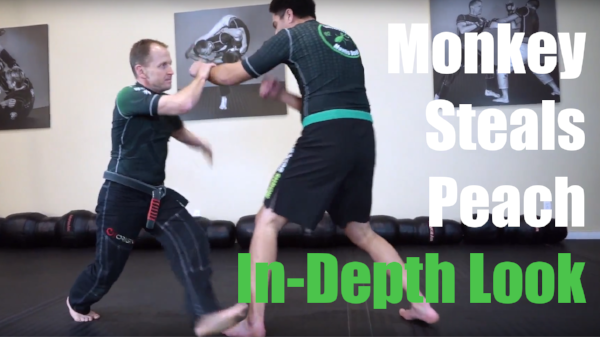
Monkey Steals Peach: In-Depth
An in-depth look at the Mantis Boxing move - Monkey Steals Peach. This is one of my favorite counters. Over the years, I've come to rely on a few follow-ups after people began countering the move, and we're including some small details to help you with the execution.

Southpaw and The Crazy Ghost Fist
There is a long history of ancient cultures including the Greeks, Romans, and Chinese, that prejudice left-handed use, or left-handed people. It is seen as - sinister, wicked, evil, and many of the words for such are derived from the word left in these languages.
In Chinese culture, the major philosophies and religions believe in the universe spinning from left to right; things must always start on the left and move toward the right to remain in harmony. This is expressed in many of the Traditional…
There is a long history of ancient cultures including the Greeks, Romans, and Chinese, that prejudice left-handed use, or left-handed people. It is seen as - sinister, wicked, evil, and many of the words for such are derived from the word left in these languages.
In Chinese culture, the major philosophies and religions believe in the universe spinning from left to right; things must always start on the left and move toward the right to remain in harmony. This is expressed in many of the Traditional Kung Fu forms that we see and is heavily documented in Tai Chi manuals. The symbol for Yin Yang depicts this cycle as well.
In stand-up martial arts - a majority of boxers place their left foot forward in fighting, just as a majority of baseball players stand on the left side of the plate at bat. By and large, right-hand dominant people outnumber left-hand dominant people, but this does not give cause to ignore the significance of this change of position when faced with a 'southpaw'.
The term 'southpaw' is typically used to define a left-handed boxer. A fighting position, or stance where one fighter has their right foot forward versus the traditional pose of the left foot forward used by right-handed boxers. Of more interest to us, are the advantages and disadvantages of this opposing, or unorthodox stance.
Why Staggered and not Square
Before we discuss that, let's hammer out why someone stands one foot in front of the other in the first place.
A squared up stance in hand-to-hand combatives can be good from a power based perspective. You give equal power to both arms, as well as equal reach. Some self-defense systems teach this at their core. The cost however outweighs the benefit.
Being square is something you can be successful with in martial arts such as Wrestling, Shuāi Jiāo, or Judo; striking arts change the game. The square position exposes our centerline to our opponent, giving access to vital targets on our body such as the solar plexus, liver, bladder, groin. These can be game-over strikes if they land on us.
By taking up a staggered stance and slanting the upper body, what we call 'blading', we decrease our profile (smaller target), but strikes are more easily deflected off the angle of the body, protecting these sensitive targets. An opponent is then required to circle to the inside line in order to access our centerline. This is easily read by veteran boxers.
Southpaw
In a staggered stance where both fighters are aware of the advantages and disadvantages of being square versus bladed, there is another, deeper component that becomes a major liability - when one fighter is on the opposite foot.
Meaning, boxer A has their left foot forward, and boxer B has their right foot forward - this is where southpaw becomes the challenge. Here are some of the pros and cons to the southpaw position:
Pros of Southpaw
- Easier to attack the flank - kidneys, ribs, temple, ear, and occipital lobe, brachial nerve; all exposed from outside angle.
- Cuts off the opponents second hand from attacking when on the outside line.
- Sets up significant number of trips, sweeps, take-downs.
- If dominant hand is forward - offers a stronger jab stunning the opponent.
- If on the inside line, it squares up the opponent, offering clear shots with the power hand to solid vital targets. in the face and body.
- Exposes the opponents groin to attacks with kicks, grabs, strikes, knees.
Cons of Southpaw
- When on the inside line we are in reach of both hands and susceptible to attacks not normally possible when directly in front of your opponent.
- Opponent can attack our flank hitting vital or destructive targets.
- Groin is exposed to kicks.
- Legs are side by side if opponent is on our inside line, making us more vulnerable to double leg takedowns, crashing tide, leg wraps, etc.
- Fighting southpaw allows our opponent to sweep our foot when we shuffle in, and if we circle to their inside, we are walking right into their power punch.
- This position also affects 'our' own range; placing the forward punch closer to our opponent, yet keeping our reverse punch so far away that it is often too far, or awkward to throw unless the other person makes a mistake.
Training Habits
In training, it is common to fight one-sided. In other words people choose a side to train and often ignore the other side, giving it less attention. In these formats a righty will spend most of their time fighting other righty's, while a lefty, or southpaw, will spend most of their time fighting righty's. This gives the lefty an advantage over the righty. They spend a far more time in this position and are then able to develop superior tactics and strategies from such.
Be aware of this tendency, and train diligently to overcome this challenge by putting yourself in weaker positions on purpose. This will allow you to adapt to this change and be hypersensitive to it in sparring/fighting.
Know your weaknesses and capitalize on your gains
What to do on the outside line
If you are on the outside you want to remain there if possible, providing you have the correct angle. In this position you should be lighting up your opponent with hooks to the head, ribs, and kidney while attacking the inside line with your other hand using effective combinations.
Look for throws that work from here. Side Leg Scoop, and Tiger Tail Throw, Reaping Leg are all obvious choices.
What to do on the inside line
- Strike up the middle high and low while being aware of any position changes made by your opponent that may put you at risk.
- Kick or Punch to the groin.
- Attack with Double Leg Takedown.
The Crazy Ghost Fist of Mantis Boxing
Mantis Boxing's Crazy Ghost Fist - The first move in the core form known as Bēng Bù (Crushing Step 崩步). This move is a perfect example of proper use of the southpaw position.
Our opponent punches. We move to the outside line while blocking the arm and striking the ribs/liver with a reverse punch.
Check out this video on how it's applied.
Southpaw can be a great advantage, or a horrible liability depending on your skill level and how you use it. As a rule, when I teach beginners I leave it out.
It's more important to understand the basic orthodox stance first, and change stance with the opponent in the early stages. This keeps your blocking system intact. Once a boxer is comfortable with this position, then we begin to explore the Southpaw advantage.