
Research Notes: (Open) Praying Mantis Boxing vs. Supreme Ultimate Boxing
Sure enough, they were the same character. This lead to further research and comparisons, and soon I had a series of principles and sub-principles that drew a solid link between the two styles. The English translations people used can vary, but the character is found to be the same for each style. Below is a work in progress but it is far enough along that I can share it.
Current document status: open and active.
Edited - 3-2020
Brothers in Arms: A Comparitive Analysis of Praying Mantis Boxing vs Supreme ultimate boxing (Tai Chi)
Although tánglángquán (praying mantis boxing 螳螂拳) and tàijíquán, also known as tai chi (supreme ultimate boxing 太极拳) have very different purposes in today's world, they share a plethora of similarities beyond just common fighting arts from the late Qīng dynasty in China. So much so, that I believe that they are intertwined in history.
Shared techniques, principles, and geographic location all hint to a broader cross-pollination of Chinese boxing techniques in this time period, and region. The reality is these styles have more in common with one another than any defining uniqueness.
For the past few years I have been working intermittently on this project and from time to time come back and update these notes with more findings, and observations. I noticed similarities with praying mantis boxing and supreme ultimate boxing back in 2012 while researching texts. At the time, I was doing an article on one of the keywords of mantis boxing - Kao (Lean), and I recalled the 13 characters of tàijíquán had the same keyword.
I decided to do a character comparison between supreme ultimate boxing and mantis boxing, and see if it was the same 'kao'. Sure enough, they were the same character. I quickly then asked myself, ‘if these were the same, were their other keywords they had in common?’
This lead to further research and comparisons, and soon I had a series of principles and sub-principles that drew a solid link between the two styles. Showing clearly that they held more similarity with one another than not. The English translations people use can vary, but the Chinese character for many of the keywords is found to be the same for each style.
Below is a work in progress but it is far enough along that I can share it.
Note: when I refer to Taijiquan, I am referring to my background in Yang style Cotton Boxing. The name was changed in the late 19th or early 20th century when the practice shifted to fitness/health, from practical fighting art.
The original names of Chen, and Yang family styles (see below), were very different than the broad characterization of tàijíquán they are muddled in nowadays. From my research it has been hard to locate any evidence of the term tàijíquán in relation to these 2 families and their boxing systems prior to the second half of the 19th century when the Wu brothers wrote about it.
The Wu’s studied with Yang Lu Chan, patriarch of the Yang family. Who had trained with the Chen family but used his own combination of 37 techniques later known as Yang style tàijíquán but what Yang referred to as mianquan, or cotton boxing.
I’ve been able to trace (thanks to the translations of other researchers that speak Chinese) that the Wu’s later studied with Yang’s son after he passed away. Eventually they separated into their own style, and from all outward appearances, then began branding it as tàijíquán, or Supreme Ultimate Boxing.
One can quickly surmise that if the Wu’s called it such, that the grandson to the founder of the Yang family’s boxing system himself, Yang Cheng Fu, who incidentally is the most influential in the spread and recognition of tàijíquán in the world today, would lay claim to that name since the Wu’s learned their art from his family/grandfather.
From there the Chen family catching wind to this, could certainly take notice and say, ‘how can you be the ‘Supreme Ultimate’ Boxing if Yang Lu Chan learned from us?’ Thus, I believe the chain reaction that caused them to possibly take on the name/moniker of tàijíquán across all families.
Regardless of the chicken and the egg argument, the fact remains that the keywords used by tàijíquán share many common terms/principles with tánglángquán. Speaking to a larger overriding argument that there was more in common with all styles of Chinese boxing as a whole rather than differences.
The following are examples of the crossover between these two arts from northern China and the Yellow River region:
12 Keywords
of
Praying Mantis Boxing
(Táng láng quán 螳螂拳)
13 Keywords
of
Supreme Ultimate Boxing
(Tài jí quán 太极拳)
Arrow-Quiver (bīng 掤)
Stroke (Luō 擠)
Press/Squeeze - (Jǐ 擠)
Press/Push, Keep a hand on (àn 按)
Split (Liè 挒)
Elbow (Zhǒu 肘)
To Retreat (Tuì 退)
Left
Right
Central Equilibrium
Shared Keywords
Includes the primary keywords listed above, sub-principles listed in the tàijíquán manuals, and some tánglángquán correlating evidence.
Hook (Gōu 勾)
A predominant tool in tánglángquán and the first keyword, yet absent from the keywords in tàijíquán. However, it is still used in tàijíquán, and seen in techniques such as strum pipa, single whip, and snake creeps down. Hook, is also listed within sub-principles in tàijíquán manuals. Similar usage in application of ‘single whip’ vs ‘slant chop’, the initiation of pluck, requires a grab, or a hook. Hooking was not unique in Chinese boxing, and is quite prevalent in many of the various ‘styles’ from the region, including numerous shuai jiao applications. It would be more difficult to explain why ‘hooking’ wouldn’t exist, rather than why it does.
Pluck (Cǎi 採)
The ‘pluck’ principle is not only present in Chinese arts, but exists in styles from around the globe. In wrestling styles of the west it is commonly referred to as a ‘snap down’, but the arm variation of pluck, while included in the Chinese variant, exists in the west as a separate method known as a ‘drag’. This keyword runs strong in tánglángquán, and tàijíquán and it used heavily in conjunction with hooking, or splitting.
Enter (Jìn 進)
To enter as in a doorway. To advance. This keyword is shared between both tánglángquán, and tàijíquán, and other styles as well. The entire premise with xíngyìquán (mind intent boxing 形意拳) for example, is to go forth and blast someone with full intent. The concept of advancing in xíngyìquán is more in line with tánglángquán. Within tàijíquán, we see the concept of yielding and retreating displayed more prominently in their framework. I would attribute this less to any sort of superior approach, and more to do with the framers incorporation of taoist, or Chinese philosophical beliefs in general, into the tàijíquán agenda. The concept of Enter is straight forward - go in. Do not dally. Press the attack into the opponent to overwhelm them.
Lean (Kào 靠)
Both ‘styles’ work inside and outside of the clinch. Whenever we’re engaged in this range, we should be leaning forward to prevent easy takedowns, or being uprooted with minimal effort. The lean principle can be applied this way, but…it’s true measure is within the application of throwing techniques such as crashing tide, or white crane spreads wings. In both praying mantis boxing, and supreme ultimate boxing, the designer of the framework for these arts that later became known as the keywords, sought to convey significant value to this character and its importance.
Connect (Zhān 粘) | Cling (Nián 黏)
[In process] - Correlation between - Connect/Cling found in tánglángquán vs Stick/Adhere/Connect/Follow within tàijíquán. The significance of sticking.
Adhere (Tiē 貼)
Any grappling based art, or hand-to-hand combat system that includes grappling, whether on the ground, or stand-up, would be remiss not to include such a principle. This is further supported by this character being prominently listed in both tánglángquán and tàijíquán which use grappling and clinch work in their application. Tiē, is an emphasis on sticking, but closer in than the aforementioned sticking highlighted in both arts with Zhān, and Nián.
Elbow (Zhǒu 肘)
One of the core forms of mantis boxing is known as 8 Elbows, or Ba Zhou. The use of elbows is highly prevalent in Mantis Boxing. This correlates to the emphasis placed on the ‘elbow strike’ in tàijíquán in it’s prime principles.
Notes on ‘Ward Off’
The first keyword of taijiquan is often called - Peng (ward off). I was unable to prove this to be true in my research. Much of my findings indicated a schism in the tai chi community at large, over what the original Chinese character was. Some claim it to be peng, others bing, what I used above. What is the most important factor here is the Chinese character. If the community cannot agree on what the original character was then any translation or meaning of the first keyword is null and void. We cannot translate that which we do not know, or are incapable of agreeing upon. This coupled with Yang Lu Chan, founder of Yang family style taijiquan, being recorded as illiterate, makes it even more preposterous to claim original intent here.
Additional Commonalities
Kicking Methods
The two styles share their kicking strategy in common. Some of the kicks found in both styles are the ‘heel kick’, ‘toe kick’, and ‘cross kick’.
Striking & Blocking
The two styles share common striking attacks and counters.
‘Deflect, Parry, Punch’ from supreme ultimate boxing is also found in mantis boxing forms.
Both styles depend on an upper block combined with a counter strike down the middle; known as ‘bend bow shoot tiger in tàijíquán, or ‘pao quan’ in xíngyìquán. This move shows up repeatedly in tánglángquán forms such as Tou Tao (White Ape Steals Peach).
The use of the 'chopping fist' shows up in both styles. This appears to have been Yang Lu Chan’s primary offensive attack/bridge. I suspect, based on the expression and representation in the original Chen style form, known as ‘cannon fist’ that this is similar. This attack method is used repeatedly in styles of Chinese boxing found in the north and south, to include, but not limited to praying mantis boxing. Other styles/sets relying heavily on this include - gongliquan, lianbuquan, tongbei, changquan, choy li fut, etc.
The Beng Quan (Crushing Fist) is used predominantly in both mantis boxing and Yang’s mianquan (cotton boxing). This attack is commonly found in mantis boxing forms, such as Beng Bu, Lan Jie, Ba Zhou, and Tou Tao, and more.
White Snake Spits Tongue is also a shared attack in both systems. Parry and counter-strike to the eyes, or throat.
Throwing/Tripping Methods
The crossover here is expected to be heavy. I will name them as they come to mind, but given the prevalence of the Mongol influence in the north, and the wrestling techniques of the Steppe peoples permeating the local cultures, it is likely this will be one of the strongest areas of similarity and crossover. Many of the movements are even evidenced back to the 1500’s in Qi Jiguang’s unarmed boxing set used to train troops in the Ming dynasty.
Techniques
Snake Creeps Down is the same move/attack as found in tánglángquán’s piercing hook method.
Single whip in tàijíquán is the same method known as slant chop in tánglángquán.
Grasp Sparrow Tail:
Stage 1 - rowing hook variant (see below).
Stage 2 - known as double sealing hands in mantis boxing.
Stage 3 - known as ‘crashing tide’ in mantis boxing.
Stage 4 - double push takedown found in an opening move of mantis boxing form known as lanjie, which evidence points to meihuaquan origin.Step Up to Seven Star is a second variation of ‘crashing tide’ that is found in another mantis boxing form. The same move, expressed with variation on the leg execution based on grappling pressure of opponent. The monkey stance or bow stance version is heavy forward momentum when going from striking to takedown. The seven star variant is when adhering to the opponent in the grapple and using forward pressure (lean) and trapping the leg to prevent the step out.
Strum Pipa is known as ‘white ape invites guest’ in mantis boxing.
Diagonal Flying is a shuai jiao move known as a rowing hook. The flying diagonal is one variant.
Golden rooster rises up is also a rowing hook variant and is found in lan jie form in mantis boxing.
to be continued…
Two Roads Same Path
The two styles took very different paths as time passed, yet originated with a similar intent. Yang tàijíquán was very condensed; using one form to house the entire system of 37 applications.
Tánglángquán, on the other hand, had 2 or 3 original forms (allegedly), and later became bloated as more and more forms were piled on. The system split into multiple lines as did tàijíquán, except each branch with a multitude of varying forms, rather than a single representation, further diluting the art.
Tàijíquán, was also transformed into the health practice commonly known as Tai Chi today and was used for physical education. This took place in the early 1900’s; spearheaded by Yang Cheng Fu. It was excellent for all ages, and those who could not perform high impact exercise thus keeping it fairly intact through the ages.
Tàijíquán had already been split into different family lines (Chen, Yang, Wu, Wu Hao, and finally Sun). It split again post-transformation from fighting to fitness. The original Chen family style (Cannon Boxing), and Yang family style (Cotton Boxing), were combative and extremely condensed. See my article on ‘The Dirty History of Tai Chi’ for more details, and a bibliography of sources.
Praying mantis boxing, was also absorbed into the national movement for better health and fitness. Jin Woo, Nanqing Guo Shu Institute are examples, but with a different methodology. They added pre-requisite forms known as fundamentals training prior to being able to focus one’s studies on mantis boxing, or another style. In Jin Woo, practitioners performed sets at a faster, and more athletic pace, to a fault; as this later became a standard by which your ‘art’ was judged, versus the original combative intent.
In the end, it saved neither from becoming obsolete, broken, and losing their teeth. Lucky for us, the forms, and the keywords/principles survived; making reassembling the arts still possible.
Below are maps to show the provinces in China where these styles originate. Eastern Henan Province, Shandong, and Hebei province.
As Douglas Wile points out in his book - ‘Lost Tai-Chi Classics of the Late Ch'ing Dynasty’,
“the Yellow River basin was a hotbed for martial arts training and fighting. Many famous boxers emerged from this region and went on to be accredited with founding of their own fighting systems.”
Crossover of techniques and principles that work, or the use of a technique that defeated another opponent, would surely be picked up and used among anyone in the know.
The common use of bēng quán (crushing fist 崩拳), pào quán (cannon punch 炮拳), and pī quán (chopping fist 劈拳) in Xing Yi Quan, Tang Lang Quan, and multiple family styles of Tai Ji Quan offers a clear example of this cross-pollination of techniques.
Maps
Yantai, Shandong, China. Birthplace of Tánglángquán
Chen family village. Henan, China. Birthplace of Tàijíquán
Dai family biaoju company. Xingyiquan Region
Research Bibliography and Character Sources:
Lost Tai-Chi Classics of the Late Ch'ing Dynasty, Douglas Wile, 1996, SUNY Press
Mastering Yang Style Taijiquan - Fu Zhongwen, translated by Louis Swaim 1999, North Atlantic Books
The Essence and Applications of Taijiquan, Yang Chengfu, translated by Louis Swaim, 2005, North Atlantic Books
Brennan, Paul. 2013. EXPLAINING TAIJI PRINCIPLES 楊班侯 attributed to Yang Banhou [circa 1875] - https://brennantranslation.wordpress.com/2013/09/14/explaining-taiji-principles-taiji-fa-shuo/

The Dirty History of Tai Chi
The history of Tai Chi, correctly called Tai Ji Quan, disseminated to the masses, is often a mythical story that involves an art form thousands of years old with Taoist immortals, monks, and fairies. Commonly it is propagated that a non-existent type of magical energy, will heal the practitioners body and/or throw opponents without ever touching them. This is a fictional portrayal that in the West we call a fairy tale and in the East they call wu xia.
The history of Tai Chi (taijiquan, supreme ultimate boxing) is often taken with too much salt. The prevalent history disseminated to the masses often involves a mythical backstory thousands of years old, which includes: Taoist immortals, monks, and fairies. It is commonly propagated that the style of Tai Chi contains and revolves around a type of magical energy (known as qi) that will heal the practitioners body and/or throw opponents, without ever touching them. This fictional portrayal in the west would be known as a fairy tale, in China it is called ‘wǔ xiá’ (武侠), martial arts stories in theater/fiction popularized during early 1900’s China.
The notion that one can achieve unequivocal power, something akin to a superhero, without ever performing a day of ‘rigorous’ training, exertion, or hard work, is certainly the stuff of movies, myth, and legend. In contrast, the truth of tai chi’s history is far less enchanting to the laymen dabbling in an exotic art. The truth involves laborious acts, physical exercise, redundant practice, mental endurance, self-discipline, perseverance, and a history full of bloodshed, violence, and oppression.

General Qi Jiguang. Source: Wikimedia
The more accurate and verifiable history at the time of this writing shows that tai chi was developed roughly 400 years ago in Chen Village, Henan Province, China. It was known as less formally as ‘Cannon Boxing’, or the Chen family style. Like many Chinese martial arts it included hand-to-hand combat techniques common to the region, area, and time period. In 1560, General Qi Jiguang developed an unarmed combat system to train a militia to fight the wokou pirates. A group of Japanese pirates, which included Chinese ex-soldiers, privateers, and ruffians were pillaging the coastal villages and sea traffic. Based on the chapter in Qi Jiguang’s manual on unarmed combat, and the included illustrations, it appears by the trained eye that many of the depicted hand-to-hand combat methods are found in what is now known as tai chi. This points to a common pool of knowledge of fighting techniques.
During the mid 1800's Yang style tai chi was created by founder Yang Lu Chan. Yang, lived and studied in Chen Village and later went on to create his own system originally called 'Small Cotton Boxing'. Now known as Yang style tai chi, or taijiquan.
While many of Yang’s techniques mirror the Chen family boxing style, Yang included some of his own methods and merged them with the techniques of the Chen style, as any fighter will do throughout their martial journey when introduced to effective combat methods that they wish to amalgamate into their own art.
Yang’s life (1799 - 1872), or the life around him, was no stranger to violence and upheaval. Throughout his adult life he bore witness, knowingly, or unknowingly, to the impending collapse of China’s final dynasty, the Qing (1636-1912). Events happening all around Yang during his life include catastrophic flooding of the Yellow River (Huang He) (1851 - 1855, and many many more), famines, droughts, drug epidemics, two wars with the west (see Opium Wars 1839-1842, and 1856-1860), multiple rebellions (see Nian rebellion 1851-1868 and Taiping rebellion 1850-1864), and the encroachment of western powers on the Chinese populace, especially in and around trade ports.
As a result of losing both of the aforementioned wars, China was forced through treaty to pay reparations to the western powers, mainly by opening previously closed trade ports in the south and the north.
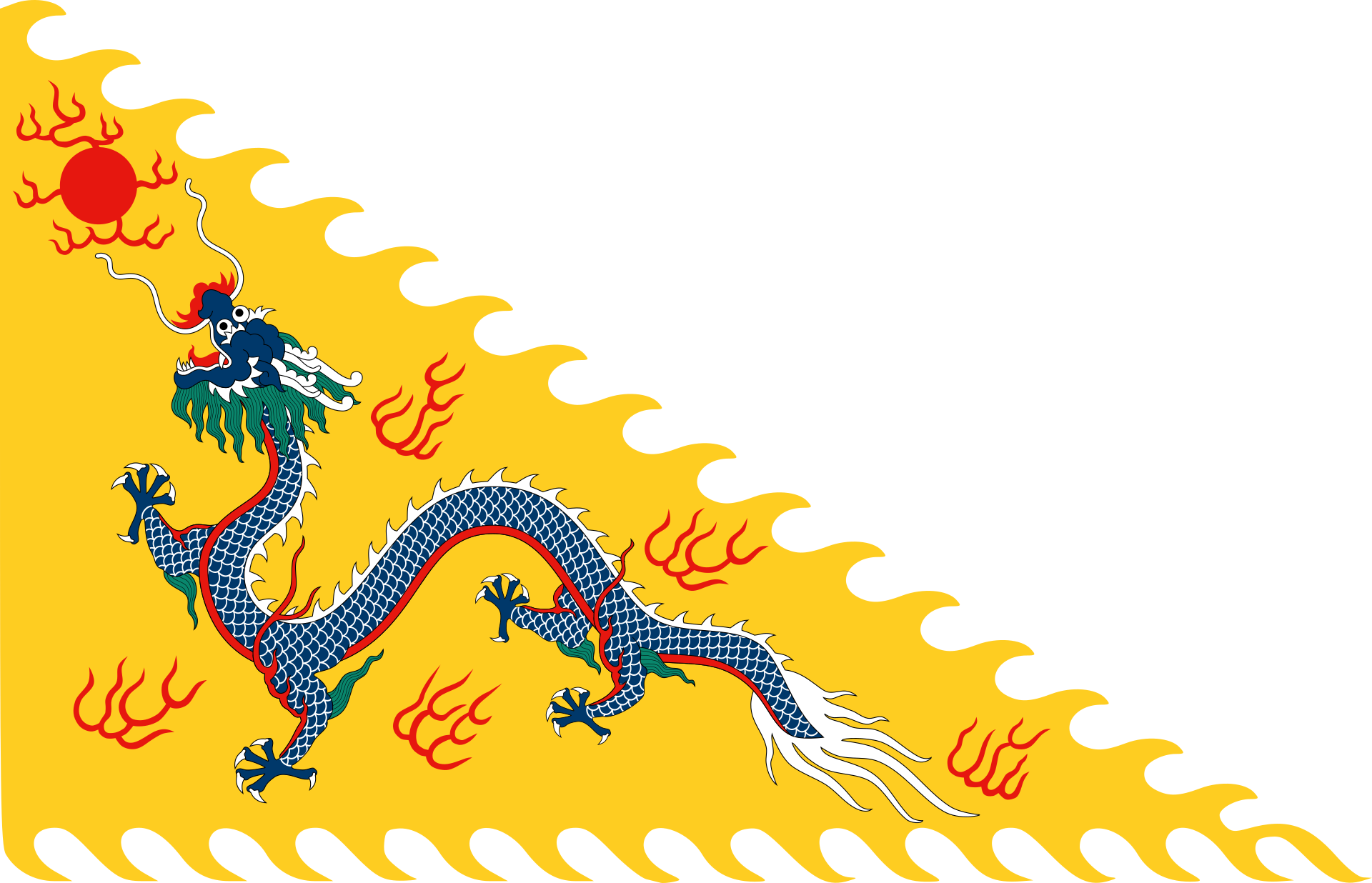
Imperial Standard of the Qing Emporer
Yang Lu Chan at one point in his life is recorded as being hired by the Qing court to teach armed, and unarmed combat to the imperial guards of the Manchu court in Beijing. Yang also disseminated his boxing art to his family.
Around the turn of the 20th century, decades after Yang’s death, the Chinese became disenchanted with their martial arts after repeated embarrassment in their confrontations with the west. More specifically incidents involving armed and unarmed combatants known as boxers, versus soldiers with firearms. Arguably the most famous of these incidents is known as the 'Boxer Rebellion', or more accurately the ‘Boxer Uprising’ (Joseph W. Esherick - The Boxer Uprising), which transpired over a four year time period with various encounters. The uprisings took place in Shandong, Hebei, and Tianjin provinces, as well as Beijing itself.

Port of Chefoo circa 1878 to 1880. Edward Bangs Drew family album of photographs of China, © President and Fellows of Harvard College, Historical Photographs of China - https://hpcbristol.net/visual/Hv37-02
A century prior to this China was one of the most powerful civilizations on earth, with one of the most formidable military forces in existence. However, the industrial age in the west brought substantial change to warfare, along with the ability for nations to project global power in greater magnitude than ever before.
Although martial arts was considered beneath the scholar class, it was prevalent with boxers, soldiers, and guards in the employ of biaoju (security-escort companies). Local militia-men, sanctioned by magistrates commonly used armed/unarmed martial arts methods to quell local bandits and keep the peace. The Qing government in the 1800’s was preoccupied and impotent to respond to many smaller internal issues. The lowest expression of martial arts was associated with criminals, gangsters, ruffians, or charlatans which the Jing Wu and early 1900’s Chinese martial arts community tried to erase, or reverse.
The ‘boxers vs firearm’, or rather, antiquated military tactics versus modernized, industrialized weapons and strategies incidents that took place around 1900, likely further cemented the general public’s poor opinion of their nations martial arts, and of the ‘boxer’ overall. Three hundred years prior during the Ming dynasty General Qi, in his second book, published two decades after the first and post wokou battles experience, considered the act of training troops in hand-to-hand combat a rather fruitless endeavor when compared to the rapid and effective weapons training such a spears and matchlocks. This is evident since his second book omitted the unarmed combat chapter altogether.

Battle of Lafang 1900. Source: https://pin.it/5uubzq3xry77n5, Public domain, via Wikimedia Commons
By the turn of the 18th to 19th century the Chinese having battled the western power’s sponsored opium crisis, repeated mass famines, floods, droughts that killed millions of people; rebellions that also killed millions more, and in addition to disease epidemics, were being called the 'sick men of Asia' by the international community. For a culture that was once in the not to distant past, more powerful than any other nation on earth this was humiliation on an epic scale.
At the end of the Qing (1910’s) and the beginning of the Republican era, a movement was initiated to change this stigma. A nationalist effort was undertaken to strengthen the populace and remove this cultural blight, or poor reputation. As a part of this movement and perhaps in an effort to keep their national arts from dying, Chinese martial arts teachers were commissioned to teach their methods for health, strengthening, and fitness, rather than for fighting.
This saw the creation of organizations such as the Jing Wu Athletics Association (circa 1910) of which tai chi, specifically Yang style, was a significant part of, as well as later the Nanjing Central Guoshu Institute in 1928. The directive of Jing Wu was primarily to improve health, and combat the 'sick men of Asia' label. Teaching physical fitness and health to affect positive national change. The Nanjing Guoshu Institute also propagated Chinese martial arts, and employed none other than Yang Chengfu, grandson to the progenitor of the style.
Yang Cheng Fu clearly had an entrepreneurial spirit that would help proliferate not only the Yang family art, but by proxy their predecessor, the Chen family, as well as the Yang offshoots of Wu family style Taijiquan, and Wu Hao style. Yang Chengfu took his grandfathers boxing art and taught far and wide, spreading it to the general public for health and wellness purposes around 1911.
Chengfu incorporated slow motion practice and longer movements as the focal point, removing much of the fighting application and combative elements taught by his grandfather, father, brother, and uncle. Thus was born a form of exercise that was all at once accessible to the young, old, weak, sick, and those of poor physical condition; to which rigorous exercise was not possible.
Prior to this Yang family taijiquan was taught strictly for combat, or a method of violence, or rather, defending against violence. It involved such skills as striking, throws, trips, takedowns, joint locks, sparring, fighting, and weapons training.
Forms practice (tào lù 套路), and push hands (tuī shǒu 推手) in contrast to present day, were likely a very small portion of the training. It is questionable if push hands had a significant role in the traditional combative training outside of skill building. It is possible that this portion of the training was derivative of the scholar class slumming in the martial arts world years after the art lost its teeth. A ‘game’ for people uninterested in fighting to pretend they are fighting.
It is also possible that given the heavy focus of the Manchu on wrestling, which was significant with the Han as well, that push hands was a tool for training wrestling skills in said competitions. The strategy of pushing an enemy in battle is ludicrous unless pushing them to the ground, or off a cliff. However, pushing someone outside a ring, or off a platform (lei tai matches) in order to score points, or win, holds a great deal of validity.
Qianlong Emporer observing wrestling match. Source: WikiCommons
Due to Yang Chengfu's efforts, and others around him, Yang style went on to become extremely popular, the most widely proliferated form of taijiquan throughout the world even to this day. The style’s true nature however is evident by some writers of the time:
Gu Liuxin writes of Yang Shaohou (Yang Cheng Fu’s older brother 1862-1930)
He used, “a high frame with lively steps, movements gathered up small, alternating between fast and slow, hard and crisp fajin (power/energy), with sudden shouts, eyes glaring brightly, flashing like lightning, a cold smile and cunning expression. There were sounds of “heng and ha”, and an intimidating demeanor. The special characteristics of Shaohou’s art were: using soft to overcome hard, utilization of sticking and following, victorious fajin, and utilization of shaking pushes. Among his hand methods were: knocking, pecking, grasping and rending, dividing tendons, breaking bones, attacking vital points, closing off, pressing the pulse, interrupting the pulse. His methods of moving energy were: sticking/following, shaking, and connecting.”

1949 Taiyuan battle finished. Source: WikiCommons
Three decades after Chengfu’s popular introduction of this rebranded art to the people, the Communist Party took control of China. As in past rebellions and changeovers of power, they once again outlawed the instruction of martial arts for the purposes of fighting. Mao Zedong, ever a student of history was well aware of the number of uprisings, rebellions, and dynastic turnovers associated with temples, and boxers. He burned the temples and banned the boxers.
During this period in the mid twentieth century, many traditional martial artists fled the country or were killed. The restriction by the government was certainly not in fear of a boxer, spearman, or swordsman attacking a tank, or machine gun nest, but rather due to a need to control the populace, a task exponentially more difficult when it involves submitting those trained in fighting arts (disenfranchised privateers, aka pirates). Martial training empowers individuals and empowered people are less willing to blindly succumb to oppression.
In 1958 after the period of unrest during the Communist Revolution (circa 1946 to 1949), China formed a committee of martial arts teachers. Choosing from a pool of those who stayed behind and used their martial arts training for coaching health/fitness, and/or those who had returned to the mainland from their exile.
The committee created what are known as the ‘standardized wushu sets’ - choreographed forms of shadow boxing summarizing and abbreviating the broad spectrum of China's legacy martial arts styles.
The wushu committee created the standardized sets for unarmed and armed styles, streamlining hundreds of styles in the north, and south that shared common techniques into one compulsory set to represent each - long fist (changquan) for the north, and southern fist (nanquan) for the south. In this consolidation effort, a few styles were left to stand alone gaining independent representation. These were, praying mantis boxing (tanglangquan), eagle claw boxing (yingzhaoquan), form intent boxing (xingyiquan), 8 trigrams boxing (baguaquan), and supreme ultimate boxing (taijiquan). Coincidentally these five styles were the advanced curriculae of the Jing Wu athletic association. Had they not been part of Jing Wu, it would be interesting to know if they would have survive long enough to be recognized by the PRC Wushu Committee.
These choreographed sets were then presented to the rest of world in a neat clean package, government regulated, and used to project China’s human martial prowess abroad, to include a trip to the Nixon White House where they demonstrated their skills. These boxing sets left behind the fighting elements of old, replacing them with sharp anatomical lines, clean corners, fancy acrobatics, and gymnastics. They became martial dance with 'timed' routines rather than the violent methods they once were.
As part of this standardization process in the 1950’s, the Yang taijiquan 24 movement form (a.k.a. Beijing Short Form) was created, and not by the Yang family itself oddly enough. This form represented Yang Style taijiquan (against the families approval) and went on to not only be a competition set, but a ‘national exercise’ that Chinese citizens would practice every morning in local parks for decades to come.
As China opened her doors to the rest of the world, westerners glimpsed the large organized gatherings of Chinese citizens performing their beautiful practice of the short form in parks day after day. Foreigners began learning this art while spending time overseas and via teachers who migrated to western countries proliferating their ‘art’ through hobby, or as a means of financial survival. The western world's interest was officially piqued.
Throughout the 1960's-70's and even into the 1980's, there may have existed a reluctance with Chinese teachers to show ‘outsiders’ their national, or personal martial arts, but others did not know the original intent of the art, and continued to spread the empty shell they were handed.
These factors helped contribute to the spread of misinformation, making it difficult to validate much of the material being practiced outside of the ‘standardized’ sets. The Chinese fighting arts were also fast approaching a century of existence without the practical combat usage of the fighting techniques housed inside the forms being transmitted as part of the art.
Without the trial by fire checks and balances that a martial fighting system uses to hold its validity; such as - 'fail to do this technique correctly and you get punched in the face, tossed on your head, or pushed off a platform' - an environment was effectuated that was ripe for esoteric practices, myth, and legend to take over. To include, but not limited to; mysticism, numerology, archaic medicine, fancy legends, mystical energy, and the most contagious of them all…pseudo-science.
While the combat effectiveness waned, the health benefits of modern taijiquan remain steadfast and clear. There have been many studies by qualified medical professionals around the world substantiating the health benefits of routine tai chi practice in one’s daily activities. However, these health benefits are not unique to tai chi, and may be attained through most almost any form of physical exercise such as, but not exclusive to - running, swimming, cycling, dance, tennis, raquetball, and numerous other sports.
There remains though, a primary advantage of tai chi over some, but by no means all other forms of exercise. A low-impact form of physical exercise accessible to those unable to perform rigorous exercise. This is especially important to senior citizens, or those with debilitating injuries who can benefit from movement, but are unable to participate in high impact sports mentioned above.
Modern tai chi, while no longer a martial art is a form of exercise or martial dance, that can be taught to people of all ages, allowing practitioners to move, think, and have fun as a social activity anywhere they go. Whether it be those looking to improve balance, circulation, stress reduction, bone strength, or those who think they are too old to work out, or too “out of shape” - all can find a welcome home in studying the soft styles of tai chi in its modern representation.
Conversely, if one is looking for a martial art for the purposes of practicing and perfecting methods of violence in its traditional sense, then the modern representations of tai chi, or taijiquan are likely not to be pursued.
What we can all stand to discard, are the esoteric pseudo-science methods transmitted by charlatans and those looking to manipulate others for financial gain, or illusions of power.
LEARN MORE…
If you enjoyed this article you may also find the following articles of interest -
Personal Quest
Alongside teaching tai chi movement for well over a decade, my thirst for the combat applications of these moves/forms overshadowed my ability to teach people without discussing, showing, demonstrating, and instructing people in the combat methods inside the tai chi forms as I unraveled them.
I realized, my goals and desires were no longer aligned with the middle aged, and senior audience that was partaking in my classes for the benefit of health and wellness. Rather than cause injury to people who were, intrigued, but not committed, conditioned, or enrolled for such a class, I amalgamated these combat methods into my mantis boxing classes so I could continue to teach them to a captive audience who is there for such knowledge and skill, and would like to put these into practice for their skill set.
While I retired from teaching tai chi for health and fitness in 2016, I remained steadfast in my quest to unlock these combat applications lost to the annals of time. If you would like a small glimpse of the results of decades of work in reverse engineering these amazing combat techniques that are half a century old, check out the following page to see videos of a few of the moves.
Tai Chi Underground - Project: Combat Methods
Bibliography
Wile, Douglas. T'ai-chi's Ancestors: The Making of an Internal Martial Art. New York: Sweet Ch'i, 1999. Print.
Kennedy, Brian, and Elizabeth Guo. Chinese Martial Arts Training Manuals: A Historical Survey. Berkeley, CA: North Atlantic, 2005. Print.
Wile, Douglas. Lost Tʻai-chi Classics from the Late Chʻing Dynasty. Albany: State University of New York, 1996. Print.
Kang, Gewu. The Spring and Autumn of Chinese Martial Arts, 5000 Years = [Zhongguo Wu Shu Chun Qiu]. Santa Cruz, CA: Plum Pub., 1995. Print.
Smith, Robert W. Chinese Boxing: Masters and Methods. Tokyo: Kodansha International, 1974. Print.
Fu, Zhongwen, and Louis Swaim. Mastering Yang Style Taijiquan. Berkeley, CA: Frog/Blue Snake, 2006. Print.