

Rise from the Ruins: Embarking Into A Dying Art of Boxing
An Essay on my Early Years in Chinese Boxing Dance
Martial arts forms (kata, tào lù) are more plentiful today than in any time in history. They are widely disseminated in a variety of martial arts schools/styles across the United States, and around the world. A majority of ‘traditional martial arts’ competitions today, are centered around stylists competing with their form of choice. One is hard pressed to enter a school of karate, kung fu; kempo, tae kwon do; or tang soo do, etc. that isn’t consumed by a curricula filled with form after form. Once you complete one form, you’ve earned the ‘privilege’ to learn another...and another...and another.
Years into my training, I went on to scorn these empty shells. For quite some time actually. One reason I held such admonishment toward ‘forms’, was having…
Finding the Mantis
I came across the art of Praying Mantis Boxing in of all places - New Hampshire, USA back in the 1990’s. I was correcting course in my life and on a quest to empower myself with martial arts training and the skills to know how to handle myself. A desire of mine since childhood. I immediately fell in love with the art, even in it’s corroded state.
Sadly, time has not been kind to this, and many other Chinese boxing systems. Much damage has been done over the past century or more, as these arts were no longer used for combat. By the time I began my training, it was difficult to tell what Mantis Boxing was in its original manifestation.
What remained was largely boxing sets (choreographed fighting moves in the air known as forms/kata/taolu), myriad drills, and a plethora of archaic Chinese weapons techniques of a bygone era.
Due to this decayed state my journey early on with this art was difficult and fraught with challenges in finding answers, or seeing an effective use of these movements in sparring/combat. Thankfully, we do have those who carried the torch over hundreds of years; bringing with them the keywords of the style as well as the old ‘boxing sets’ which allow us to view into the past.
I have dedicated over 20 years to mantis boxing, as well as other stand-up fighting arts in a quest to reconstruct the art so that it is intact for my students going forward. Through traveling, studying with experts, training, competing, teaching, sparring, researching; anything I could find that would yield improvements. We move forward with methods so that others, like you, can receive a fighting art that is versatile, effective, and well…quite frankly - RAD!!!
My efforts to ultimately reshape, redefine, and revolutionize the art have created a new version of mantis boxing that is relevant for self-protection in modern times. This last part being of great import to me. I believe any martial art should be applicable and functional. Ensuring not only its own survival for future generations, but also the survival of its practitioners.
BOXING SETS
Throughout my martial arts career I have had many opinions on forms/boxing sets. These viewpoints have shifted like the swirling tides along the rock-strewn coastline of Maine. Early on, when I began my training I was heavily invested in these sets. They were, after all, the primary method of transmission for the art that I chose to study - Tángláng Quán (Praying Mantis Boxing 螳螂拳), and before that, Tae Kwon Do.

Mantis Catches Cicada - circa 1999
Mantis boxing was handed down to me by my early teachers, and their teacher’s before them, with forms as a primary method of transmission. Completely absent of the mechanical inner workings that made these moves functional with live opponents in actual hand-to-hand combat. In all fairness to the first mantis coach I had, was up front with me from the beginning about this. I was under no illusions.
Martial arts forms (kata, tào lù) are more plentiful today than in any time in history. They are widely disseminated in a variety of martial arts schools/styles across the United States, and around the world. A majority of ‘traditional martial arts’ competitions today, are centered around stylists competing with their form of choice. One is hard pressed to enter a school of karate, kung fu; kempo, tae kwon do; or tang soo do, etc. that isn’t consumed by a curricula filled with form after form. Once you complete one form, you’ve earned the ‘privilege’ to learn another...and another...and another.
Years into my training, I went on to scorn these empty shells. For quite some time actually. One reason I held such admonishment toward ‘forms’, was having learned over fifty of them in my first seven years dedicated to wu shu (martial arts) training.
As soon as I would finish one form, I would be handed another; whether by my request for some shiny new toy I was enthralled by, or a suggestion by the instructor(s). It became impossible to remember all of these sets, and far too time consuming to practice them all; little did I understand why at the time.
When it came to fighting and sparring in the martial arts schools I attended, the combative application was entirely disembodied from these forms; like a warrior’s sword detached from it’s handle - once upon a time a dangerous weapon to be feared, now - a toothless tiger.
Crossover from form to fighting never existed in the schools that I trained in. We would warm-up, practice movements, shadow box, and spar the last few minutes. When it came time to spar with classmates, it usually manifested as ‘bad kickboxing’. To be fair to these coaches, their passion lied with what they were teaching - forms, not fighting.
I kept sparring as much as possible, and competing in matches. I became increasingly frustrated over time. I would ask myself - “wasn’t the point of martial arts to learn how to defend yourself? Wasn’t the ultimate goal to become empowered? To know secret ways to disable attackers, fend off bullies, submit miscreants that wish harm upon us, or protect our families?” I was profoundly confused by the training practices I was experiencing, versus what I had envisioned martial arts being meant for.
COMBAT ARMS

Flight School - aka ‘Fight School’ - Alabama 1990
Having been in the military for a short period of my life, I was used to an environment built on training for ‘combat’. We certainly didn’t pretend to drive tanks, or fly invisible helicopters, fire imaginary bullets downrange, or use toy weapons. Lessons on my martial arts path were not adding up with my life experience. Why was a bulk of my time training, just pretending to fight opponents in the air???
While I was stationed in Texas, I briefly undertook the study of taekwondo until my military units’ training schedule was ramped up and I could no longer juggle it in. It was enjoyable at the time, but certainly wasn’t my favorite martial art style. I had a good teacher, and I enjoyed my time there (however brief), but the art was too simple, and too linear for my taste. However, to the instructors credit, in those classes we spent a bulk of our time sparring.
Years later, as I was well into my Chinese martial arts training, I knew something was amiss with the way I was being trained. I tried taking moves from some of the forms I had learned, and experimented with them while sparring in class. This was often met with punishment being doled out by my opponent’s barrage during my risky ventures. Still, I tried to pull them off, but rarely did I find success.
Instead of introducing something new into my game, it became increasingly easier to rely on a few well-timed tricks, and speed/power to overcome my opponents. Sticking to the attacks/counters I was already good at. Reinforcing my current skills rather than growing as a fighter/boxer/martial artist.
Along the way I had decided, with the encouragement, and support of those around me, to become a martial arts teacher for a living. I was instructing at another school while this metamorphosis was taking place, and I opened a school with a friend of mine (2004). Off we went. Things did not improve; quite the opposite actually.
MIRROR INTO THE SOUL

Chris and Vincent - Tournament - Fall 2007
Now that I was teaching others full-time, the disconnect became crystal clear. I no longer had only myself to worry about, but my reflection staring back at me day in and day out. That reflection was my students. The truth became less than encouraging. My students would learn to move, perform cool looking forms, win competitions, but their fighting skills were no match for other martial artists such as boxers, wrestlers, judoka, etc.
I would ask myself - “Why someone taking western boxing for 6 months, could decimate a practitioner from kung fu, karate, kempo, tae kwon do, etc.?” In many cases, the latter had been training for years, or in some case decades.
I was thoroughly frustrated. I could suffer this no longer. We can be either part of the problem, or part of the solution. So I began to change the way I was teaching. I turned the focus of my classes more heavily on qín ná (the Chinese submission art of bone/joint locking and seizing).
In my early training, I had spent 4 years studying this discipline in tandem to my forms regimen. Dedicating multiple hours each week with partners in my first mantis school, and training with friends on the side. I felt better. It wasn’t perfect, but at least this was drilling with live people, and I was giving my students something that felt like martial arts/self-defense, rather than dance.

Jess and Mike - 3 Section vs Staff - 2005
I incorporated more ‘2-person’ hand-to-hand, and weapon sets from kung fu. Again, thinking that at least these had combative moves that involved a live partner to test against. All the while, I was still voraciously searching for answers.
I made it my mission to figure out how these forms worked in fighting; continuing my research; sparring as much as I could with friends that were traditional martial artists, and who were also frustrated by the norm. I turned the pages of tome after tome, reading historical accounts, watching videos. Any sources I could find. I turned my attention and focus to seeking out the core/roots of each system. Then…something enlightening happened.
A pattern began to emerge. I noticed a common theme while traversing my archaeological quest. How these styles began…
Tángláng Quán - two forms.
Yīng Zhuǎ - two forms and one partner set.
Tàijíquán - zero forms.
Hóng Jiā (Hung Gar 洪家) - one form.
Bāguà quán (8 Trigrams Boxing 八卦拳) - zero forms.
Xínyìquán (Intent Boxing 形意拳) - zero forms.
The writing was on the wall. In giant print. None of these styles started out with…so...many...forms. It was now obvious to me what I needed to do. Purge!
I embraced the ‘less is more’ philosophy. Even though, and unbeknownst to me at the time, I was still clinging to too much material. I discarded a bulk of the forms I had learned over the previous seven years. I no longer practiced, or taught them.
I sought out the core forms of the arts that I really enjoyed - Praying Mantis Boxing, Eagle Claw, Tai Chi, and Xing Yi. My intent being to ‘mine’ these forms for applications. To see what the original methods, movements were, so I could reconstruct these arts. Lofty goals to be sure, but I was not to be deterred. I was too invested at this point.
Traditional Long Weapons - Nationals Qualifiers - 2004 - Hershey, PA
After repeated polite inquiries with various mantis boxing teachers around the country, I was rebuffed by taciturn ‘masters’ unwilling to share their art. They behaved as if these forms were valuable magical secrets. As if I was asking for their priceless gems.
These teachers clearly coveted their core forms, like a mage who possessively guards their spellbook. I truly failed to comprehend why teachers were so disinterested in...teaching. I was ready and willing to learn! Why were they not helping me?
I had been learning forms a dime a dozen over the years, why were these such prized antiquities? Instead of welcoming an interested student, people were possessive; greedy, condescending, and cold. Again, rebuffing my ideals of what a martial artist is about.
During my journey, I learned that one “Grand Master” went so far as to try and sue people for stealing his forms. His organization actually attempted to copyright them. Other’s demarcated forms with fake moves so they would know when someone ‘stole’ it from a video, demonstration, or tournament. Marring the art, and further tainting it from its original intent and true purpose. This was chaos incarnate, and I simply did not understand it.
Martial arts in general, and forms specifically, are not something one can ‘steal’. One can copy someone’s form, but if the ‘thief’ does not do the work, or fails to comprehend the intent of the moves within, they have no score.
If the purported burglar does the work - learns it, trains it, tries to perfect it; studies it thoroughly, then they have been taught. Perhaps, without them knowing they’ve been taught. As a teacher, or even a practitioner that wants their art to survive, is that not our ultimate goal and purpose?

Snakes Creeps Down (low single whip) Taijiquan demo - circa 2006
I continued on. I was teaching Tai Chi, and finding it difficult to find any sort of consistency from one person to the next when it came to the movements. Additionally, I could find no one that knew what these moves did, so there was no litmus test to know if a movement was ‘right’, or ‘wrong’. Every reason someone had, seemed esoteric, and subjective. Like judging dance, or art.
Xingyiquan was another focus of mine during this time. I enjoyed the premise behind it. I was told it was highly destructive, energetic, explosive, and aggressive. That it was a badass style of Chinese boxing. I was into that! A coach that introduced me to it, thought it would be a good fit for my…temperament.
Again, it seemed like the standards for success in xingyi, were completely arbitrary. The only ‘depth’ I was finding, was “sit in your san ti (3 dimensional shape) stance for 30 minutes a day.” Aside from that, I wasn’t told how to fix anything, or how to get better at xingyi. Later I realized - because you need to HIT things to really get it!!!
I sought out more coaches in these arts. I was successful in finding a tàijíquán/xingyiquan ‘master’; or so I thought. I attended one of his New England workshops and saw a glimpse of some power generation techniques in his Xing Yi that was of interest to me. I was told “he knows his stuff.” I thought there was something there, so I delved deeper.
I cobbled together some money and traveled to NYC to train with him. I hosted him for a few days at my house and school to help him share his art with my students. To hopefully glean greater technical knowledge from him on how these two arts functioned in combat.
It turned out to be forms, and hocus pocus. The tàijíquán was more incessant drumming of the most mundane minutiae. Where the hands should be aligned to maximize the ‘chi’. How one’s thumb position next to the quadricep was somehow important for mystical energy alignment. No accompanying demonstration of combat application to show why this mattered; nevermind how it was relevant in a real fight.
The renowned xingyiquan, a style known for its destructive capacity, and reputation for general badassery, was also more ‘air-fu’ (martial arts done in the air). Never hitting a punching bag, or pad. Never sparring. Never blocking and hitting. Just more chi (cheese). More pseudo-science. More nonsense. I left it behind.
In addition to the aforementioned individuals foul bathroom habits, and erratic/obnoxious behaviors, this arrangement was not working out to my satisfaction. Could ‘anyone’ in Chinese martial arts actually fight? Using Chinese martial arts techniques? I was growing more and more disenchanted.
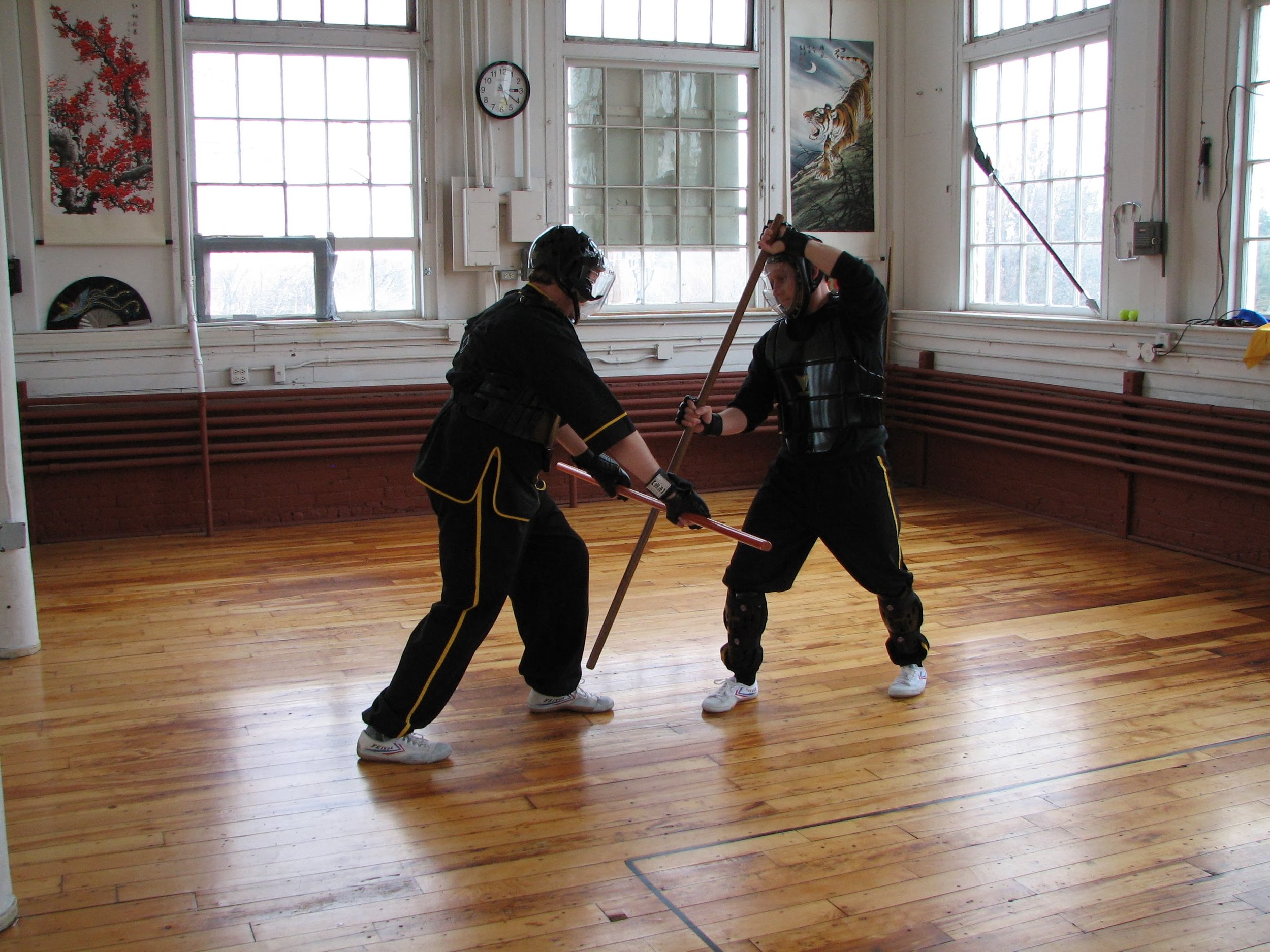
Staff vs Staff - circa 2006
I returned to my research and training. Buying any books I could find. I read over 100 books on Tàijíquán, most of them a complete waste of time. It’s amazing how many words have been written about nothing.
I found the other arts lacking in content altogether. At least to my favor, tàijíquán is well documented. The most widely proliferated Chinese martial art in existence. Unfortunately, much of this is without practical meaning, and comprised mostly of esoteric beliefs, or lacking clarity of purpose. Whether this is intentional, or through innocent ignorance is certainly a matter of debate.
I took to searching for videos of the core forms of the styles I had chosen. For mantis boxing, I was able to find one of Bēng Bù (Crushing Step), but had no such luck with Lán Jié (to Intercept 拦截) , or Bā Zhǒu (8 Elbows 八肘). I ordered videos from China, familiarizing myself with the Chinese characters enough that I could search for books and VCD’s containing these sets, or anything close to them. I signed up for a Chinese class to assist in my quest.
My language venture did not last long. It turned out to be the same misguided approach to teaching language that is rampant in public, private, and even collegiate school systems across America even to this day. Grammar first. Years go by, and one is still unable to speak fluently, or converse with a native speaker. It is odd, that this failure of a student to speak, is not a measure of success for a language arts curriculum, or a teacher’s capabilities...
I digress. It so happened that in my research, I had come across an excellent resource of knowledge - an online forum for mantis boxers. Rich, and fascinating conversations took place in this venue, people seemed to be sharing knowledge and communicating their ‘secrets’ without reservation. I visited it from time to time, never saying much as they seemed far more knowledgeable than I; and there existed an hierarchy of lineage holders that I was not part of.
One day, I read a thread where an individual was chastising and insulting anyone who learned from a video. This individual was particularly demeaning, condescending, and harsh in their criticism. Stating matter of factly, that “anyone interested in learning mantis should only be doing so from qualified teachers; certainly not from video!!!”
This infuriated me. Who was this person to dismiss one of the three ‘primary methods of human learning’ (verbal, kinesthetic, and visual)? What position of expertise did they hold in life to stand up and blatantly proclaim that personal instruction (which I had experienced plenty of), was the ONLY way someone should, or could, properly learn. I balked at this notion. I broke my silence and chimed in.
My response was snarky; full of contempt. I no longer cared who held what position, or however ‘exalted’ they seemed to be. I had too many years of feeling like I had been duped. I rose up upon my soapbox and fired back my reply - “blah, blah, blah, - insert stuff about learning types and video being a modern tool to assist people, - blah, blah, blah”. Then (I paraphrase here) - “perhaps if you mantis masters were not so rude and possessive with your forms, those of us whom you shun, would study from you, rather than be forced to pick scraps from videos.”
Shortly thereafter, I had a reply to my post in the thread. I opened it, adrenaline coursing through my veins. I awaited the inevitable online battle that was sure to ensue. Knowing, full well, some virtual vitriolic response from the original author of the post was there unopened in my inbox. Instead, I was greeted with - “Come to San Diego. I’ll show you the core forms of mantis.”
What!?!?!?! I was stunned. Stopped dead in my tracks. This was not at all what I expected. Who was this person? What did they know? Why were they so quick to offer and share what everyone else tried to hide?
I looked at the member profile. They were a member for years, yet barely posted a thing. I found a name. I Googled it. Nothing (Google was in it’s infancy then). I searched further; looking deeper. I finally found some grainy black and white videos of this Mantis Boxer doing the form Bā Zhǒu (8 Elbows 八肘), and another of one of his black belts doing Tōu Táo (Monkey Steals the Peach 猴子偷桃).
I could tell from the way they moved that they knew how to fight. I replied. “I’m interested. Let’s discuss.” Phone numbers were exchanged. A time set to talk. After an hour or so long phone call, and a lengthy discussion on his background, methods of teaching, and why he only works the core forms of Mantis, I booked a flight and hotel to San Diego, CA. Off I went.
I never looked back. In my first 15 minutes of meeting with this mantis boxer, I learned more about ‘fighting’ than I had in 7 years of kung fu training.
“Where do you look when you fight?”, he asked. I thought about it, and replied with “I look off to the side of my opponent.” He paused, a quizzical look on his face. Apparently he hadn’t expected that response. Then came his reply - “Not at them?” I said, “No, but I’ve been told all things of the sort - look in their eyes. Watch their head…” He asked me why I look off to the side. “It’s just something I do.” I replied. “It seems to work better for blocking.” He grinned.
“You’ve figured something out”, was his response. This made me feel good. I was eager to hear more. He proceeded to explain the reason behind why I was doing this, why it worked, and drills to prove it. Beyond that, he offered up the name of a ‘principle’ to go along with it. I was ecstatic. This was amazing! I had never experienced such a thing in martial arts; neither kung fu, nor tae kwon do. A ‘principle’ to teach fighting!?!?!
We then proceeded outside to work on Bēng Bù, a form from mantis boxing, and the one I was already familiar with. I was more interested in Lán Jié, since I had been unable to find anything solid on this form. However, being one of the core forms of Mantis that I already knew, it was a good launch point and gave us a way to see what one another knew.
We spent the next couple hours training in the parking lot of my hotel in the middle of the night, and well into the next morning. He left for home, and I spent the next hour scrambling notes and trying to calm down enough to sleep.

Qín Ná (Capture and Seize 擒拿) training - circa 2000
The next day we met for training around 9 a.m. We spent hours in the park, going over mantis boxing’s Lán Jié (to intercept 拦截) - as well as an application for each move. I was ecstatic and soaking it up like a sponge. We broke for lunch in the early afternoon and then met up with some of his students at his house. Training went well into the night again.
He asked - “How did you learn to block punches?” I stood there for a moment, realizing how little I had been taught on this. Most of my experience with blocking had been from taekwondo. I replied with something that I can no longer recall, but surely it was meek.
He had me pair up with one of his students to show him how I block. I was not allowed to move, and his student was to throw slow, controlled punches while I demonstrate my blocking skills. He destroyed me.
I blocked one or two shots, and then I was lucky to block one of every five after that. His student, had only been training 1.5 years. I was on my 7th year of training. Countless trophies under my belt, and a National 2x Gold, 1x Silver Medalist. I was running my own martial arts school, with a cadre of dedicated students looking to me to teach them how to defend themselves. This was humiliating, demoralizing, and excruciatingly raw. I felt like a novice. I felt as if I had wasted all my efforts. Years of training had been for nothing.
Right then and there, I had a choice to make. I could leave. Throw my hands up in defeat and walk away; quitting martial arts altogether. Or…I could do something less extreme - go home. Go home and lie to myself that I did fine. That he cheated, or that he did something nefarious to trick me. Pretend I was better than I was.
I looked at his student. Then turned my gaze upon the teacher as he stood there quietly gauging my reaction. My brow furrowed, I looked him in the eye with all my will behind me, and said - “teach me.”
Nationals Qualifier 2004 - Eagle Claw Form - Traditional Hand Forms. Hershey, Pennsylvania
To be fair, and honest, this was a bit of a rigged game. I wasn’t allowed to counter-strike, move, kick, clinch, or takedown. Real fighting, does not subsist with such a ruleset. Just blocking for any length of time is a failed strategy. One should be delivering parry/counter, block/counter, move/counter, etc. But the lesson hit home nonetheless.
I revisited everything I thought I knew, from the ground up. Asking him to go over stances, footwork, punching; anything I had already learned, or thought I learned. I wanted to know what was missing. The rest of the weekend turned to working on everything but, a form. He had to keep asking me - “Don’t you want to learn this form you came for?” [With a grin on his face of course.]
I spent the next few years going to San Diego twice/year, flying this coach to my school once/year. I met up with him at other people’s schools just to squeeze in whatever training I could get with him. Here was someone that knew how to fight, and did Chinese martial arts. I was all aboard.
As far as forms go, I learned Lán Jié, Bēng Bù (again), Báiyuán Tōu Táo (White Ape Steals Peach), 5th Son Staff, Saber, Da Dao (Military Saber), and a couple of 8-Step Mantis forms. I also learned how to block, punch, kick, and move; as well as throws, joint locks, and his core fighting principles to diagnose problems we have when sparring.
He helped me fix some forms I still held onto such as liánbùquán, and gongliquan, and my tai chi knowledge grew deeper and richer. As time went on, I had so much practical knowledge to work, the forms seemed superfluous, and nothing more than distractions.
I progressed, and my students became more and more in need of real skills. I went on to scorn forms in full force. Thinking them unnecessary, archaic, and highly corrupted distractions. Time-sucks that stole focus away from the more important aspects of martial arts - application, combat techniques, and self-defense skills.
Regardless of my disappointment and waning interest in forms, throughout it all, some part deep inside of me always held on to the notion that they are significant, important, and central to the art. Not in the possessive covetous way other teachers hold on to them, but in some more intrinsically valuable way.
Afterall, why were these core sets so important as to be handed down no matter what line of Mantis one studied? Why did the same set, with variations of course, exist across multiple lines in the family tree of Mantis Boxing? Why did almost every style of Chinese boxing have a ‘set’, or ‘sets’?
Ultimately I came to the realization that forms are treasure troves of knowledge. Ancient vehicles designed to carry the knowledge of a fighter’s system. Without the techniques, principles, and applications to go along with it however, or the work ethic to practice them tirelessly, they are worthless shells of long forgotten arts. The form, cannot exist without the function.
Without function, martial arts forms are merely martial dance. A non-practical artistic representation of a bygone mode of combat, and self-defense. There is nothing whatsoever wrong with people wanting to participate in the practice of this ‘dance’. It is only problematic when they believe, or are allowed to believe, that this practice of shadow boxing, will lead to the attainment of ‘real’ fighting skills.
In today’s world of video, books, a literate populace due to mass education, and the accessibility of martial arts schools and resources, forms are no longer necessary for a teacher to carry on an art of hand-to-hand, or weapons combat. As evidenced by judo, jiu-jitsu, muay thai, wrestling, filipino stick/knife arts, boxing, and more. All existing without the need for forms to muddy up the waters, or distract students from the true goal of martial arts - the dedicated practice of methods of violence to empower, embolden, and strengthen themselves out of immediate necessity, or the potential threat of such.
What is sorely needed for Chinese boxing to regain its rightful place on the mantle of formidable martial arts in the world of today is - less forms. More techniques. More application, and definitely more sparring.
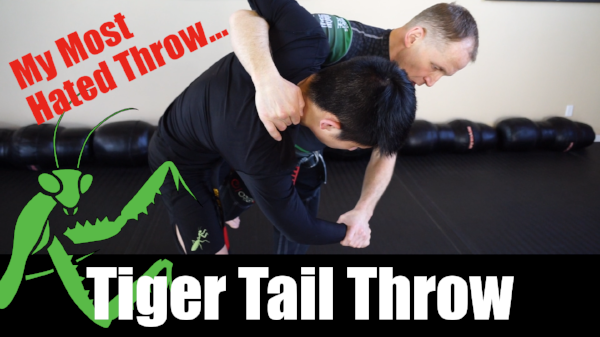
The Tiger Tail - My Most Hated Throw!!!
This was truly one of my most hated throws. In 2009, on one of my semi-annual sojourns to San Diego to train with my Mantis Boxing coach at the time, I was introduced to this personal menace.
The primary purpose of this trip, was for my teacher to share with me the 20 throws of Mantis Boxing that his 8-Step Mantis Boxing teacher had...
This was truly one of my most hated throws. In 2009, on one of my semi-annual sojourns to San Diego to train with my Mantis Boxing coach at the time, I was introduced to this personal menace known as a ‘thigh lift throw’, or in Judo - ‘uchi mata’.
The primary purpose of this trip, was for my teacher to share with me the 20 throws of Mantis Boxing that his 8-Step Mantis Boxing teacher had shared with him. We were to meet up with another of his Black Belt's - Mike Dasargo, and work on these techniques at Mike's school.
As the coach would show each throw, Mike and I would work on them together, and I would scribble notes down as we went. Doing my best to catalog each throw and its variations. As the day went on, we finally arrived on the ‘thigh lift throw’, what I have affectionately named the Tiger Tail Throw (as it looks like the tail of a tiger sticking up). A ferocious takedown.
I don't know what it was, but this throw was the single most difficult one for me to get. Maybe I was getting hungry, or having a 'short day' (sarcastic reference to my height), but this one was just not clicking. It seemed like a throw for taller people; at least that was my whiny excuse at the time. I took it down my notes, maybe even left a nasty comment in there, practiced a bit more, and moved on.
When I returned from San Diego, my ritual was to work on everything I did on the trip as soon as possible, so I would not lose it. I practiced this throw along with all the all 19 other throws even though I didn't care for it.
I'm not sure what happened next, but eventually, this throw became one of my favorite takedowns in Mantis Boxing, and probably the one I use with the highest frequency. Most likely...since I worked on it more than all of the others because of the difficulty I had with it, it began to morph and I adapted to it, and it to me.
In this video, I'm not only sharing the Tiger Tail Throw with you, but additionally the alternative throws (Descending Dragon, Demon Wheel, Retreat Astride Tiger, Mantis Hangs from Branch), Knee Strikes, Guillotine Chokes, that I use when someone counters this throw, or I miss on the execution.
Timestamps:
Tiger Tail Throw - (2:05)
Descending Dragon Takedown - (5:39)
Demon Wheel & Guillotine Choke - (7:00)
Knee Strike & Shoulder Lock - (8:02)
Retreat Astride Tiger - (8:50)
Mantis Hangs from Branch - (10:40)
--
Leave your comments and questions below. Don't forget to SUBSCRIBE and GET HOOKED!

Martial Arts vs Self-Defense Training
Basic self-defense knowledge can mean the difference between life and death, or assault and avoidance, but is it necessary in suburban America? If so, what is the best type of training for you? How do you find a good course, or even know what to look for? How involved does the training need to be for it to be effective? Click this article to find out.
Basic self-defense knowledge can mean the difference between life and death, or assault and avoidance, but is self-defense training necessary in suburban America? If so, what is the best type of training for you — a martial arts class (kung fu, karate, judo, jiu-jitsu, wrestling, boxing, etc), or a quick one-off self-defense class?
How do you find a good martial arts class, or self-defense course, or even know what to look for? How involved does the training need to be for it to be effective? Let’s start with what type of training best suits your needs.

What type of training - Martial Arts or Self-Defense?
Martial arts IS self-defense training, right? Not quite, and the difference between ‘Martial Arts vs Self-Defense Training’ can mean achieving your goals in the short-term, or delaying them for years to come. While a majority of martial arts styles do teach self-defense, there are just as many that do not. In addition, the pace to reach competency, to apply your training in real world scenarios, can be long and arduous and not always conducive to your body type, or strength capacity in that particular style of fighting.
Another trap is, some styles of martial arts focus predominantly on competition fighting which, due to rules, prevents you from training to hit targets you would normally want to hit in a real attack in order to quickly, and expediently disable an attacker that is trying to take your life, your virtue, or harm a loved one. Here’s an article you can read later on why simply knowing where to hit someone, is not enough. We have to train it - The Truth of the Effective Strike Principle
Martial Arts
Martial arts is phenomenal, but this approach is better if your self-defense goals are less ‘urgent’, and if they also include lifestyle improvement such as - confidence, self-esteem, fitness level, perfecting combat skills; while also enjoying the process of learning, camaraderie, training regimen and overall self-improvement. An amazing evolution takes place while studying martial arts, one unmatched in other sports and activities, and this is a powerful tool that has improved my own life, as well as hundreds of students who have joined me on this journey.
While I do highly recommend martial arts training to you if you are looking for self-defense training, if you ‘require’ this skillset with any sort of expediency, you are better off focusing on a concentrated course, rather than martial arts. For example, in Brazilian jiu-jitsu it can take 4 to 6 years of training to be competent at defending yourself against a wide range of attackers with varying size, shapes, and skills. This still does not address the lack of training in strike or kick defense, and will focus so much on the ground fight, that the stand-up grapple (shoves, trips, takedowns, throws) are minuscule.
In my experience, most BJJ gyms and coaches, focus so much on sport, they fail to address basic defense of someone striking you while on the ground. This can completely incapacitate a highly experienced BJJ grappler in seconds, as seen by countless MMA fights where high level jiu-jitsu grapplers entered the cage with little to no striking experience. This is no unique to BJJ gyms, and happens in any sport focused martial art. The time and energy is not spent on self-defense specific skills, as competition is the focus.
Self-Defense
The training methodology and techniques in a self-defense course are typically, and should definitely, be streamlined and focused. While it lacks the benefits of self-improvement, personal growth, teamwork, goal achievement, and fun, that one gets from training martial arts, it is replaced by short term, combat oriented training that produces effective results - i.e., quick, simple methods to get you out of a bad situation.
Self-Defense training is something I highly recommend if you are interested solely in protecting yourself and/or your loved ones. It is for men, women, adults and teens of any size, shape, and fitness level. It should not require you to be at a certain level of fitness in order to perform the techniques.
A self-defense course is especially relevant to you, if you are in a line of work that requires skills to protect you in the line of duty, e.g. soldiers, law enforcement, corrections officers, security guards, bodyguards. Or, those frequently by themselves in remote locations - gas station attendants, convenience store clerks, real estate agents, couriers, etc., or those who work after hours or close down a business alone or in small numbers.
Do you really need a course like this?
There are many reasons we can find to spend our free time doing activities we enjoy, working around the house, or shuffling from one activity to the next, or just enjoying a breather from school/work. Here are a few things to consider when deciding whether or not to invest your time and money into a self-defense course.
Do you plan to travel?
Are you going to, or returning to college?
Do you work a high risk job?
Do you live alone?
Do you reside, or work in a high risk environment?
Do you experience anxiety, or fear over past*, or perceived threat situations?
There are many reasons to take a course like this. No one plans to be attacked and need something like this. Then again, no one plans on drowning either, but most of us still learn to swim. You never really need a self-defense course, until you REALLY need one.
Taking one at least once in your life can make a difference. Know a few basic ways to defend yourself without a firearm, spray, or other weapon in the event of a dire circumstance is sound logic.
*Warning - if you have experienced a traumatic attack in the past, a course like this can revisit these traumatic experiences. While it is possible it can help overcome fears and anxieties, and teach you how to solve a problem that still plagues you, it is advised to speak with a medical professional prior to taking a course.
How do you find a good self-defense course?
S.E.E. - Look for a course that promotes principles such as - simple, easy, highly effective. Courses that rely on multi-step responses to a bad guy's attack, or the over-reliance on ‘fine motor skills’ vs gross motor skills, will fail you when you need them most.
Simple, clean techniques that use gross motor function, and are reinforced through repetition will be reliable under dire stress and an adrenaline dump.
Martial Arts training uses repetition to reinforce fine motor skills in combat over a much longer period of time. A weekend warrior style self-defense course should rely heavily on gross movements, the type that your body uses under duress.ZERO PUNCHING - This is so important. Your course of choice should address physical differences such as size, gender, strength, and not rely predominantly on punching. Punching, apart from being a refined skill that takes months, or years of practice in and of itself, will be harder for smaller and/or weaker opponents to produce enough stopping power to disable or slow down an aggressive attacker. Think 115 lbs woman versus 280 lbs male.
Keep in mind: the human skull has evolved over millions of years to protect the brain inside of it. It's hard, and not meant to crumble at the first hint of danger. Quoting a bike-helmet study published in the Journal of Neurosurgery: Pediatrics,
"235 kg (520 pounds) or 2,300 newtons of force would be needed to crush a human skull, almost twice as much force as human hands could possibly muster."
Punching the head can lead to breaking your hand. There are better ways to defend yourself.Strength Not Required - (don’t read this if you are sensitive) there are great self-defense oriented training programs out there. Krav Maga, an Israeli armed forces program, is an example. For what it was designed for, it is amazing! Who was it designed for? Highly trained, physically fit, special force commandos caught in hand-to-hand combat situations against an untrained, unfit, and often surprised, indigenous combatant.
Much to their chagrin, and this will likely get me in hot water - it is NOT, a suitable form of self-defense for college women, high school girls, suburban housewives, etc. I do not deem it fit for women in general, because that is NOT who it was designed for, and it’s success criteria will not work if you are smaller, weaker in stature than the opponent. Before you send me hateful comments - it is not fit for ME either. I’m a smaller male, and I found it problematic using the techniques against larger opponents.
I don’t sugar coat things when it comes to defending people’s lives. There are obvious anatomical differences ‘in general’ between women, and men. Knowing this, and choosing a course that takes this into account, no matter what your gender, is important. Know your strength/condition before undertaking a specific style of training. While I respect the Krav Maga training methods, this style ‘requires’ strength, speed, and highly aggressive bursts in order for it to work. Smaller, out of shape - find something that uses solid techniques/principles to work, rather than 2 years of combat training.Scenarios - Scenario training puts you in a stressful situation against a suited attacker so you can test the material you learned. Stress has an amazing ability to reinforce learned material in the brain. Having the opportunity to use what you learned, gives you the confidence to know that it works, and you can succeed. Make sure the course offers some type of stress testing.
Length - the length of the course should be relatively short. 40 hours of self-defense training is not a bad thing, but if 40 hours is required in order to get you through all the material, then see my previous statement on simplicity and efficacy under stress.
Usually a two hour focused course is 'ok', but should not be all encompassing. 8 to 12 hours of training is substantial, and if reinforced every few years, can be extremely beneficial.Types of Attacks - look for courses that cover defenses from common attacks such as: body/neck holds, grabs; while promoting the use of weapons you will have on you at all times (your limbs).
Reaching in your purse, or pocket for a weapon when being caught off guard, takes away the use of your natural weapons that could be better used to defend yourself.Weapons - some courses offer Kubotan training, or pepper spray/mace solutions in their arsenal. Weapons can be great tools, but do you have it on you at all times? Is it accessible? What happens if the attacker takes it away from you? Are you prepared for defending against your own weapon if it is taken away from you? Weapons can be excellent tools, but in civilized nations/environments, how likely are you to be able to access it when needed?
THE GROUND - I can’t stress this one enough. The course you take should absolutely address ground self-defense. Anyone can end up on the ground in an altercation, and many attacks end up here especially in sexual assault situations. Make sure the course offers extensive knowledge and training on how to deal with a larger, stronger, heavier attacker that has you pinned on the ground. Again, with simple, and effective techniques!
Verbal Boundaries - For some of us (specifically those that have trouble telling other people “no”), this can be the toughest type of training, but the most rewarding.
Ideally a you take course offers scenario training with suited attackers, but depending on your goals, and situation, you may want to address 'verbal boundaries', and how to deal with obnoxious, what I like to call 'space invaders'. Think creepy family friend or relative that likes to touch you while no one is looking. Or the person on your commuter train that puts their hands where they don’t belong. These are subtler situations that much akin to ‘date rape’, do not always warrant a full on death dealing blow. Rather, a lower-key response that sends a strong message you are not a willing participant in their sick fantasy.
Weapon Disarmament Courses
Weapon disarm courses should be considered with extreme care. Gun disarms are a viable training course and highly useful knowledge to have. While knife defense training is a slippery slope.
Knives are very dangerous!!! Buyer beware. It is extremely difficult to teach knife defense to an untrained person, especially in a short course. Also, there are many knife defense techniques that will not work, and are based off of unrealistic attack styles (Jim Carey’s ‘In Living Color’ skit comes to mind - see below). Be careful, and skeptical when seeking out knife defense training. Ask around before signing up for one.
If taking a gun disarm course, a quick tell on whether or not the material you are learning will work is this: does the move account for someone pulling the gun away while you are trying to perform the technique?
How much should it cost?
What should a self-defense course cost? The field varies from free courses, to expensive courses, and anything in between. We’ve all heard the saying “You get what you pay for.”, but let’s add a little perspective.
Free Courses
Sometimes a person offering a free course is doing so because they believe strongly in helping others to avoid becoming a victim. It is not a direct indicator of low quality. Perhaps they were a victim themselves at one time, and decided to channel their horrible experience into something positive in an altruistic manner.
We live in a monetary based society, and like it or not, we rate the value of something based on the price. This is good, and bad. Charging money for something does not automatically mean it is of higher quality. It is ultimately up to the consumer to research the courses, or try the free one first, and see if it is adequate by using some of the suggestions/criteria above. If you are satisfied and received a good service, then count yourself ahead.
Paid Courses
When dealing with paid courses, how much is too much? This becomes tricky. We’re not simply talking about life or death; the true ‘cost of living’ can mean surviving a sexual assault, mugging, or domestic violence, and avoiding the emotional trauma for years or decades to follow.
If these situations can be avoided altogether, the savings in monetary, emotional, psychological, and physical currency will be priceless.
Choosing a good course and instructor is priority one above all else. In the end, you will walk away feeling that you can rely on the material you learned, and hopefully never need it!
photos courtesy of Max Kotchouro

How to Start Martial Arts
As we get more people contacting us, and joining classes of late, I thought it was a good time to send around this video again. Max put this episode together a few years ago as part of his Swamp Talks series. Enjoy the sound effects. [Gunshots were not an intentional part of the production]
How to get started in martial arts. Here are some tips and advice on what to look out for as you search for your first, or subsequent martial arts school.
Enjoy the sound effects. [Gunshots were not an intentional part of the production]
Types of martial arts vary, but this can apply to any of them. Here is a list of some of the more common styles you may find in your quest in the USA:
Boxing (western and Chinese) - often depicted in modern times as the sport with two contestants wearing trunks and padded gloves facing off in a ring. Original roots encompass a far broader definition that included grappling, and weapons. Something more similar with Chinese boxing styles like mantis, eagle claw which include kicking, grappling, and joint locks/chokes/submissions in addition to striking with fists, palms, fingers, and elbows.
Kickboxing - a combination of striking and kicking. Also more sport oriented with rules to protect combatants from serious injury.
Wrestling - as with boxing, in modern times this calls forth distinct imagery in our minds of two combatants on a mat grappling one another to the ground and looking for a pin. Wrestling’s roots are far more pervasive and have origins to every continent on the globe. Greco-Roman which is more common in our minds today, to catch wrestling, to folk-style wrestling that changes slightly from culture to culture whether in Asia, Europe, Africa, or the Americas.
Jiu-Jitsu (Brazilian and Japanese) - jiu-jitsu origins hearkens back to the combat arts of the samurai which included but were not limited to hand-to-hand combat methods such as throws, joint locks, and ground finishing moves (submissions). Eventually this migrated to Brazil in the 1900’s where it was blended with catch-wrestling methods and focused more heavily on the ground fighting component of hand-to-hand combat.
Judo - a descendant of Japanese jiu-jitsu that focused on the grappling and ground fighting elements of jiu-jitsu.
Karate - an Okinawan fighting art that originated by blending methods from Southern China with the indigenous grappling methods of the Okinawan people. Also included weapons in addition to hand-to-hand combat applications.
Shuai Jiao - a Chinese throwing art similar to Judo but lacking the ground fighting elements. Descendant from Bokh, and other folk wrestling styles found in Mongolia and northeast Asia.
Tae Kwon Do - a Korean martial art developed in the mid 1900’s that focuses heavily on kicking.
Hapkido - also a Korean martial art that focuses more on locking and throwing methods.
Aikido - a Japanese martial art centered around falling, throwing, and locking an opponent.
Tai Chi - an old style of Chinese boxing that has been converted to a form of health practice and physical education since the early 1900’s. Prior to that it was a hand-to-hand combat art that included striking, kicking, throwing, and joint locking/chokes.
Kempo - an American martial art that early on focused on practical self-defense. Combined methods from all forms of Asian fighting arts as well as boxing and kickboxing.
Krav Maga - an Israeli hand-to-hand combat system designed specifically for commandos/special forces. Techniques are straightforward and practical, relying heavily on strength and speed to overwhelm the opponent.