
The Straight Punch - Throwing the Forward and Reverse Punch
The Straight Punch - devastating and destructive! Forward and Reverse punch are a good place to start when learning to punch in Mantis Boxing, or other striking arts. They are destructive, and can easily be modified to open hand strikes if necessary.
The following video shows the in's and out's of...
The Straight Punch - devastating and destructive! Forward and Reverse punch are a good place to start when learning to punch in Mantis Boxing, or other striking arts. They are destructive, and can easily be modified to open hand strikes if necessary.
The following video shows the in's and out's of starting to punch with these two strikes and some of the pitfalls to watch out for.
Using footwork with punches, increases the power, improves range, and helps keep us mobile instead of fixed. Check out pad drills, and blocking drills, or use these on a heavy bag to train on your own.
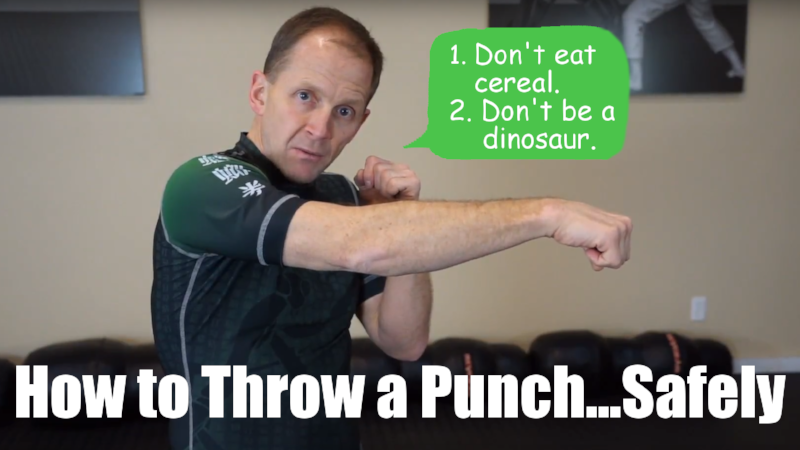
How to Throw a Punch...Safely
Having an improper structure, leaving a finger misplaced, or snapping our elbow, can all cause lasting damage, injuring ourselves more than the object we are trying to hit.
Whether we are hitting bags, pads, mitts, makiwara boards, or sparring partners, it's important to keep these tips in mind to keep us punching without injury for years to come.
Having an improper structure, leaving a finger misplaced, or snapping our elbow, can all cause lasting damage, injuring ourselves more than the object we are trying to hit.
Whether we are hitting bags, pads, mitts, makiwara boards, or sparring partners, it's important to keep these tips in mind to keep us punching without injury for years to come.

I'm Not Ready For That.
Another article on the inner demons that get in the way of our training. This one - "I'm not ready for that."
"I'm not ready for that." is a healthy approach to training things that overwhelm us.
Here are a couple of counters to the standing guard pass to help your game. Years ago I learned the second of these moves at a workshop with Renan Borges. I was still a white belt at the time, and even though I really liked the move, it wasn't something I was ready for.
I filed it away in the "I like this, but I'm not ready for it right now. I'll do my best today, and someday I'll come back to this." A few months ago, it started reappearing in my rolls and here's how I integrated it and hopefully you can too. When you are ready.
Sickle Sweep - place the feet in the hips as they stand up. As they push the leg down, rotate your foot inside to help with leverage. Not necessary, but it can give a good bite on the hip.
Use your other arm to attack the ankle with an underhook. Push up with the foot in the hip, and slice the back of the ankle with your leg as you hold the other ankle.
Deep Pass Defense - when they step through more aggressively, it is difficult to get the leverage to apply the sickle sweep. Here we shoot the arm through the leg following with our head and shoulder. Think of the hand as the tip of the arrow, and the head is the feather.
Place the back of the tricep on the back of the leg to help finish rotating through. No need to pull the leg all the way through, and it is faster to use the shin with the other leg. Grab the ankles and leverage up.
You can then take the back, or attack the ankles.

The Truth on Effective Strike
Effective Strike (Xiao Da), is the Chinese principle of striking to vital targets, or targets that have more destructive impact than other areas of the body. This is a common concept in many styles of martial arts. I recall the first time I showed up for Tae Kwon Do/Hapkido class back in 1991 - my teacher said - "Want to kill a man? Hit here, here, here, or here." I was happy, but stunned.
reprint of an article published in 2013 in the Journal of Seven Star Praying Mantis -
Xiao Da - The Truth on Effective Strike (Journal of 7 Star Mantis vol. 4, issue 4/Northern Shaolin Praying Mantis Institute and Association 2013)
Targets
Listed below are the targets and the effects a person experiences when being hit in those regions.
8 Head Targets
Throat
Side of Neck
Back of Neck
Jaw
Nose
Eyes
Ears
Temple
12 Body Targets
Shin
Knee
Outer Thigh
Inner Thigh
Groin
Bladder
Rib (Floater)
Kidney
Liver
Stomach
Solar Plexus
Collar Bone
Photos courtesy of Max Kotchouro

Cervical Spin - Downward Elbow Strike
Effective Strike (Xiao Da), is the Chinese principle of striking to vital targets, or targets that have more destructive impact than other areas of the body. This is a common concept in many styles of martial arts. I recall the first time I showed up for Tae Kwon Do/Hapkido class back in 1991 - my teacher said - "Want to kill a man? Hit here, here, here, or here." I was happy, but stunned.
I thought to myself - "WOW! Cool!!!" Followed by - "wait...why would you tell someone that in their first class? Isn't that dangerous information to hand out to strangers? After all even US Army Basic Training Hand to Hand Combat didn't teach us that!". I chalked it up to him just being half psychopath since he spent most of his life training elite South Korean Special Forces Soldiers in Hand-to-Hand Combat.
It was some time later in my martial arts career that I realized why this information wasn't so dangerous after all. The reason is simple. If you don't train it, you won't use it. Effective Strike is a skill like any other. It needs extensive practice and proper training in order to be effective in real combat, or in other words - to manifest itself under stress. In said Tae Kwon Do class, we never used finger strikes, throat chops, or did any sort of training that incorporated strikes to these vital areas; we simply kicked, punched (less), blocked, and smashed our shins and forearms on one another till bruised an battered.

Brachial Stun using Slant Chop
Train Like You Fight, Fight Like You Train
I like to use the terminology - train like you fight, fight like you train. In your Kung Fu training, the constant focus of hitting to Effective Strike targets is crucial to making this habitual. There is no time to think in a fight. One must react and react appropriately; which is the whole objective of proper training.
So when should you learn this skill? Ideally the sooner the better, especially for smaller fighters. Smaller fighters lack the power that a larger or heavier opponent can produce, so this skill is crucial for us. Being able to hit someone in a targeted area means that your strikes pack more bang for the buck.
With that said, one needs to learn how to properly punch first, before focusing on Effective Strike. Trying to perform Xiao Da from Day One, gives the brain too much to focus on at one time. A beginner should be more concerned with proper striking, blocking, guard principle, and defense first. Once Xiao Da is properly introduced, aim for these targets with every strike in your arsenal.
After you have learned it, you can then veer off to other non-effective targets that may lure or distract your opponent; creating what we call Open Doors to the effective targets we want. This is necessary because an opponent with a good defense will 'require' you to 'open doors' in order to hit his covered targets.

Training Tips
These vary based on whether or not you have a training partner. I did not have a partner to use when I wanted to integrate this into my fighting, so I took colored price stickers used in yard sales, and I plastered them on my heavy bag in the general target areas on the human body. I then practiced various combinations striking to these targets. To test them, I sparred with other people.
For those with a partner, I recommend a great technique called 'Walk the Body', passed down to me from a mantis boxing coach on the west coast. Walk the Body has one person standing still (in their fighting stance is fine) while the other practices slow and very low power combinations to targets on their partners body.
As you grow more comfortable with the targets, the complexity increases by having your partner put their hands up in a defensive fighting position forcing you to move their arms. Following that, you need striking combinations, that the partner blocks, so you can open doors to the Effective Strike targets you wish to hit using solid striking combinations.
Note: this is not a fast paced exercise and requires patience, cooperation, and hours of practice to become second nature. It challenges your critical thinking skills once you add the complexity of combinations versus a live defense. Done properly however these strikes will become automatic and ingrained in your skill set.

Ear Claw
DIM MAK - The fallacy of pressure point based combat
Early in my training I met people, and still do from time to time, that have little knowledge of martial arts, but they talk about Dim Mak (pressure point striking) from books they've read, or videos they've watched, or even some Hollywood movie.
You can find videos online of teachers knocking out students at demonstrations to show Dim Mak, and all the supposed power one can have over other human beings by hitting them in these targets. People are fascinated by this and very enthusiastic. I can understand why, the idea of knocking out someone else with such ease is...alluring! Unfortunately, while some of these are legitimate strikes to real targets, some are incredibly finite and difficult to get to.
In a previous article, Size Matters - In Chin Na I discuss 'gross' versus 'fine' motor function in combat. Just like finite Chin Na skills, high precision striking is less reliable when we are under stress, AND when our opponent is trying to hit us back. That's the live, active, and moving opponent that is also trying to ‘take your head off’ component.
This complicates things and makes it much more difficult to perform a finite strike to a small target area. So unless you're Luke Skywalker firing your torpedo at the Death Star, give up on the idea, and stick with something that will work.
Natural armor - in addition, a human being under the affects of adrenaline in combat (never mind the affects of drugs), is more resilient to these strikes. It really sucks when you're in the thick of it and your silver bullet doesn't really kill the werewolf! This is why it is better to learn multiple targets, strike in combinations that you would normally throw, and cover your bases in case you miss the first target. Meaning, you missed but it still hurts them like hell!!!
Targets Defined

Temple Strike using Backfist
8 Head Targets
Throat - Crush the larynx making it difficult to impossible for opponent to breathe
Side of Neck (Brachial Stun) - Knock out blow, or excrutiating pain at the least
Back of Neck (Occipital Lobe) - Knock out blow
Jaw - Break or Dislocation. Extreme pain.
Nose - Pain. Bleeding. Watery Eyes causing reduced vision.
Eyes - Loss of sight. Extreme pain.
Ears - Tear them off for extreme pain.
Temple - Knock out blow. Extreme pain. Disorientation.

Knee Break using Cross Kick
12 Body Targets
Shin - Extreme pain and discomfort.
Knee - Break/Dislocation. Extreme pain. Loss of Mobility.
Outer Thigh - A solid kick to this target can cripple a fighter and make them think twice about closing distance.
Inner Thigh (Femoral Nerve) - Identical to the Outer Thigh, this target causes excruciating pain.
Groin - Extreme pain and discomfort. Potentially cripple opponent.
Bladder - Pain and discomfort. Possible bladder release. (you figure it out)
Rib (Floater) - Break. Extreme pain and discomfort. Possible breathing effects.
Kidney - Potential knock out as well as extreme pain.
Liver - Knock out blow. Extreme pain/discomfort.
Stomach - Knock out blow. Extreme pain/discomfort.
Solar Plexus - High concentration of nerves. Also the meeting point of the heart, liver.
Collar Bone - Break. Extreme pain. Loss of use of arm on that side. Harder target to hit and not effective on everyone.