
Martial Superiority: The Silent Assassin
When we look at one school versus another, and determine that one of them is promoting people to Black Belt with far easier requirements than we ourselves went through, or they are expecting less of their students than what we expect of our students, we can climb on our rickety soap box and take a stand against them, railing at the injustice of it all, or we can look at it like this...

View of Mt. Washington from 7000 feet - 2012
I had this amazing conversation the weekend before last, with two accomplished martial artists/teachers over lunch - Sensei Ando, and Sensei Dave Abraham.
During the discussion, we arrived on the topic of judging other schools, or the policing of other martial arts schools/styles because of what they are doing; whether said instruction, or the belt requirements not being up to standards.
I shared something that took me years to arrive at within myself, and what I believe is an important perspective to maintain for all of us as martial artists; especially, as teachers/mentors.
When we look at one school versus another, and determine that one of them is promoting people to Black Belt with far easier requirements than we ourselves went through, or they are expecting less of their students than what we expect of our students, we can climb on our rickety soap box and take a stand against them, railing at the injustice of it all, or we can look at it like this...
Harvard University does not concern itself with trashing lesser universities, community colleges, night schools. They do not publicly humiliate students of those institutions for taking classes there, nor for their effort they applied to achieve their goals under said curricula.
If you attend either school, an Ivy League, or a Community College, you will receive a bachelor's degree upon completion of the required courses/credits just the same. Both are Bachelor's degrees, both are opportunities to learn and grow. One of these holds more credibility, or esteem than the other, by outward appearances only. Yet the price tag attached along with it is far greater as well.
The individual who studies is the one who truly defines the value of the degree. Going to an ivy league school is not a qualifier that we received a good education. The inverse is true as well; going to a community college, or night school, is not definitive proof someone received a sub par education.
This judgement happens in the martial arts world as well. People use lineage, and even race, as a testimonial to the value of their belt. I have witnessed this first hand. If we study a Japanese Art, is our teacher from Japan? Did we go to Japan to study? The implication in the question being, that an answer of 'No', somehow makes your achievement less significant.
If we practice Brazilian Jiu-Jitsu, is our teacher Brazilian? Did we sweat in the dojo's of Rio? If we follow Chinese Martial Arts, is our teacher Chinese? These are seemingly innocent questions from the uninitiated, but I have seen more times than I can count, this being used as a bully tactic from those in the martial arts world. A world where we are largely responsible for empowering others to stop bullies.
A Mantis Boxing coach I trained with for years, is Mexican-Filipino. He jokes with people that he is 'Paco the Gardener'. Why? Where he lives, people will see him as that, long before recognizing him as a highly effective, and battle tested warrior.
"Not all Black Belts are created equal." - unknown
The quality of a Black Belt is another mountain we stand upon to look down upon others from on high. I have seen this in Mantis Boxing, Eagle Claw, Tai Chi; and it will become more prevalent in Brazilian Jiu-Jitsu as the art becomes more proliferated and widely spread.
The Tibetan Monks did not populate temples in the mountains to look down upon others, but rather to peer closer to the heavens.
Someone who received their belt from a no name individual, but trained diligently for years, persevering numerous trials; could, and at times does, outmatch a person who has had access to, and trained in the best facilities, with a famous fighter/teacher that awarded them their Black Belt.
The person makes the belt. The teacher is only a guide. We should be careful judging others, as it is simply Narcissism disguised as justification, goodwill, or constructive criticism.
Focus on what we have, be the best we can be, and we will rise above the fray. Stay focused on what everyone else is doing, and we will drag ourselves down into the mire.

Defending the Worst Position Ever!!
The High Mount combined with striking is a deadly combination. This is by far, one of the worst positions you can get stuck in on the ground. The traditional BJJ escape for mount - bridge, trap, and roll doesn't work quite yet, and meanwhile our opponent is raining punches on us, and bringing the thunder like Poseidon.
All too often, we panic in this situation and end up flailing, or trying to grab arms. Here we show a technique we call - 'Shield Up / Shimmy Up' to help you deal with this problematic position. We have to work from where we are, not where we want to be.
The High Mount combined with striking is a deadly combination. This is by far, one of the worst positions you can get stuck in on the ground. The traditional BJJ escape for mount - bridge, trap, and roll doesn't work quite yet, and meanwhile our opponent is raining punches on us, and bringing the thunder like Poseidon.
All too often, we panic in this situation and end up flailing, or trying to grab arms. Here we show a technique we call - 'Shield Up / Shimmy Up' to help you deal with this problematic position. We have to work from where we are, not where we want to be.
Like the video? Don't forget to hit subscribe.

Is a Self-Defense Course for You? And How to Pick the Right One.
Basic self-defense knowledge can mean the difference between life and death, or assault and avoidance, but is it necessary in suburban America? If so, what is the best type of training for you? How do you find a good course, or even know what to look for? How involved does the training need to be for it to be effective? Click this article to find out.
Basic self-defense knowledge can mean the difference between life and death, or assault and avoidance, but is it necessary in suburban America? If so, what is the best type of training for you? How do you find a good course, or even know what to look for? How involved does the training need to be for it to be effective?

Do I really need a course like this?
There are many reasons we can find to spend our free time doing activities we enjoy, working around the house, or shuffling from one activity to the next, or just enjoying a breather from school/work. Here are a few things to consider when deciding whether or not to invest your time and money into a self-defense course.
Do you plan to travel?
Are you going to, or returning to college?
Do you work a high risk job?
Do you live alone?
Do you reside, or work in a high risk environment?
Do you experience anxiety, or fear over past*, or perceived threat situations?
There are many reasons to take a course like this. No one plans to be attacked and need something like this. Then again, no one plans on drowning either, but most of us still learn to swim. You never really need a self-defense course, until you REALLY need one.
Taking one at least once in your life can make a difference. Know a few basic ways to defend yourself without a firearm, spray, or other weapon in the event of a dire circumstance is sound logic.
*Warning - if you have experienced a traumatic attack in the past, a course like this can revisit these traumatic experiences. While it is possible it can help overcome fears and anxieties, and teach you how to solve a problem that still plagues you, it is advised to speak with a medical professional prior to taking a course.
What type of training is best for me? Should I take Martial Arts, or a Self-Defense Course?
Most of us don't know the difference between ‘Martial Arts vs Self-Defense Training’, but there definitely is one! Significant ones at that.
While a majority of martial arts styles do teach self-defense, there are just as many that do not. In addition, the pace to reach competency to apply your [insert style of martial art] for real world scenarios can be long and arduous; and not always conducive to your body type, or strength capacity in that particular style.
Some styles of martial arts focus predominantly on competition fighting, which does not allow you to hit targets you would normally want to hit in order to quickly, and expediently disable an attacker that is trying to take your life, your virtue, or harm a loved one.
Martial Arts
Martial arts is phenomenal (insert biased opinion), But this approach is better if your self-defense goals are less ‘urgent’, and if they also include lifestyle improvement, fitness level, perfecting combat skills; while also enjoying the process of learning, camaraderie, training regimen and overall self-improvement.
There is an amazing evolution that takes place while studying martial arts, and it is a powerful tool that has improved my life, and many others.
While I do highly recommend martial arts training to you if you are looking for self-defense training, if you require this skillset with any sort of expediency, you are better off focusing on a concentrated course, rather than martial arts.
Self-Defense
Self-Defense training is something I recommend for you if you are interested solely in protecting yourself and/or your loved ones. It is for men, women, adults and teens of any size, shape, and fitness level. It should not require you to be at a certain level of fitness.
On the job - a self-defense course is especially relevant to you, if you are in a line of work that requires skills to protect you in the line of duty, e.g. soldiers, law enforcement, corrections officers, security guards. Or, those frequently by themselves in remote locations - gas station attendants, convenience store clerks, real estate agents, those working after hours in small numbers, or solo.
The training methodology and techniques in a self-defense course, are typically, and should definitely, be streamlined and focused. While it lacks the benefits of self-improvement, personal growth, teamwork, goal achievement, and fun, that one gets from training martial arts, it is replaced by short term, combat oriented training that produces effective results - i.e., quick, simple methods to get you out of a bad situation.
How do you find a good self-defense course?
S.E.E. - Look for a course that promotes principles such as - simple, easy, highly effective. Courses that rely on multi-step responses to a bad guy's attack, or the over-reliance on ‘fine motor skills’ vs gross motor skills, will fail you when you need them most.
Simple, clean techniques that use gross motor function, and are reinforced through repetition will be reliable under dire stress and an adrenaline dump.
Martial Arts training uses repetition to reinforce fine motor skills in combat over a much longer period of time. A weekend warrior style self-defense course should rely heavily on gross movements, the type that your body uses under duress.ZERO PUNCHING - This is so important. Your course of choice should address physical differences such as size, gender, strength, and not rely predominantly on punching. Punching, apart from being a refined skill that takes months, or years of practice in and of itself, will be harder for smaller and/or weaker opponents to produce enough stopping power to disable or slow down an aggressive attacker. Think 115 lbs woman versus 280 lbs male.
Keep in mind: the human skull has evolved over millions of years to protect the brain inside of it. It's hard, and not meant to crumble at the first hint of danger. Quoting a bike-helmet study published in the Journal of Neurosurgery: Pediatrics,
"235 kg (520 pounds) or 2,300 newtons of force would be needed to crush a human skull, almost twice as much force as human hands could possibly muster."
Punching the head can lead to breaking your hand. There are better ways to defend yourself.Strength Not Required - (don’t read this if you are sensitive) there are great self-defense oriented training programs out there. Krav Maga, an Israeli armed forces program, is an example. For what it was designed for, it is amazing! Who was it designed for? Highly trained, physically fit, special force commandos caught in hand-to-hand combat situations against an untrained, unfit, and often surprised, indigenous combatant.
Much to their chagrin, and this will likely get me in hot water - it is NOT, a suitable form of self-defense for college women, high school girls, suburban housewives, etc. I do not deem it fit for women in general, because that is NOT who it was designed for, and it’s success criteria will not work if you are smaller, weaker in stature than the opponent. Before you send me hateful comments - it is not fit for ME either. I’m a smaller male, and I found it problematic using the techniques against larger opponents.
I don’t sugar coat things when it comes to defending people’s lives. There are obvious anatomical differences ‘in general’ between women, and men. Knowing this, and choosing a course that takes this into account, no matter what your gender, is important. Know your strength/condition before undertaking a specific style of training. While I respect the Krav Maga training methods, this style ‘requires’ strength, speed, and highly aggressive bursts in order for it to work. Smaller, out of shape - find something that uses solid techniques/principles to work, rather than 2 years of combat training.Scenarios - Scenario training puts you in a stressful situation against a suited attacker so you can test the material you learned. Stress has an amazing ability to reinforce learned material in the brain. Having the opportunity to use what you learned, gives you the confidence to know that it works, and you can succeed. Make sure the course offers some type of stress testing.
Length - the length of the course should be relatively short. 40 hours of self-defense training is not a bad thing, but if 40 hours is required in order to get you through all the material, then see my previous statement on simplicity and efficacy under stress.
Usually a two hour focused course is 'ok', but should not be all encompassing. 8 to 12 hours of training is substantial, and if reinforced every few years, can be extremely beneficial.Types of Attacks - look for courses that cover defenses from common attacks such as: body/neck holds, grabs; while promoting the use of weapons you will have on you at all times (your limbs).
Reaching in your purse, or pocket for a weapon when being caught off guard, takes away the use of your natural weapons that could be better used to defend yourself.Weapons - some courses offer Kubotan training, or pepper spray/mace solutions in their arsenal. Weapons can be great tools, but do you have it on you at all times? Is it accessible? What happens if the attacker takes it away from you? Are you prepared for defending against your own weapon if it is taken away from you? Weapons can be excellent tools, but in civilized nations/environments, how likely are you to be able to access it when needed?
THE GROUND - I can’t stress this one enough. The course you take should absolutely address ground self-defense. Anyone can end up on the ground in an altercation, and many attacks end up here especially in sexual assault situations. Make sure the course offers extensive knowledge and training on how to deal with a larger, stronger, heavier attacker that has you pinned on the ground. Again, with simple, and effective techniques!
Verbal Boundaries - For some of us (specifically those that have trouble telling other people “no”), this can be the toughest type of training, but the most rewarding.
Ideally a you take course offers scenario training with suited attackers, but depending on your goals, and situation, you may want to address 'verbal boundaries', and how to deal with obnoxious, what I like to call 'space invaders'. Think creepy family friend or relative that likes to touch you while no one is looking. Or the person on your commuter train that puts their hands where they don’t belong. These are subtler situations that much akin to ‘date rape’, do not always warrant a full on death dealing blow. Rather, a lower-key response that sends a strong message you are not a willing participant in their sick fantasy.
Weapon Disarmament Courses
Weapon disarm courses should be considered with extreme care. Gun disarms are a viable training course and highly useful knowledge to have. While knife defense training is a slippery slope.
Knives are very dangerous!!! Buyer beware. It is extremely difficult to teach knife defense to an untrained person, especially in a short course. Also, there are many knife defense techniques that will not work, and are based off of unrealistic attack styles (Jim Carey’s ‘In Living Color’ skit comes to mind - see below). Be careful, and skeptical when seeking out knife defense training. Ask around before signing up for one.
If taking a gun disarm course, a quick tell on whether or not the material you are learning will work is this: does the move account for someone pulling the gun away while you are trying to perform the technique?
How much should it cost?
What should a self-defense course cost? The field varies from free courses, to expensive courses, and anything in between. We’ve all heard the saying “You get what you pay for.”, but let’s add a little perspective.
Free Courses
Sometimes a person offering a free course is doing so because they believe strongly in helping others to avoid becoming a victim. It is not a direct indicator of low quality. Perhaps they were a victim themselves at one time, and decided to channel their horrible experience into something positive in an altruistic manner.
We live in a monetary based society, and like it or not, we rate the value of something based on the price. This is good, and bad. Charging money for something does not automatically mean it is of higher quality. It is ultimately up to the consumer to research the courses, or try the free one first, and see if it is adequate by using some of the suggestions/criteria above. If you are satisfied and received a good service, then count yourself ahead.
Paid Courses
When dealing with paid courses, how much is too much? This becomes tricky. We’re not simply talking about life or death; the true ‘cost of living’ can mean surviving a sexual assault, mugging, or domestic violence, and avoiding the emotional trauma for years or decades to follow.
If these situations can be avoided altogether, the savings in monetary, emotional, psychological, and physical currency will be priceless.
Choosing a good course and instructor is priority one above all else. In the end, you will walk away feeling that you can rely on the material you learned, and hopefully never need it!
photos courtesy of Max Kotchouro

Cracking the Black - Vincent Tseng
On July 8, 2017, Vincent Tseng was awarded his Black Belt in Mantis Boxing (Tángláng quán 螳螂拳). Vincent arrived at our wŭguān (martial hall) in 2006 at the age of 16. I still recall our first phone conversation...
July 8, 2017
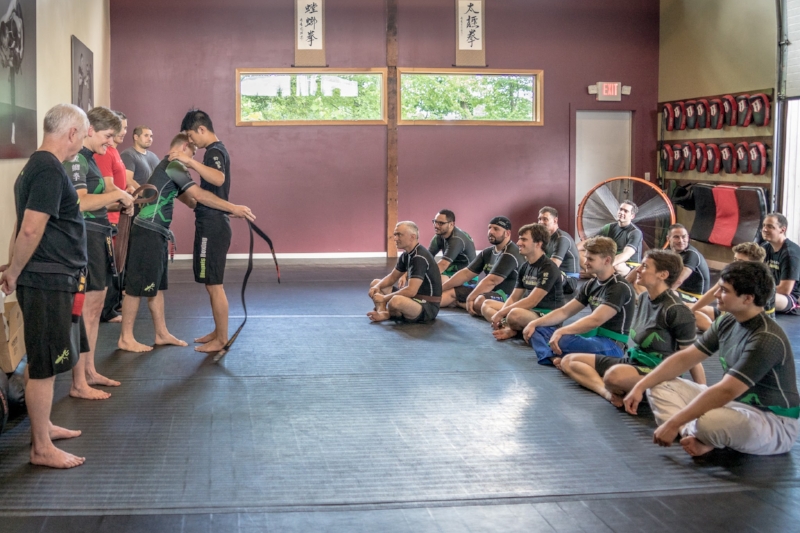
On July 8, 2017, Vincent Tseng was awarded his Black Belt in Mantis Boxing (Tángláng quán 螳螂拳). Vincent arrived at our wŭguān (martial hall) in 2006 at the age of 16. I still recall our first phone conversation.
Vincent was searching for a martial art, but he was extremely comprehensive in his quest. Asking detailed questions and thorough in his research. Many of his friends at the time studied martial arts, but Vincent was seeking something different, something more.
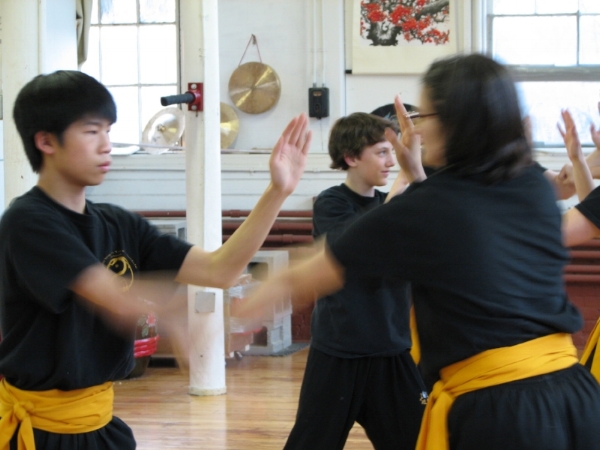
Vincent, Adria, Chris - Littleton Mill, 2007
In his research, he found out about the Chinese Martial Art of Praying Mantis Boxing. He then called me with a clear determination that Mantis Boxing was the style he wanted to do.
When he arrived at the school to discuss his training, he was full of exuberance, and commitment. We talked for a while, and he came back soon after and began classes. He spent the next 2 years training diligently before leaving for college.
One of my favorite Vincent stories...
We were attending the annual Mantis Boxing Anniversary dinner in New York City in honor of Great Grandmaster Chiu Leun. We met up with our West Coast family - Sifu Mike Dasargo, Sifu Mark Melton, and our late Grand Master, Sigung Stephen Laurette.
At the dinner, people will get up on stage and perform a demonstration for the crowd. Vincent waits quietly at our table as the night unfolds. When the stage was empty for a while, he looked at me and asked if he could go up. I nodded.
He stood up and walked earnestly past 20 or so teachers, and 40+ other attendees made of practitioners of the art, family members, and friends. He arrives on stage, but the audience is too busy eating, drinking, and sharing stories to notice.
Vincent does the salutation, and steps out into his horse stance with thunder. Everyone looks up and stares as he begins his set; Gong Li Quan (Power Building Fist) if I recall. He lets loose with vigor through the first road of the form. As he gets further in, he has a momentary lapse and is suddenly lost as to what his next move is. When this happens, it feels like years are passing by, when in reality, it is barely a second to the audience, and if played right, they will never know you forgot.
Instead, Vincent erupts with a loud 'SHIT!!!!!" in front of the audience. There is silence for a moment, then you hear some laughter, or maybe I was the only one laughing, and then everyone resumes their meals and conversations while Vincent is humbled by his 'black out' and embarrassed by his words.
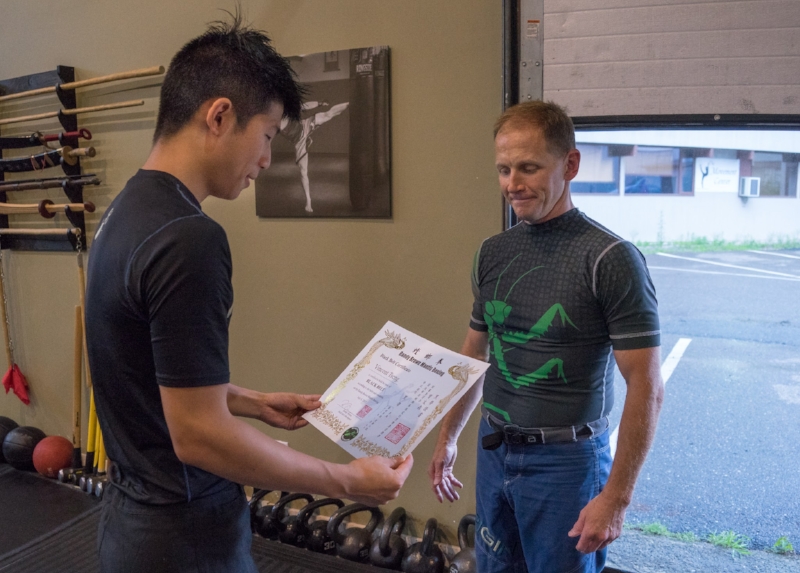
Vincent receiving his certificate.
Vincent went off to college after High School, and although he was still in the State, it was far enough away that he could not regularly attend classes. Still, he would pop in on the occasional weekend, over the holidays, train in the summers, and practice on his own.
Vincent maintained a presence in the school even when he couldn't be here, returning to the fold a few years later to pick up where he left off. I'm not sure if my words here can express the significance of that last statement.
In the martial arts, you are training with the same group regularly for the period of time you are there. When life throws something in the way, you have to step aside while your peers continue to train and progress. This is often difficult for a student to overcome. They feel behind, left out, and there is a strong deterrent from returning even though they would be welcomed back with open arms.
The ego is powerful and unruly. Instead of continuing something we enjoy, we'll decide to quit for good and miss out on the joys, experiences, and team we had once been part of.
Vincent came back without issue. He stepped onto the mats, and quickly realized the people he knew before, even some that started after him, had surpassed his level. Instead of quitting, being bitter, or letting this be a problem, he smiled, chuckled (the same laugh we hear when we get a solid punch, or clean throw on him), and congratulated those that had advanced beyond him. He then set himself to the task of moving forward once more. A testament to his character.
It is an honor have Vincent join us as a Black Belt in Mantis Boxing, carrying the torch for future generations.
photos courtesy of Max Kotchouro
video by Holly Cyr

How to Escape the Bow and Arrow Choke
I absolutely love the Bow and Arrow choke, but it sucks to be on the receiving end. Here we demonstrate the choke, an escape from the choke, and then how to prepare yourself for your next move after you release the choke.
I absolutely love the Bow and Arrow choke, but it sucks to be on the receiving end. Here we demonstrate the choke, an escape from the choke, and then how to prepare yourself for your next move after you release the choke.
Having an exit strategy can really help shut down the counters our opponent may throw at us.
Like the video? Don't forget to hit subscribe.

Training Your Elbows and Joint Locks (Chin Na)
Joint locks (Chin Na) are fun!!! If you are into pain that is. ;-) Seriously, standing submissions are very cool; unfortunately, they can be extremely difficult to pull off for real.
Here is a more advanced drill to help you train ways to...
Joint locks (Chin Na) are fun!!! If you are into pain that is. ;-) Seriously, standing submissions are very cool; unfortunately, they can be extremely difficult to pull off for real.
Here is a more advanced drill to help you train ways to flow your fighting into those nifty locks. In order to make this drill easier, you'll want to have some knowledge of elbow strikes, and joint locks before doing this.
As Vincent and I throw elbow strikes, it forces the other person to counter the strike and place themselves in a position where we can setup a joint lock, rather than trying to attack a completely resistant opponent. This is a softening the target, or creating a distraction so we can affect the lock.
Enjoy!
Like the video? Don't forget to hit subscribe.
►SUBSCRIBE on YouTube: https://www.youtube.com/mantisboxers

Collapse and Fall Into Ruin - (Beng 崩)
A huge thanks to Gene Ching and the team at Kung Fu Tai Chi Magazine for publishing my article this month. Such an awesome presentation! Thank you to my team - Holly Cyr, Vincent Tseng, Max Kotchouro, Bruce Sanders, and Sean Fraser for your assistance in making this happen. I am honored.
A huge thanks to Gene Ching and the team at Kung Fu Tai Chi Magazine for publishing my article this month. Such an awesome presentation! Thank you to my team - Holly Cyr, Vincent Tseng, Max Kotchouro, Bruce Sanders, and Sean Fraser for your assistance in making this happen. I am honored.
The article is an expose on the Mantis Boxing principle of Beng (Crush, or to Collapse and Fall Into Ruin). You can read the rest of the article 'Collapse and Fall Into Ruin' in the July/Aug issue on store shelves now, or available online.


BJJ Mount Attacks For Smaller Fighters
Fighting bigger opponents can be frustrating when we try and control the mount position. I know I avoided the mount most of the time as a BJJ White Belt after getting tossed around repeatedly. After a while, I started using the high mount to setup some attacks. Here's are two videos highlighting some attacks from the mount.
Fighting bigger opponents can be frustrating when we try and control the mount position. I know I avoided the mount most of the time as a BJJ White Belt after getting tossed around repeatedly. After a while, I started using the high mount to setup some attacks. Here's are two videos highlighting some attacks from the mount.
Moving closer to the head helps maintain the control needed, but many opponents will seal their arms up to try and stop arm bars, and americanas. Here's a tool to crack open that pesky shell and get the arms exposed for attack.
Like the videos? Don't forget to hit subscribe.
5 Reasons Brazilian Jiu Jitsu is THE Best Martial Art for Kids
Striking arts, whether they be Karate, Tae Kwon Do, Boxing, Kickboxing, etc. - all require high degrees of focus on multiple facets of fighting, & self-defense (you can read more on this in my 2015 blog post).
I have spent the past 18 years practicing Mantis Boxing, and the past 5 of those also practicing Brazilian Jiu Jitsu. I also spent years teaching kids both Kung Fu, and Brazilian Jiu Jitsu. My first love will always be Mantis Boxing, but frankly speaking, it is not for kids.
Striking arts, whether they be Karate, Tae Kwon Do, Boxing, Kickboxing, etc. - all require high degrees of focus on multiple facets of fighting, & self-defense (you can read more on this in my 2015 blog post).
I have spent the past 18 years practicing Mantis Boxing, and the past 5 of those also practicing Brazilian Jiu Jitsu. I also spent years teaching kids both Kung Fu, and Brazilian Jiu Jitsu. My first love will always be Mantis Boxing, but frankly speaking, it is not the best for kids.
This is not only because of the recent knowledge we have into the dangers of concussions, CTE, and other brain injuries; which is extremely important. It also has to do with deeper reasons that go far beyond injuries. One such factor is - results.
However, where striking arts lead to more common injuries in the pursuit of 'real' skills, or are watered down to the point of boredom, BJJ can be a fun way to bring kids to a high level of competence; preparing them for dangers life may throw their way while giving them an opportunity to grow into more confident, physically fit individuals and enjoy their time doing so.
Here are the 5 main reasons Brazilian Jiu Jitsu is the best martial art for your child -
1. Natural Art
BJJ is much akin to our natural movements and innate self-defense skills. Like tiger cubs that practice sparring before leaving the safety of their mother, so to do we as humans practice fighting when we are young, pliable, and less likely to hurt one another, and ourselves.
Any parent with multiple children, or adults who grew up with siblings knows this to be true. Growing up in the 70's and 80's, we were always getting in tussles some playful, some not so much.
Watch untrained kids go at it with one another. What do you see? They have a natural predilection towards a rolling around, wrestling modality. If they had fur, a tail, and pink butts you'd think they were monkeys.
BJJ works within the natural instincts we are all born with. It operates predominantly on the ground where it shines above all other martial arts.
2. The Great Equalizer
The bare truth of self-defense is - size matters. In order to beat size and strength, you must have superior skill. The stronger they are, or the more skilled they become with strength, the better your technique must be.
Brazilian Jiu Jitsu uses leverage and physics to equalize this disparity. Kids learn to flip and roll larger opponents, like a chef flipping pizza dough. Except after they flip the dough, they rip it up and choke it out. :-D
Nothing gives a child more confidence than watching their skills progress and being able to do things they never would imagine.
Watch this video with BJJ Black Belt Robson Moura battling a guy that walked into his school and challenged them to fight. Here you will see how size was neutralized with BJJ.
3. Physical Fitness
With regular training in BJJ, you get unmatched core strengthening, and overall functional full body strength. With each movement you are engaging your entire body to perform an action.
Here are a few examples of how BJJ makes you stronger, faster, and in better shape.
Upper body - using your arms to support your weight and maintain 3 points of contact at all times, activates the arms, shoulder, chest, back, and core. Over time, the upper body will gain muscle and tendon strength.
Making grips on your partner's gi, will also increase hand and forearm muscle and tendon strength.
Legs - when on your back, you are using hip flexors, glutes, quads, hamstrings, calves, feet, and back/core muscles to maintain guard, and perform sweeps and submissions. This may all be jargon to many parents, but know this - it's an incredible muscle engagement platform that rolls over into other sports and activities that kids perform in their lives.
Cardio - in BJJ we have something called rolling. Rolling is sparring, but we're mostly on the ground. When learning to roll, and move, the cardiovascular system is working hard to put our bodies through a range of movements, as well as activate muscles that don't normally get taxed in this manner. A typical match is 3 to 5 minutes for beginners.
Early on in the training process, when a match ends, you will typically see people are breathing hard, and sweating like they were working out for an hour.
4. Bully Prevention
This is one area that Brazilian Jiu Jitsu shines above almost every other martial art for kids. There is much confusion with how to deal with the bullying problem in schools, and out. Even adults can have bully problems in the workplace.
The focus seems to always be on the bully, and how to stop them from doing what they do. This is like trying to stop the earth from spinning, or an avalanche from falling. You're pretty much wasting your time unless you can completely change the environment, background, parenting, siblings, or whatever other reason or reasons is causing the bully to be a jerk.
What we CAN change, is us. A bully targets a victim subconsciously based on visual cues they pick up. This can be an obvious physical trait that is difficult or impossible to change - height, skin complexion, deformities, etc. The other criteria a bully uses, is body language.
Human communication is 93% non-verbal (why email and text messaging are such horrible mediums for trying to talk to one another). Most of our communication is through body language. How we stand, sit, walk, can send hidden messages to those around us about how we feel about ourselves.
Take someone who is shy and walks with their head down and their chest concave. This shows a bully we are insecure, lack self-esteem, confidence, and are easy prey to their wicked whims.
Take a stance that exudes confidence, even when we don't feel it, and the secret cues are telling the bully - "Hey, maybe we shouldn't mess with that person." Bullies want easy victims, not those who are going to fight back verbally, mentally, or physically; making everyone around them aware of THEIR insecurities and weakness.
Where does Brazilian Jiu Jitsu come into play? Simple. By empowering people to be able to defend themselves, they walk around with more confidence and self-esteem. Just by believing in themselves, and their skills, they exude an aura of defense that shuns most predators from wanting to partake in a duel of any sort.
This leads to the final reason in this article...
5. Results = Confidence (Belts)
Results are first and foremost in Brazilian Jiu Jitsu. There are no forms (kata), or synchronized choreographed (A + B) from my partner = (C + D) response from me. There is no standing in weird postures for minutes at a time to prove some arbitrary goal of perseverance, or discipline.
Jiu Jitsu for kids is extremely tactile, fun, and engaging. Everything is done with partners, and stress tested to ensure you can make it work. When a child evolves in Jiu Jitsu, they are doing so through real feedback.
Belts in Jiu Jitsu are much harder to come by. Even though it is far easier for kids to move up ranks than adults, it is still far more difficult than many other styles of martial arts. If a child is ranking up in Jiu Jitsu, it is due their constant participation, and skill advancement. They don’t just wear the accolades, they feel the improvement.
There are no 'child Black Belts' in Jiu Jitsu. Period. You cannot even attain a Blue Belt (first rank after White for adults) until you are 16 years old. You cannot be a Black Belt under the age of 19. This makes a huge difference for kids. Kids are smart, and incredibly aware of status and real achievements. They know when they are getting participation trophies vs real rewards for hard work.
When it is time for a promotion, the kids in Jiu-Jitsu are awarded their new belt. Then they go right back to training, and rolling, and learning with their friends. They submit others, get submitted themselves; staying humble.
Do they play games and have fun? Yes, they play games in class, but you won't stay to watch and find your son or daughter playing dodgeball, running around cones, playing tag, or some other unrelated martial art exercise to burn up a majority of the class time. The games are all built around fundamental Jiu Jitsu movements that reinforce their skills and build their physical form, and inner self.

How to Start Martial Arts
As we get more people contacting us, and joining classes of late, I thought it was a good time to send around this video again. Max put this episode together a few years ago as part of his Swamp Talks series. Enjoy the sound effects. [Gunshots were not an intentional part of the production]
How to get started in martial arts. Here are some tips and advice on what to look out for as you search for your first, or subsequent martial arts school.
Enjoy the sound effects. [Gunshots were not an intentional part of the production]
Types of martial arts vary, but this can apply to any of them. Here is a list of some of the more common styles you may find in your quest in the USA:
Boxing (western and Chinese) - often depicted in modern times as the sport with two contestants wearing trunks and padded gloves facing off in a ring. Original roots encompass a far broader definition that included grappling, and weapons. Something more similar with Chinese boxing styles like mantis, eagle claw which include kicking, grappling, and joint locks/chokes/submissions in addition to striking with fists, palms, fingers, and elbows.
Kickboxing - a combination of striking and kicking. Also more sport oriented with rules to protect combatants from serious injury.
Wrestling - as with boxing, in modern times this calls forth distinct imagery in our minds of two combatants on a mat grappling one another to the ground and looking for a pin. Wrestling’s roots are far more pervasive and have origins to every continent on the globe. Greco-Roman which is more common in our minds today, to catch wrestling, to folk-style wrestling that changes slightly from culture to culture whether in Asia, Europe, Africa, or the Americas.
Jiu-Jitsu (Brazilian and Japanese) - jiu-jitsu origins hearkens back to the combat arts of the samurai which included but were not limited to hand-to-hand combat methods such as throws, joint locks, and ground finishing moves (submissions). Eventually this migrated to Brazil in the 1900’s where it was blended with catch-wrestling methods and focused more heavily on the ground fighting component of hand-to-hand combat.
Judo - a descendant of Japanese jiu-jitsu that focused on the grappling and ground fighting elements of jiu-jitsu.
Karate - an Okinawan fighting art that originated by blending methods from Southern China with the indigenous grappling methods of the Okinawan people. Also included weapons in addition to hand-to-hand combat applications.
Shuai Jiao - a Chinese throwing art similar to Judo but lacking the ground fighting elements. Descendant from Bokh, and other folk wrestling styles found in Mongolia and northeast Asia.
Tae Kwon Do - a Korean martial art developed in the mid 1900’s that focuses heavily on kicking.
Hapkido - also a Korean martial art that focuses more on locking and throwing methods.
Aikido - a Japanese martial art centered around falling, throwing, and locking an opponent.
Tai Chi - an old style of Chinese boxing that has been converted to a form of health practice and physical education since the early 1900’s. Prior to that it was a hand-to-hand combat art that included striking, kicking, throwing, and joint locking/chokes.
Kempo - an American martial art that early on focused on practical self-defense. Combined methods from all forms of Asian fighting arts as well as boxing and kickboxing.
Krav Maga - an Israeli hand-to-hand combat system designed specifically for commandos/special forces. Techniques are straightforward and practical, relying heavily on strength and speed to overwhelm the opponent.

Emotional Control - A Core Fighting Principle
‘Emotional Control’ - this often sought after, and rarely attained, side effect from martial arts training. We envision the wise old master sitting quietly in meditation, only to turn into a verifiable badass the moment the movie needs an action star to save the day.
What we don’t see, is that emotional control doesn’t really come for free, or as an automatic trait of just taking martial arts classes a few times per week. It doesn't come with...

Serenity Now!!!
Update (1-7-19) - I recorded a new podcast on this topic. Click below to access it.
‘Emotional Control’, this often sought after and rarely attained side effect from martial arts training. We envision a wise old master sitting quietly in meditation, serene, placid, only to turn into a verifiable badass the moment the movie needs an action star to save the day. Undertaking martial arts, consuming supplemental materials in our journey such as movies, television, or in Asian style martial arts, wu xia, or even religious or philosophical teachings that were, tacked on to the art at times. We can experience teachings and practices that espouse control over the body, mind, and spirit, and yet, fail to show us the way.
What we don’t see is, emotional control does not come for free, nor as an proxy trait of simply being enrolled in martial arts classes a few times per week year over year. Emotional control does not come with sparring, nor does it come without sparring. This skill only comes from proper training, and constant diligence in applying said training.
Being punched, slapped, kicked, or choked induces a highly emotional reaction for most of us. Especially if we have experienced some sort of trauma or abuse in life. For others, the act of hitting someone else is a highly emotional act, and may even cause unforeseen responses in us such as: anxiety, fear, hesitation, and more.
These reactions caused by different catalysts are each, common for some, and completely foreign to others. What they share in common is, learning to control ourselves when we are experiencing these combative acts, and overcoming the body and/or minds’ natural response so that we can still function and apply our skills under duress. Sparring, the glue that binds martial arts training, allows us to confront things within ourselves that we may never see otherwise. In my experience, the mats teach us more about ourselves than we can learn in any other activity we undertake. If attended to, and cultivated we can take that knowledge, and experience growth not just physically but mentally, and spiritually.
REQUIRED TRAINING
If someone studies martial arts but never spars, they simply cannot know what it is like to function under stress until it is too late; they have not been inoculated to violence. On the opposing side, if someone spars all the time and isn’t taught to control their emotions (rage, fear, jealousy, inferiority, retaliation, pity, etc.), they will fail to develop this skill of emotional control.
Rage and anger can cost us a fight, I have won, and lost fights entirely due to this lack of control. Here one of many examples:
One sunny summer day in the early 1980’s, there was a concrete bandstand in the center of a small town in New Hampshire, USA. I was 10 years old. A friend and I were playing on the elevated deck of the bandstand when another friend arrived. I was sitting on the railing about 10 feet of the ground when he suddenly and violently pushed me off the edge.
I fell, slamming into the ground below. He raced down to revel in his glory and laughed uncontrollably as my other friend stood by. I felt the pain, but what overtook my body was an intense broiling rage. My heart raced, my vision closed to tiny tubes as if I were peering at my target through the scope of a snipers rifle; adrenaline coursed through my veins giving me a primal strength my youthful body had never felt. I attacked with all the savage ferocity my tiny preadolescent body could muster.
My opponent, a student of karate, laughed and remained calm in face of my oncoming barrage. He deftly applied his superior range and agility, side stepping my furious charge and throwing me to ground like a doll of rags. I sprung to my feet again and again, each time he would deflect, sending me into the dirt face first. This only angered me more, causing me to go back with increased fury.
Eventually my newfound ally adrenaline fled the front lines, leaving me spent and broken in the coarse hot dirt, starkly aware that with my greatest of efforts, I was utterly useless and defeated. At the time, I could not see that my excessive, wild, and animalistic attacks were causing my own demise.
Emotional control does not mean we are immune to feeling fear, anger, or the other emotions that accompany the chaos of engaging in conflict with another human. It means that we experience these feelings, and we continue function without letting them control us, without allowing them to inhibit us, or prevent us from defending ourselves.
In order to build this skill in training we need to spar, to test our skills to ensure that they work. However, doing this improperly, or too soon, can have permanent adverse effects much akin to trauma.
How do we train Emotional Control?
If sparring is necessary to build emotional control, how do we do so without putting ourselves in the fire of all out conflict and no holds barred fighting? How do we lower the cost of failure in sparring in order to build fighting skills along with emotional control?
There are a few mandatory components to ensure effective results. First though, is understanding what all of us will do if/when we are introduced to sparring too early in the training process.
Slow to learn, fast to test.
Each an every one of us walking into martial arts training has two attributes we come through the door with regardless of whether or not we are absent of skill. These attributes become a crutch that we fall back on whenever we are faced with stress, anxiety, fear, aggression, or the unknown. These attributes are speed and power.
You can easily say, “I’m not strong.”, or “I’m not fast.”, but when push comes to shove, you will move fast and go hard, it is instinctive. In order to properly train skills we need to remove these elements from the training process. Slow things down so we have time to figure things out, to diagnose, to recognize mistakes.
When I was first introduced to this idea, I latched right on to it. Some research on the human brain, learning methods, teaching techniques over the years, all reinforced this in various ways. But the place I learned it didn’t enforce it, only said it over and over like lip service. I spent years saying it in my own gym, telling students to slow down, to stop using strength. Things improved but it was never reliable.
There was one way to mitigate this, and it truly works.
Talk
Yes, talking. It is that simple. Before sparring with someone, especially if we are nervous, try talking with them for a moment. Ask how they are doing. Talk about a recent movie, or current event. Find a way to break the ice, to create a connection between the two of you. This can change the future.
What follows next, is a vastly different approach to the sparring match than what would have happened had we gone into the match amped up, nervous, scared, etc. Silence is deafening. Especially in the training hall. Help one another. Point out what we like about the other's technique or skills.
When I learned this principle from a Mantis Boxing coach I was already a coach myself. I was traveling across the country to train two to three times per year with this group. I only sparred with members of this group on those trips. The rest of the time I was sparring with my own students, and friends, which changes the dynamic of using this principle, especially when you’re the only one who knows it. I was always the one using it to help my students acclimate to sparring.
Aside from when I was first shown it, I never really benefited from this being used to help me, but I gained a invaluable insight from this process. As I traversed my Brazilian Jiu-Jitsu path, more times than I can count I would attend class, team training, or visit another school to train at, invariably I would get paired up with the meanest looking player in the room.
The coach would pair us off, and having already scouted the room beforehand, I knew who was trouble. They would usually have a disgusted or angry face on, and no one would go near them to even talk to them before class. Looking at them, I could ascertain that if I were paired up with them it was going to be all out war in the ensuing match. Instead, I fell back on this skill I had built from coaching.
As it so happened, I would usually end up being paired off with these folks. When the coach called out our names I would go up, shake hands, and sit in front of them or aside them on the mats. As we waited for the coach to finish pairing people off, then for the bell to go off, or after the bell if there was no time, I would ask their name, where they are from, or what they do for work. Something to break the tension.
It turns out, with the exception of one person out of all the times this happened, and it was many, the individual was super nice, and we found something in common after talking for a few minutes. The result? The match would be relaxed, smooth, and injury free. Excellent experiences and the beginning of new friendships.
What I came to realize is, these individuals were just as nervous, anxious, afraid, not of my hulking 5’6” demon frame, but of sparring with people they didn’t know, or wondering if they were going to get smashed again today, or even worse…injured. By the look on their face it was easy to assume they were angry, or mean, but this was simply a mask, their mask, to hide the real underlying emotion - fear. Once someone took the time to say hello, they became completely different people and showed their true colors.
TALK BOX
You can even talk while sparring. I know this seems silly, and it can be quite difficult at first, but later this becomes a crucial training tool. By talking we learn to stabilize our emotions while getting hit or hitting someone else. Removing the stress from the situation allows the brain freedom to learn, and the ability to maintain a good 'speed' for gaining, and advancing skill.
We want to focus on relaxing, and gaining this coveted emotional control. Later on when we have achieved this and sparring is less of a stress to us, we can focus on trying to fix things while we’re sparring. At this stage, we'll be in a different place skill-wise. As our training progresses, so too does our ability to control our emotions. We train, not only to be able to handle ourselves physically in bad situations, but also to inoculate ourselves to physical contact so if and when things go bad outside the gym, we react without thought, we perform as our training has prepared us, without our emotions getting in the way.
UPDATES
All of the above is true and I still stand by it. However, I will add that in the past two years we have taken another step to ensure success. We no longer allow sparring until students have gone through the entire curriculum one time. By giving people skills to fall back on, rather than relying on speed and power when faced with the unknown, we’ve been able to reduce injury, increase camaraderie, and begin building emotional control from the ground up, rather than what we were doing prior.
At the time of this article, and since first learning and instituting this in my gym back in 2006, the success rate was pretty poor from student to student. This was due to sparring early on. We had not replaced the attributes with skills, or instituted a few other necessary practices that have shown extremely high success rates. When it is complete, I’ll post a link to my recent talk on this at the Martial Arts Studies conference in Cardiff, UK. Stay hooked.
YOU ARE NOT ALONE
In the meantime, check out my friend Ando’s vlog on this same topic. Ando is an extremely high level martial artist, and incredibly adept coach who has spent decades perfecting his teaching methods. Take a few moments to watch this great video he put together on how he deals with emotions in the training process. You will laugh, and perhaps cry along with him as you watch. I highly recommend following his channel to see some of the great work he puts out.

Research Notes: (Open) Praying Mantis Boxing vs. Supreme Ultimate Boxing
Sure enough, they were the same character. This lead to further research and comparisons, and soon I had a series of principles and sub-principles that drew a solid link between the two styles. The English translations people used can vary, but the character is found to be the same for each style. Below is a work in progress but it is far enough along that I can share it.
Current document status: open and active.
Edited - 3-2020
Brothers in Arms: A Comparitive Analysis of Praying Mantis Boxing vs Supreme ultimate boxing (Tai Chi)
Although tánglángquán (praying mantis boxing 螳螂拳) and tàijíquán, also known as tai chi (supreme ultimate boxing 太极拳) have very different purposes in today's world, they share a plethora of similarities beyond just common fighting arts from the late Qīng dynasty in China. So much so, that I believe that they are intertwined in history.
Shared techniques, principles, and geographic location all hint to a broader cross-pollination of Chinese boxing techniques in this time period, and region. The reality is these styles have more in common with one another than any defining uniqueness.
For the past few years I have been working intermittently on this project and from time to time come back and update these notes with more findings, and observations. I noticed similarities with praying mantis boxing and supreme ultimate boxing back in 2012 while researching texts. At the time, I was doing an article on one of the keywords of mantis boxing - Kao (Lean), and I recalled the 13 characters of tàijíquán had the same keyword.
I decided to do a character comparison between supreme ultimate boxing and mantis boxing, and see if it was the same 'kao'. Sure enough, they were the same character. I quickly then asked myself, ‘if these were the same, were their other keywords they had in common?’
This lead to further research and comparisons, and soon I had a series of principles and sub-principles that drew a solid link between the two styles. Showing clearly that they held more similarity with one another than not. The English translations people use can vary, but the Chinese character for many of the keywords is found to be the same for each style.
Below is a work in progress but it is far enough along that I can share it.
Note: when I refer to Taijiquan, I am referring to my background in Yang style Cotton Boxing. The name was changed in the late 19th or early 20th century when the practice shifted to fitness/health, from practical fighting art.
The original names of Chen, and Yang family styles (see below), were very different than the broad characterization of tàijíquán they are muddled in nowadays. From my research it has been hard to locate any evidence of the term tàijíquán in relation to these 2 families and their boxing systems prior to the second half of the 19th century when the Wu brothers wrote about it.
The Wu’s studied with Yang Lu Chan, patriarch of the Yang family. Who had trained with the Chen family but used his own combination of 37 techniques later known as Yang style tàijíquán but what Yang referred to as mianquan, or cotton boxing.
I’ve been able to trace (thanks to the translations of other researchers that speak Chinese) that the Wu’s later studied with Yang’s son after he passed away. Eventually they separated into their own style, and from all outward appearances, then began branding it as tàijíquán, or Supreme Ultimate Boxing.
One can quickly surmise that if the Wu’s called it such, that the grandson to the founder of the Yang family’s boxing system himself, Yang Cheng Fu, who incidentally is the most influential in the spread and recognition of tàijíquán in the world today, would lay claim to that name since the Wu’s learned their art from his family/grandfather.
From there the Chen family catching wind to this, could certainly take notice and say, ‘how can you be the ‘Supreme Ultimate’ Boxing if Yang Lu Chan learned from us?’ Thus, I believe the chain reaction that caused them to possibly take on the name/moniker of tàijíquán across all families.
Regardless of the chicken and the egg argument, the fact remains that the keywords used by tàijíquán share many common terms/principles with tánglángquán. Speaking to a larger overriding argument that there was more in common with all styles of Chinese boxing as a whole rather than differences.
The following are examples of the crossover between these two arts from northern China and the Yellow River region:
12 Keywords
of
Praying Mantis Boxing
(Táng láng quán 螳螂拳)
13 Keywords
of
Supreme Ultimate Boxing
(Tài jí quán 太极拳)
Arrow-Quiver (bīng 掤)
Stroke (Luō 擠)
Press/Squeeze - (Jǐ 擠)
Press/Push, Keep a hand on (àn 按)
Split (Liè 挒)
Elbow (Zhǒu 肘)
To Retreat (Tuì 退)
Left
Right
Central Equilibrium
Shared Keywords
Includes the primary keywords listed above, sub-principles listed in the tàijíquán manuals, and some tánglángquán correlating evidence.
Hook (Gōu 勾)
A predominant tool in tánglángquán and the first keyword, yet absent from the keywords in tàijíquán. However, it is still used in tàijíquán, and seen in techniques such as strum pipa, single whip, and snake creeps down. Hook, is also listed within sub-principles in tàijíquán manuals. Similar usage in application of ‘single whip’ vs ‘slant chop’, the initiation of pluck, requires a grab, or a hook. Hooking was not unique in Chinese boxing, and is quite prevalent in many of the various ‘styles’ from the region, including numerous shuai jiao applications. It would be more difficult to explain why ‘hooking’ wouldn’t exist, rather than why it does.
Pluck (Cǎi 採)
The ‘pluck’ principle is not only present in Chinese arts, but exists in styles from around the globe. In wrestling styles of the west it is commonly referred to as a ‘snap down’, but the arm variation of pluck, while included in the Chinese variant, exists in the west as a separate method known as a ‘drag’. This keyword runs strong in tánglángquán, and tàijíquán and it used heavily in conjunction with hooking, or splitting.
Enter (Jìn 進)
To enter as in a doorway. To advance. This keyword is shared between both tánglángquán, and tàijíquán, and other styles as well. The entire premise with xíngyìquán (mind intent boxing 形意拳) for example, is to go forth and blast someone with full intent. The concept of advancing in xíngyìquán is more in line with tánglángquán. Within tàijíquán, we see the concept of yielding and retreating displayed more prominently in their framework. I would attribute this less to any sort of superior approach, and more to do with the framers incorporation of taoist, or Chinese philosophical beliefs in general, into the tàijíquán agenda. The concept of Enter is straight forward - go in. Do not dally. Press the attack into the opponent to overwhelm them.
Lean (Kào 靠)
Both ‘styles’ work inside and outside of the clinch. Whenever we’re engaged in this range, we should be leaning forward to prevent easy takedowns, or being uprooted with minimal effort. The lean principle can be applied this way, but…it’s true measure is within the application of throwing techniques such as crashing tide, or white crane spreads wings. In both praying mantis boxing, and supreme ultimate boxing, the designer of the framework for these arts that later became known as the keywords, sought to convey significant value to this character and its importance.
Connect (Zhān 粘) | Cling (Nián 黏)
[In process] - Correlation between - Connect/Cling found in tánglángquán vs Stick/Adhere/Connect/Follow within tàijíquán. The significance of sticking.
Adhere (Tiē 貼)
Any grappling based art, or hand-to-hand combat system that includes grappling, whether on the ground, or stand-up, would be remiss not to include such a principle. This is further supported by this character being prominently listed in both tánglángquán and tàijíquán which use grappling and clinch work in their application. Tiē, is an emphasis on sticking, but closer in than the aforementioned sticking highlighted in both arts with Zhān, and Nián.
Elbow (Zhǒu 肘)
One of the core forms of mantis boxing is known as 8 Elbows, or Ba Zhou. The use of elbows is highly prevalent in Mantis Boxing. This correlates to the emphasis placed on the ‘elbow strike’ in tàijíquán in it’s prime principles.
Notes on ‘Ward Off’
The first keyword of taijiquan is often called - Peng (ward off). I was unable to prove this to be true in my research. Much of my findings indicated a schism in the tai chi community at large, over what the original Chinese character was. Some claim it to be peng, others bing, what I used above. What is the most important factor here is the Chinese character. If the community cannot agree on what the original character was then any translation or meaning of the first keyword is null and void. We cannot translate that which we do not know, or are incapable of agreeing upon. This coupled with Yang Lu Chan, founder of Yang family style taijiquan, being recorded as illiterate, makes it even more preposterous to claim original intent here.
Additional Commonalities
Kicking Methods
The two styles share their kicking strategy in common. Some of the kicks found in both styles are the ‘heel kick’, ‘toe kick’, and ‘cross kick’.
Striking & Blocking
The two styles share common striking attacks and counters.
‘Deflect, Parry, Punch’ from supreme ultimate boxing is also found in mantis boxing forms.
Both styles depend on an upper block combined with a counter strike down the middle; known as ‘bend bow shoot tiger in tàijíquán, or ‘pao quan’ in xíngyìquán. This move shows up repeatedly in tánglángquán forms such as Tou Tao (White Ape Steals Peach).
The use of the 'chopping fist' shows up in both styles. This appears to have been Yang Lu Chan’s primary offensive attack/bridge. I suspect, based on the expression and representation in the original Chen style form, known as ‘cannon fist’ that this is similar. This attack method is used repeatedly in styles of Chinese boxing found in the north and south, to include, but not limited to praying mantis boxing. Other styles/sets relying heavily on this include - gongliquan, lianbuquan, tongbei, changquan, choy li fut, etc.
The Beng Quan (Crushing Fist) is used predominantly in both mantis boxing and Yang’s mianquan (cotton boxing). This attack is commonly found in mantis boxing forms, such as Beng Bu, Lan Jie, Ba Zhou, and Tou Tao, and more.
White Snake Spits Tongue is also a shared attack in both systems. Parry and counter-strike to the eyes, or throat.
Throwing/Tripping Methods
The crossover here is expected to be heavy. I will name them as they come to mind, but given the prevalence of the Mongol influence in the north, and the wrestling techniques of the Steppe peoples permeating the local cultures, it is likely this will be one of the strongest areas of similarity and crossover. Many of the movements are even evidenced back to the 1500’s in Qi Jiguang’s unarmed boxing set used to train troops in the Ming dynasty.
Techniques
Snake Creeps Down is the same move/attack as found in tánglángquán’s piercing hook method.
Single whip in tàijíquán is the same method known as slant chop in tánglángquán.
Grasp Sparrow Tail:
Stage 1 - rowing hook variant (see below).
Stage 2 - known as double sealing hands in mantis boxing.
Stage 3 - known as ‘crashing tide’ in mantis boxing.
Stage 4 - double push takedown found in an opening move of mantis boxing form known as lanjie, which evidence points to meihuaquan origin.Step Up to Seven Star is a second variation of ‘crashing tide’ that is found in another mantis boxing form. The same move, expressed with variation on the leg execution based on grappling pressure of opponent. The monkey stance or bow stance version is heavy forward momentum when going from striking to takedown. The seven star variant is when adhering to the opponent in the grapple and using forward pressure (lean) and trapping the leg to prevent the step out.
Strum Pipa is known as ‘white ape invites guest’ in mantis boxing.
Diagonal Flying is a shuai jiao move known as a rowing hook. The flying diagonal is one variant.
Golden rooster rises up is also a rowing hook variant and is found in lan jie form in mantis boxing.
to be continued…
Two Roads Same Path
The two styles took very different paths as time passed, yet originated with a similar intent. Yang tàijíquán was very condensed; using one form to house the entire system of 37 applications.
Tánglángquán, on the other hand, had 2 or 3 original forms (allegedly), and later became bloated as more and more forms were piled on. The system split into multiple lines as did tàijíquán, except each branch with a multitude of varying forms, rather than a single representation, further diluting the art.
Tàijíquán, was also transformed into the health practice commonly known as Tai Chi today and was used for physical education. This took place in the early 1900’s; spearheaded by Yang Cheng Fu. It was excellent for all ages, and those who could not perform high impact exercise thus keeping it fairly intact through the ages.
Tàijíquán had already been split into different family lines (Chen, Yang, Wu, Wu Hao, and finally Sun). It split again post-transformation from fighting to fitness. The original Chen family style (Cannon Boxing), and Yang family style (Cotton Boxing), were combative and extremely condensed. See my article on ‘The Dirty History of Tai Chi’ for more details, and a bibliography of sources.
Praying mantis boxing, was also absorbed into the national movement for better health and fitness. Jin Woo, Nanqing Guo Shu Institute are examples, but with a different methodology. They added pre-requisite forms known as fundamentals training prior to being able to focus one’s studies on mantis boxing, or another style. In Jin Woo, practitioners performed sets at a faster, and more athletic pace, to a fault; as this later became a standard by which your ‘art’ was judged, versus the original combative intent.
In the end, it saved neither from becoming obsolete, broken, and losing their teeth. Lucky for us, the forms, and the keywords/principles survived; making reassembling the arts still possible.
Below are maps to show the provinces in China where these styles originate. Eastern Henan Province, Shandong, and Hebei province.
As Douglas Wile points out in his book - ‘Lost Tai-Chi Classics of the Late Ch'ing Dynasty’,
“the Yellow River basin was a hotbed for martial arts training and fighting. Many famous boxers emerged from this region and went on to be accredited with founding of their own fighting systems.”
Crossover of techniques and principles that work, or the use of a technique that defeated another opponent, would surely be picked up and used among anyone in the know.
The common use of bēng quán (crushing fist 崩拳), pào quán (cannon punch 炮拳), and pī quán (chopping fist 劈拳) in Xing Yi Quan, Tang Lang Quan, and multiple family styles of Tai Ji Quan offers a clear example of this cross-pollination of techniques.
Maps
Yantai, Shandong, China. Birthplace of Tánglángquán
Chen family village. Henan, China. Birthplace of Tàijíquán
Dai family biaoju company. Xingyiquan Region
Research Bibliography and Character Sources:
Lost Tai-Chi Classics of the Late Ch'ing Dynasty, Douglas Wile, 1996, SUNY Press
Mastering Yang Style Taijiquan - Fu Zhongwen, translated by Louis Swaim 1999, North Atlantic Books
The Essence and Applications of Taijiquan, Yang Chengfu, translated by Louis Swaim, 2005, North Atlantic Books
Brennan, Paul. 2013. EXPLAINING TAIJI PRINCIPLES 楊班侯 attributed to Yang Banhou [circa 1875] - https://brennantranslation.wordpress.com/2013/09/14/explaining-taiji-principles-taiji-fa-shuo/

The Easy Principle To Achieve Your Fitness Goals
Yesterday I was meeting with a professional from a different part of the health, wellness, fitness industry who mentioned her gym membership(s) going to waste. Her story may be familiar to some of you, so I thought I would share it, and offer some of my personal tips to stave off similar circumstance.
Yesterday I was meeting with a professional from a different part of the health, wellness, fitness industry who mentioned her gym membership(s) going to waste. Her story may be familiar to some of you so I thought I would share it and offer some of my personal tips to stave off similar circumstances you may find yourself in.
I will call her Suzie for the purposes of this article. Suzie is currently a member at 2 different gyms, and goes to neither. She continues to claim she will eventually go, but laments the fact that she ‘has to’. This cycle of negativity keeps Suzie from attaining her goals, and only perpetuates this cycle of wasting money and prolonging, or worse, never reaching one’s goals. This is an all too common occurrence but one that can be fixed with an easy principle.
Find A Passion

It sounds simple but elusive I know. In order to exercise most of us need to be motivated. In order to be motivated we have to 'want' to be doing the activity that will help us achieve our fitness goals.
This is so important, that I want to TYPE IT IN CAPS SO IT GETS YOUR ATTENTION. You can't turn over a new leaf by saying that you are going to start running a couple days/week when you despise running, and expect that you will miraculously have the willpower to go out and run. Especially when you leave work at 4:30p, and it is already dark, raining; snowing, freezing cold, and the nice warm house with a couch and TV are beckoning.
There's no rational reason any of us would choose that unless we were super excited about running. If running is your passion, then that should be your go to method of fitness during 'sacred time'. If rock climbing is more your calling, then strap in and tackle those rock walls.
There are so many things to do that involve movement - hiking, biking, swimming, roller-blading, street hockey, racket ball, tennis, orienteering, skiing, snow-shoeing, kite boarding, diving, hang-gliding, martial arts such as boxing, kickboxing, judo, Brazilian jiu-jitsu, etc., etc., etc. The most significant part of this - MOVE!

Nonsense
Here is a saying I have heard countless times over the past 18 years - “I have to get in shape first.” This is absolute nonsense. I can tell you this, every single time I have heard those words uttered from someone’s lips, they have never returned.
Do what you love. Don’t wait. Do it safely, but do it now. Even if you have to stop every 20 seconds, or take advantage of more specialized training to reach your goals, you will rise to occasion and start to acclimate to the sport/activity that inspires you. Reverse your reasoning and step forward into what will keep you coming back every day.
Falling Off the Wagon
If we already have an activity we are passionate about, but we just aren't attending it and sticking to it, that is different problem. One solved by breaking the rut we’re in and re-establishing a routine.
Setting a consistent week to week schedule that is what I like to call - 'sacred time', (time that is uninterruptible by other nonsense or static) is crucial. For example: doctor appointments, legal, car registration, etc. We don't let other things get in the way of those, but we'll let someone's phone call interrupt our health and wellness time.
Sacred time is your time to take care of you. We do our best to establish this, and then leave it be; unhindered by the comings and goings of the rest of life. It takes a little time, and the right mindset to get into this, but once you do, you will quickly understand the importance of it.
Some people can let their schedules stay in flux and maintain discipline, but most of us need a solid day/time that we go do something, and we don't miss it unless it is an emergency. If someone asks us to do something during that time, we can simply respond with - "I have an appointment." They don't need to know that you are going to roller derby, laying waste to leather bags in kickboxing, choking people in Jiu-Jitsu, or running half-pipes with your skateboard friends. They simply hear "appointment" and know that you are busy.
MOVE! MOVE! MOVE!
The human body is designed to move. The more studies come out on stagnation the more we learn that sitting at a desk all day, or lounging around too much equals bad news for our bodies, and our waistlines.
"The increased risk of death linked with sitting for eight hours a day was eliminated for people who were physically active for at least one hour a day."
You can see in this Norwegian study cited in this article on CBS News (and many other news sites) showing that prolonged sitting increases our propensity for all sorts of ailments, disease, and early deaths.
Find a Tai Chi class, Yoga, Pilates, stretching. Anything. But...and I can't stress this enough, enjoy what you are doing so you want to go back and keep doing it. If you hate it, resent it, or are even luke warm about it, then you won't want to go. It is time to ditch it and move on. Cut your losses.
This leads to a final point - when we have our 'gym membership' and we don't go, or keep telling ourselves "next week", then we feel anxious, depressed, discouraged, or a failure. What good is that doing to our lives? Exercise helps combat these feelings, but if it is the cause of them, then we need to reassess.
Personally, I am partial to contact sports such as martial arts, along with high intensity training in short intervals. Some people prefer 90 to 120 minutes of running, or 30 minutes of Yoga. What you do is up to you, but find what you enjoy and find a place to do it with good people around you that are on the same path and motivate you to keep going. We become who we surround ourselves with, so community can be a highly valuable tool in our progression.


Cracking the Black - Don Maurer
We have some great news to share from last weekend. Don Maurer was awarded his Black Belt in Mantis Boxing by my hand on December 3, 2016. Don was one of our first students when we started this school. He has spent the past...

We have some great news to share from last weekend. Don Maurer was awarded his Black Belt in Mantis Boxing by my hand on December 3, 2016.

Don Maurer - 2006
Don was one of our first students when we started this school. He has spent the past 12 years training with us, and is, in my mind, the epitomy of perseverance. No matter the setbacks life has thrown his way, he has found a way to stay the course and keep his feet on the path.
Don has always worked at bettering his skills, and bettering those around him. Some of you may even remember when he was helping run classes back in the mill. He is a tenacious martial artist, and always pushing forward through adversity.

I recall a story Don told me once from his childhood that I believe had a profound affect on his ability to stick with it when life tried to say otherwise.
When he was a child, Don's father came home one day with a guitar. He asked his father what the guitar was for, and his father replied - "It's yours. I signed you up for guitar lessons and you start next week." Don adamantly told his father that he did not want to learn guitar. His father's respons - "Too bad. You're taking guitar."
After a couple years, Don grew to love playing the guitar. Do you know what he still does to this day, some 40+ years later? Plays guitar. I have not personally heard him play, but I can tell through our discussions, and how he relates martial arts to music, that he is at a master level.

That same perseverance has paid off again. Now his level of understanding has evolved in Mantis Boxing. The ability to see the unseen, to know the intricacies, to connect the dots. To achieve something that cannot be taken away, or erased. A mark is left.
It is such an honor to be able to guide people to this level of the journey. Thank you, Don. I am glad Mantis Boxing is being passed down and I am grateful to be able to share the art with you.

photos by Max Kotchouro

Increase Your Martial Arts Learning Potential
"I don't like this move."
"This technique isn't for me."
These are examples of things I hear from students from time to time. Usually they are unaware I am listening, and I like to keep it that way so they feel free to express themselves in the process of learning. I myself have said similar things in the past while going through the process.

"I don't like this move."
"This technique isn't for me."
These are examples of things I hear from students from time to time. Usually they are unaware I am listening, and I like to keep it that way so they feel free to express themselves in the process of learning. I myself have said similar things in the past while going through the process.
One such time, I was on a trip to San Diego to train with a Mantis Boxing coach for a few days back in 2008. On this particular trip, he was passing on to me, his entire 8 Step Mantis Boxing throwing curriculum as taught to him by Sifu James Shyun.
I was excited to go through this material, and we spent the entire afternoon at Sifu Mike Dasargo's school going through all 20 of the throws and their variations. During the session, I remember getting to one throw, what we call Thigh Lift Throw (see photo) and absolutely hating it.
I felt so disconnected from the movement, and I was laying out reasons why this throw wasn't for me, and why I would never use it. I convinced myself to learn it, practice it, but I put it in a category for something that will work for someone else's body type, but not mine.
I returned from San Diego and set out practicing all the material from that weekend. I spent months going over everything, and working on integrating some of it into my fighting. Obviously some takedowns worked better than others, but I practiced them all.
Fast forward a couple of years and I was hit in the head by an 'epiphany stick'. Also known as that voice in your head saying - "Look at you dumbass." I noticed the throw I was successfully using the most, was none other than...the Thigh Lift Throw. The one throw out of all of them that I despised, turned into something I relied upon heavily in my fighting repertoire.
I realized how silly I had been, and I picked up the pieces to move on, vowing never to make that mistake again. I can't say for sure that I have been completely successful in that undertaking, but I can be certain that I stop myself whenever I hear those words enter my mind.
This single experience helped me beyond measure when approaching the learning of a different art - Brazilian Jiu-Jitsu. There were many times I was attending a camp, workshop, or class, and felt that what we were learning was way beyond my level. Instead of getting angry and throwing my "sucker in the dirt" (Sifu Puyot), I categorized what I was learning as 'something for later', and committed myself to participating in the workshop with full focus, and effort so my partners could get the most out of the workshop too.
The things we struggle with the most, will occasionally turn into some of our best work. As we go through the process of learning and meet these moments of difficulty, if we step back and observe ourselves in the moment, as well as what we are learning, we can approach things with an open mind and empty cup.
If we try our best, ask questions, assist our partners, and prepare ourselves to see that material again in the future, we will be better prepared at that time to receive the knowledge and we will not become bogged down with bitterness and despair.
We should never discount what we are being taught as something - "not for us", or - "that will never work for me", etc. In doing so we limit our potential for growth.
No DISCOUNTS!!!

Speed Kills
Whether you are Boxing, rolling in Jiu Jitsu, or Wrestling on the mats, speed is a factor that can destroy, or enhance your training depending on how you use it. Here's a quick rundown on the benefits of controlling speed to enhance your training.
In martial arts there is a significant importance placed on speed. Why shouldn't there be, this trait is often times what gives one fighter an advantage over another right? Yes. The problem is, speed in 'training', has more negative effects than positive.
All too often speed is the culprit that inhibits our learning and growth when training how to fight. This is easily explained by the emotional state of the fighter who is stressed out in unfamiliar territory; confused, and/or trying to multi-task. Once we can slow down the training/sparring, we see that there is much to learn when we play things out at a decreased pace.
Example
While footwork training two students are going too fast for their skill level. One has never done the drills at all and is green as a Mantis. At the speed they are going, the two of them are wandering all over the ring with no concept of where they are, and why they are moving. Just moving for the sake of moving. They are failing to use all of their newly trained footwork skills, the same skills that they just trained earlier in the class; instead opting for speed. This causes them to revert back to what they had done the most, thereby losing possible advantages gained by reinforcing the lesson learned in class.
When we are learning something like footwork, if someone says, "Freeze!", can you explain the reason you stepped where you did on the last step? Can you describe the advantages and disadvantages of your current position? Can you map out the last 3 moves before you landed there? Or, what your opponent has to do from here to counter you?
If not, then you could benefit greatly from decreasing speed. Slowing down the footwork allows us to see our mistakes. We can then either do it over again, or move on knowing next time not to repeat our previous mistake because we were running at a speed where we could analyze instead of just react.
This principle applies to other aspects of combat training as well, and is not restricted to just footwork. Blocking is a great example. Our partner is throwing punches at us. We are blocking away. They speed up. We start getting hit more often than not. Now we're in survival mode, not training/learning mode. If our partner slows the pace down to 'success, success, fail, success, fail, success' from 'fail, fail, fail, success, fail, success, fail, fail' then we are able to learn and fix. Once we start succeeding too consistently it's time for our partner to ramp the speed up a notch or two till we again fail once in a while.
SPEED IS A MUST!
Do not mistake this as advocating an abolition of speed, as speed is a necessary component when introduced at the right time in the training process. If training is slow all the time, you will never build up the reactions, kinisthetic feedback, or gain the confidence to block for real. So speed has to be a part of the training.
Speed is used heavily to test skills, to determine if we have attained and retained a technique, movement, skill, reaction, but has to go away if failure is the higher percentage of results, or if new material is introduced.
When going fast, we have no ability to analyze our actions. We are throwing our training to the 'Fates'. Speed increases with skill, not the other way around.
"Fast as you can, slow as you must!" and "Slow to learn. Fast to Test." - unnamed source
The DO OVER
A highly productive training environment is evident when sparring/rolling and you are able to ask your partner for a 'do over'. Yes, a 'do over'. A chance to go back one, two, or three positions and try the same move over again to see why you failed. Perhaps you got your De La Riva hook in, but you were too slow and missed the sweep, only realizing after the fact. It could be months before you end up there again, so repeating the setup then and there is a perfect way to try again.
A real fight doesn't give you that opportunity, but our training environment, and friends in the dojo are able and willing to help. This produces better fighter's than an ultra competitive atmosphere where no one ever wants to see their partners succeed. In martial arts, we're only as good as those around us. If you don't help elevate your partners/classmates, then your skills will eventually plateau until you or someone else helps others rise up.
(original post - April 11, 2009 - updated September 14, 2016)

Cracking the Black - Holly Cyr
Saturday was a very special day. Holly Cyr received her Black Belt in Mantis Boxing (Tángláng quán 螳螂拳) on Saturday, January 2, 2016. The first Black Belt awarded by my hand. Holly has spent the past seven, almost eight years dedicated and committed to
photo courtesy of Haeyong Moon

Saturday was a very special day. Holly Cyr received her Black Belt in Mantis Boxing (Tángláng quán 螳螂拳) on Saturday, January 2, 2016. The first Black Belt awarded by my hand. Holly has beaten the odds and continued to stay the course. Becoming one of the few women to achieve such a rank in Mantis Boxing.
Holly has spent the past seven plus years dedicated and committed to not only her training, but the elevation of her peers. She constantly contributes to the team in any way possible, and has been an upstanding student, mentor, and coach.

Holly receiving her first belt in Mantis Boxing. 2008
Over the years Holly attended classes every possible chance she could. Including workshops (here and abroad), mountain retreats, and competitions. Training during the day, returning again at night. Day after day. Any opportunity to train, learn something new, or hone an existing skill, she was on it. This took second place only to her desire to help others.
As our mantis boxing has grown and evolved, so too did Holly along with it. Change is difficult for many, but rather than let it stop her, she embraced it. If it improved what we did, she never looked back.
In 2010, we added to our striking and kicking, with a class devoted to throwing. Holly jumped right in. When we added Fitness Kickboxing to create a bridge to the local community, she offered to help coach it. When we needed a kids instructor, she was there helping to run the class, and organize holiday events for the kids.
Seeing a need in the local communities, she jumped at the chance to help coach self-defense training for adult and teen women. Later integrating her knowledge of ground fighting into her coaching.
Continuing to add to her skillset, she took on Brazilian Jiu-Jitsu and devoted a passion and focus and to ground fighting and self-defense. She competed and gold medaled at the International Brazilian Jiu-Jitsu Federation in 2013, and was one of the first Brazilian Jiu-Jitsu Blue Belts in our school.
Over the past year, her Mantis Boxing has coalesced into a formidable art; Holly has become a force to be reckoned with on and off the mats. Her hard work has paid off, and will continue to serve her well into the future.

IBJJF Boston Open 2013
It has been a true honor to watch Holly grow and evolve as a coach. It is the pinnacle of our experience to be able to see someone reach this level. Many fall by the wayside over the years, which only makes this achievement all the more meaningful. Staying the course for this length of time, persevering, seeing something through to this level, is a sign of true inner strength.

This accomplishment did not demarcate an end to Holly’s journey, nor a completion of her training. More aptly, it has only served as an entry into Holly’s greater sight, skills, knowledge, and an ever growing desire and ability to share her art with those around her.
No matter where she goes. No matter how hard life gets. No one can ever take this achievement away from her. Thank you Holly for many years of dedication and commitment to the arts, and the pleasure of being able to award you this honor. You are an inspiration to all those who follow in your footsteps. I look forward to seeing where you take the arts from here.

Why is BJJ Easier than Boxing/MMA?
"Why is BJJ easier than Boxing?" This was a question proposed to me last year when we were taking submissions for the Swamp Talks videos. Truth be told, it was a question that made me uncomfortable at first, as I assumed it would be misconstrued. This question, out of all of them, really stood out to me and made me think.
It made me think about something I hadn't previously considered. Something that was clearly...
Learning to Walk Again With Martial Arts

"Why is BJJ easier than my stand-up fighting art?" This was a question proposed when we were taking submissions for a podcast. Truth be told, this question out of all, made me uncomfortable. I assumed it would be misconstrued by the internet tigers, and they would all pounce. “What do you mean BJJ is easy!?!?!” This question, out of all of them though, really stood out to me.
It made me think about something I hadn't previously considered. Something that was clearly on the mind of more than one of my students who train multiple fighting modalities. At first, I opted not to address this question, even though I left it on the list. I needed more time to think about it. To ponder the implications. It wasn't until a few months later that I had formulated a decent answer and can now commit to writing it out. The question:
“Why is it so difficult to get the stand-up game compared to BJJ?” Let's break it down by each element and hopefully make some sense of it. BJJ is not easy, and I know that was never the intent of the questioner, but it is certainly easier than learning stand-up fighting.
Crawl. Walk. Run.
When fighters get frustrated with footwork, I ask them - "Did you walk out of the womb?" A rhetorical question, to set up the greater lesson - First we laid on our back kicking our legs. Then we laid on our belly for a while doing push-ups. Next we started to crawl. Then we started to use our arms to climb, and stand. Once our legs gained strength, we began to take our first steps.
After falling quite a few times, we got the walking thing down. Later we started to run. Fast forward to here and now. We are learning to walk all over again, in a way that makes us effective boxers. But rather than laying there kicking our legs for a while, we are insisting we should be able to run right away. Therein lies the problem.
You Monkey!
Monkey Staff - 2003
At our roots we are primates. Our instinctive method of striking is large, powerful swings that maximize our anatomical structure. This creates power, but leaves little in the way of protection.
In martial arts (boxing, kickboxing, karate, etc.), we learn a new way of striking. Ways completely counter to our instincts, and some that will build off of them. These new methods we learn can provide power while simultaneously offering a guard for helping to protect our own head in a fight.
Striking seems simple from the outside. I believe that is why I see so many people baffled by the amount of time it takes to get good at it.
I read a blog post from Dan Djurdjevic yesterday speaking about 'what it means to be a beginner' (see his post here). In his article he brought up boxing, and the amount of time before a boxing coach thinks you are moderately skilled at striking. This was new to me as I am not in the western boxing circuit that focuses solely on striking (no kicks, takedowns, elbows, or knees like mantis boxing). Dan claimed, 4 years for proficiency. That coaches do not consider you close to stepping into a ring with a pro-fighter until much later. This is a martial art modality built around 'STRIKING AND FOOTWORK ONLY'. Yet four years of training before an amateur level is achieved by the average person.
It is healthy to have realistic expectations. A heavy bag routine a few days/week can help increase our striking game and cut down on the mistakes we make. Remember, it's about building motor function. The more we punch, the easier it becomes to tweak and fix.
Building Blocks
We may have come with a natural affinity for striking, even if a coach tells us it is the wrong way to fight. But when it comes to blocking, we will definitely have more limitations to proficiency. Our natural instincts tell us to shield up, turn into a ball, or flail wildly.
When we enter martial arts, these motions are new, and we have to refine and work on them. Which includes technical elements, structure, timing, position. The training time for this can be fairly quick with proper partner training, but is not enough by itself. Unfortunately we can't stand there and block all day long. Eventually they will find a hole in our defense.
Your 'Other' Left Foot
‘Soooooo…we thought we knew how to walk...?’ Since we spend a large part of our life moving around on our feet, you'd think footwork would be a given. Nope. On the contrary, building a proper stance and then learning how to move in that stance, takes a lot of repetition for it to become second nature. Until we achieve said proficiency, we will have holes in our game that are easy to capitalize on for a moderately skilled opponent.
Shuffling, stepping, circling, angling, cross circle steps, spin outs, change steps, are a lot of meat on the table. In order to polish these, we'll need to spend time working it out. The nice thing is, we don't NEED a partner to practice footwork. Just a small open space.
Just for Kicks
As if all the aforementioned challenges were not enough, now we're thinking we should be able to throw kicks with ease. To go from a bi-ped day in and day out, to now standing on one leg while breathing, relaxing, and kicking someone hard enough to make them think twice about attacking us again. This one is definitely outside the normal realm of human motion and fighting instincts.
Kicking is going to be a skill that takes on a focus on it's own. There are entire martial arts built around this one modality (see tae kwon do). As with striking, if we have a bag we can beat on, it will do leaps and bounds to help us get our kicking to a decent skill level. Once we have the repetition, and we aren't falling on our ass every time we lift one leg off the ground, then we can grab a partner and focus on targeting, plus timing.
Kicks expend more energy, and create bigger liabilities (depending on the type of kick). Wasting them on targets that are not open can bleed out our endurance, and leave us sucking wind. Knowing when and where to throw the kick is the key to the leg game.
Throwdown!
Next on our list is another completely foreign skill that we did not come pre-packaged with. Beyond the basic charge and tackle, throwing another human being is an art form. Also, as we saw with kicking, evidenced by the fact that there are entire martial arts styles built around this pillar as well. Styles such as Shuai Jiao, and Judo. Both comprised of techniques not inherent to human instinct.
Learning the technique is one thing; building the timing for the perfect execution is a highly advanced skill that requires years of practice and sparring.

Chin Na class. Averill's Martial Arts. circa 1999
Locked Up
Joint locks (Chin Na) are another highly technical aspect of martial arts. They require a certain finesse to be effective and become proficient in. There are tons of limb locks out there, but knowing how, when, and on who we can use them is sometimes confusing, and almost mythical. Combine this with timing these off a punch, or grab, and the difficulty increases exponentially.
"Repetition is the mother of all skill." This is the truth with joint locks especially. The more we train them, the better we will get, and the more sensitivity we will have to make adjustments when things change on the fly. Check out Size Matters for more on the intricacies of joint locks and why they usually do not work.
Hooked Up
Once the range changes, we now have to deal with the clinch and getting tied up with hooks. Learning to escape and dominate the clinch, as well as throwing elbow strikes, and knee strikes, is yet another skill we throw in the mix. Like kicking and punching before, practicing these on a heavy bag, or throwing dummy can help knock off some of the repetition and get our skills kick started, but we'll definitely need to apply it with a partner to get the full benefit.
So, "Why is BJJ easy?"
Part of my discomfort with this question was, as I said in the beginning, that I knew it would be misconstrued. I understood what the individual really meant to say, but I was afraid others might take it as "BJJ is EASY!?!?! Say, What?!?!?" That was not the implication in the question.
BJJ is not easy, and the person asking the question struggled plenty with that training as well. The elements of the question have merit though. Why does it seem easier to become skilled in BJJ than with stand-up arts?
Brazilian jiu-jitsu, at least most sport BJJ, is heavily focused on the ground game. That means we are working on a single plane. Our body weight is fully supported across a wider surface than two feet can come close to attaining. This allows for ease of movement with our arms and legs available to focus on attack, and defense, rather than balance, mobility, striking, kicking, defense, and grappling all at once.
Additionally, unlike all the items we listed in stand-up that have nothing to do with our instincts - jiu-jitsu is much akin to our natural instinctive body movements, and innate self-defense skills. Like tiger cubs that practice sparring before leaving the safety of their mother, so to do we practice fighting when we are young, pliable, and less likely to hurt one another, and ourselves. We can see this when we watch untrained siblings go at one another in the living room of our home. They have a natural inclination towards wrestling, grappling and that style of movement. If they had fur and tails we’d think they were monkeys.
We Don't Need Another Hero
We all have hero's we see in films, or in the ring/cage. We see people we admire for their skills. But that's it, we see the results. The results of their effort. What we do not see, is the countless hours of training they had to go through to get there. The blood, sweat, tears; the pain, the setbacks, the injuries.
Many people find Bruce Lee to be an inspiration. There exists a seemingly invisible effort behind his movements, joined by every other icon we may have - Mike Tyson, Muhammad Ali, Rhonda Rousey, Holly Holm, etc. When we see them, we see them in their prime, or entering their prime. We see them after years/decades of training, practicing, sweating, sacrificing.
There is no 'short cut' to gaining "mad skillz". We have to do the work. In order to do the work, we have to enjoy the art, the people we train with, and stay focused on our goals. If we do not enjoy the process, then we need to vacate the space and find another sport we enjoy.
The Sum of All Parts
So in summary, if we look at the base elements I listed above, we can quickly see how things can seem overwhelming and hard to accomplish. It's normal. Any skill we wish to achieve in life, takes time to master.
On top of each individual component of stand-up fighting being an art in and of itself, trying to tie all the pieces together while our brain is in the early stages of learning, is thrilling, and yet seemingly insurmountable at times. Push through this and we will be rewarded.
When we walk into a stand-up martial art like mantis boxing, at it's essence - we are being told that we do not know how to walk, talk (lingo/jargon), punch, kick, grapple, or throw. We are starting fresh. This is a great time, and wonderful feeling that we’ll one day miss when we are more experience. After a few months, when the newness wears off, we start to feel the deck is stacked against us. Things we took for granted in everyday life, are now being retrained, and in the interim, someone else is taking advantage of our newly realized deficiencies. This can be overwhelming, humbling, and at times seem unattainable. It isn’t.
Take a deep breath, relax, and focus on enjoying the process, the people we train with, and have fun with learning. If we think in terms of belts/time, or years to mastery, we will forget why we started doing this in the first place. We’ll talk ourselves out of the arts altogether. Live in the moment. Enjoy the journey.
Thank you Max Kotchouro for some of the photos and video.
Embrace the Suck!!!
Another article on the ‘inner demons’ that hinder our training. “I’m not getting any better…”, or “Why do I suck at this?”
I want to take a few minutes today and try to shed some light on this obscure 'suck zone' we go through, and perhaps offer you some perspective to help you not only get through it, but optimize your progression. “Arrrrgghh!!! Why Can't I Get This!?!?!", "Why is that person getting this so much faster than I am?", "Why do I feel so stupid, or uncoordinated?"
These are common questions I hear, or see, as a coach/mentor/instructor. In order to understand why martial arts, or any
Frustrated with your progress or lack thereof? Embrace the Suck!
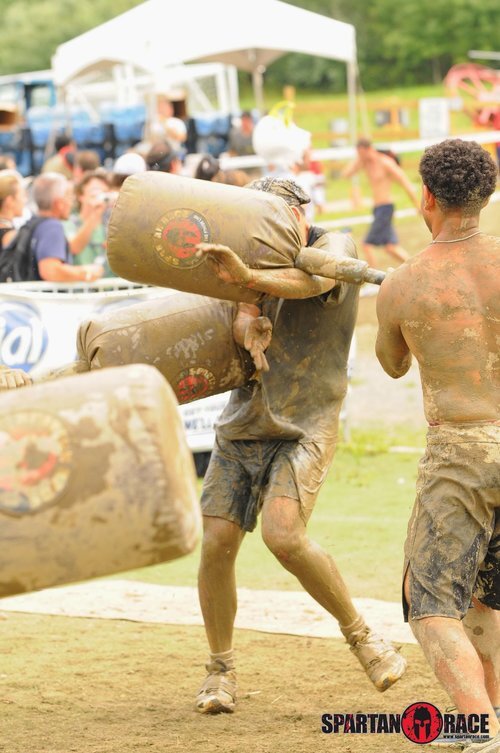
I want to take a few minutes today and try to shed some light on this obscure 'suck zone' we go through, and perhaps offer some perspective to help you not only power through it, but optimize your progression.
"Arrrrgghh!!! Why Can't I Get This!?!?!"
"Why is that person getting this so much faster than I am?"
"Why do I feel so stupid, or uncoordinated?"
These are common questions I hear, or see, as a coach/mentor/instructor. In order to understand why martial arts, or any new activity requiring physical prowess [other sports apply here] is giving us a hard time, we have to look at the human brain.
Over the past decade and a half, I have taught highly intelligent people. By and large, most of them extremely intelligent. And yet, when forced to freeze a motion and are asked, many cannot tell you where their arm is located in that moment in time if they do not stop and look at it. I have lost count of the amount of times I have given a correction to someone, and received an incredulous look while stating - "I am leaning, really?!?!?!"
What many of us fail to recognize in ourselves, or cut ourselves slack for, is our level of physical activity going into the arts. So maybe we played sports in high school...then we went to college, got a job, started a family, and then realized at 35 we haven't been active in 17 years and need to so something, anything to do to get moving.
Maybe we are 16 years old and have lived in front of a video game console our whole life; never really using our body. Maybe we are 65 and deciding to take up Tai Chi to stay active, but we spent a bulk of our life parked at a desk job since we were in our 30’s. To our brain, there is a common thread here.
The human brain is incredibly conservative. If something is not being used, then the brain ignores it. Don't exercise? Our muscles atrophy. Don't stand/walk put a load on your skeletal system? Our bones atrophy; after only 18 hours (on a molecular level). It doesn't take long to regress with our physicality, and the brain does the exact same thing.

FRUSTRATED???
We have pathways connecting neurons in our brain, and each pathway connects one piece of information to another, to another; creating a network, or a web of interconectivity. This happens with physical activity as well. Compare it to our high school Algebra experience. That thing we said we would never use in life. Let’s say we were right, and we never used it after leaving school. Now, when we try to do Algebra at the age of 25, 30, 35, it doesn't work so well. The same thing happens with our body and physical movement.
When we have a group of common connections with shared threads, it is due to our brain building relationships. Connecting one neuron to another neuron to build a 'network'. Think of it as a power grid; transmitting electricity from node to node. If one node goes down, other connections still exist. Except...this power grid automatically shuts down lines that are not being used in order to save energy.
Unfortunately, if we stop using a pathway, the brain starts overwriting these connections it no longer deems relevant. Pathways grow dormant, and new information that is relevant to whatever we are doing in our life HERE and NOW, is what is going to take precedence.
If physical activity is not at the forefront of our life, then atrophy sets in; physical AND mental. The brain does not waste time and energy trying to keep things 'alive' that are not useful to its purpose. If we were a star athlete in college, we will still have pathways for those actions in our prior sport, but they have faded; and continue to fade over time. If we return to the sport in our 30's, we will probably stumble a bit in the beginning, but will likely pick things back up relatively quickly after the initial grind.
The Neural Network

Neural Network
Our brain is full of billions of neurons. When we start training in martial arts, we may develop a neuron for a block, or a punch that we learned. We practiced the block, we know the block, and it is now a reflexive part of us. We practiced punching for hours on end as well.
Now, when someone punches us, we block successfully, but we don't punch, or there is a delay before we punch. Why? No connection...yet.
After practicing for a while we see similar circumstances. One day we are comfortable enough with our blocking, and punching enough that when someone in class takes a familiar swing at us, we suddenly match up an opening we see in their guard when we are offensively punching, with the opening we see after blocking one of their strikes at us. We then throw a counter punch.
After an action like this, our brain now creates a connection from the ‘punch’ neuron, to the ‘block’ neuron and we become accustomed to seeing that opportunity in the future, and responding that same way the next time. Voilà! Progress.
Now, let's add a piece to the puzzle. Person A punches. We block. We counter punch, but suddenly our punch misses. The person slips the punch. Now we stand there for a second unsure what to do next. Why? We don't have the connection laid yet. This is a new situation that has occurred. We have to build a new path from here. This is like trying to cross from Boston to San Diego in our car, but there is no map. We have to try road after road, retracing steps and getting familiar with paths so we can venture down new paths from there.
Grappling example: We learn how to do an armbar. Neuron is mapped. We learn how to triangle choke from guard. Neuron mapped. Now we are fighting with an opponent in our guard and we go for an armbar. An armbar that we may be quite successful at and have trained thoroughly over and over.
Our opponent pulls the arm before we can secure it. We lose the submission and have to start over with something else. Or instead, we take that triangle choke we practiced a thousand times and we learn how to snap that on as they counter the armbar. We have successfully mapped a connection between these two submissions and our next response is to immediately counter their counter, with another submission. Something that is impossible to do when we have not mapped out either neuron, or built the connection between them.
The more we train, the more we experience on the mats, failures most importantly, the more neurons we build connections to as we find solutions. Eventually, we get a web of connections and when faced with unfamiliar stimuli, we have a wider net to catch it in, and formulate a ‘creative’ response based on all the other connections in our web. The better we get, the more likely we are to have a 'proper' response to this new threat or action. The more we can ‘see’.
A.I.
When I was studying Artificial Intelligence, the coolest subject I had in college, and yet somehow turned to the most boring in practicum (still unclear how one can do this), we learned about neural networks. One of the early mistakes made by pathfinders in the field was to try and code every potential outcome into the machine in advance.
While this may work with a simple 3 instruction test, they quickly found it was impossible to train every single scenario/outcome that can happen. Even some of the simplest tasks would take years of coding and massive amounts of storage. Impossible for hardware at the time.
The solution, was to go from ‘trying to program every response possible’, to ‘building neural networks’ - nodes with pathways, interconnected so the computer could train as it goes through a series of pass fails - what is now known as 'machine learning'. Learn through added stimuli, the same way we learn as humans - through trial and error.
Fighting is chaos incarnate. The supercomputer residing inside our skull would take 100's of years to try and calculate all the possible responses in fighting. Instructors training students in this way, would result in absolute disaster. Instead, we train principles. We train using sparring and rolling to create randomness and variability, causing us to error out, and learn a mistake. The results we get are far superior.
This explains why someone becomes more proficient the longer they train. They see more options, form more connections, and become more and more adaptable.
Coaches Perspective
"Your left foot. NOOOO!!! YOUR OTHER LEFT FOOT!!!"
From a coach's perspective, it can be extremely frustrating to tell someone to move their left, or right foot, and have them unaware of where their leg is. I have been in schools where teachers have thrown out students and told them - "Get out!!! This is not for you."; completely giving up on the student due to their lack of coordination.
I wholeheartedly disagree with this approach; even though at times past I confess to watching students and wondering if they were ever going to get it. We never know where someone is going. We all have our own struggles, some earlier in the process than others. Sometimes these same individuals turn out to be the hardest workers because of the struggles they faced early on.
They could become the next coach, mentor, or even a champion; the next in line to pass on the art. If we turn them off of martial arts for good because they didn't get it right away, then the loss of potential is immediate, and sometimes everlasting. Encourage, guide, support.
Patience, understanding, and empathy are easier said than done, but they are necessary tools when teaching our art to ALL those who wish to receive it. Someone with long periods of physical inactivity, is going to take longer to get up to speed with basic movement than a seasoned athlete. We each face our own struggles.
MILITARY TRAINING vs. CIVILIAN

Holly - playing in the mud at Spartan Race 2014
The drill instructors in boot camp have one hell of a job to do - 8 weeks to turn goofy, uncoordinated, immature, head up their a$$ teenagers into lean, mean, fighting machines.
This is not an easy task, and our lives, and the lives of those around us, depend on getting it right. And quickly. However, we are a captive audience; by choice, or not.
When teaching adults/civilians, who are not REQUIRED by some threat to stand there and take our bull$%&^, we have to be somewhat flexible in our demands. We can do this by drawing out the timeline for success. We can't just scream, degrade, and humiliate them until they get it; like boot camp. If we are training people for combat in a condensed period of time, then absolutely.
However, in that case we likely are not teaching in-depth martial arts that require years of training to explore high levels of skill. We would be focused on simplified fighting systems like Xing Yi, Krav Maga, or some other streamlined hand-to-hand combat system. Simplified, and meant for short training not mastering high levels of skill.
High Skill Competition Training
If we are training competitively, or training a team to compete, then this can also change the game. Pushing people, and people wanting you to push them, become an interwoven dynamic to increase performance, and achieve higher gains.
This process is voluntary on both sides, and usually involves a higher degree of focus and effort on the part of the competitor. Skills increase over time, and people compete at the level/age bracket they are currently at. As they gain higher skill and aptitude, they move up in rank and compete against more advanced opponents.
The Long Term Approach
If we are teaching out of our garage, do not need to sustain ourselves from a vibrant school, or we are trying to train people as quickly as possible, then we can cherry pick our students, and kick out (directly, or indirectly) the one's that won't get up to speed fast enough for our taste, or goals.
But...if we are interested in creating a strong community of martial artists that help one another grow and learn to a high level over time, a group that accepts people of all skill and talent levels among their ranks, then we need to keep in mind that not everyone has been training for these arts their entire life. Some will need more time and patience in the process.
One approach I like to use in thinking about this - drawing. When we want to draw a human face, we don't start by drawing every freckle, line, or hair. We start with a rough circle for the head, and rough circles for the eyes, nose, mouth, ears. Then, we begin to create finer and finer circles and lines. Adding more and more detail as we go, and erasing/removing unnecessary lines. Martial Arts is no different. We don't need to feel like our ROUGH DRAFT is supposed to be the final MASTERPIECE.
All black belts are not created equal. All black belts are not created in the same amount of time.
No SECRETS
There really are no secrets. The solution is simple, but not easily achieved. The longer we train, the more we surround ourselves with other people who train, the more we watch; the more we read, ponder, discuss; the more 'consumption', will directly affect the pace at which we move up the skill ladder.
This obviously takes other traits and behaviors such as discipline to keep showing up, perseverance to get up after each failure and try again, and overall grit to stick through the lows and not just ride the highs. Combine this with continuing to build that neural network, and you have the recipe for success. Eventually creating a web in your brain that is ready to catch anything that flies through it.
Many people come and go from activities. If we keep showing up, keep training, we will keep evolving. Sometimes the successful people we see in various fields, were not the best at what they do, but they are the one's that kept showing up.
Stay the course. All will be revealed with time and effort.
--
Photos courtesy of Max Kotchouro
Bibliography:
Buonomano, Dean. Brain Bugs: How the Brain's Flaws Shape Our Lives. New York: W.W. Norton, 2011. Print.
"The Brain That Changes Itself: Stories of Personal Triumph from the Frontiers of Brain Science Paperback – December 18, 2007." The Brain That Changes Itself: Stories of Personal Triumph from the Frontiers of Brain Science: Norman Doidge: 9780143113102: Amazon.com: Books. N.p., n.d. Web. 20 Nov. 2015.

Essay: The Heart of Mantis
Update - 10-MAR-2019
Below is an essay from May of 2013. After 14 years in Chinese boxing styles, thousands of hours of training, and a year into my journey of Brazilian Jiu-Jitsu, in 2012 my ideas and approach to the art of praying mantis boxing began to shift. I was not happy with the ‘status quo’, the failure of the art (meaning the methods within forms) to ‘work’ in fighting, and I began to approach mantis from a different angle - a grappling mindset. What you are about to read, is written during this early period in my transformation. Some of this (the history in particular) is incorrect, or incomplete. Later, through further training, research, and sparring, I was able to more deeply develop an understanding of the art. This is the foundation, the beginning of the evolution. I consider this to be when my art truly began. While I could delete this, hide it, or pretend I was never ‘new’, I leave this here to demarcate a point in time on my journey in martial arts. - Randy
Update - 10-MAR-2019
Below is an essay from May of 2013. After 14 years in Chinese boxing styles, thousands of hours of training, and a year into my journey of Brazilian Jiu-Jitsu, in 2012 my ideas and approach to the art of praying mantis boxing began to shift. I was not happy with the ‘status quo’, the failure of the art (meaning the methods within forms) to ‘work’ in fighting, and I began to approach mantis from a different angle - a grappling mindset. What you are about to read, is written during this early period in my transformation. Some of this (the history in particular) is incorrect, or incomplete. Later, through further training, research, and sparring, I was able to more deeply develop an understanding of the art. This is the foundation, the beginning of the evolution. I consider this to be when my art truly began. While I could delete this, hide it, or pretend I was never ‘new’, I leave this here to demarcate a point in time on my journey in martial arts. - Randy
The Heart of Mantis - What is Praying Mantis Kung Fu?
By Randy Brown - 28-MAY-2013
photos by: Max Kotchouro
The story goes something like this...
Wang Lang observed a Praying Mantis fighting a larger and more powerful Cicada sometime in the 1600’s. After watching the Mantis defeat the Cicada with ease, he adopted the Praying Mantis' combat style into his Kung Fu. He began mimicking the hooking techniques, as well as the fighting strategy into his own fighting, to much success. Mantis is said to be a hybrid of 18 different styles of Kung Fu; streamlined and polished for efficiency in combat.

Concept art for new logo - 2013
Here is a style created some 350+ years ago in an area of northern China known as the Shandong Province. The style has survived dictators killing/imprisoning/exiling martial artists, rebellions, war, racial boundaries, distrust, and cultural diversity through the annals of time. It has survived in part because of it's legend as a superior fighting art. So why isn't it being used by anyone in the UFC (Ultimate Fighting Championships)? Why isn’t it at the forefront of self-defense like other systems? Why isn't it as well known as Tae Kwon Do, Aikido, Jiu Jitsu, Karate?
As with much of the Chinese Martial Arts known as Kung Fu, the fighting application was lost over the centuries or decades. Practitioners and teachers were left with choreographed forms; empty shells of a bygone fighting art. Speculating on what it meant to fight like a Praying Mantis, and what the true art contained. After all, we don't have 4 legs, 2 arms with large hooks and spikes on them, or the ability to fly. So how does a human fight like a bug? And how is it relevant to hand-to-hand combat in the 21st century?
What is Praying Mantis Kung Fu?

Mantis Hooks
A Praying Mantis seizes it's opponent with it's large arms and hooks. It pulls it's prey off balance, and devours it on the ground. When observing the mantis against a larger foe, one can see the mantis pounce, take the back of it’s foe, use it’s legs to hold on, and continually try to control it's opponent while it bites and gains better hook positions to keep it safe.
We don't have large mandibles to chew on our opponents, nor would I advocate biting your enemies unless absolutely necessary. What's important about the mantis' tactics is, the controlling, the seizing, the binding up...the hooks! This is what I love about Mantis, and what I believe has been misunderstood for quite some time - where the hooks belong.
We often thought Mantis was all about grabbing wrists and pulling our opponents around. Some have made that work quite well for themselves, especially those with large hands, or body types. What of the rest of us? How do those techniques get used against a full speed attacker coming to take you down, or knock you out? How does a smaller person use that to grab someone with wrists twice as thick? It doesn't, and they don’t. Plain and simple. It might work on low skill opponents, or those under the influence of drugs/alcohol. If it worked in full out combat against a trained opponent, you'd see that style of fighting in a venue such as the UFC.
Mantis should be based on the following - if you had two large hooks, not small hands with 10 fingers, how would you control a human opponent? How would you fight like a Mantis? What would you take away from watching a real mantis that could function in live combat?
A Stand-Up Grappling Art

You would use these hooks to clinch, to control your opponent; latching onto their neck, their upper arms, their body - over hooks, under hooks, clinch. Similar to what is seen in other fighting arts - Judo, Jiu Jitsu, Wrestling, Muay Thai, etc. These techniques are still alive today in other art forms. Minus the defining attribute of Mantis - the hooking hand (more on that below).
The moves inside the Mantis forms make much more sense when viewed from this perspective. Many obscure and often seemingly useless applications/movements, suddenly come to life as amazing and ingenious solutions to combat at mid to close range. Approaching it from this angle, one can also disseminate and get rid of stylized marketplace Kung Fu, stuff that has the practitioner just trying to act like a bug with no real purpose.
The hooking hand is used to grab an opponent’s wrist in some applications. Mantis accounts for the range it likes to function in; the hooking hand vs. the forearm/wrist becomes an important tool for maintaining the dominant position or winning the fight when grappling for control.
The Hooks (Gōu 勾)

‘Mantis Hook’ as depicted in Chinese martial arts forms.
The Mantis Hook - an obvious indicator of the Kung Fu style. Making it readily apparent that the practitioner is doing Praying Mantis Kung Fu. This seemingly innocuous shape is highly effective and ingenious in it’s design.
Other martial arts styles use hooks (White Crane, Muay Thai, Wrestling - Mongolian and Western), but unlike Mantis, there is no emphasis on the curling of the fingers. The little finger (a.k.a. - the pinky) is the grip finger. This finger controls our grip and governs the strength of such. When latching onto an opponent, focusing the energy and intent in the pinky increases the tightness of the hold.
When practicing Mantis in the air, folding the fingers into the hook hand engages the muscles in the forearm, making your hooks stronger, thereby giving you more control, and being more difficult to contend with. Use this to clinch and control your opponent so you can topple them to the ground, or cling to them while you strike, knee, elbow. The common hooks are neck hook, over hook on the tricep, under hook, arm hook, wrist hook, leg hook.
Hook positions, And Where They Attach
Some applications involve wrist hooking and lower arm control as stated - defensive measures in the clinch, but predominantly the hooks are used to control upper limbs and body. Control the head, and you control your opponent.
The following pictures show some of the common holds in Mantis, as well as other fighting arts.

Hook variations found in mantis forms. Common to other styles of martial arts as well.
The Mantis Boxer Strategy
Bridge, Strike, Kick, Contact, Cling, Takedown/Throw, Destroy

Bridging with Closing Door Kick
The 5 elements of a Mantis Boxer:
Bridge using deceptive kicking.
Overwhelm with ‘crushing’ strikes (Beng Da) or block counter-strikes.
Contact/Cling - engage the hooks for control in the clinch. Use elbows/knees where necessary.
Takedown or throw the opponent to the ground.
Finish them with ground strikes, kicks, knees, elbows, or joint locks.
This is the overall offensive strategy in Mantis. Overwhelm, seize, control, strike with knees, elbows, tight hooks, uppercuts - all from the clinch; then take to the ground, and finish the fight, mimicking the same actions of a Praying Mantis in the wild. If the opponent is offensive, block incoming blows, close to the clinch, then strike, knee, and take to the ground.
Conclusion

What makes Mantis different from so many of the other fighting arts in the limelight today? Not much. A few incredible things that were developed for the range that Mantis likes to control from, and the nuances of the hooking hand - using it to delay an opponent’s return to a defensive position long enough for a counter attack, etc.
Like many of the Northern Kung Fu styles, Mantis descends from centuries of Mongolian Wrestling (Elephant Style Wrestling). An artform in and of itself, whereby Genghis Khan tested the fortitude and skills of his warriors.
Northern Kung Fu styles such as Praying Mantis developed from these roots and evolved to include combat effective techniques. Used properly, Praying Mantis Kung Fu can be a highly effective and destructive fighting system.